


TL;DR:
- Restorative yoga uses fully supported poses to promote deep muscular release and nervous system reset.
- It significantly reduces stress, improves sleep, and supports chronic pain management through passive holds.
- Proper props, space setup, and consistent practice are essential for effective relaxation and recovery.
After a long day, your body carries the weight of every meeting, every commute, and every hour spent sitting at a desk. You lie down hoping to rest, but your mind races and your muscles stay tense. If this sounds familiar, you are not alone. Restorative yoga offers a structured, evidence-based solution: a 4-6 prop-supported poses held for 5-20 minutes each in a 45-90 minute session, designed to trigger complete muscular release and reset your nervous system. In this guide, you will learn what restorative yoga is, how to set up your space, follow a step-by-step workflow, and troubleshoot common challenges.
Table of Contents
- What is restorative yoga? Benefits, principles, and ideal users
- Gather your tools: Props and space setup for success
- Restorative yoga workflow: Step-by-step guide for daily practice
- Troubleshooting and modifications: Common problems and adaptations
- Restorative vs. Yin: Choosing the best workflow for your needs
- Our take: Why a restorative workflow is the missing link for lasting recovery
- Enhance your restorative journey with wellness tools
- Frequently asked questions
Key Takeaways
| Point | Details |
|---|---|
| Simple workflow structure | A typical restorative yoga session uses 4-6 supported poses held for 5-20 minutes each to foster full relaxation. |
| Evidence-backed wellness gains | Restorative yoga can reduce stress, improve sleep, and relieve pain, with measurable benefits observed in clinical studies. |
| Props make a difference | Bolsters, blankets, and supportive props—or DIY alternatives—are essential for safe, effective restorative yoga at home. |
| Personalize for your needs | Modifications and gentle adjustments ensure restorative yoga remains accessible and safe for adults with various needs or health conditions. |
| Consistency leads to results | Practicing restorative yoga 2-3 times per week produces the best long-term results in relaxation and recovery. |
What is restorative yoga? Benefits, principles, and ideal users
Restorative yoga is not about stretching or building strength. It is about doing nothing, intentionally. Each session uses 4-6 gentle, fully supported poses where your body is held in place by props so your muscles can release completely. There is no effort required and no sensation to push through. Your only job is to breathe and let go.
This practice was pioneered by B.K.S. Iyengar and later popularized by Judith Lasater, who recognized its power for everyday recovery. It differs from dynamic yoga styles and even Yin yoga, which still involves a mild stretch sensation. Restorative yoga eliminates sensation entirely, making it ideal for adults aged 40-65 who are managing fatigue, chronic stress, or ongoing discomfort.
The science backs this up strongly. Research shows significant mindfulness improvements with FFMQ scores rising at p=.001, alongside better sleep and reduced pain in workers. Studies on cancer survivors found reductions in pro-inflammatory cytokines, with IFN-γ dropping at p=0.04 and IL-1b at p=0.02. A meta-analysis confirmed medium-to-large effects on well-being and stress compared to control groups, with an effect size of g=0.76.
Key benefits of restorative yoga at a glance:
- Reduces relaxation and cortisol levels and overall stress response
- Improves sleep quality and duration
- Supports chronic pain management without aggravating injuries
- Boosts mindfulness and emotional resilience
- Activates the parasympathetic nervous system, your body’s natural rest-and-digest mode
| Feature | Restorative yoga | Other yoga styles |
|---|---|---|
| Muscular effort | None | Moderate to high |
| Stretch sensation | None | Mild to intense |
| Pose duration | 5-20 minutes | 30 seconds to 5 minutes |
| Primary goal | Full nervous system reset | Strength, flexibility, or flow |
| Ideal for | Fatigue, stress, recovery | Fitness, mobility, energy |
If you are someone who feels wired but tired, or struggles to fully switch off, restorative yoga may be the missing piece in your recovery routine.
Gather your tools: Props and space setup for success
With an understanding of restorative yoga’s benefits and role, let’s ensure you’ve got the right tools and setting to start your workflow. The good news is that you do not need a fully stocked yoga studio to practice effectively at home.
Essential props for restorative yoga:
- Bolster: The centerpiece of most poses. It supports your torso, hips, or legs in a neutral, comfortable position.
- 2-3 blankets: Used for padding, warmth, and elevating body parts for better alignment.
- 2 blocks: Helpful for supporting knees, arms, or the bolster itself.
- Eye pillow (optional): Blocks light and adds gentle pressure to calm the nervous system.
- Strap (optional): Keeps legs in position during longer holds without muscular effort.
Don’t have yoga equipment? No problem. Firm bed pillows work well in place of bolsters. Rolled bath towels can substitute for blankets. Hardcover books stacked together can replace blocks. The key poses like Supported Child’s Pose, Reclined Bound Angle, and Legs-Up-The-Wall all adapt well to household items.
| Yoga prop | DIY alternative |
|---|---|
| Bolster | Firm bed pillow or rolled blanket |
| Block | Hardcover books (stacked) |
| Blanket | Folded bath towel |
| Eye pillow | Folded washcloth |
| Strap | Bathrobe tie or long scarf |
Your space matters as much as your props. Choose a quiet room where you won’t be interrupted. Dim the lights or use a lamp with warm light. Keep the temperature slightly warm, since your body temperature drops when you are still for long periods. A clean, uncluttered area signals safety to your nervous system and helps you settle faster. Learning how to set up a relaxation zone can make a real difference in how quickly you transition into rest.
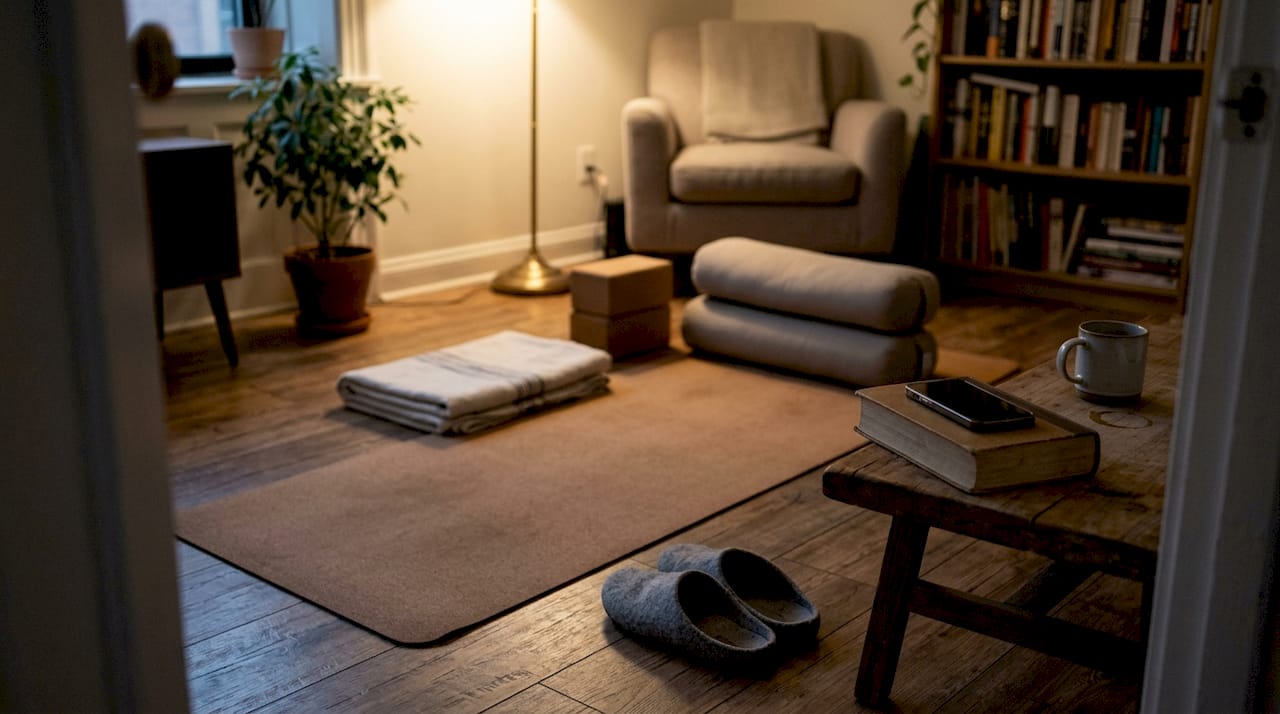
Pro Tip: Dedicate one corner of your home exclusively to your yoga practice. Keep your props stacked and ready so there’s no friction between the idea of practicing and actually starting. Lowering that barrier is often the difference between consistency and giving up.
Restorative yoga workflow: Step-by-step guide for daily practice
With your props ready and space set, it’s time for hands-on practice. Here is a simple, effective 45-minute workflow to get you started. Each pose is fully supported, so your muscles stay completely passive throughout.
Your 45-minute restorative yoga workflow:
-
Supported Child’s Pose (8 minutes): Place your bolster lengthwise on your mat. Kneel behind it, then lower your torso over the bolster and rest your forehead on your hands or a folded blanket. This pose gently releases the lower back and hips. Enter slowly, breathing out as you fold forward.
-
Reclined Bound Angle, or Supta Baddha Konasana (8 minutes): Sit in front of your bolster, bring the soles of your feet together, and lean back onto the bolster. Support each knee with a folded blanket. This opens the chest and hips while calming the nervous system.
-
Legs-Up-The-Wall, or Viparita Karani (10 minutes): Sit sideways next to a wall, then swing your legs up as you lower your back to the floor. Place a folded blanket under your hips for elevation. This is one of the most effective poses for reducing fatigue and improving circulation.
-
Supported Bridge Pose (8 minutes): Lie on your back with knees bent. Place a block or bolster under your sacrum (the flat bone at the base of your spine) and let your hips rest fully on the support. This gently opens the chest and releases spinal tension.
-
Supported Savasana (10 minutes): Lie flat with a bolster under your knees and a blanket over your body. Cover your eyes with an eye pillow. This final pose allows full integration of everything your body has released.
A complete session follows a 4-6 prop-supported poses structure held for 5-20 minutes each. Beginners should start with 5-8 minute holds and build up gradually. You can explore more step-by-step relaxation techniques to complement this workflow, or try pairing it with a morning relaxation routine for consistent results. For additional pose guidance, 20-minute restorative yoga sequences can be a great starting point.
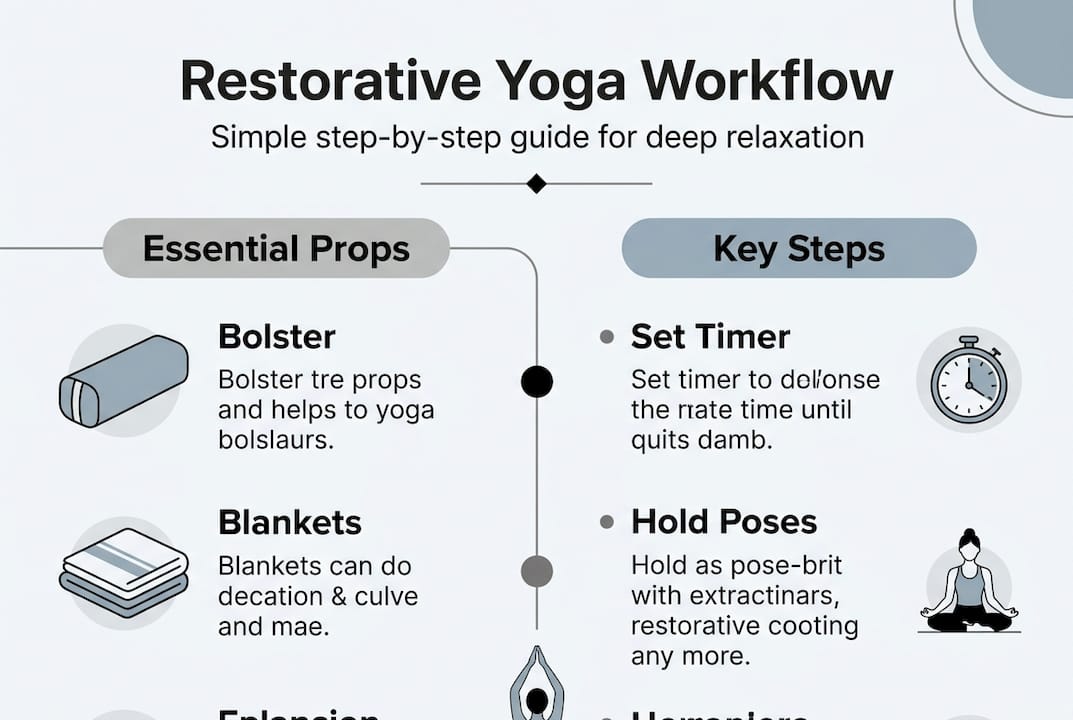
Pro Tip: Set a gentle timer for each pose so you are not watching the clock. Use soft music or nature sounds at low volume to help your mind settle without distraction.
Troubleshooting and modifications: Common problems and adaptations
Even with a clear workflow, beginners and experienced users alike may face challenges. Here is how to navigate and adapt for ongoing success.
Common issues and how to handle them:
- Restlessness: If your mind won’t quiet down, start with shorter sessions of 15-20 minutes. Use a timer so you’re not tempted to check the clock. Soft background music or a guided audio track can help anchor your attention.
- Knee discomfort: Add extra folded blankets under or beneath the knees. Never force a joint into position. Try a slightly different angle or reduce your hold time.
- Neck tension: Use a folded blanket under your head in every pose. Avoid any pose that compresses the neck or requires you to hold your head up.
- Lower back pain: Elevate your hips slightly in supine poses using a folded blanket. In Legs-Up-The-Wall, move slightly away from the wall to reduce the angle.
- Feeling too cold: Keep a blanket nearby to cover yourself as soon as you settle into each pose. Body temperature drops quickly during stillness.
Always consult your physician before starting restorative yoga if you have had recent surgery, are managing high blood pressure, or have been diagnosed with glaucoma. Some poses may require modification or should be avoided entirely.
For pregnancy and menopause, personalized relaxation tips can guide you toward side-lying poses with increased bolster support. According to contraindication guidance, acute inflammation, high blood pressure, and recent surgery are key reasons to seek medical clearance before practice. A yoga modifications guide can also help you adapt poses safely for your unique needs.
Restorative vs. Yin: Choosing the best workflow for your needs
Sometimes you may wonder if another slow yoga style would be more suitable. Here is how Restorative and Yin yoga differ and which approach best fits your goals.
| Feature | Restorative yoga | Yin yoga |
|---|---|---|
| Hold duration | 5-20 minutes | 3-5 minutes |
| Stretch sensation | None | Mild to moderate |
| Target tissue | Nervous system | Connective tissue |
| Effort required | Zero | Minimal |
| Best for | Deep rest, fatigue, anxiety | Flexibility, joint mobility |
Restorative yoga eliminates sensation entirely so your nervous system can fully rest, while Yin yoga applies mild stress to connective tissues to improve flexibility, with a noticeable stretch sensation throughout each hold.
Which should you choose?
- Choose restorative yoga when you feel exhausted, anxious, or are recovering from illness or injury.
- Choose Yin yoga when you want to improve flexibility or release tightness in specific areas.
- Consider combining both in a weekly routine, using restorative sessions on your most depleted days and Yin when you feel more energized.
If you are curious about how supported rest compares to other recovery methods, exploring recliner therapy can offer additional insight into passive recovery techniques that complement your yoga practice.
Our take: Why a restorative workflow is the missing link for lasting recovery
Most relaxation methods give you temporary relief. A hot bath feels great, a nap helps, a walk clears your head. But none of these create the sustained shift in your nervous system that a consistent restorative yoga workflow can deliver.
Here is what we have observed working with adults in the 40-65 range: the people who practice restorative yoga 2-3 times per week report lasting changes in sleep quality, pain tolerance, and emotional resilience within 4-6 weeks. The ones who try it once or twice and stop never get there.
The real barrier is not physical. It is the belief that lying still for 10 minutes with your legs up a wall is not doing enough. But that resistance is exactly the problem. Most of us live in a chronic state of fight-or-flight, and no amount of effort-based exercise can undo that. Only deep, extended rest can. Pairing your practice with a solid after work relaxation routine creates the consistency that makes the difference. The workflow is simple. The commitment is what transforms it.
Enhance your restorative journey with wellness tools
Your restorative yoga practice becomes even more powerful when you have the right support around it. The right props, recovery tools, and home environment work together to help your body fully let go and restore.

At Lunix, we design recovery and comfort solutions that fit naturally into your daily wellness routine. Whether you are looking for supportive cushions, recovery aids, or tools to create a dedicated relaxation space, our wellness recovery tools are built with your body’s restoration in mind. Visit the Lunix wellness homepage to explore our full collection and find the products that best support your restorative journey. Your body does the work of healing every night. We help make sure it has everything it needs.
Frequently asked questions
How long should a restorative yoga session last for best results?
A restorative yoga session is most effective at 45-60 minutes, but even 15-20 minute sessions deliver meaningful relaxation and recovery benefits.
What props can I use if I don’t own yoga equipment?
You can substitute firm pillows and towels for bolsters and blankets, and stacked hardcover books work well in place of blocks during home practice.
Is restorative yoga safe for people with recent injuries or health conditions?
Consult your physician before starting if you have recent surgery or high BP, glaucoma, or acute inflammation, as some poses may need modification or should be avoided.
Can beginners benefit from short restorative yoga sessions?
Yes, even 15-20 minute sessions can meaningfully improve relaxation and recovery, making this practice accessible and effective from your very first try.
What are the main differences between restorative and Yin yoga?
Restorative yoga is fully supported with no stretch to rest the nervous system, while Yin yoga involves a mild stretch sensation and shorter holds targeting connective tissue flexibility.
Recommended
- Morning relaxation routine guide for adults 40-65 in 2026 – Lunix
- Guide to relaxing after work: proven strategies 2026 – Lunix
- Master your 2026 morning relaxation routine in 15 minutes – Lunix
- Step by Step Relaxation Techniques for Stress Relief – Lunix
- Como criar rotina de yoga: passos práticos para bem-estar