


TL;DR:
- Functional comfort supports body alignment and reduces long-term strain better than traditional softness.
- Proper ergonomic seating decreases muscle fatigue and improves recovery outcomes.
- Older adults benefit from adjustable, supportive furniture that balances firmness and contouring.
Most people assume that a softer seat means better comfort. It feels logical. But that assumption quietly works against your body every single day. True comfort isn’t about how plush something feels in the first five minutes. It’s about how your body feels an hour later, or the next morning. This article breaks down what functional comfort actually means, why it outperforms traditional cushioning for relaxation and recovery, and how you can apply it in your own home. Whether you’re dealing with back tension, fatigue, or simply want a better rest experience, understanding this difference can genuinely change how your body feels at home.
Table of Contents
- Defining functional comfort: Support versus cushion
- The science behind functional comfort
- Practical applications for home wellness
- Functional comfort for aging adults: Real-world considerations and contrasting views
- Why functional comfort is the real wellness game changer
- Ready to transform your home with functional comfort?
- Frequently asked questions
Key Takeaways
| Point | Details |
|---|---|
| Support beats softness | Long-lasting comfort depends on proper support and alignment, not just plush cushions. |
| Science-backed results | Ergonomic designs reduce fatigue and improve relaxation based on measurable outcomes. |
| Ideal home set-up | Use adjustable seating and wellness zones for better recovery and stress relief in your home. |
| Age-adjusted ergonomic tips | For those over 40, choose seats with lower height and moderate recline for the best comfort and safety. |
Defining functional comfort: Support versus cushion
Now that we’ve questioned the typical approach to comfort, let’s clarify what functional comfort actually means and how it changes the game.
Functional comfort is not about maximum softness. It’s about how well a surface supports your body’s natural alignment, distributes pressure evenly, and reduces the strain that builds up over time. As research confirms, functional comfort focuses on supportive structures, alignment, and long-term well-being, not just softness. That’s a meaningful shift in how we think about seating and relaxation.
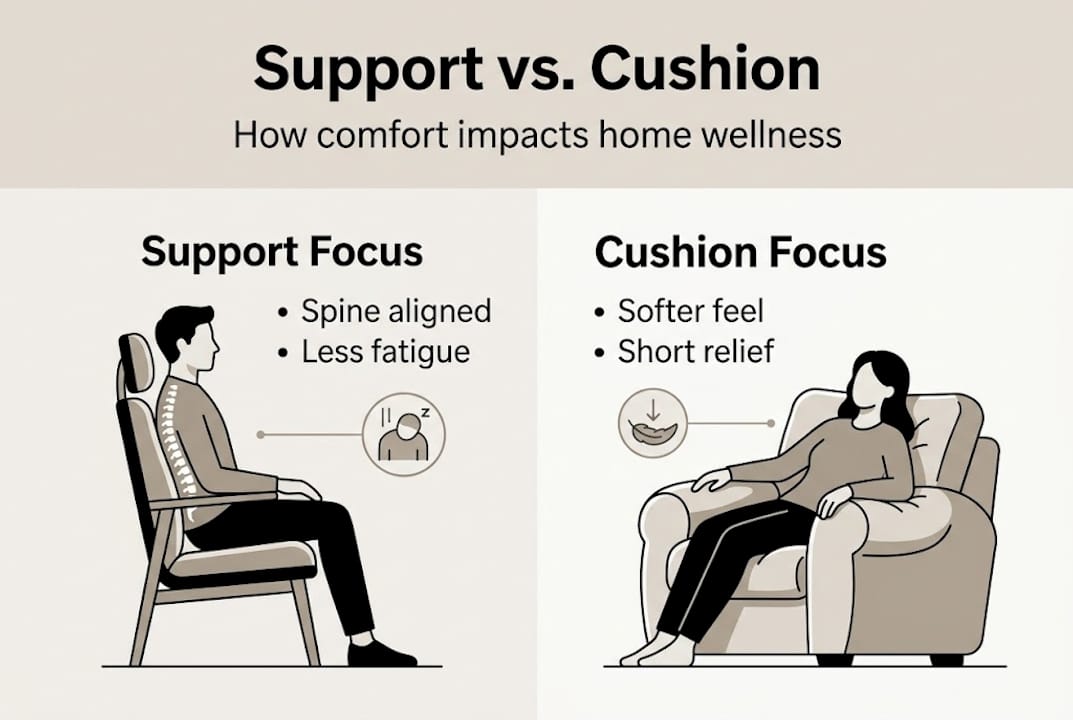
Traditional cushioning gives you an immediate sense of relief. You sink in, it feels soft, and your brain registers comfort. But sinking too deep into a surface can actually misalign your spine and hips, creating tension in muscles that are now working overtime to hold your body in place. That tension adds up.
Functional comfort, by contrast, keeps your body in a position where muscles can genuinely relax. It supports the curves of your spine, keeps your pelvis level, and reduces the pressure points that cause soreness after long sitting sessions. The benefits of ergonomic products go well beyond furniture aesthetics. They reach into real, daily physical relief.
“Support-based seating reduces muscle activation requirements, allowing the body to truly rest rather than compensate.” This principle sits at the core of functional comfort design.
Cushion versus support: What’s the difference?
| Feature | Traditional cushioning | Functional support |
|---|---|---|
| Initial feel | Soft, sink-in sensation | Firm, body-contouring feel |
| Pressure distribution | Uneven, concentrated points | Distributed across contact zones |
| Spinal alignment | Often compromised | Maintained and supported |
| Muscle fatigue | Increases over time | Reduced with proper design |
| Long-term benefit | Minimal | Significant for recovery |
Hallmarks of functional comfort:
- Adjustable support zones that respond to body shape
- Even pressure distribution across seat and backrest
- Maintains natural lumbar curve without forcing it
- Encourages relaxed muscle tone rather than compensatory tension
- Designed for sustained use, not just first impressions
The science behind functional comfort
With a clearer definition in mind, let’s look at the science and data that explain why functional comfort matters, especially for recovery and long-term wellness.
Your body is constantly making small adjustments when you sit or recline. Muscles activate to keep you upright, to prevent slipping, and to compensate for surfaces that don’t quite fit your shape. When a seat supports you properly, those micro-adjustments quiet down. That’s when real relaxation begins.

Research shows that flexible seat pans improve hip and lumbar angles while measurably reducing muscle fatigue. This isn’t a minor effect. When your hips and lower back sit at better angles, the chain reaction moves up your spine and into your shoulders and neck. One well-supported position can reduce tension across your entire body.
Studies on pressure redistribution also show that dynamic cushioning reduces peak pressure by around 16%. That may sound small, but pressure points are cumulative. Even small reductions prevent the soreness and circulation issues that come from prolonged sitting.
Support versus cushion: Measurable outcomes
| Outcome metric | Traditional cushion | Functional support |
|---|---|---|
| Peak pressure reduction | Minimal | Up to 16% lower |
| Hip and lumbar angle | Often unfavorable | Improved by flexible design |
| Muscle fatigue reduction | Low | Up to 47% in dynamic systems |
| Recovery effectiveness | Limited | Significantly enhanced |
One of the most striking findings is that muscle fatigue drops by up to 47% when dynamic support systems are used compared to standard cushioned surfaces. That’s nearly half the physical strain, simply from better design.
Pro Tip: When choosing seating for relaxation or recovery, look for dynamic cushioning explained in the product specs. Static foam may feel comfortable initially, but dynamic systems adapt to your body’s movement and provide lasting relief.
Practical applications for home wellness
After understanding the science, the next step is figuring out how to put these principles to work for your own relaxation and wellness at home.
Creating a functional comfort zone at home doesn’t require a full renovation. It starts with the right furniture choices and a clear setup strategy. Wellness stations with ergonomic furniture have been shown to lower cortisol by 25% and support muscle recovery by 40%. Those are real outcomes from intentional design.
Here’s how to build your home relaxation zone step by step:
- Choose your anchor piece. Start with an adjustable recliner, a zero-gravity chair, or a flexible seat designed for ergonomic support. This becomes the centerpiece of your wellness space.
- Set the seat height correctly. Your feet should rest flat on the floor with your knees at roughly a 90-degree angle. This is called popliteal height, and getting it right prevents lower body tension.
- Dial in your recline angle. A moderate recline of around 105 degrees is ideal for most people. It takes pressure off the lumbar spine without putting you in a position where you have to work to stay in place.
- Add support where you need it. Use lumbar pillows or adjustable headrests to fill gaps between your body and the seat. These small additions make a big difference in sustained comfort.
- Position your accessories. Side tables, foot rests, and lighting all contribute to a space where your nervous system can genuinely wind down.
You can also master ergonomics at home by adjusting your existing furniture before investing in new pieces. Small angle changes and added support cushions can transform a standard chair into a more functional comfort tool.
Pro Tip: Before buying new seating, sit in it for at least 15 minutes. Test how your lower back feels, not just how soft the seat is. If you feel any strain or pressure building, the support isn’t doing its job. Learn more about recliner therapy benefits to understand what proper recline can do for stress and recovery.
Functional comfort for aging adults: Real-world considerations and contrasting views
It’s important to recognize that comfort isn’t one-size-fits-all, especially for older adults. Let’s explore age-specific tips, common missteps, and ongoing debates.
As we move through our 40s, 50s, and 60s, our bodies change in ways that make standard seating increasingly uncomfortable and even problematic. Muscle tone shifts, flexibility decreases, and joint sensitivity increases. A seat that works fine at 35 might cause real discomfort at 55.
Research on ergonomic seat design for aging shows that older adults benefit from lower seat heights matched to their popliteal height, moderate recline angles to prevent forward slippage, and firm enough support to avoid the body sinking into positions that are hard to recover from. Too soft, and you create a slipping risk. Too firm without contouring, and you create pressure points.
“Seat design for elderly users must balance firmness and contour to prevent slippage while maintaining postural integrity.” This finding highlights why age-specific ergonomic design is not optional; it’s essential.
The debate between cushion and support is particularly visible here. Softer chairs often feel more inviting and safe to older adults. But the short-term appeal of sinking into softness masks the long-term issue: getting back out of an overly soft chair is physically demanding, and staying in one too long contributes to back tension and poor circulation.
Common mistakes and smarter choices for home seating:
- Mistake: Choosing seating based on how it feels in the first 30 seconds
- Smart choice: Sit for 10 to 15 minutes and assess how your lower back and hips feel
- Mistake: Ignoring seat height and forcing yourself to perch or sink
- Smart choice: Match seat height to your actual leg length for proper support
- Mistake: Assuming more padding equals more safety for aging joints
- Smart choice: Prioritize firm contouring with adjustable features over raw softness
- Mistake: Setting recline too far back, which increases slip risk
- Smart choice: Use a moderate 105-degree recline with lumbar support in place
For practical back pain relief at home, the right seating choices are often more effective than people expect.
Why functional comfort is the real wellness game changer
Here’s something most home wellness content won’t tell you: the biggest barrier to recovery isn’t the absence of a massage or expensive equipment. It’s sitting in the wrong chair for years and calling it rest.
We’ve seen how the body responds to supportive design, and the data is clear. But the deeper insight is about perception. When something feels soft, we associate it with safety and care. That emotional response is real, but it can mislead us into accepting furniture that quietly undermines our recovery night after night.
Most home environments prioritize aesthetics and initial feel over biomechanical function. A beautiful, overstuffed sofa photographs well. But if it misaligns your pelvis and collapses your lumbar curve every evening, it’s working against your body’s ability to restore itself.
The mindset shift we encourage is this: think of your resting environment the way an athlete thinks about recovery equipment. Strategic, intentional, and body-led. Explore ergonomic design for back pain to see how support-driven design actively transforms the quality of rest and recovery, not just the feeling of it.
Ready to transform your home with functional comfort?
To support your journey with the right tools for functional comfort, here’s how to take the next step.
You now have the science, the framework, and the practical checklist to build a home wellness space that genuinely works for your body. The next step is finding the right products to bring it all together.

At Lunix, we design recovery and comfort solutions specifically for people who want their home to support their health, not just look good. From ergonomic recliners to precision-built recovery tools, our ergonomic recovery solutions are built around the same functional comfort principles covered in this article. Browse our full range of Lunix home wellness products and find the pieces that fit your body, your space, and your recovery goals.
Frequently asked questions
What makes functional comfort different from soft cushioning?
Functional comfort focuses on support and alignment for long-term wellness, while soft cushioning provides only a temporary sense of comfort. Support improves body alignment and reduces fatigue in ways that simple cushioning cannot.
Which types of home furniture best promote functional comfort?
Ergonomic recliners, flexible seats, and zero-gravity chairs offer the best functional comfort for relaxation and recovery at home. These designs improve posture and reduce chronic pain more effectively than standard upholstered furniture.
How does functional comfort help with relaxation and recovery?
By distributing pressure and supporting the body’s natural alignment, functional comfort reduces muscle fatigue and accelerates recovery. Dynamic cushions and ergonomic seating cut cortisol and speed up muscle recovery in measurable ways.
What features should older adults look for in functional comfort furniture?
Adults over 40 should prioritize adjustable seat height, moderate recline angles, and stable support to maximize safety and effectiveness. Lower seats and moderate recline suit older adults to prevent slippage and discomfort during extended use.