


TL;DR:
- Holistic comfort involves physical, psychospiritual, environmental, and sociocultural well-being.
- Addressing multiple comfort dimensions simultaneously improves sleep, reduces pain, and enhances recovery.
- Personal tweaks in environment, mindset, and social connection can significantly boost overall comfort.
Most people assume comfort is about a soft mattress or a warm bath. But true comfort runs far deeper than that. Holistic comfort is a multi-dimensional state that touches your body, mind, spirit, and surroundings all at once. Developed through decades of nursing research, this framework reveals why some people recover faster, sleep better, and feel more at ease in their daily lives. In this article, you’ll learn what holistic comfort really means, how it’s measured, what the evidence says about its benefits, and how you can put it to work for your own relaxation and recovery.
Table of Contents
- Understanding holistic comfort: Foundations and key concepts
- How holistic comfort is measured and practiced
- Holistic comfort in action: Empirical benefits and real-world results
- Nuances, limitations, and expanding holistic comfort beyond nursing
- Why holistic comfort matters more than ever for midlife recovery and well-being
- Enhance your relaxation and recovery with holistic comfort solutions
- Frequently asked questions
Key Takeaways
| Point | Details |
|---|---|
| Multi-dimensional foundation | Holistic comfort blends physical, psychospiritual, environmental, and sociocultural factors for deeper well-being. |
| Actionable strategies | Simple tools and practices can help you assess, improve, and sustain holistic comfort at home. |
| Evidence-based benefits | Studies show holistic comfort interventions lead to better sleep, less pain, and greater satisfaction. |
| Personalization matters | Tailoring comfort strategies to your body, environment, and relationships boosts recovery and long-term relaxation. |
Understanding holistic comfort: Foundations and key concepts
With the stage set, let’s unpack what holistic comfort truly encompasses and why this matters.
When most people think of comfort, they picture pain relief or a cozy chair. That’s a narrow view. Holistic comfort is a state involving relief, ease, and transcendence across four distinct contexts, each one shaping how you feel in ways you may not even notice.
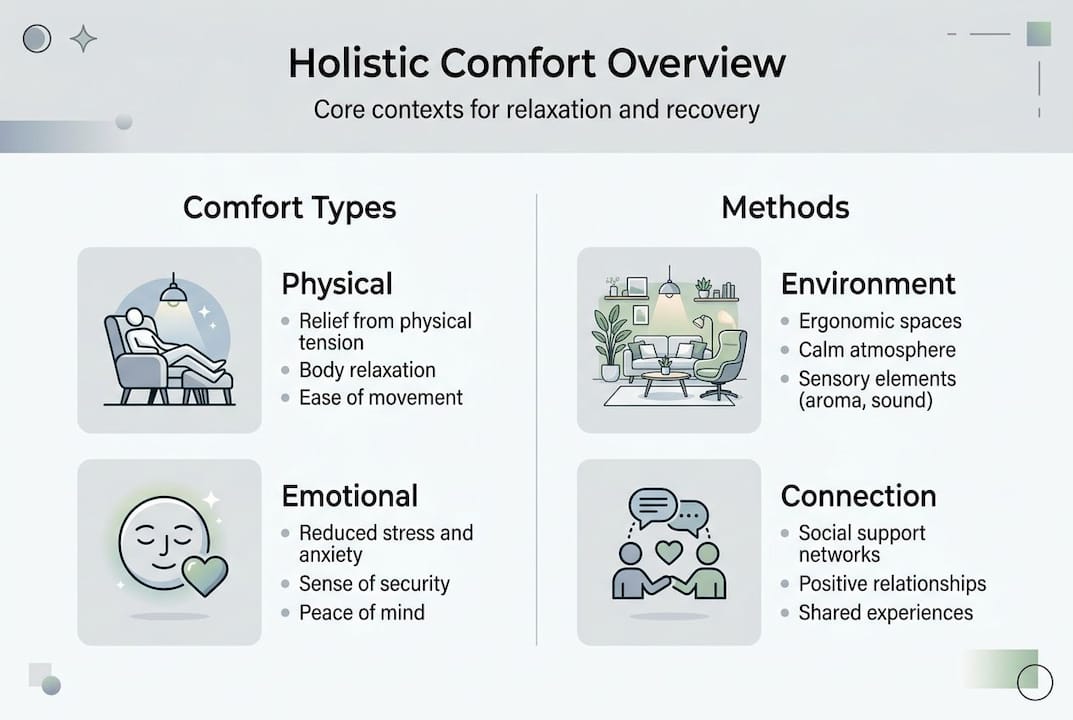
Kolcaba’s Comfort Theory is the leading model in this space. Developed by nursing theorist Katharine Kolcaba in the early 1990s, it defines comfort not as a single feeling but as a layered experience. Understanding it gives you a much more powerful lens for improving your well-being.
The three forms of comfort:
- Relief: The satisfaction of a specific need, like reducing pain or easing tension after a long day.
- Ease: A state of calm and contentment, where nothing feels urgent or strained.
- Transcendence: Rising above challenges, feeling capable and resilient even when conditions aren’t perfect.
The four contexts:
- Physical: Bodily sensations, including pain, temperature, and physical function.
- Psychospiritual: Your sense of inner peace, purpose, and emotional well-being.
- Environmental: Your surroundings, including light, noise, temperature, and space design.
- Sociocultural: Your relationships, cultural background, and sense of belonging.
Here’s a simple comparison to show how these forms and contexts interact:
| Context | Relief example | Ease example | Transcendence example |
|---|---|---|---|
| Physical | Pain medication | Ergonomic support | Completing a workout despite discomfort |
| Psychospiritual | Emotional support | Meditation practice | Finding meaning in recovery |
| Environmental | Reducing noise | Comfortable room temperature | A space that inspires calm |
| Sociocultural | Family presence | Feeling culturally understood | Community belonging |
Older or more simplistic views of comfort treated it as purely physical. Kolcaba’s model challenges that directly. It shows that ignoring your environment or your sense of purpose can undermine physical recovery, no matter how good your mattress is. This is why a holistic approach leads to results that targeted fixes simply can’t match.
How holistic comfort is measured and practiced
Now that we understand what holistic comfort includes, how is it evaluated and fostered in day-to-day life?

Measuring something as personal as comfort requires thoughtful tools. Nurses use the General Comfort Questionnaire and other tools to assess comfort needs holistically, capturing data across all four contexts. Visual analog scales (simple 0-10 rating tools) and behavioral checklists round out the toolkit, especially for people who struggle to verbalize how they feel.
Typical comfort assessment process:
- Identify the individual’s current comfort needs across all four contexts.
- Use a validated tool like the General Comfort Questionnaire to gather baseline data.
- Observe behavioral cues, such as restlessness, facial expressions, or withdrawal.
- Develop a personalized comfort plan that addresses gaps in each context.
- Reassess regularly to track progress and adjust interventions as needed.
Once needs are identified, interventions fall into three main types:
| Intervention type | Description | Example |
|---|---|---|
| Technical | Evidence-based physical treatments | Cooling therapy, positioning aids |
| Coaching | Guidance, reassurance, and education | Breathing exercises, comfort journaling |
| Spiritual | Support for inner peace and meaning | Mindfulness, prayer, or reflection practices |
Creating a healing environment is one of the most overlooked interventions. Small changes, like adjusting lighting, reducing clutter, or adding calming scents, can shift your environmental comfort context significantly. This matters more as you age, since sensory sensitivity often increases after 40.
For comfort in healthy aging, consistent self-monitoring is key. You don’t need clinical tools to start.
Pro Tip: Keep a simple comfort diary for two weeks. Each evening, rate your physical ease, emotional state, environment, and social connection on a scale of 1 to 5. Patterns will emerge quickly, showing you exactly where your comfort gaps are.
Holistic comfort in action: Empirical benefits and real-world results
Having looked at the tools and methods, let’s explore what happens when holistic comfort is actually put into practice.
Comfort theory-based interventions reduce anxiety and pain, increase satisfaction, and improve sleep outcomes across a wide range of settings. These aren’t just clinical observations. They translate directly into everyday life for people managing chronic pain, recovering from surgery, or simply trying to sleep better.
One striking finding: bed cooling improves sleep by an average of 19 minutes per night and reduces the time it takes to fall asleep by about 10 minutes. That’s a meaningful gain for anyone who lies awake feeling too warm or restless.
“Holistic comfort interventions consistently improve subjective well-being, sleep quality, and recovery speed when applied across multiple comfort contexts simultaneously.”
Here’s what this looks like in real life:
- Post-op recovery: Patients who received comfort-focused care, including environmental adjustments and emotional support, reported lower pain scores and shorter hospital stays.
- Palliative care: Addressing psychospiritual comfort alongside physical symptom management significantly improved quality of life for patients and their families.
- Chronic pain management: Individuals who combined physical interventions with mindfulness and environmental changes experienced more sustained relief than those using physical treatment alone.
Specific day-to-day benefits of holistic comfort strategies:
- Deeper, more restorative sleep
- Reduced muscle tension and physical discomfort
- Lower levels of anxiety and emotional fatigue
- Greater sense of personal agency and resilience
- Stronger social connection and reduced isolation
For personalized comfort results, the key is addressing more than one context at a time. Pairing a supportive sleep surface with a calming bedtime routine and a cooler room temperature creates a compounding effect. Each layer reinforces the others. You can explore more at-home comfort tips to build your own personalized approach.
Nuances, limitations, and expanding holistic comfort beyond nursing
But no approach is perfect. In the real world, holistic comfort faces unique challenges and opportunities for adaptation.
One of the most important nuances is the overlap between physical and psychospiritual comfort. Chronic pain, for example, is rarely just physical. It reshapes your sense of identity, your relationships, and your outlook. Treating only the body while ignoring the emotional and spiritual dimensions often leads to frustrating results.
Holistic comfort has proven effective even for non-verbal patients and in multicultural settings, though it does come with real-world limitations. High workloads, staffing shortages, and the challenge of reading non-verbal cues can all reduce the quality of comfort care in clinical environments. Cultural differences also mean that what feels comforting to one person may feel intrusive to another.
Broader wellness perspectives link sleep, nutrition, and environment to holistic comfort in ways that extend well beyond traditional healthcare. This is good news for you. It means the same principles that guide recovery in hospitals can be adapted for your home, your routines, and your daily choices.
Actionable steps for optimizing your own holistic comfort:
- Audit your sleep environment: temperature, light, noise, and surface support.
- Build a short daily mindfulness or reflection practice to address psychospiritual needs.
- Prioritize social connection, even brief, meaningful check-ins with people you trust.
- Align your nutrition and movement routines with your recovery goals.
- Explore comfort solutions for faster recovery that support multiple comfort contexts at once.
Pro Tip: Try a “holistic comfort audit” once a month. Review your environment, your social interactions, your mindset, and your physical routines. Ask yourself: which context feels most neglected right now? Start there.
Why holistic comfort matters more than ever for midlife recovery and well-being
Stepping back, here’s what this all means for your own journey to lasting well-being.
Most people over 40 focus almost entirely on physical comfort. They invest in better pillows, pain relief creams, or ergonomic furniture. These things help. But they miss the bigger picture. The psychospiritual and environmental contexts are often where the real gaps are, and they’re the ones most likely to be ignored.
We’ve seen this pattern repeatedly. Someone optimizes their physical recovery but still feels restless, disconnected, or emotionally drained. That’s not a physical problem. It’s a comfort gap in another context entirely.
Conventional wellness advice rarely bridges these dimensions. It treats sleep, stress, pain, and environment as separate problems with separate solutions. Holistic comfort theory says they’re all connected, and the evidence backs that up. Integrating new tools and technology, like temperature-regulating sleep surfaces or guided recovery programs, works best when it’s part of a broader comfort strategy, not a standalone fix. Exploring natural pain relief options alongside environmental and psychospiritual practices is where sustained improvement actually happens.
Enhance your relaxation and recovery with holistic comfort solutions
Ready to put holistic comfort ideas into action? At Lunix, we design products specifically to support the physical and environmental contexts of comfort, the two areas where thoughtful tools make the biggest difference in daily recovery and relaxation.

Our relaxation products are crafted to help you ease tension, improve sleep quality, and create the kind of calm environment that supports genuine restoration. For those focused on bouncing back faster, our recovery solutions are built around the same evidence-based principles you’ve read about here. Browse our collections and find the right tools to make holistic comfort part of your everyday routine.
Frequently asked questions
What are the four contexts of holistic comfort?
Holistic comfort includes physical, psychospiritual, environmental, and sociocultural contexts, covering everything from bodily sensations to social relationships and sense of purpose.
How is holistic comfort measured?
It’s measured using tools like the General Comfort Questionnaire, visual analog scales, and behavioral checklists, often tailored by nurses or wellness professionals to the individual’s specific needs.
Are holistic comfort strategies effective for sleep and recovery?
Yes. Studies show they can improve sleep quality, lower pain levels, and support faster recovery when applied consistently across multiple comfort contexts.
Can holistic comfort be applied outside of a hospital or clinical setting?
Absolutely. Holistic comfort principles guide everyday choices about your environment, routines, relationships, and mindset, making them just as relevant at home as in any clinical setting.