


TL;DR:
- Wellness technology benefits adults over 40 by improving recovery, cognition, and emotional health.
- Wearables and digital therapeutics provide real-time feedback, reducing anxiety and enhancing confidence.
- Overcoming barriers like digital literacy and privacy concerns enables long-term health improvements.
Recent research suggests that wellness technology offers cognitive and emotional benefits for adults aged 40-65 that rival physical activity in reducing cognitive impairment risk. That finding stops many people cold, because most of us assume fitness trackers and wellness apps belong to a younger crowd. They don’t. If you’re between 40 and 65 and serious about recovery, relaxation, and long-term health, today’s technology was practically built for your needs. This article walks you through the types of tools available, the science explaining why they work, the real results people are seeing, and how to get started without feeling overwhelmed.
Table of Contents
- How technology is redefining wellness for adults 40-65
- The science: How wearables and digital therapeutics drive recovery and relaxation
- Evidence-based benefits: What the research shows for adults 40-65
- Barriers and bridges: Overcoming challenges to adopting wellness tech
- What most wellness tech advice misses for adults over 40
- How to try wellness technology for better recovery today
- Frequently asked questions
Key Takeaways
| Point | Details |
|---|---|
| Science-backed results | Wearables and apps offer measurable physical and cognitive improvements for adults 40-65. |
| Real-time feedback reduces anxiety | Monitoring health in real time helps users feel more in control and less anxious. |
| Barriers can be overcome | Support, education, and easy-to-use devices make adopting wellness tech easier at any age. |
| Personalization matters | AI-tailored interventions provide better results and higher motivation for users. |
How technology is redefining wellness for adults 40-65
Let’s clear up a persistent myth right away: wellness technology is not just for 20-somethings obsessed with fitness metrics. The fastest-growing group of wearable and app users is adults over 40, and the results are turning heads in the health research community.
The term “wellness tech” covers a wide territory. Here’s what it actually includes for people in your age group:
- Wearables: Smartwatches, fitness bands, and heart rate monitors that track steps, sleep, stress, and recovery
- Telehealth platforms: Virtual appointments and remote monitoring that keep you connected to care without the commute
- Cognitive-motor training tools: Programs that challenge your brain and body simultaneously, often using gamified interfaces
- Recovery devices: Red light therapy panels, PEMF (pulsed electromagnetic field) mats, and massage tools that support tissue repair and relaxation
- Wellness apps: Guided meditation, sleep coaching, biofeedback, and digital therapeutics built on clinical frameworks
What unites all of these is their ability to give you real-time data about your own body. That feedback loop changes everything. When you can actually see how your sleep affects your recovery, or how a short walk shifts your heart rate variability, you stop guessing and start making informed choices.
Research backs this up clearly. Technology-enabled interventions measurably improve both physical and emotional health in adults over 40, with outcomes spanning better mobility, reduced anxiety, and sharper cognition. Exploring home health tools that support recovery and well-being is a practical first step, especially when you understand how deeply comfort for healthy aging shapes long-term outcomes.
Self-efficacy is another underrated benefit. When you track your progress and witness actual improvement, confidence builds. That confidence makes you more likely to stay consistent, which compounds the health benefits over time. It’s a positive cycle, and technology is the catalyst.
The science: How wearables and digital therapeutics drive recovery and relaxation
Understanding why these tools work makes it easier to commit to using them. So let’s look at the mechanisms.
Wearables do more than count steps. They monitor heart rate variability, sleep stages, blood oxygen levels, and even skin temperature trends. For adults in recovery from intense activity or managing chronic stress, this data provides clarity that reduces health anxiety. Studies confirm that wearables reduce health anxiety in middle-aged adults, giving users a sense of control that traditional wellness routines simply can’t match.

Digital therapeutics take this a step further by combining behavioral science with technology. The most effective programs pair wearable biofeedback with cognitive behavioral therapy (CBT) principles. The result? Combined digital therapeutics using wearables and CBT apps significantly reduce depressive and anxiety symptoms. That’s not a minor footnote. That’s clinical-level improvement delivered through a device you wear on your wrist.
| Technology type | Primary mechanism | Key benefit |
|---|---|---|
| Heart rate wearables | Real-time biofeedback | Reduces health anxiety, improves recovery pacing |
| CBT wellness apps | Cognitive reframing + behavioral prompts | Lowers depressive and anxiety symptoms |
| Red light/PEMF devices | Cellular energy support | Muscle recovery, reduced inflammation |
| Cognitive-motor tools | Dual-task training | Improved cognition and physical endurance |
AI personalization is becoming the most exciting part of this space. Modern platforms learn your patterns and adjust recommendations dynamically. Rather than generic advice, you get a feedback loop tailored to your unique physiology, schedule, and goals. This is where wellness tech for relaxation and devices for recovery are heading, and the personalization is what separates results from just going through the motions.
Pro Tip: If you’re new to wearables, start by tracking just one metric, like resting heart rate or sleep quality, for two weeks before adding more data streams. This prevents information overload and helps you build real insight gradually.
“When you see your own data trending in the right direction, motivation becomes automatic. The technology isn’t replacing willpower. It’s making willpower easier.”
Evidence-based benefits: What the research shows for adults 40-65
Once you understand how these tools work, the next question is: how much of a difference do they actually make?
The short answer is: a meaningful one. Research tracking adults over 12 months shows that wearables improve balance, quality of life, and cognitive performance measured by standardized assessments. Balance improvements alone matter enormously for adults over 50, since falls are one of the leading causes of serious injury in this age group.
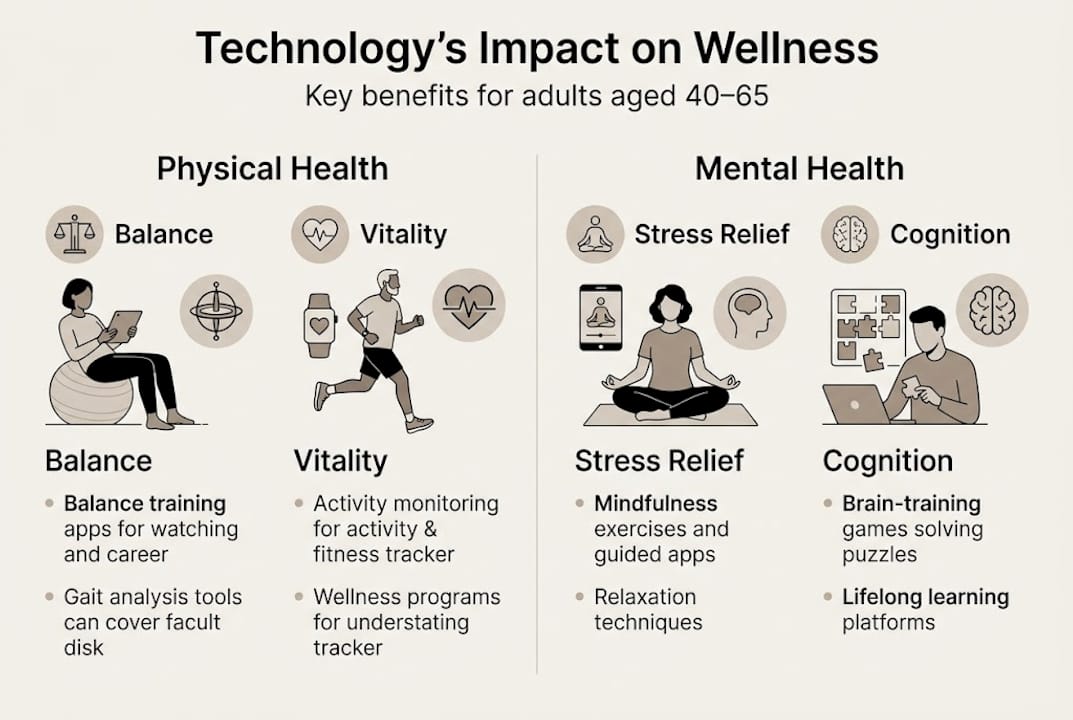
Beyond balance, the cognitive gains are striking. Cognitive-motor wearable training improves cognition by 8.60% and endurance by 4.65% compared to control groups. Think about that in real terms: sharper focus, better memory recall, and the ability to walk farther and stronger, all from a structured program using wearable technology.
Here’s a breakdown of proven benefits by technology type:
| Technology | Physical benefits | Cognitive benefits | Emotional benefits |
|---|---|---|---|
| Activity wearables | Improved balance, endurance | Better memory, processing speed | Reduced anxiety |
| CBT + biofeedback apps | Reduced physical tension | Enhanced focus | Lower depression scores |
| Cognitive-motor programs | Increased walking distance | 8.60% cognition improvement | Greater confidence |
| Recovery devices (PEMF/red light) | Faster muscle repair | Clearer thinking post-rest | Improved sleep quality |
Who benefits most? People who were less active before adopting these tools often see the most dramatic improvements, because there’s more room to grow. High-step users maintain gains, while previously sedentary users can experience life-changing shifts in energy, mood, and physical capability.
- Adults with mild cognitive concerns showed the strongest cognitive gains from structured wearable programs
- Those with high baseline anxiety saw the most significant mood improvements from digital therapeutics
- Individuals managing joint pain or fatigue benefited most from recovery-focused devices
For a fuller picture of what this means day-to-day, exploring practical self-care for 40-65 and the advantages of home wellness can help you connect the research to your real life.
Barriers and bridges: Overcoming challenges to adopting wellness tech
The benefits are compelling, but real-world experiences often involve hurdles. Let’s break down how to navigate and resolve them.
Adopting new technology is rarely seamless, especially when age-related stereotypes suggest you shouldn’t bother. Research identifies several consistent barriers to tech adoption for adults in this age group, including digital illiteracy, usability issues, cost, privacy concerns, and tech anxiety that tends to increase with age or lower income levels.
Ageism also plays a complicated role. Sometimes the belief that “this stuff is for younger people” comes from inside, not from the technology itself. Recognizing that internalized bias is the first step toward moving past it.
Here are five practical steps for getting started without stress:
- Start with one device. A simple step-tracking wristband or a sleep app costs very little and builds familiarity before you invest in more advanced tools.
- Invite family in. Having a son, daughter, or trusted friend help you set up and learn a new device removes friction and adds accountability.
- Choose user-centered designs. Look for technology with large displays, simple interfaces, and clear tutorials. Many brands now design specifically for adults over 50.
- Protect your privacy. Read the app’s data policy before downloading. Stick to established brands with clear privacy commitments.
- Give it 30 days. Most benefits from wellness technology become noticeable within a month of consistent use. Commit to the window before evaluating.
Pro Tip: Search for local library programs or community center workshops on technology for wellness. Many are free and taught by people who understand exactly where you’re starting from.
“The goal isn’t to become a tech enthusiast overnight. It’s to add one useful tool at a time, until your daily routine quietly transforms.”
Setting healthy boundaries with tech is also important. You’re integrating these tools to serve your health, not to add another source of stress.
What most wellness tech advice misses for adults over 40
Here’s the part most technology and wellness guides leave out: the technology is almost never the hardest part.
Most articles focus on features, specs, and study results. What they skip is the human layer. Success with wellness tech depends on user-centered design, ongoing training, and addressing inequities in access. In plain terms, that means the device you use matters less than whether you have support while learning it.
We’ve seen that the adults who stick with wellness technology long enough to feel real benefits are almost always those with some form of encouragement, whether that’s a partner tracking goals alongside them, a friend who recommended the tool, or a coach who checks in regularly. Community is the multiplier.
Personalization and patience also matter more than any single feature. Jumping straight to an advanced biometric monitor before you understand your baseline data is like skipping the first chapter of a book. Gradual integration builds both skill and confidence. One metric at a time. One habit at a time. Explore home wellness perspectives that align with this patient, steady approach to real transformation.
How to try wellness technology for better recovery today
You now have a clear picture of what wellness technology can do for your body, mind, and daily life. The next step is finding tools that are genuinely designed for how you live and what your body needs.

At Lunix, we build recovery solutions specifically for adults who take their health seriously and want technology that fits naturally into their routine. From PEMF mats and targeted recovery devices to smart comfort tools, our catalog is curated for people who want results without complexity. Browse Lunix wellness technologies to find the recovery and relaxation tools that match your goals, your space, and your pace.
Frequently asked questions
Can technology actually reduce stress and anxiety for adults aged 40-65?
Yes. Digital therapeutics with wearables and CBT apps have been clinically shown to significantly reduce anxiety and depressive symptoms in middle-aged adults, often matching outcomes seen with traditional therapy alone.
How do wearables support physical recovery and better aging?
Wearables give you biofeedback on activity, sleep, and recovery metrics, and research confirms that consistent use improves balance, quality of life, and cognitive performance over 12 months.
What stops people from using wellness technology, and how can I start?
Common barriers include digital literacy gaps, cost, and privacy concerns, but starting with a single easy-to-use device and enlisting family support is a proven way to get comfortable quickly.
Does using technology really help protect against dementia?
Regular use of AI-driven tools and wearables is linked to a lower risk of cognitive decline. Research shows these tools build what scientists call a “technological reserve” that helps protect brain health even after accounting for other lifestyle factors.