


TL;DR:
- Comfort actively enhances health behaviors, recovery, and long-term resilience across multiple dimensions.
- Physical comfort influences performance, recovery, and wellbeing, especially in adults over 40.
- Structured recovery strategies rooted in comfort principles support sustained wellness and performance.
Comfort isn’t just about feeling cozy. It’s one of the most underestimated drivers of sustained performance, recovery, and long-term wellness. Most people assume that pushing harder, training more, or simply resting is enough. But Kolcaba’s Comfort Theory shows that comfort actively enhances health-seeking behaviors, which directly shapes how well you perform and how fast you recover. If you’re between 40 and 65 and want to stay mobile, energetic, and resilient, understanding comfort at a deeper level is one of the smartest moves you can make.
Table of Contents
- The multidimensional nature of comfort: Kolcaba’s theory explained
- Physical comfort and performance: evidence from older adults and athletes
- Recovery strategies that boost comfort and performance
- Nuances, edge cases, and misperceptions about comfort’s role
- What most wellness guides overlook about comfort and performance
- Enhance your recovery with Lunix comfort solutions
- Frequently asked questions
Key Takeaways
| Point | Details |
|---|---|
| Comfort drives recovery | Holistic comfort strategies enhance wellness and accelerate recovery regardless of age. |
| Structured routines matter | Consistency in comfort-enhancing activities trumps sporadic high-intensity sessions for performance. |
| Wellbeing and performance differ | Improved comfort may boost wellbeing even when measurable performance gains are modest. |
| Personalized approaches are key | Age, gender, and individual needs shape the most effective comfort and recovery techniques. |
| Evidence supports multidimensional comfort | Kolcaba’s framework and recent studies show comfort operates across physical, psychospiritual, social, and environmental domains. |
The multidimensional nature of comfort: Kolcaba’s theory explained
With comfort’s importance established, let’s clarify its full scope and how it functions as a multidimensional driver of wellness.
Most people think of comfort as simply the absence of pain or discomfort. But comfort, when viewed through a wellness lens, is far richer than that. Kolcaba’s comfort theory defines it across three distinct types and four life domains, creating a framework that explains why some people recover faster, feel better, and perform more consistently than others.
The three types of comfort are:
- Relief: The experience of having a specific need met (like reducing joint pain after activity)
- Ease: A state of calm and contentment that allows the body to function without friction
- Transcendence: The ability to rise above challenges and discomfort, performing at your best despite physical limitations
These three types apply across four domains: physical, psychospiritual, environmental, and social. Physical comfort addresses the body directly. Psychospiritual comfort covers your sense of meaning and emotional balance. Environmental comfort relates to your surroundings, lighting, temperature, and ergonomics. Social comfort involves the support and connection you feel from others.
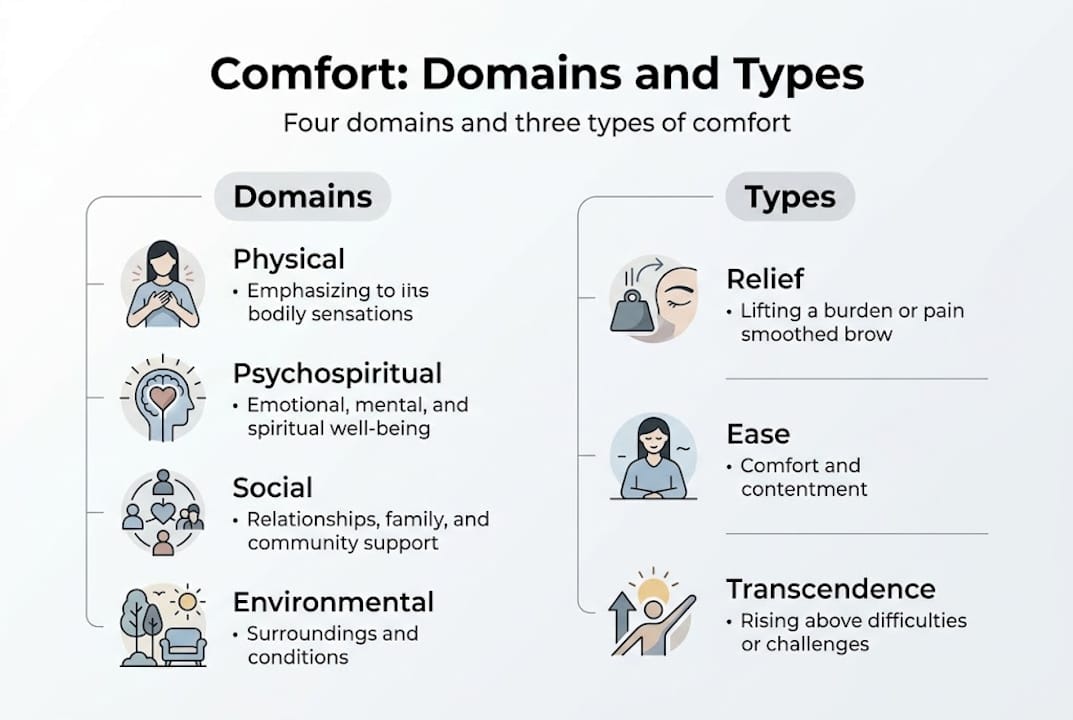
Here’s a quick look at how each domain influences your wellness:
| Comfort domain | What it addresses | How it affects performance |
|---|---|---|
| Physical | Pain, fatigue, mobility | Directly impacts energy and function |
| Psychospiritual | Mood, motivation, meaning | Drives consistency in health behaviors |
| Environmental | Space, temperature, design | Shapes recovery quality and sleep |
| Social | Connection, support, belonging | Sustains long-term wellness routines |
Kolcaba’s validated comfort scale captures these dimensions with six measurable factors that collectively explain 59% of variance in health outcomes. That’s a significant finding. It means more than half of how you feel and function can be traced back to how comfortable you are across these domains.
“Comfort is not a passive state. It is an active foundation from which meaningful health behaviors emerge.”
For a broader look at how these principles come together, our holistic comfort guide is a great starting point. And if you’re curious about how comfort specifically supports aging well, explore our resource on comfort for healthy aging.
Physical comfort and performance: evidence from older adults and athletes
Now that we understand comfort’s theoretical structure, let’s see how comfort translates to measurable physical performance, drawing on recent evidence.
There’s a growing body of research connecting comfort and physical performance specifically in adults over 40. The results are encouraging and practical.
One standout data source is the U.S. National Senior Games. Athletes competing in these games show that high fitness links directly to exercise volume and low rates of chronic conditions. In other words, the people who feel physically comfortable enough to stay consistently active are the ones who maintain the best health outcomes over time.
A 2025 study published in Frontiers in Aging found that physical performance modestly correlates with mental wellbeing in older adults, sharing roughly 20% variance. This modest link is actually important. It tells us that physical performance and mental wellbeing are related but largely independent. You can’t simply address one and expect the other to follow automatically.
Here’s a comparison of comfort-related factors across two performance levels in older adults:
| Factor | Lower performance group | Higher performance group |
|---|---|---|
| Weekly exercise volume | 1-2 sessions | 4-5 sessions |
| Chronic condition count | 2-4 conditions | 0-1 conditions |
| Reported comfort level | Moderate | High |
| Recovery time after activity | 48-72 hours | 24-36 hours |
Pro Tip: If you feel sore or stiff after activity, that’s your body asking for better recovery support, not less movement. Consistent, gentle movement combined with proper recovery tools tends to reduce discomfort faster than rest alone.
To build on this, here are four practical ways physical comfort supports performance as you age:
- Reduced joint stress allows for longer, more consistent exercise sessions without setbacks
- Better sleep quality (linked to environmental and physical comfort) accelerates muscle repair
- Lower inflammation through relaxation and recovery strategies improves mobility over time
- Stronger mind-body connection helps you recognize early signs of fatigue before they become injuries
For deeper guidance, explore our physical recovery tips and our practical comfort solutions for recovery.
Recovery strategies that boost comfort and performance
Understanding the link between comfort and physical performance, let’s unpack specific, research-backed recovery strategies that help you maximize both.
Recovery isn’t just about sleep or sitting still. It’s a structured process that, when done right, can meaningfully raise both your comfort levels and your physical capacity. The research here is specific and actionable.

A 2025 study found that multidimensional exercise programs combining strength, balance, flexibility, and cardiovascular training significantly improved health-related quality of life (HRQoL) and cardiovascular fitness in previously inactive older adults. Women and adults in the 65 to 69 age range saw the greatest benefits. That’s not a coincidence. These groups often experience the sharpest declines in comfort-related factors like joint mobility and hormonal balance, so targeted programs deliver the most noticeable gains.
Here are the recovery strategies with the strongest evidence behind them:
- Multidimensional exercise: Combines strength, flexibility, and cardio to address comfort from multiple angles at once
- HIIT in structured formats: Short bursts of higher effort followed by recovery periods support cardiovascular comfort without overtaxing joints
- Consistent sleep routines: Sleeping in a cool, dark, supported environment improves both physical repair and psychospiritual comfort
- Supportive physical environments: Ergonomic seating, proper cushioning, and positioning tools reduce the cumulative strain that builds up through the day
- Active recovery days: Light walking, stretching, or gentle movement keeps circulation flowing without adding stress
“Subjective comfort and objective performance don’t always move together. A recovery strategy that feels good may be building resilience even when the scale or the stopwatch doesn’t show it yet.”
Pro Tip: Don’t wait until you feel exhausted to schedule recovery. Build it into your weekly routine the way you build in workouts. Planned recovery prevents the domino effect of physical strain that leads to setbacks.
For practical ways to create your ideal recovery environment at home, visit our at-home comfort tips and learn how to speed up recovery after physical therapy or demanding activity.
Nuances, edge cases, and misperceptions about comfort’s role
But comfort isn’t always straightforward. Here’s what the latest research reveals about its nuances, uncommon cases, and the pitfalls in popular thinking.
One of the biggest misperceptions is that if you feel comfortable, you must be making progress. And the reverse is just as common: if you’re sore or struggling, you must be doing something right. Neither is consistently true.
Recent exercise research nuances confirm that there’s no direct, strong correlation between subjective comfort and objective performance changes. Comfort improves wellbeing independently, which matters enormously for long-term adherence and quality of life, even when the performance numbers stay flat.
Here are some edge cases worth knowing:
- Fast-twitch muscle fiber loss (natural after age 40) means that high-volume training without recovery can increase discomfort without increasing strength
- Tendon stiffness increases with age, making flexibility-focused recovery essential for sustained comfort during activity
- Peri-menopause and hormonal shifts affect thermoregulation and sleep quality, which directly disrupts the environmental and physical comfort domains
- Overconfidence in subjective comfort can lead people to skip recovery steps when they feel fine, missing the cumulative benefits of consistent care
Common misperceptions that trip people up:
- “More intensity always means better results.” Structured sessions with built-in recovery outperform sporadic high-intensity volume for most adults over 40.
- “Comfort is passive.” Real comfort is actively created through routines, environments, and consistent health behaviors.
- “Mental wellbeing automatically improves physical performance.” The connection exists, but it’s indirect. Both need to be supported separately.
“You can feel great and still be building a wellness deficit, or feel challenged and still be making meaningful gains. That’s why a holistic, multi-modal strategy is essential.”
For practical ways to shape your environment to support comfort across domains, see our resources on home comfort optimization and how to design effective home wellness stations.
What most wellness guides overlook about comfort and performance
Pulling these findings together, let’s reflect on what most wellness strategies miss and how you can turn comfort into your greatest asset for lasting performance.
Most wellness guides treat comfort as a side effect of good health rather than a foundation for it. That’s the gap. What the research actually shows is that comfort, especially transcendence-level comfort, is what allows people to sustain health-seeking behaviors over months and years, not just days.
The people who stay active, mobile, and resilient into their 60s and beyond aren’t just working harder. They’ve built environments, routines, and recovery habits that make wellness feel accessible rather than exhausting. That’s a fundamentally different approach. Sporadic high-intensity efforts feel productive in the short term, but structured, consistent routines built on genuine comfort lead to better outcomes over time.
The missing ingredient isn’t more effort. It’s the kind of comfort that supports understanding comfort in recovery as a dynamic, ongoing process. When comfort becomes part of your daily design rather than a reward after you’ve pushed yourself hard, performance tends to follow naturally.
Enhance your recovery with Lunix comfort solutions
Ready to act on what you’ve learned? Here’s how Lunix applies these comfort strategies to support your wellness and performance.
At Lunix, we design recovery and comfort tools that put the research into practice. Whether you’re managing post-activity soreness, optimizing your sleep environment, or building a daily recovery routine, our recovery products are built around the same multidimensional comfort principles covered in this article.

You don’t have to choose between feeling good and performing well. Our comfort solutions are designed to support both, giving your body the structured support it needs to restore, recover, and stay consistent. Explore our full range and find the tools that fit your lifestyle and your recovery goals.
Frequently asked questions
How does comfort directly influence physical performance for adults over 40?
Comfort boosts health-seeking behaviors like consistent exercise and better sleep, which indirectly improve mobility and physical performance for adults in the 40-plus range. Think of comfort as the environment in which better performance becomes possible.
Why is there only a modest correlation between mental wellbeing and physical performance?
Mental wellbeing and physical performance share roughly 20% variance, which means each is shaped by a wide set of independent factors. Supporting both separately, rather than assuming one drives the other, is the smarter strategy.
What are the best comfort-enhancing recovery strategies for middle-aged adults?
Multidimensional exercise, structured sleep routines, ergonomic environments, and active recovery days are all evidence-backed approaches. Exercise programs improve HRQoL and fitness, with comfort playing a central role in sustaining those gains.
Is subjective comfort always linked to measurable improvement in performance?
No. Subjective comfort and objective performance don’t always move in sync. Feeling comfortable can support wellbeing and long-term adherence even when performance metrics remain stable in the short term.
What types of comfort does Kolcaba’s theory address?
Kolcaba’s theory addresses four domains: physical, psychospiritual, environmental, and social, each expressed through relief, ease, and transcendence. Together they form a complete picture of what genuine comfort looks like in practice.