


TL;DR:
- Postural health involves maintaining body alignment during stillness and movement to prevent pain and injury.
- Age-related physical changes and sedentary habits increase risks of back pain, reduced lung capacity, and balance issues.
- Consistent small habits like strengthening muscles, stretching, and ergonomic adjustments support long-term posture and wellness.
Postural health is far more than a reminder to sit up straight. It’s the ongoing alignment of your body that keeps muscles, joints, and nerves working smoothly during every activity you do. According to Cleveland Clinic, posture encompasses every position your body holds, from sleeping to walking to reaching overhead. For adults between 40 and 65, getting this right matters more than ever. The aches you chalk up to “just getting older” are often tied to alignment patterns built over decades. The good news: understanding what postural health really means puts the power to change it squarely in your hands.
Table of Contents
- Understanding postural health: The basics
- Why postural health matters for adults 40-65
- Debunking myths: Is there a perfect posture?
- Postural problems: Red flags, risks, and how to spot them
- Evidence-based methods to improve postural health
- The real secret of postural health as you age
- Next steps: Support your postural health journey
- Frequently asked questions
Key Takeaways
| Point | Details |
|---|---|
| Postural health defined | Postural health means maintaining natural body alignment during all activities for comfort and injury prevention. |
| Age and activity impact | Daily movement, muscle balance, and spinal curve protection are key to postural wellness—especially as you age. |
| No one-size-fits-all | There’s no perfect posture; healthy habits and frequent adjustments matter more than strict alignment. |
| Practical solutions | Strengthening, stretching, ergonomic changes, and consistent movement can meaningfully improve postural health. |
Understanding postural health: The basics
With the foundation set, let’s clarify what postural health actually means and why it’s more complex than simply keeping your back straight.
Postural health refers to the natural alignment and positioning of the body maintained by the musculoskeletal system during both still and moving activities. It supports spinal curves and efficient body mechanics for comfort and injury prevention. Think of it as your body’s default setting. When that setting is well-tuned, you move efficiently and feel good. When it’s off, the ripple effects can be wide-ranging.
There are two main types of posture, and both deserve your attention:
- Static posture: How you hold your body when you’re not moving, such as sitting at a desk or standing in line.
- Dynamic posture: How you carry yourself while moving, like walking, bending, or lifting groceries.
Most people focus only on one or the other. Real postural health requires managing both.
Your spine has three natural curves: the cervical curve in your neck, the thoracic curve in your mid-back, and the lumbar curve in your lower back. Together, these form a gentle S-shape that acts like a shock absorber for daily life. When any of these curves becomes exaggerated or flattened, the rest of the body compensates. That compensation creates the domino effect of physical strain that leads to pain, fatigue, and long-term wear.
Here’s a quick look at what each spinal region does and what disrupts it:
| Spinal region | Natural role | Common disruptor |
|---|---|---|
| Cervical (neck) | Supports head weight | Forward head posture from screens |
| Thoracic (mid-back) | Protects organs, enables rotation | Slouching, rounded shoulders |
| Lumbar (lower back) | Bears body weight | Prolonged sitting, weak core |
One more thing worth understanding: posture is not fixed. It changes with age, muscle strength, flexibility, and daily habits. Learning why posture correction matters now means less corrective work later.
Why postural health matters for adults 40-65
Now that you know the fundamentals, let’s see why posture becomes more crucial with age and how it shapes health outcomes.
The body changes between 40 and 65 in ways that make posture more consequential. Muscle mass gradually decreases, ligaments lose elasticity, and the discs between your vertebrae thin out. These changes don’t happen overnight, but they compound quietly. Poor posture accelerates this process by placing uneven load on joints and soft tissues.
Proper posture reduces strain on muscles, ligaments, and joints, which directly prevents back and neck pain, headaches, joint wear, and sports injuries. For middle-aged adults, this isn’t abstract science. It’s the difference between a productive day and one spent managing discomfort.

The health risks from a sedentary lifestyle layer on top of postural decline in ways that are hard to separate. Sitting more than 8 hours daily increases risks of obesity, metabolic syndrome, heart disease, and cancer mortality, but these risks can be offset with 60 to 75 minutes of moderate activity daily.
Here are the most common health consequences adults 40-65 face from poor postural habits:
- Chronic back and neck pain: The most frequently reported complaint, often linked to sitting too long in unsupported positions.
- Reduced lung capacity: Slouched posture compresses the chest cavity and limits how deeply you breathe.
- Fatigue and low energy: Misaligned muscles work harder to hold you upright, draining energy throughout the day.
- Balance problems: Poor spinal alignment affects your center of gravity and raises fall risk.
- Headaches: Tension from the neck and shoulders often travels upward into headache patterns.
Pro Tip: Set a timer to stand and move for two minutes every 30 minutes. This simple rhythm does more for your postural health than any single stretching session.
For a deeper look at posture and wellness after 40, the connection between alignment and everyday energy is both motivating and practical.
Debunking myths: Is there a perfect posture?
With the health stakes established, it’s important to sort fact from fiction and avoid anxiety about ‘bad’ posture.
Most of us grew up hearing “stand up straight” or “don’t slouch” as if there were one perfect way to hold the body. Experts now push back on this idea firmly. There is no perfect posture; poor posture is not a direct cause of pain but one contributing factor among many. Research increasingly questions a strong, direct posture-to-pain link and emphasizes building healthy habits over worrying about textbook alignment.
Here’s what that means for you in practice:
- Forcing yourself into a rigid “correct” position can create its own muscular tension.
- Healthy posture varies from person to person based on body type, flexibility, and history.
- The goal is adaptability, not a fixed, frozen alignment.
- Movement itself is often the best posture medicine.
“Self-esteem influences how people perceive their own posture more than actual structural health does.” — Cleveland Clinic
This matters because many people feel embarrassed about their posture and make overcorrections that backfire. If you’ve ever jammed your shoulders back so hard that your mid-back ached by noon, you’ve experienced this firsthand.
What does work is consistency with small, sustainable habits: adjusting your screen height, shifting positions regularly, and building the muscle strength that supports natural alignment. A solid guide to posture correction focuses on exactly these principles rather than rigid rules.
The bottom line is that healthy posture is a moving target, literally. Bodies that move frequently and vary their positions tend to fare better than those locked into any one position, even a theoretically “perfect” one.
Postural problems: Red flags, risks, and how to spot them
Understanding that posture isn’t all-or-nothing, recognize warning signs so you can take action when it counts.
Some postural changes sneak up on you. Others show up as hard-to-ignore symptoms. Knowing the difference helps you decide when to handle something at home and when to see a specialist.
Common postural problems in the 40-65 age group include:
- Hyperkyphosis: Excessive rounding of the upper back, sometimes called a “hunchback.” It affects a surprisingly high percentage of younger adults too and worsens without intervention.
- Anterior pelvic tilt: The pelvis tips forward, arching the lower back and weakening the glutes and abdominals. Prolonged sitting is a leading cause.
- Height loss: Losing 5 centimeters or more in height raises mortality risk. This is a measurable red flag worth tracking.
- Forward head posture: For every inch your head moves forward, the effective weight on your spine increases significantly.
A striking data point: 36.74% of U.S. adults report low back pain. That’s not a fringe issue. It’s widespread, and postural habits play a meaningful role.
| Warning sign | Possible cause | Action to take |
|---|---|---|
| Difficulty rising from a chair | Weak core and hip flexors | Core and glute strengthening |
| One-leg balance under 10 seconds | Balance decline, mortality risk | See a physical therapist |
| Increasing stoop or lean | Hyperkyphosis progression | Medical evaluation recommended |
| Persistent neck or shoulder tension | Forward head posture | Ergonomic and exercise adjustments |
Pro Tip: Check your height annually. A consistent drop of more than a centimeter per year deserves professional attention, not just a new mattress.
For practical strategies on the most common complaint, explore ways to prevent back pain and take a look at healthy aging for joints to protect your mobility long-term.
Evidence-based methods to improve postural health
After spotting problems, you’ll want solutions. Here’s what science and physical therapists recommend for real improvement.
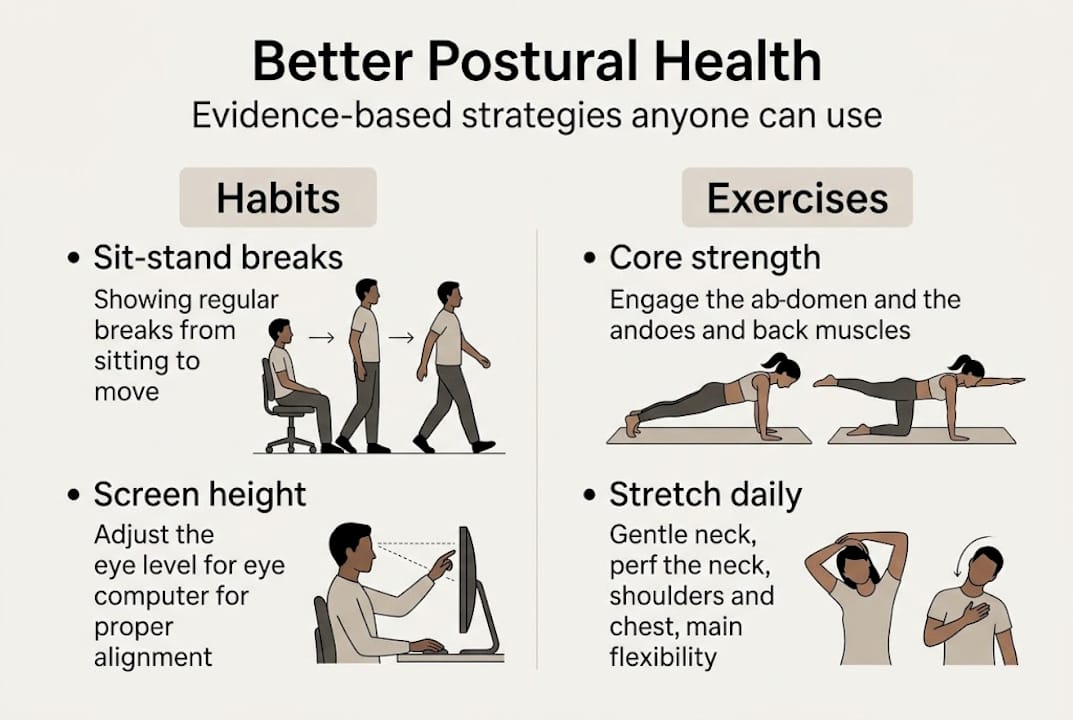
Improving postural health doesn’t require expensive equipment or complex routines. It requires the right habits applied consistently. Research points clearly to a few core strategies that work at any age.
Strengthen the muscles that support alignment:
- Core muscles (planks, dead bugs, bridge exercises)
- Upper back muscles (rows, face pulls, band pull-aparts)
- Glutes and hips (squats, clamshells, hip hinges)
Physical therapist-backed methods consistently include these exercises alongside ergonomic adjustments and structured movement breaks throughout the day.
Stretch what tightness holds back:
- Chest and shoulder openers (doorway stretches, chest flies)
- Hip flexors (low lunge, couch stretch)
- Hamstrings (seated forward fold, supine stretch)
Build a supportive environment:
Your workspace, your car seat, and your favorite chair all shape your posture for hours every day. Raising your monitor to eye level, supporting your lumbar curve while seated, and keeping your feet flat on the floor are small changes with outsized impact. An ergonomic comfort guide can help you make these adjustments systematically.
General health recommendations call for 150 minutes of aerobic exercise plus two days of strength and balance training per week. These targets support both postural and cardiovascular health simultaneously.
For a structured daily plan, a solid routine for back pain relief gives you a clear starting point.
Pro Tip: Short posture resets, 30 seconds of shoulder rolls and a chin tuck every hour, beat a single long stretching session every time. Frequency is the ingredient most people skip.
The real secret of postural health as you age
With all the tools in hand, let’s cut through the noise about ‘perfect’ posture and focus on what really creates lasting change for adults like you.
Here’s something most posture articles won’t tell you: chasing perfect alignment is often the enemy of actual progress. We’ve worked with enough adults in the 40 to 65 range to know that the people who make the most lasting improvements are not the ones who obsess over every angle and degree. They’re the ones who listen to their bodies, build small consistent habits, and adjust when something stops feeling right.
Your body is giving you feedback constantly. Tightness in one hip, a shoulder that creeps upward during stressful calls, lower back fatigue after an hour at the computer. These signals matter more than any mirror check. Trusting that feedback and responding to it with movement, rest, and position changes is the real skill to build.
Consistency always wins over intensity. Shifting your position every 45 minutes, doing a few glute bridges before bed, or choosing a supportive pillow that keeps your spine aligned during sleep, these are the quiet habits that keep joints strong naturally over decades. No single perfect posture moment will ever match what sustainable movement and body awareness deliver over months and years.
Next steps: Support your postural health journey
Ready for positive change? Here’s how the right support tools can jumpstart your comfort and postural gains.
Building better postural habits is rewarding, and the right tools make it easier to stay consistent. Supportive products work best when they reinforce the habits you’re already building, not replace the effort. Whether you’re recovering from discomfort or simply want to feel more supported during rest and sleep, thoughtfully designed comfort solutions make a real difference.

At Lunix, we design recovery and comfort products to fit seamlessly into your daily life. Our orthopedic wedge pillow system is built to support spinal alignment during rest, reducing the pressure your body carries through the night. If you’re ready to take the next step, explore our recovery solutions and find tools designed to help your body restore, relax, and feel its best.
Frequently asked questions
What are the earliest signs of poor postural health?
Early signs include frequent back or neck pain, stiffness after sitting, and poor balance during daily movements. Headaches with no clear cause are also common early indicators worth paying attention to.
Can I improve my posture after 50?
Absolutely. Age-appropriate exercises, stretching, and ergonomic adjustments can meaningfully improve posture at any age, including well past 50. Consistency matters far more than age.
How much sitting is too much for posture?
Sitting more than 8 hours daily raises health and postural risks meaningfully, especially without regular movement breaks or physical activity to offset it.
Does ‘perfect posture’ guarantee a pain-free life?
No. Research confirms no single perfect posture exists, and pain involves many factors beyond alignment. Building healthy movement habits delivers far more lasting results than striving for a rigid ideal.