


TL;DR:
- Mindfulness therapy is a structured, evidence-based approach teaching skills to observe thoughts without judgment.
- It involves regular practices like breath awareness, body scans, and mindful movement over eight-week programs.
- Benefits include moderate improvements in stress, anxiety, and depression, especially when integrated into daily routines.
Mindfulness therapy is not simply sitting quietly and breathing. It is a structured, evidence-based intervention that teaches you to observe your thoughts, feelings, and physical sensations without judging them. For adults navigating the pressures of midlife, this approach offers something genuinely different from generic stress advice. Science backs it up, clinicians use it, and thousands of adults have found it more sustainable than they expected. This guide walks you through what mindfulness therapy actually is, how it works in practice, what the research really says, and how you can start weaving it into your daily wellness routine.
Table of Contents
- Understanding mindfulness therapy: Key concepts and origins
- How mindfulness therapy works: Methods, techniques, and what to expect
- What the evidence shows: Effectiveness and limitations for mental health
- Mindfulness therapy in daily life: Practical applications for adults 40-65
- A fresh perspective: The real-world impact (and limits) of mindfulness therapy
- Integrate mindfulness and wellness: Next steps for your daily routine
- Frequently asked questions
Key Takeaways
| Point | Details |
|---|---|
| Mindfulness therapy defined | This evidence-based approach uses structured practices to cultivate present-moment, non-judgmental awareness. |
| Science-backed benefits | Research shows moderate, lasting effects for stress, anxiety, and depression, especially for adults integrating regular practice. |
| Best daily applications | Short, consistent exercises like breath awareness or body scan fit easily into wellness routines and offer practical results. |
| Know the limits | Mindfulness therapy supports resilience best as part of a broader self-care and mental health strategy, not as a cure-all. |
Understanding mindfulness therapy: Key concepts and origins
Mindfulness therapy is not the same as downloading a meditation app and hoping for the best. It is a formal mental health approach with a clear structure, professional guidance, and measurable outcomes. The key distinction is intentionality. While informal mindfulness means pausing to notice your surroundings, mindfulness therapy teaches you specific skills, including how to recognize unhelpful thought patterns, how to sit with discomfort, and how to respond rather than react.
The roots of this practice stretch back thousands of years to Buddhist contemplative traditions. However, the modern clinical version was developed in the late 1970s as a secular strategy for managing chronic pain and stress. Jon Kabat-Zinn, a molecular biologist at the University of Massachusetts, is widely credited with bringing these ancient concepts into Western medicine. His work gave birth to what we now call Mindfulness-Based Stress Reduction, or MBSR.
From there, the field expanded. Mindfulness-Based Cognitive Therapy, or MBCT, emerged in the 1990s as a way to prevent depression relapse by combining mindfulness skills with cognitive-behavioral techniques. Both programs share a core principle: awareness of the present moment without judgment.
The core methodologies of MBSR and MBCT include meditation, body scan exercises, and mindful movement. Each is designed to build a different kind of mental muscle. Here is what sets them apart:
- MBSR targets stress, pain, and general well-being through an 8-week group program
- MBCT focuses on preventing depression relapse by adding cognitive exercises to mindfulness practice
- Both programs emphasize home practice between sessions
- Neither requires prior experience with meditation or therapy
“The goal of mindfulness therapy is not to empty your mind. It is to change your relationship with your thoughts, so they no longer run the show.”
If you are curious about how these ideas connect to everyday stress relief, exploring mindfulness techniques for stress can give you a helpful starting point alongside the formal programs.
How mindfulness therapy works: Methods, techniques, and what to expect
Now that you understand the background and core ideas, let’s break down how a mindfulness therapy program actually works day-to-day.
Most structured programs follow a similar rhythm. MBSR runs for eight weeks, with weekly group sessions of about two to two and a half hours, plus daily home practice of 45 minutes. That sounds like a lot, but the structure is intentional. Repetition is how these skills move from conscious effort to natural habit.
MBCT follows a similar eight-week format but layers in cognitive exercises. Participants learn to recognize the early warning signs of low mood and use mindfulness to interrupt the spiral before it deepens. This is especially valuable for adults who have experienced depression before and want to protect their emotional health going forward.
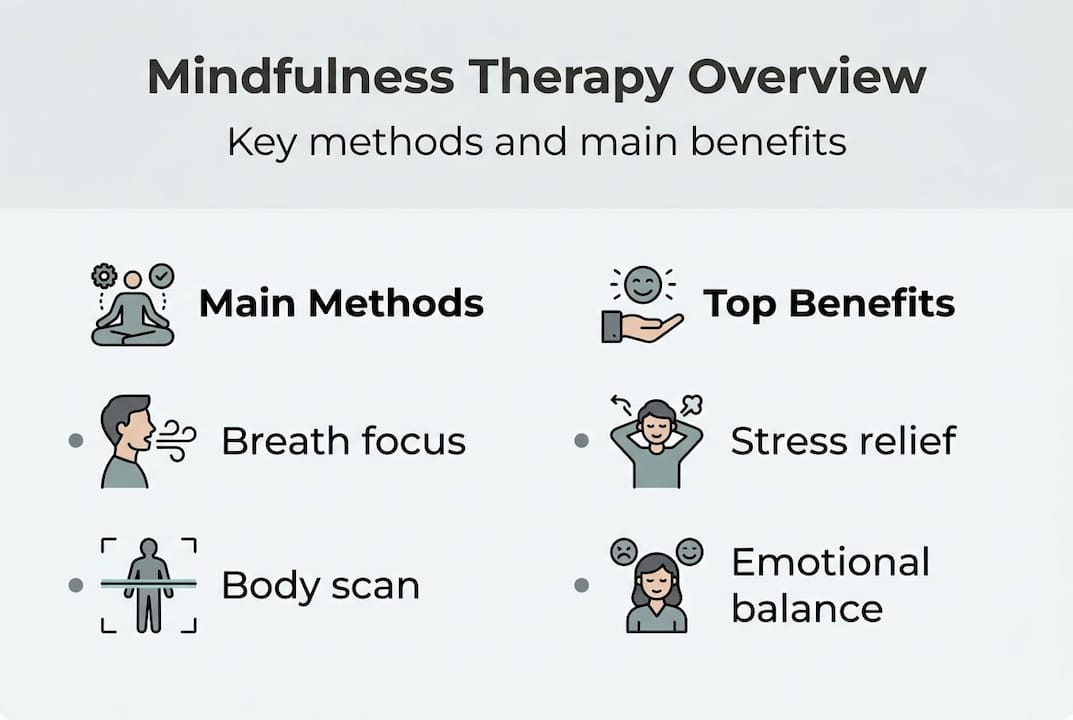
The core techniques in both programs include breath awareness, body scans, and mindful movement. Here is how each one works:
- Breath awareness: You focus attention on the physical sensation of breathing. When your mind wanders, you gently return focus without self-criticism.
- Body scan: You move attention slowly through each part of the body, noticing tension, discomfort, or ease without trying to change anything.
- Mindful movement: Gentle yoga or walking while paying close attention to physical sensations, helping you stay anchored in the present.
- Mindful transitions: Brief pauses between activities, like before a meeting or after a meal, to reset your attention.
| Technique | Time needed | Best for |
|---|---|---|
| Breath awareness | 5 to 10 minutes | Anxiety, focus |
| Body scan | 10 to 20 minutes | Tension, sleep |
| Mindful movement | 15 to 30 minutes | Stress, stiffness |
| Mindful transitions | 1 to 2 minutes | Daily integration |
For busy adults, a stress management guide can help you fit these techniques into a realistic schedule. You can also explore top meditation techniques to complement your practice.
Pro Tip: Informal daily practice, like eating mindfully or pausing before responding in a conversation, often delivers better long-term results than occasional intensive sessions. Consistency beats intensity every time.
What the evidence shows: Effectiveness and limitations for mental health
But does mindfulness therapy really work? Let’s examine what decades of research reveal, including what matters most for adults looking to boost resilience and emotional health.
The short answer is yes, with important nuance. A 2026 meta-analytic review found moderate but meaningful effects across key mental health outcomes:
- Stress: Standardized mean difference (SMD) of -0.53
- Anxiety: SMD of -0.48
- Depression: SMD of -0.38
These numbers represent real, measurable improvements that hold up at follow-up assessments, meaning the benefits do not simply fade when the program ends. Both clinical populations (people with diagnosed conditions) and non-clinical adults (those managing everyday stress) showed positive outcomes.
What drives these results? Research on the efficacy of mindfulness therapy points to acceptance and non-judgment as the key active ingredients. It is not just the meditation itself. Learning to observe a difficult emotion without immediately trying to fix or suppress it is what creates lasting change. That shift in perspective is what separates mindfulness therapy from simple relaxation.
However, honesty matters here. The effect sizes are moderate, not dramatic. Mindfulness therapy is not superior to Cognitive Behavioral Therapy (CBT) for treating depression, and it works less well as a standalone approach in severe cases. Think of it as a powerful tool in a broader wellness toolkit, not a replacement for professional care when you truly need it.
For adults 40 to 65 managing the accumulated stress of career, family, and health changes, the real value lies in building a relaxation practice that fits real life. Pairing mindfulness with broader self-care habits amplifies the benefits considerably.
Mindfulness therapy in daily life: Practical applications for adults 40-65
Armed with evidence-based facts, here is how you can bring mindfulness therapy into your real-life wellness routine, especially if you are busy or new to the concept.

The biggest misconception is that you need a quiet room and 30 uninterrupted minutes. You do not. Research on mindfulness for daily routines confirms that brief daily practices like breath focus or body scans are highly effective for non-clinical adults managing everyday stress. Even five minutes counts.
Here are practical ways to start:
- Morning breath check: Before getting out of bed, take five slow breaths and notice how your body feels. No agenda, just noticing.
- Mindful meals: Eat one meal a day without screens. Pay attention to taste, texture, and hunger cues.
- Transition pauses: Before starting your car or opening your laptop, take three conscious breaths.
- Evening body scan: Spend 10 minutes lying down and moving your attention from your feet to your head, releasing tension as you go.
- Mindful walking: On your next walk, leave the headphones behind and notice the sounds, sights, and sensations around you.
One of the most common obstacles is distraction. Your mind will wander. That is not failure; it is the practice. The mechanisms of mindfulness involve learning to observe thoughts as temporary events, not facts. Each time you notice your mind has drifted and gently return, you are building a real skill.
Skepticism is another common barrier, especially for adults who have tried and abandoned meditation before. Mindfulness therapy is not about achieving a blissful state. It is about building a different relationship with stress. That reframe alone changes how approachable it feels.
For a broader reset, mental spring cleaning offers complementary strategies. And if you want to understand the physical side of the equation, relaxation and cortisol reduction explains why calming your nervous system has measurable health benefits.
Pro Tip: Mindfulness is about noticing and accepting, not emptying your mind. When you catch yourself thinking during practice, that moment of awareness is the practice working.
A fresh perspective: The real-world impact (and limits) of mindfulness therapy
Here is something most mindfulness articles will not tell you: the formal program matters far less than what you do between sessions.
Decades of research and real-world outcomes show that mindfulness therapy works best as an adjunct to a broader wellness routine, not as a standalone cure. The adults who benefit most are not the ones who meditate perfectly for 45 minutes a day. They are the ones who pause before reacting to a frustrating email, who notice tension in their shoulders before it becomes a headache, who treat their emotional life with the same attention they give their physical health.
For adults 40 to 65, the real win is consistency over intensity. Chasing perfect calm is a trap. Accepting imperfect awareness, practiced daily, is where the genuine benefit lives. A personalized relaxation guide can help you build a routine that actually fits your life, rather than one that looks good on paper but never happens.
Mindfulness therapy is a real, evidence-backed tool. Use it wisely, alongside other strategies, and it can genuinely shift how you experience stress.
Integrate mindfulness and wellness: Next steps for your daily routine
If you are ready to take the next step toward a more mindful, resilient lifestyle, the right environment and tools make a meaningful difference. Mindfulness practice deepens when your body is comfortable and your space supports recovery.

At Lunix, we design stress recovery products that complement the kind of daily restoration mindfulness therapy encourages. Whether you are winding down with a body scan or simply creating a dedicated space for quiet reflection, having the right support around you matters. Explore the full range of wellness solutions at Lunix and find what fits your routine. Small, intentional upgrades to your environment can make your mindfulness practice feel less like a task and more like something you genuinely look forward to.
Frequently asked questions
Is mindfulness therapy the same as regular meditation?
No. Mindfulness therapy is a structured clinical intervention with specific programs like MBSR and MBCT, while meditation can be a standalone practice without the psychoeducation or skill-building components.
How quickly do mindfulness therapy benefits appear?
Most people notice stress relief within a few weeks of daily practice. Sustained effects at follow-up suggest that longer-term emotional benefits build gradually with consistent use.
Is mindfulness therapy effective for everyone over 40?
It offers moderate benefits for most adults, particularly for managing stress or mild depression. However, research confirms it is not a replacement for professional care in severe cases.
What’s the difference between MBSR and MBCT?
MBSR focuses on stress reduction through meditation and mindful movement, while MBCT adds cognitive therapy techniques to specifically prevent depression relapse in people with recurrent episodes.