


TL;DR:
- Sleep routines are crucial for adults aged 40-65 due to hormonal and biological changes.
- A structured bedtime routine with environmental adjustments improves sleep quality and overall health.
- Flexibility in routines and small consistent habits support sustainable, restorative sleep in busy lives.
If you’re lying awake at 2 a.m., watching the ceiling and wondering why rest feels so out of reach, you’re not alone. For adults between 40 and 65, poor sleep is one of the most common and most underestimated health challenges. Hormonal shifts, rising stress, and years of irregular schedules can quietly erode the quality of your nights. But here’s the encouraging part: the right bedtime routine can change all of that. This guide walks you through exactly what to do, from setting up your environment to building habits that stick, so you can wake up feeling genuinely restored.
Table of Contents
- Why sleep routines matter for adults 40–65
- What you need for a restful bedtime routine
- Step-by-step: How to build your restful bedtime routine
- Troubleshooting and optimizing your bedtime routine
- What most sleep advice misses for ages 40–65
- Next steps: Restore your rest with Lunix solutions
- Frequently asked questions
Key Takeaways
| Point | Details |
|---|---|
| Consistency is key | Adults sleep better when they maintain regular bed and wake times. |
| Wind-down rituals work | A dedicated hour to relax before bed can significantly lower stress and improve sleep quality. |
| Personalization matters | The most effective routines are tailored to your preferences and lifestyle. |
| Avoid common sleep disruptors | Limiting caffeine, heavy meals, and screen time helps ensure a smoother transition to restful sleep. |
Why sleep routines matter for adults 40–65
Sleep doesn’t stay the same as you age. Between 40 and 65, your body goes through real biological changes that make restful sleep harder to come by. Estrogen and testosterone levels shift. Cortisol, the body’s stress hormone, tends to run higher. Melatonin production, which signals your brain that it’s time to sleep, naturally declines. The result? You may find yourself waking up earlier, taking longer to fall asleep, or feeling unrefreshed even after a full night in bed.
This is where a consistent routine becomes your most powerful tool. A 7 to 9 hours nightly sleep schedule reinforces your circadian rhythm, the internal clock that governs when you feel sleepy and when you feel alert. When that clock is well-calibrated, falling asleep and staying asleep becomes much easier.
Here’s a quick look at how sleep needs and challenges compare across this age range:
| Age range | Common sleep challenges | Recommended nightly sleep |
|---|---|---|
| 40–50 | Stress, early wake-ups | 7–9 hours |
| 50–60 | Hormonal shifts, lighter sleep | 7–9 hours |
| 60–65 | Reduced melatonin, more fragmentation | 7–8 hours |
Beyond just feeling rested, a consistent sleep schedule pays dividends across your entire life. Consider what improves when you sleep well:
- Mood and emotional resilience: Poor sleep amplifies irritability and anxiety. Good sleep steadies both.
- Cognitive sharpness: Memory consolidation happens during deep sleep. Skipping it costs you focus and recall.
- Immune function: Your body repairs tissue and fights inflammation overnight.
- Cardiovascular health: Chronic sleep deprivation is linked to higher blood pressure and heart disease risk.
- Weight management: Sleep regulates hunger hormones, making it easier to maintain a healthy weight.
For more well-being tips for adults in this life stage, it helps to understand that sleep isn’t passive recovery. It’s active restoration. Treating it that way changes everything.
What you need for a restful bedtime routine
Understanding why routines matter, let’s see what you’ll need to create a restful bedtime environment. The good news is that most of what you need is already within reach.
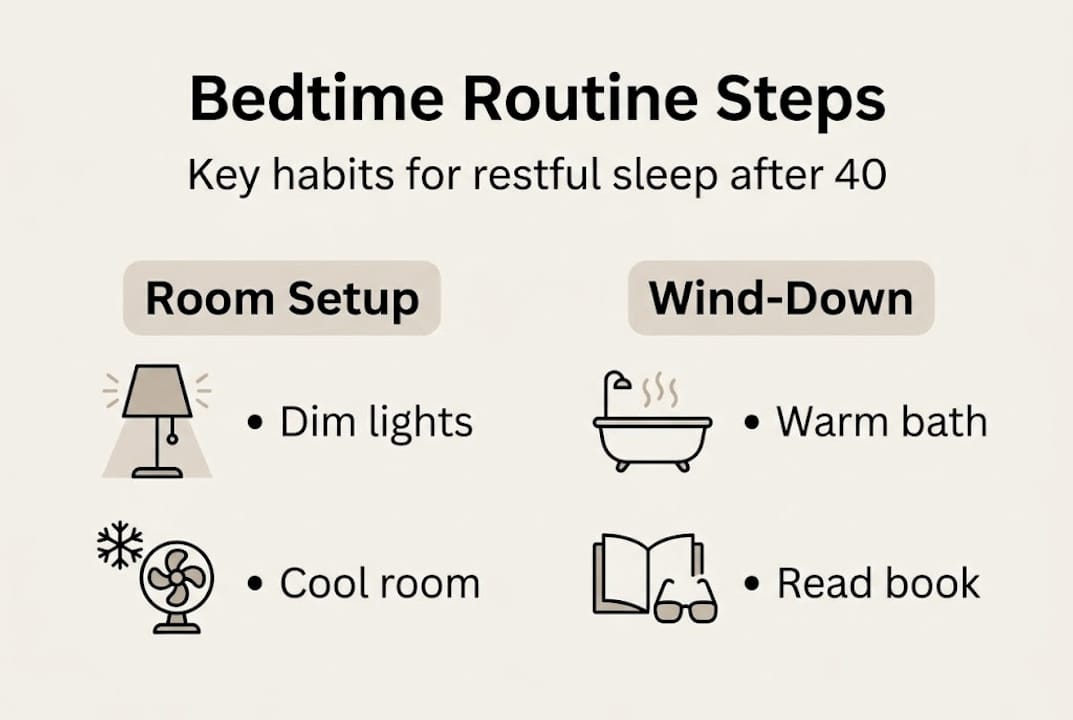
Start with your room. Your bedroom should signal rest, not stimulation. Aim for a room temperature between 65 and 68 degrees Fahrenheit. Keep it dark using blackout curtains or a sleep mask. Remove or silence devices that emit light or notifications. Even a small LED indicator on a TV can disrupt melatonin production.

Here’s a simple setup checklist:
| Element | Ideal condition | Why it matters |
|---|---|---|
| Temperature | 65–68°F | Promotes deeper sleep stages |
| Lighting | Dark or very dim | Supports melatonin release |
| Noise | Quiet or white noise | Reduces sleep fragmentation |
| Screens | Off 60+ minutes before bed | Lowers mental stimulation |
Beyond your room, gather a few optional but helpful tools:
- A journal for writing down tomorrow’s tasks or today’s worries
- Herbal tea like chamomile or valerian root
- Calming music or nature sounds through a speaker, not your phone
- Bath salts or lavender oil for a warm soak
- A light novel or non-stimulating reading material
The science backs a structured wind-down. A one-hour pre-bed routine that includes dimming lights, taking a warm bath or shower, and practicing relaxation techniques like deep breathing or journaling helps lower cortisol and ease your nervous system into sleep mode. Understanding lowering cortisol for sleep can help you appreciate just how much this single hormone affects your nights.
Pro Tip: Set a “wind-down alarm” on your phone 60 to 90 minutes before your target bedtime. When it goes off, that’s your cue to start dimming lights and stepping away from screens. Treat it like an appointment you keep with yourself. If you want to go further, explore creating a relaxation zone in your home to reinforce these cues every evening.
Step-by-step: How to build your restful bedtime routine
With everything you need in place, here’s how to assemble your bedtime routine, step by step.
- Set your sleep and wake times. Choose a bedtime and wake time you can realistically maintain seven days a week, including weekends. Consistency is more important than the exact hour.
- Prepare your space 90 minutes out. Lower the thermostat, dim the lights, and put your phone on Do Not Disturb.
- Do a brain dump at 60 minutes out. Spend five to ten minutes writing down any lingering thoughts, to-do items, or worries. This clears mental clutter before it follows you to bed.
- Take a warm bath or shower at 45 minutes out. The drop in body temperature afterward signals your brain to release melatonin.
- Practice a relaxation technique at 30 minutes out. Try meditation techniques like body scan meditation, progressive muscle relaxation, or slow deep breathing. Even ten minutes makes a measurable difference.
- Read or listen to calming content at 15 minutes out. Choose something light and non-stimulating. Save thrillers and news for daytime.
- Lights out at your target time. Keep the room dark and your phone out of arm’s reach.
Research confirms that behavioral interventions like meditation and yoga improve sleep quality and cognitive function in middle-aged adults, and that goal-setting strategies are especially effective for building lasting habits. If you’re new to these practices, top meditation techniques and step-by-step relaxation techniques are great places to start.
A word of caution: Skipping steps occasionally is human. But skipping them consistently breaks the chain of cues your brain relies on to shift into sleep mode. If you miss a night, don’t overhaul the routine. Just return to it the next evening without judgment.
Pro Tip: Start with just two or three steps if the full routine feels like too much. Add one new element each week. Small wins build momentum faster than trying to change everything at once.
Troubleshooting and optimizing your bedtime routine
Now that your routine is in place, here’s how to maintain it and solve common sleep challenges.
Even the best routine hits friction. Travel, work stress, family obligations, and seasonal changes can all throw off your rhythm. The key is knowing which disruptions to watch for and how to respond without abandoning the routine entirely.
Common mistakes that undermine your bedtime routine:
- Scrolling social media in bed. The blue light and emotional stimulation from your feed are two of the fastest ways to delay sleep onset.
- Inconsistent weekend sleep times. Sleeping in two hours on Saturday creates what researchers call “social jet lag,” which makes Monday mornings brutal.
- Using alcohol to wind down. Alcohol may help you fall asleep faster, but it fragments sleep in the second half of the night.
- Napping too late or too long. Naps after 3 p.m. or longer than 30 minutes steal sleep pressure from nighttime.
- Ignoring how light affects you. Understanding how light affects sleep is one of the most overlooked factors in sleep optimization.
Diet timing matters more than most people realize. Avoid caffeine after noon, keep alcohol at least four to six hours from bedtime, and finish heavy meals two to three hours before you plan to sleep. Caffeine has a half-life of about five to six hours, meaning a 3 p.m. coffee is still half-active in your system at 8 p.m.
For busy lifestyles, adapt rather than abandon. If travel disrupts your routine, focus on just two anchor habits: your wind-down alarm and your wake time. These two alone can preserve most of the benefit. When stress spikes, add an extra five minutes of deep breathing rather than skipping the routine altogether. For more targeted strategies, improving sleep tonight offers practical, immediate steps you can take right now.
What most sleep advice misses for ages 40–65
Most sleep articles hand you a checklist and call it a day. But here’s what we’ve seen time and again: rigidity is the enemy of lasting change. Adults in this life stage are managing careers, aging parents, health concerns, and shifting identities. A routine that demands perfection will fail the moment life gets complicated, which it always does.
The real goal isn’t a flawless routine. It’s a flexible one. Think of your bedtime routine as a dial, not a switch. Some nights you’ll do all seven steps. Other nights, you’ll manage three. Both count. Both move you forward.
Small, realistic changes compound over time in ways that dramatic overhauls never do. Shifting your bedtime by 15 minutes, adding one calming habit, or simply relaxing after work with intention before your wind-down begins can shift your sleep quality noticeably within weeks. Sustainability beats perfection every single time.
Next steps: Restore your rest with Lunix solutions
If you’re ready to take your sleep routine further, here’s how Lunix can help.
Building a bedtime routine is a powerful first step, but the tools and environment around you matter just as much. Lunix designs recovery and comfort solutions specifically to support the kind of deep, restorative rest your body needs.

From supportive recovery products to wellness tools built for real life, our recovery solutions are designed to complement every step of your bedtime routine. Whether you’re working on muscle recovery, improving your sleep posture, or simply creating a more restful space, explore Lunix wellness tools and find what fits your life. Better nights are closer than you think.
Frequently asked questions
How long does it take to see results from a bedtime routine?
Most adults notice better sleep quality within one to two weeks of consistently following a new routine. Your brain responds quickly to repeated cues, and a consistent sleep schedule helps reinforce your circadian rhythm faster than most people expect.
Which relaxation technique is most effective before bed?
There’s no single best method, but techniques like deep breathing, body scan meditation, and journaling all work by lowering cortisol. A one-hour wind-down routine that includes at least one of these practices consistently outperforms sporadic use of any single technique.
Is it okay to have a small snack in the evening?
A light snack is generally fine if it prevents hunger from keeping you awake. Just be sure to avoid heavy meals within two to three hours of bedtime, as digestion can interfere with your ability to fall and stay asleep.
What should I avoid before bedtime to improve sleep?
The biggest disruptors are caffeine, alcohol, heavy meals, and screen time. Avoiding caffeine after noon and keeping alcohol at least four to six hours from bedtime makes a noticeable difference in sleep depth and continuity.