


TL;DR:
- Choosing the right women’s wellness app requires prioritizing privacy, personalization, scientific evidence, usability, and community support. Layering specialized apps, such as cycle trackers and behavior coaches, provides more comprehensive and effective health management than relying on a single tool. Regularly adjusting your app stack and maintaining privacy hygiene enhances your overall wellness journey across hormonal and life stage changes.
Scrolling through hundreds of wellness apps can feel like searching for one specific book in a library with no labels. Between cycle trackers, menopause support tools, nutrition coaches, and habit builders, the options seem endless and the differences are hard to spot. But the right app can genuinely shift how you feel day to day, especially when it actually understands where you are in your hormonal journey. This guide cuts through the noise by laying out clear selection criteria, honest comparisons, and personalized recommendations so you can choose with confidence, not guesswork.
Table of Contents
- How to choose a wellness app for women: Key criteria
- Top 6 wellness apps for women: Features and benefits
- Head-to-head: Comparing women’s wellness app strengths
- Which wellness app is right for you? Recommendations by scenario
- The real secret: Why no single wellness app fits every woman
- Next steps: Enhance your wellness journey
- Frequently asked questions
Key Takeaways
| Point | Details |
|---|---|
| Personalization matters most | Wellness apps tailored to women’s cycles and life stage offer better results than generic solutions. |
| Privacy is a top priority | Choose apps with transparent policies like Clue, since 71% of menstrual apps share data with third parties. |
| No single perfect app | Combining cycle, nutrition, and coaching apps creates a more complete approach. |
| Consistent use boosts results | Daily engagement with wellness apps strongly links with improved mental and physical health. |
| Check for evidence | Look for science-backed apps with medical partnerships or certifications for trustworthiness. |
How to choose a wellness app for women: Key criteria
Not every wellness app is built with you in mind. Some are designed for general populations and happen to include a period tracker. Others are so focused on calorie counting that they miss the bigger picture of what women’s health actually looks like across different life stages. Before you download anything, it helps to know what to look for.
Here are the key criteria that separate a truly useful app from a forgettable one:
- Privacy. This is non-negotiable. A systematic review of menstrual apps found that 71% of menstrual apps share data with third parties, which is a serious concern especially for women living in states with reproductive health restrictions. Apps like Clue have built their reputation on GDPR compliance and transparent data practices, while Aurora uses secure protocols designed to protect hormonal health data.
- Personalization. Generic wellness advice does not move the needle the way personalized guidance does. Aurora’s cycle-syncing approach aligns your nutrition, fitness, and daily habits to your hormonal phases, and research backs this up: personalized cycle-syncing consistently outperforms one-size-fits-all wellness programs.
- Evidence base. Look for apps that cite peer-reviewed research, hold medical certifications, or partner with healthcare providers. A pretty interface means nothing if the advice behind it is not grounded in science.
- Usability. An app you dread opening will not help you. Clean dashboards, smart reminders, and easy health reporting make a real difference in long-term adherence.
- Community support. Forums, group challenges, and peer networks can provide the motivation boost that solo tracking often lacks, particularly for women navigating perimenopause or postpartum recovery.
Pro Tip: Before downloading any cycle or menopause tracking app, read the full privacy policy. Look specifically for language around “third-party data sharing” and “law enforcement requests.” This matters more than any feature list.
Understanding technology’s wellness benefits is the first step. With these criteria in hand, let’s see how top-recommended apps stack up for women seeking a truly personal health journey.
Top 6 wellness apps for women: Features and benefits
These six apps consistently rise to the top when women in their 30s and 40s are looking for meaningful health support. Each has a distinct focus and strength, which is actually good news because it means there is likely one (or two) that fit your life right now.
| App | Best for | Key features | Age focus |
|---|---|---|---|
| Aurora | Hormonal health | Cycle-syncing, AI affirmations, nutrition alignment | 25 to 45 |
| Balance | Perimenopause | ORCHA-certified, doctor reports, yoga library | 40 to 55 |
| Clue | Privacy + cycle tracking | GDPR, perimenopause mode, wearable sync | All ages |
| Reverse Health | Weight loss over 40 | Custom nutrition and workouts, community | 40 and up |
| MyFitnessPal | Nutrient precision | 84 nutrients tracked, barcode scan, integrations | All ages |
| Noom | Behavior change | Psychology coaching, habit formation | All ages |
Here is a closer look at what makes each one stand out:
- Aurora offers a genuinely fresh take on women’s wellness by syncing your habits and nutrition to your hormonal cycle phases. Rather than treating every day the same, Aurora’s cycle-syncing methodology recognizes that your energy, focus, and recovery needs shift throughout the month.
- Balance is specifically designed for perimenopause and is ORCHA-certified for perimenopause tracking. It lets you generate downloadable health reports to share with your doctor, which is rare and genuinely useful when you are trying to describe symptoms you have never had words for before.
- Clue is widely respected for its transparent, science-backed approach to cycle tracking. It includes a perimenopause mode, integrates with wearables, and is one of the few apps that has publicly committed to not sharing your data with third parties.
- Reverse Health was built specifically for women over 40 and offers tailored nutrition and fitness plans designed around the metabolic changes that come with this life stage. Many users report losing 15 to 25 pounds over 12 weeks, which aligns with the program’s structured approach.
- MyFitnessPal remains the gold standard for nutrition tracking, covering 84 nutrients in detail including micronutrients that most apps completely ignore. If you have specific dietary goals or work with a nutritionist, this level of detail pays off.
- Noom takes a psychology-first approach, using behavioral science to help you understand why you eat and move the way you do. Clinical data shows Noom users achieve 7.5% average weight loss within 16 weeks, which speaks to the power of addressing habits at the root.
For simple daily movement ideas to pair with any of these apps, a little consistency goes a long way. You can also find broader wellness tips for women to round out your approach.
Pro Tip: If you want both hormone-aligned fitness and psychology-based habit coaching, try combining Aurora with Noom. They address completely different layers of your wellness and work well together without overlap.
Head-to-head: Comparing women’s wellness app strengths
Now that you know what each app offers, a side-by-side comparison helps you quickly identify which one earns a place on your phone.
| Feature | Aurora | Balance | Clue | Reverse Health | MyFitnessPal | Noom |
|---|---|---|---|---|---|---|
| Privacy standard | Strong | Strong | GDPR | Strong | Basic | Basic |
| Personalization | High | High | Moderate | High | Low | Moderate |
| Community | Limited | Yes | Limited | Yes | Yes | Yes |
| Medical certification | No | ORCHA | Partnerships | No | No | Clinical trials |
| Perimenopause support | Partial | Full | Full | Partial | No | No |
| Hormone-synced features | Yes | Partial | Partial | No | No | No |
| Nutrition depth | Moderate | Low | Low | High | Very high | Moderate |
A few things stand out immediately. Balance is the only app with an ORCHA certification, which means it has been independently evaluated for health app quality. Clue is the strongest on privacy, particularly relevant given that 71% of menstrual apps share data with third parties, a significant risk for women who want to keep their reproductive health data private.
Research also confirms that choosing to use these apps consistently pays off. A study in Frontiers in Psychology found that fitness app use boosts exercise adherence with an effect size of 0.341, and that regular users show dramatically better mental health outcomes, with an R² of 0.82, along with healthier eating patterns overall.
“Daily fitness app users show the strongest mental health outcomes, with regular engagement predicting lower BMI, better dietary quality, and significantly improved psychological well-being compared to occasional or non-users.”
That is not a small finding. It reinforces that the act of engaging with a wellness app consistently, even imperfectly, creates a real ripple effect across your health.
For women building midlife wellness routines, these tools can be the structure that makes consistency feel natural rather than forced. And if you want to go deeper on motivation and mindset, exploring the science of happiness offers a useful complement to what any app can provide.
With the differences clear, let’s consider which app (or mix) works best for different life stages and goals.
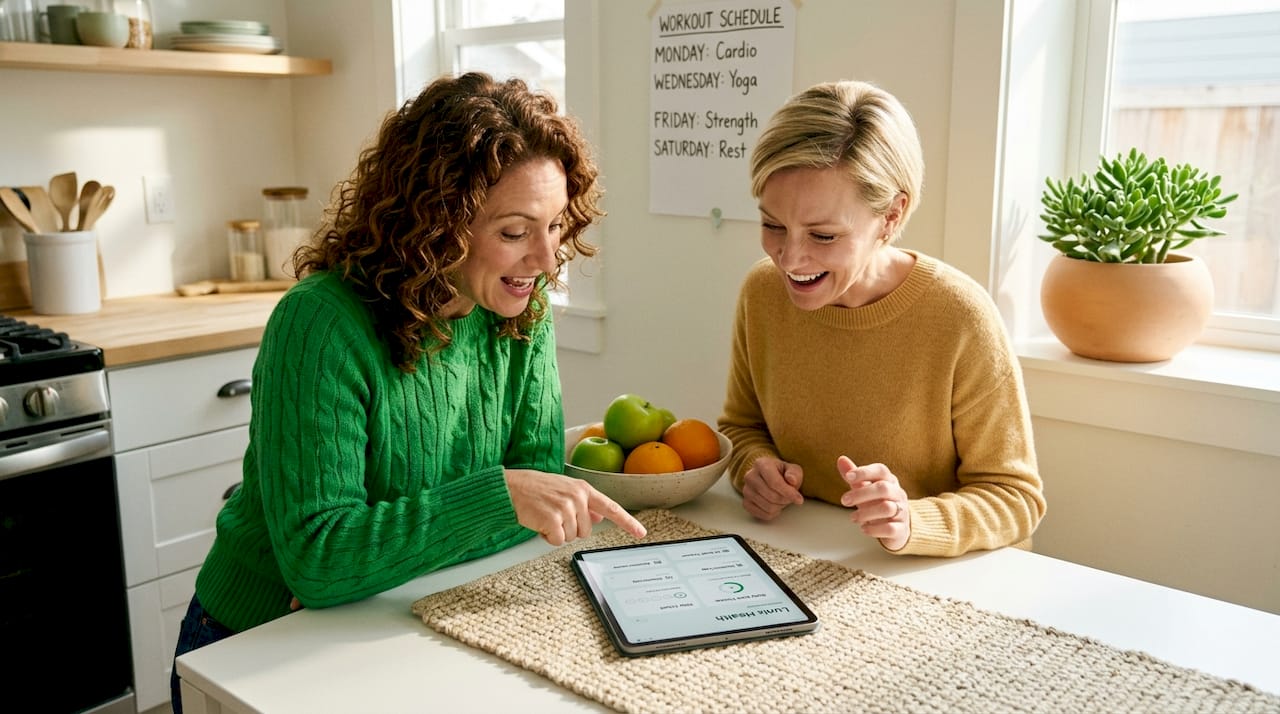
Which wellness app is right for you? Recommendations by scenario
The best app is the one that matches where you actually are, not where you think you should be. Here are five common scenarios and the apps that serve them best:
-
You are navigating perimenopause. Start with Balance or Clue. Both apps include dedicated perimenopause modes, and Balance specifically integrates health reports for doctor visits along with cognitive behavioral therapy (CBT) tools for symptom relief. Being able to hand your doctor a printout of your symptoms changes that conversation entirely.
-
You experience hormonal fluctuations that affect your energy and mood. Aurora or Clue will serve you well here. Aurora’s cycle-syncing approach adapts your recommended activities and nutrition to each phase of your cycle, while Clue gives you the data to spot patterns and correlations over time.
-
You want to lose weight and want both data precision and real behavior change. Combining MyFitnessPal with Noom gives you the best of both worlds. MyFitnessPal handles the micro-level nutrition detail (tracking specific vitamins, minerals, and macros) while Noom builds the psychological habits that make those choices stick long term.
-
You are over 40 and want fitness and nutrition support that actually fits your body’s current reality. Reverse Health was built for this exact scenario. Its workouts and meal plans account for the hormonal and metabolic shifts that women over 40 experience, which makes it feel far more relevant than general fitness apps that were clearly designed for a 25-year-old.
-
Privacy is your top priority, above everything else. Clue is your answer. It has the clearest public commitment to not selling or sharing your data, which is especially important if you live in a state with reproductive health legislation.
You do not have to choose just one. Many women find that layering two apps, like Clue for cycle tracking and Reverse Health for fitness, fills gaps that neither covers alone. Think of it like building a self-care ritual: the individual pieces stack up into something that genuinely works for your whole life.
The real secret: Why no single wellness app fits every woman
Here is something most app review articles will not tell you: the search for the perfect single wellness app is a bit of a red herring. Real personalization almost always requires layering tools.
Think about it. Your health right now involves your hormonal cycle, your sleep quality, your nutrition, your stress levels, your fitness capacity, and your mental health. No single app covers all of those dimensions with equal depth. The ones that try to do everything tend to do nothing particularly well.
The most effective approach we see is what might be called a “wellness stack”: two or three apps that each do one thing really well and complement each other. A privacy-first cycle tracker plus a nutrition logger plus a behavior change coach. That combination covers far more ground than any one app ever could.
Privacy management deserves its own mention here. Post-Roe, US women face real data risks from wellness apps that share health information with third parties. This is not a hypothetical concern. As your wellness routine evolves, your privacy hygiene should evolve alongside it. Check your app settings annually, revoke permissions you no longer need, and resist the convenience of linking your real name or email to sensitive health tracking tools.
The women who get the most out of wellness technology are not the ones who found the perfect app. They are the ones who experiment, adjust regularly, and treat their app stack the way they treat other self-care practices: as something that grows and changes with them.
Creating a wellness space at home is a natural extension of this mindset. Your digital tools and your physical environment work together to support your well-being.
Pro Tip: Never link your legal name or primary email to a cycle tracking or menopause app. Use a secondary email address to put an additional layer of protection between your identity and your most personal health data.
Next steps: Enhance your wellness journey
Your app stack is a powerful starting point, and the right physical tools can take that momentum even further. At Lunix, we design recovery and comfort solutions that work seamlessly alongside your digital wellness routine, helping your body restore and relax so you can show up fully for every phase of your cycle and every stage of life.
Explore our wellness recovery products to find tools that complement the habits you are building with your chosen apps. Whether you are recovering from intense workouts, managing perimenopause symptoms, or simply prioritizing rest as part of your self-care practice, our women’s recovery resources offer practical support for every chapter. If this guide helped you, share it with a friend who is also navigating the world of women’s wellness technology.
Frequently asked questions
Are wellness apps safe for tracking menstrual or menopause data?
Many menstrual and menopause apps share data with third parties, but those like Clue offer GDPR-level privacy protection, so always carefully review an app’s privacy policy before entering your health data. A 2025 review found 71% of menstrual apps share user data externally.
What app works best for perimenopause symptoms?
Balance and Clue specialize in perimenopause tracking and both provide options to generate doctor-friendly health reports and structured symptom lists. Balance is ORCHA-certified and includes CBT-based tools for managing symptoms.
Which wellness app helps most with sustainable weight loss?
Noom achieved 7.5% average weight loss in clinical studies by targeting behavior change, while pairing it with MyFitnessPal adds precise nutrient-level tracking for even stronger results.
How do fitness apps impact mental health in women?
Regular fitness app use is strongly linked to better mental health outcomes, including lower BMI and improved dietary quality. Studies show an R² of 0.82 between consistent app engagement and positive mental health results in women.
Is it better to use a single wellness app or combine several?
Most women get better overall results by combining a cycle-tracking app with a nutrition logger and a coaching tool, since no single app covers every dimension of women’s health equally well. Pairing tracking with behavioral coaching addresses both data precision and long-term habit change simultaneously.