


TL;DR:
- Ergonomic living involves designing environments and habits to support the body’s changing needs after 40.
- Regular movement, position variation, and proper ergonomics reduce pain and improve mobility.
- Small, consistent adjustments and adaptive strategies are more effective than one-time solutions.
If you’re over 40 and dealing with persistent back aches, stiff joints, or daily fatigue, you’re far from alone. Physical inactivity is the strongest lifestyle factor for severe pain in adults over 50, yet most people still associate “ergonomics” narrowly with office chairs and monitor heights. Ergonomic living is actually a whole-life approach that touches how you sit, rest, move, and set up your spaces every single day. In this article, you’ll learn why it matters so deeply after 40, what the science says about your body’s changing needs, and exactly how to make practical adjustments that create real, lasting comfort.
Table of Contents
- What is ergonomic living and why does it matter?
- The science: How ergonomics affects your body after 40
- How to set up your home for ergonomic living
- Daily habits: Movement and variation matter
- The genuine difference: What most guides don’t tell you about ergonomic living
- Take the next step toward ergonomic comfort
- Frequently asked questions
Key Takeaways
| Point | Details |
|---|---|
| Movement is essential | Alternating positions and regular activity prevent pain more effectively than any one posture. |
| Ergonomics plus habits | Combining smart furniture with daily movement offers the best protection for aging bodies. |
| Small adjustments, big results | Simple ergonomic changes in your routine and surroundings can greatly improve comfort and lower pain. |
| Age-specific needs matter | After 40, muscle loss and pain risk increase, so proactively updating your habits and setup is crucial. |
What is ergonomic living and why does it matter?
Ergonomic living means designing your environment and daily habits to work with your body, not against it. Instead of forcing your body to adapt to uncomfortable furniture or rigid routines, you flip the equation. Your spaces, tools, and habits adjust to fit you. It sounds simple, and in practice it is. But the impact is significant.
The core principles of ergonomic living can be remembered as three words: adjust, alternate, and activate.
- Adjust your physical environment. That means your chair height, screen position, mattress support, and any surface you regularly use.
- Alternate your positions throughout the day. No single posture, however “correct” it looks, is good for your body over many hours.
- Activate your body regularly with intentional movement, even in small doses, to keep muscles and joints functional.
This matters especially for adults between 40 and 65 because this is the decade when sedentary patterns begin to take a serious toll. Sedentary behavior doubles the risk of chronic low back pain in adults aged 45 and older. That’s not a minor inconvenience. Chronic pain affects sleep, mood, energy, and your ability to enjoy the people and activities you love.
The good news is that understanding the ergonomic design benefits for back pain and comfort shows you that small, intentional changes pay off in meaningful ways. You don’t need to overhaul your entire home or spend a fortune. What you need is an understanding of why your body responds the way it does, and then a willingness to make steady changes.
“Ergonomics isn’t about perfection. It’s about reducing unnecessary strain so your body can focus its energy on living well.”
Many adults in their 40s and 50s dismiss discomfort as an inevitable part of aging. It is not. Pain is often a signal that your environment and habits haven’t kept up with your body’s evolving needs. When you address those mismatches early, you protect your mobility, reduce inflammation, and maintain a quality of life that keeps you active and independent well into later decades. The investment you make in ergonomic living now is one of the highest-return health decisions available to you.
The science: How ergonomics affects your body after 40
After understanding the importance of ergonomics, let’s examine what happens inside your body as you age, and how the right changes make a real difference.
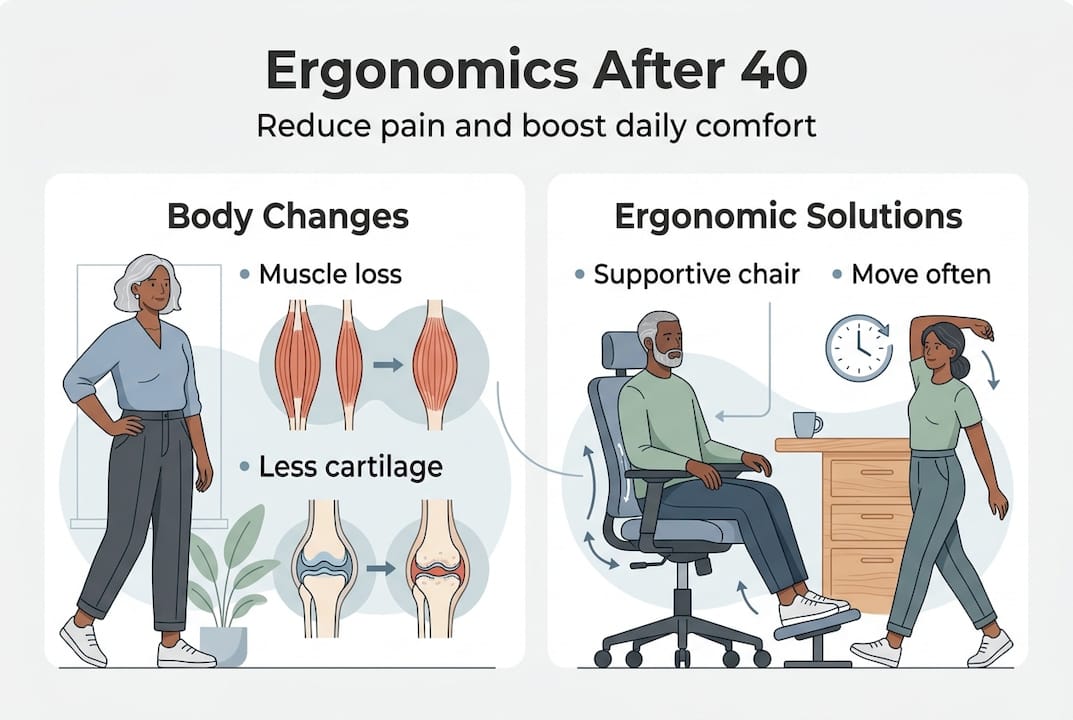
Starting around age 40, your body goes through changes that most people don’t notice until pain or stiffness forces them to pay attention. One of the biggest shifts is sarcopenia, which is the gradual loss of muscle mass that begins in your 40s. Adults lose roughly 1% of muscle mass every year from age 40 onward unless they actively counteract it with movement and resistance training. Less muscle means less support for your spine, joints, and connective tissues. The result is that poor posture or prolonged sitting creates strain far faster than it would have in your 30s.
Beyond muscle loss, cartilage thins, bone density gradually decreases, and the discs between your vertebrae lose hydration, becoming less shock-absorbent. These are not catastrophic changes on their own, but they do mean your body has less tolerance for mechanical stress. Poor ergonomics amplifies that stress. Ergonomic living, on the other hand, reduces unnecessary load on vulnerable joints and tissues so your body can function at its actual capacity.
| Body change after 40 | How it increases pain risk | How ergonomics helps |
|---|---|---|
| Muscle loss (sarcopenia) | Less spinal support, fatigue faster | Supported seating, movement breaks |
| Disc dehydration | Reduced shock absorption | Lumbar support, position variation |
| Reduced cartilage | Joint stress under load | Pressure-distributing surfaces |
| Decreased bone density | Higher fracture and strain risk | Stability in furniture and movement |
The data on inactivity is striking. Physical inactivity is the strongest lifestyle factor for severe pain in adults over 50, ranking above poor sleep and even smoking. That finding should reframe how you think about daily comfort. It isn’t primarily about the chair you sit in. It’s about how much you move, and whether your environment supports or discourages that movement.
Pro Tip: Pair an ergonomic home setup with light resistance exercise three times per week. Research shows that ergonomics combined with resistance training is the most effective approach to preserving both muscle and bone density after 40, reducing your overall injury risk significantly more than either strategy alone.
Exploring practical resources on ergonomics at home gives you a solid starting point for applying these principles room by room. Your bedroom, living room, and workspace all play a role in how well your body recovers and performs each day.
How to set up your home for ergonomic living
With the science behind us, let’s bring ergonomics home with step-by-step guidance that fits busy adult lives.
Setting up your home ergonomically doesn’t require a complete renovation. It requires looking at the spaces where you spend the most time and making targeted, effective adjustments. For most adults over 40, that means your workstation, your couch or favorite chair, and your sleeping environment.
Starting with your chair, research confirms that optimal chair adjustments include seat height that allows your elbows to rest at 90 degrees with your feet flat on the floor, adjustable lumbar support that follows the natural curve of your lower back, multi-directional armrests that reduce shoulder tension, and seat depth that prevents pressure behind your knees. Getting these four elements right is more impactful than any other single furniture change you can make.
Here’s a simple comparison to help you evaluate your current seating:
| Feature | Standard chair | Ergonomic chair |
|---|---|---|
| Seat height | Fixed | Adjustable to your body |
| Lumbar support | None or rigid | Adjustable, follows your curve |
| Armrests | Fixed or absent | Multi-directional |
| Seat depth | Fixed | Adjustable to leg length |
| Recline | Limited | Tension-adjustable |
To set up your ergonomic workspace at home, follow these steps in order:
- Adjust your chair height so your feet rest flat on the floor and your knees are at a 90-degree angle.
- Position your monitor so the top of the screen is at or slightly below eye level, about an arm’s length away.
- Set armrests so your shoulders stay relaxed and your elbows bend at roughly 90 degrees.
- Place your keyboard so your wrists remain neutral, not bent upward or downward.
- Add lumbar support by adjusting your chair’s built-in support or using a rolled towel behind your lower back.
- Check your lighting. Bright overhead glare causes you to lean forward unconsciously, creating neck strain over time.
A back pain relief routine that complements your setup helps reinforce the physical benefits of an ergonomic space. If you use a laptop frequently, reviewing laptop ergonomic tips can help you avoid the forward-head posture that laptops on flat surfaces almost always create.
Pro Tip: If you’re working with a limited budget, prioritize an adjustable chair over a standing desk. A quality chair correctly set up delivers significantly more daily benefit than a standing desk used without proper technique or position variation.
The rest of your home matters too. The height of your kitchen counter, the depth of your couch, and the support level of your mattress all contribute to your cumulative daily strain. Pay attention to any surface where you spend more than 30 minutes at a time.
Daily habits: Movement and variation matter
Great ergonomic living isn’t just about your surroundings. It’s about your daily habits. Here’s how to make movement a vital part of your day.
You could have the most well-adjusted ergonomic setup in the world and still experience significant pain and fatigue. Why? Because furniture alone doesn’t solve the problem. Position variation is the real key: alternating between sitting and standing every 30 to 60 minutes reduces the cumulative fatigue and strain that any static posture creates, whether that’s sitting in a perfect chair or standing at a perfectly adjusted desk.
This is a point worth slowing down on. Many people switch from a traditional desk to a standing desk believing it will fix their discomfort. But a Cochrane review found insufficient evidence that sit-stand desks alone reduce musculoskeletal symptoms long-term. The most promising results came from multi-component interventions that combined furniture changes with behavioral strategies, including scheduled movement breaks and postural awareness.
“Standing all day is not the solution to sitting all day. Movement is.”
So what does healthy movement actually look like throughout a regular day? Here are practical strategies you can start using immediately:
- Set a position alarm every 45 minutes to change from sitting to standing or vice versa.
- Use a movement snack: walk to get water, do five shoulder rolls, or step outside for two minutes between tasks.
- Stretch during transitions. Walking from one room to another is an opportunity for a hip flexor stretch or a shoulder opener.
- Reorganize your space so frequently used items require you to get up rather than reach from your chair.
- Walk while on phone calls whenever possible. For most adults, this single habit adds 20 or more minutes of movement per day.
- End each hour with 60 seconds of gentle movement. Standing up, reaching overhead, or doing a brief walk around your home resets your posture and circulation.
Pro Tip: Use the 20-8-2 rule to structure your workday. Spend 20 minutes sitting, 8 minutes standing, and 2 minutes moving for every half hour block. This rhythm is both sustainable and significantly more protective than any fixed position.
Understanding posture correction after 40 adds another layer to this picture. Posture isn’t a fixed achievement. It’s an ongoing practice of awareness and adjustment. Learning about chronic pain management strategies helps you understand how movement habits interact with pain signals and what you can realistically expect from consistent ergonomic choices over weeks and months.
The cumulative effect of these small habits is not small at all. Over a week, month, and year, they add up to a fundamentally different relationship with your body. Less pain. More energy. Better sleep. Greater confidence in your ability to stay active.
The genuine difference: What most guides don’t tell you about ergonomic living
Most ergonomic guides give you a checklist and send you on your way. Buy this chair. Set your monitor here. Done. But after years of working with wellness-focused adults, we’ve noticed something important: the people who feel the most sustained improvement aren’t the ones who made the biggest purchases. They’re the ones who made the smallest, most consistent changes and kept adjusting as their needs shifted.
The myth of the one-size-fits-all solution runs deep in the ergonomic industry. Your ideal setup at 45 may need revision at 52 and again at 60. A flare-up in your lower back might call for more support one week and more movement the next. Postural health strategies that account for this kind of personal evolution are almost always more effective than rigid prescriptions.
The real power of ergonomic living is its adaptability. It asks you to pay attention to how your body feels in different positions and environments, and to respond to those signals with curiosity rather than frustration. That mindset shift, from seeing discomfort as a flaw to treating it as useful information, is what separates people who thrive ergonomically from those who buy the chair and wonder why nothing changed.
Start small. Notice what helps. Adjust. Repeat.
Take the next step toward ergonomic comfort
You’ve already done something important by learning what ergonomic living actually involves. Now comes the part where knowledge becomes action. The right tools and products make it easier to sustain the habits you’ve learned about here, from supported seating and sleep surfaces to recovery tools that help your body bounce back each day.

At Lunix, we design ergonomic living solutions that fit naturally into your daily life. Whether you’re looking to improve how you sit, rest, or recover, our curated recovery solutions are built for adults who take their long-term comfort seriously. Explore the full range and find the specific products that match where your body needs support most. Your most comfortable daily life is closer than you think.
Frequently asked questions
What are the most important ergonomic changes for adults over 40?
Prioritize an adjustable chair with proper lumbar support, as optimal chair adjustments including correct seat height, armrests, and seat depth have the most direct daily impact, combined with frequent position changes and intentional movement breaks.
Is standing at your desk all day better than sitting?
No. Prolonged standing causes fatigue and strain just as prolonged sitting does. Alternating between sitting, standing, and moving every 30 to 60 minutes is what actually protects your body.
Can ergonomic living reduce chronic pain risk?
Yes. Both physical inactivity and sedentary behavior are strongly linked to severe pain in older adults, while staying active and reducing sedentary time significantly cuts the risk of chronic low back pain.
How much muscle do I lose each year after age 40?
Adults lose about 1% of muscle mass annually starting at age 40, which increases vulnerability to pain and injury. Combining ergonomic setups with regular resistance training is the most effective way to slow this process.