


Poor posture in adults aged 40 to 65 leads to a forward-shifted center of gravity and increased risks such as falls, back pain, headaches, and breathing difficulties. Many dismiss posture as cosmetic, yet it profoundly affects your health and everyday comfort. Correcting posture enhances wellness by reducing pain, improving balance, and boosting energy. This article clarifies why posture correction truly matters and provides practical ways to improve it, empowering you to reclaim comfort and vitality in your daily life.
Table of Contents
- Key takeaways
- The hidden health risks of poor posture after 40
- How good posture improves your health and quality of life
- Effective posture correction methods supported by science
- Practical posture improvement tips for adults 40 and older
- Explore posture and recovery support products at Lunix
- FAQ
Key Takeaways
| Point | Details |
|---|---|
| Health risks rise | Poor posture after age 40 shifts the center of gravity, increasing fall risk while causing back and neck pain, headaches, and breathing difficulty. |
| Neurologic and mortality links | Hyperkyphosis and postural distortions are associated with neurologic deficits and higher mortality risk. |
| Posture improves health | Correcting posture reduces pain, improves breathing and digestion, enhances balance, and boosts energy and mood. |
| Practical correction steps | Targeted exercises, daily habits, and ergonomic products support sustainable posture improvement. |
The hidden health risks of poor posture after 40
Posture deterioration accelerates after 40, bringing consequences far beyond appearance. Your body’s center of gravity shifts forward, compromising balance and increasing fall risk. This mechanical change strains muscles, compresses nerves, and overloads joints. The result? Chronic back and neck pain, persistent headaches, restricted breathing, and difficulty walking.
Research reveals that poor posture shifts your center of gravity forward, directly causing these problems in adults 40 to 65. When your head juts forward and shoulders round, your spine loses its natural curves. This misalignment forces muscles to work overtime just to keep you upright. Over time, these compensations become painful habits.
Hyperkyphosis, the excessive forward curvature of the upper back, signals serious trouble. Studies show that postural distortion patterns and hyperkyphosis associate with neurologic deficits and increased mortality risk. Even more striking, inability to stand on one leg for 10 seconds raises all-cause mortality by 84%. This simple balance test reveals how profoundly poor posture undermines your body’s core stability.
The hidden health risks of desk jobs compound these issues. Prolonged sitting reinforces forward head posture and rounded shoulders, creating a vicious cycle. Your muscles adapt to these positions, making proper alignment feel unnatural.
Consider these specific risks:
- Fall susceptibility: Forward-shifted gravity reduces your ability to catch yourself when balance falters
- Respiratory compromise: Rounded shoulders compress your chest cavity, limiting lung expansion
- Neurologic decline: Spinal misalignment can impinge nerves, affecting coordination and sensation
- Mobility limitations: Postural compensations restrict your range of motion and walking efficiency
“Postural decline isn’t just about looking slouched. It’s a measurable predictor of serious health outcomes, including mortality risk and neurologic function.”
The good news? These risks are reversible. Understanding them is the first step toward reclaiming your health and comfort through targeted posture correction.
How good posture improves your health and quality of life
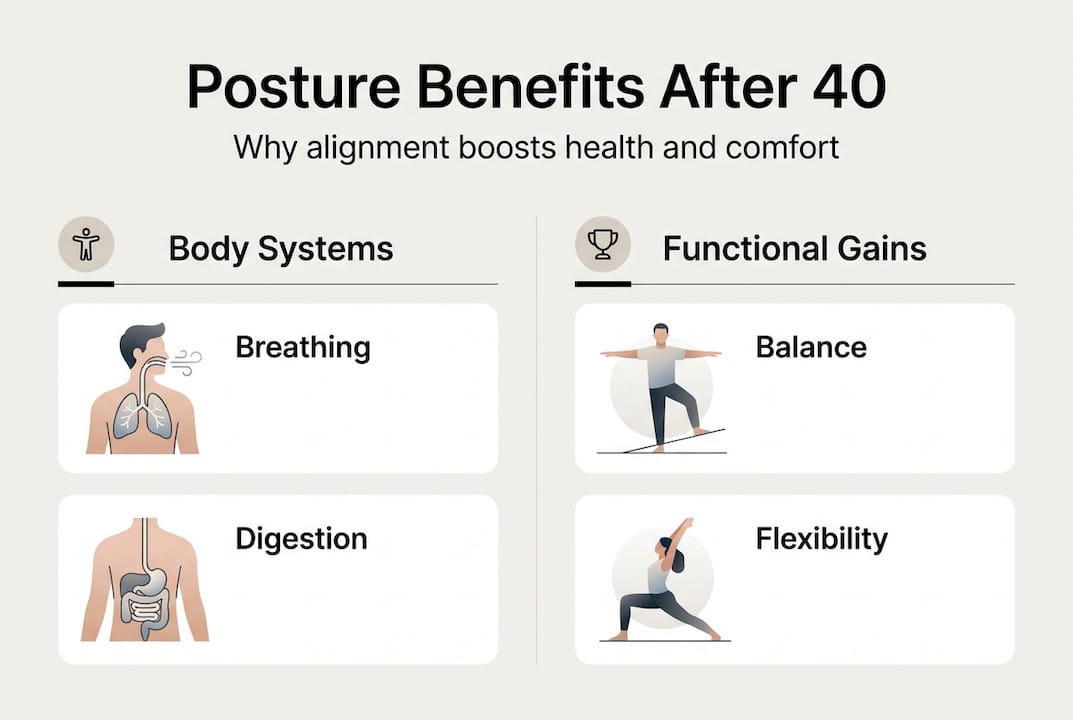
Proper alignment delivers benefits that extend far beyond standing straighter. When your spine maintains its natural curves, every system in your body functions more efficiently. Good posture reduces chronic pain, boosts breathing, improves digestion, enhances balance, increases energy, elevates mood and mental focus, and prevents nerve compression and disc herniation.

Your respiratory system thrives with proper alignment. An upright posture expands your chest cavity, allowing your lungs to fill completely with each breath. This increased oxygen intake fuels your cells, sharpening mental clarity and physical stamina. Many people report feeling more alert and energized simply by correcting their sitting and standing positions.
Digestion also improves when you sit and stand properly. Slouching compresses your abdominal organs, slowing digestive processes and contributing to discomfort. Proper posture creates space for your stomach and intestines to function optimally, reducing bloating and improving nutrient absorption.
Balance and coordination benefit dramatically from spinal alignment. Your vestibular system relies on accurate sensory input from your spine and muscles. When these structures align correctly, your brain receives clear signals about your body’s position in space. This enhanced proprioception reduces fall risk and improves movement efficiency.
The mental and emotional advantages surprise many people. Studies consistently show that upright posture correlates with improved mood, increased confidence, and better stress management. Your physical bearing influences your psychological state more than you might expect.
Key health improvements from proper posture include:
- Pain reduction: Decreased strain on muscles, joints, and ligaments throughout your body
- Enhanced breathing: Up to 30% more lung capacity compared to slouched positions
- Better circulation: Improved blood flow when vessels aren’t compressed by poor alignment
- Nerve protection: Reduced risk of impingement that causes numbness, tingling, or weakness
- Spinal health: Prevention of disc herniation and degenerative changes
The connection between posture and the dangers of sitting all day becomes clear when you consider cumulative effects. Small daily adjustments compound into significant wellness gains over weeks and months.
Pro Tip: Set hourly reminders to check your posture. This simple habit creates awareness and reinforces proper alignment throughout your day, making good posture feel increasingly natural.
Your body adapts to the positions you hold most frequently. By consistently choosing proper alignment, you train your muscles and nervous system to maintain healthy posture with less conscious effort. This adaptation transforms posture correction from a chore into an automatic wellness habit.
Effective posture correction methods supported by science
Several evidence-based techniques offer proven results for adults seeking to improve posture and reduce pain. These methods go beyond generic advice, providing structured approaches backed by clinical research.
Global Postural Re-education (GPR) focuses on treating the body as an interconnected system rather than addressing isolated symptoms. This technique uses specific stretches and breathing exercises to release muscle chains that hold poor posture in place. GPR shows medium effect on pain reduction and function improvement in spinal disorders. The method requires guidance from a trained therapist who customizes positions to your specific postural patterns.
Spiral stabilization takes a different approach by activating deep stabilizing muscles through spiral movement patterns. This technique improves the coordination between muscle groups that support your spine. Research demonstrates that spiral stabilization significantly improves posture angles in the short term. The exercises involve controlled movements that challenge your balance while reinforcing proper alignment.
The Canali Postural Method combines postural exercises with manual therapy techniques. This integrated approach addresses both muscular imbalances and joint restrictions. Studies show that the Canali Postural Method outperforms generic exercises in pain relief and reducing disability in nonspecific low back pain, with benefits sustained at three months. The method emphasizes progressive loading and functional movement patterns.
| Method | Primary focus | Key benefit | Best for |
|---|---|---|---|
| Global Postural Re-education | Muscle chain release | Pain reduction and function | Chronic spinal disorders |
| Spiral stabilization | Deep muscle activation | Improved posture angles | Balance and coordination issues |
| Canali Postural Method | Integrated exercise and manual therapy | Superior pain relief | Nonspecific low back pain |
Choosing the right method depends on your specific needs and goals. Consider these factors:
- Your primary complaint: Different methods excel at addressing specific issues like pain versus mobility
- Access to professionals: Some techniques require trained therapists while others can be self-directed
- Time commitment: Methods vary in session frequency and duration requirements
- Personal preferences: Some people prefer hands-on therapy while others favor independent exercise
The relationship between posture correction and positional therapy with wedge pillows highlights how supporting proper alignment during rest enhances correction efforts. Your body continues adapting to positions held during sleep, making nighttime positioning a valuable complement to daytime techniques.
Pro Tip: Start with a professional assessment to identify your specific postural deviations. This baseline evaluation helps you select the most appropriate correction method and track your progress objectively.
Consistency matters more than perfection. Regular practice of any evidence-based method yields better results than sporadic attempts at multiple techniques. Choose an approach that fits your lifestyle and commit to it for at least eight to twelve weeks before evaluating effectiveness.
Practical posture improvement tips for adults 40 and older
Targeted exercises strengthen the muscles that support healthy posture while releasing tight structures that pull you into misalignment. These movements require no special equipment and integrate easily into your daily routine.
Recommended exercises include scapula squeezes, rows, planks, chin tucks, and wall slides. Scapula squeezes activate the muscles between your shoulder blades, counteracting the forward shoulder roll common in desk workers. Perform them by pulling your shoulder blades together and down, holding for five seconds, and repeating 10 times.
Rows strengthen your mid-back muscles, which are essential for maintaining upright posture. You can use resistance bands, light dumbbells, or even water bottles. Focus on pulling your elbows straight back while keeping your shoulders down and away from your ears.
Planks build core stability that supports your entire spine. Start with 20 to 30 second holds and gradually increase duration as your strength improves. Proper form matters more than time, so maintain a straight line from head to heels.
Chin tucks address forward head posture by strengthening deep neck flexors. Gently draw your chin straight back, creating a double chin appearance, and hold for five seconds. This simple exercise can be done anywhere and provides immediate feedback about your head position.
Wall slides improve shoulder mobility and reinforce proper upper body alignment. Stand with your back against a wall, arms raised in a goalpost position, and slowly slide your arms up and down while maintaining contact with the wall.
Daily habits complement these exercises by reinforcing proper alignment throughout your day:
- Rolled towel support: Place a small rolled towel behind your shoulders when sitting to encourage chest opening
- Ergonomic sitting: Position your computer screen at eye level and keep your feet flat on the floor
- Movement breaks: Stand and stretch every 30 to 45 minutes to prevent postural fatigue
- Mindful standing: Distribute your weight evenly on both feet and avoid locking your knees
- Sleep positioning: Use pillows that maintain neutral spine alignment
The ergonomic design benefits extend beyond office furniture. Consider how every environment you frequent either supports or undermines your posture goals. Your car seat, favorite chair, and even your kitchen counter height all influence your alignment.
Integrating benefits of ergonomic products into your correction strategy accelerates progress. Lumbar support cushions, adjustable standing desks, and ergonomic keyboards reduce the constant strain that fights against your exercise efforts. These tools maintain proper positioning during the hours between your dedicated posture sessions.
Pro Tip: Link your posture exercises to an existing daily habit. Perform chin tucks while brewing your morning coffee or do scapula squeezes during commercial breaks. This habit stacking technique dramatically improves consistency.
A comprehensive back pain relief routine at home combines these exercises with stretching and relaxation techniques. The synergy between strengthening, stretching, and proper ergonomics creates lasting change. Most people notice improvements in comfort and energy within two to three weeks of consistent practice.
Tailor the intensity and frequency to your current fitness level. Starting too aggressively leads to soreness that discourages continuation. Begin with shorter sessions and fewer repetitions, gradually increasing as your body adapts. Quality of movement always trumps quantity.
Explore posture and recovery support products at Lunix
Your posture correction journey benefits from specialized tools designed to support alignment and accelerate recovery. Lunix creates smart recovery and comfort solutions that integrate seamlessly into your daily routine, helping your body restore proper positioning while you work, rest, and relax.

Our posture and recovery products include ergonomic supports that maintain spinal alignment during rest and activity. These tools complement your exercise routine by reinforcing proper positioning throughout the day. From lumbar cushions that support your lower back during sitting to positioning aids that optimize your sleep posture, each product addresses specific alignment needs.
The posture improvement products collection features carefully designed solutions for adults seeking wellness enhancements. Ergonomic back supports reduce strain during prolonged sitting, while positioning pillows maintain neutral spine alignment during rest. These products work synergistically with the exercises and habits outlined in this article, creating a comprehensive approach to posture correction.
Explore the full range of wellness solutions at Lunix, where thoughtful design meets deep commitment to your wellbeing. Combining quality products with consistent exercise and mindful daily habits maximizes your health benefits and accelerates your progress toward lasting comfort and improved posture.
FAQ
Is posture correction really effective after age 40?
Yes, posture correction remains highly effective for adults over 40 with appropriate routines and consistency. Evidence from studies like GPR and spiral stabilization demonstrate measurable posture and pain improvements for adults, including middle-aged groups. Your body retains the ability to adapt and strengthen supporting muscles regardless of age. While changes may occur more gradually than in younger individuals, the health benefits of improved posture, including reduced pain, better balance, and enhanced breathing, make the effort worthwhile at any age.
What daily habits help maintain good posture?
Simple posture cues integrated throughout your day create lasting alignment improvements. Daily posture cues like rolled towel behind shoulders and ergonomic sitting improve spinal alignment significantly. Set hourly reminders to check your position, ensuring your ears align over your shoulders and your shoulders over your hips. Take brief standing breaks every 30 to 45 minutes to prevent postural fatigue. When sitting, keep your feet flat on the floor and your computer screen at eye level. These small adjustments compound into significant benefits over time.
Are ergonomic products worth using for posture correction?
Ergonomic products provide valuable support for posture correction efforts when combined with exercises and mindful habits. Ergonomic products can reduce pain by 60% and boost productivity by 12%, directly supporting posture improvement goals. Lumbar cushions, adjustable desks, and positioning pillows maintain proper alignment during the many hours between dedicated exercise sessions. These tools reduce the constant strain that undermines correction efforts, allowing your body to adapt more quickly to healthier positions. Quality ergonomic products represent a worthwhile investment in your long-term wellness and comfort.
How long does it take to see posture improvement results?
Most people notice initial improvements in comfort and energy within two to three weeks of consistent practice. Visible postural changes typically emerge after six to eight weeks of regular exercise and mindful positioning. Structural adaptations in muscle length and strength continue developing for three to six months. The timeline varies based on your starting posture, consistency of practice, and the severity of existing misalignments. Patience and persistence yield the best outcomes, as rushing the process can lead to setbacks and discouragement.
Can poor posture cause permanent damage?
Prolonged poor posture can lead to structural changes that become increasingly difficult to reverse over time, though rarely truly permanent with proper intervention. Chronic misalignment may cause disc degeneration, nerve compression, and muscle imbalances that require more intensive correction efforts. However, even long-standing postural issues respond to targeted treatment combining exercises, manual therapy, and ergonomic modifications. Early intervention prevents these complications, making posture correction a worthwhile priority regardless of your current alignment. The key is starting your correction journey now rather than waiting until problems become more entrenched.