


Short at-home physical decompression sessions genuinely reduce muscle tension and speed perceptual recovery when you use the right device and protocol. You don’t need an hour or a gym. Here’s what works tonight:
- Heated air compression for hands and forearms: A session of several minutes at a warm temperature range relieves the stiffness that builds from typing and gripping all day.
- Percussion on the neck and upper back: 20–60 seconds per spot across the trapezius and shoulder muscles loosens the knots most desk workers carry home.
- A systematic review covering 2010–2025 found that combined heated compression outperformed heat or compression alone for perceived soreness and local perfusion, with protocols running 38–45 °C, 15–30 mmHg, and 5–20 minutes.
- Physical therapists recommend keeping percussion to 10–20 seconds per spot and no more than roughly 2 minutes across a large muscle, starting at low intensity.
If you can only try one device tonight, a heated air compression hand massager is the most direct match for the forearm and hand tension most adults accumulate during a workday.
Key Takeaways
Physical decompression after work, done consistently with the right device and protocol, reduces muscle tension and improves perceptual recovery within a single session.
| Point | Details |
|---|---|
| Start with 5–12 minutes | A short heated compression and percussion sequence delivers reliable relief without a long time commitment. |
| Match device to symptom | Hand massager for forearm stiffness, percussion massager for shoulder knots, wedge pillow for overnight alignment. |
| Follow safe parameters | Use 38–45 °C and 15–30 mmHg for compression; limit percussion to 10–20 seconds per spot and 2 minutes per muscle. |
| Track progress simply | A 1–10 stiffness scale before and after each session shows whether your routine is working over time. |
| Lunix for at-home use | Lunix heated compression, percussion, and orthopedic pillow devices are built for adults 40–65 seeking daily post-work relief. |
Table of Contents
- Why physical decompression changes how your body feels after work
- What the research actually says about these devices
- Which at-home device actually fits your after-work problem
- How Lunix devices fit your post-work recovery
- A practical 5–12 minute after-work routine you can start tonight
- What to look for when buying an at-home decompression device
- Safety rules and when to stop
- What relief looks like and when you’ll notice it
- Recovery routines work best when they’re built to last
- Lunix devices built for post-work recovery
- Sources
Why physical decompression changes how your body feels after work
Sitting, typing, or standing for hours creates a predictable domino effect of physical strain: blood pools in the lower legs, forearm muscles shorten and stiffen, and the upper trapezius holds chronic low-level tension that never fully releases between tasks. Physical decompression interrupts that cycle at the tissue level.
The four core mechanisms:
- Vasodilation and improved circulation: Heat raises local muscle temperature, which widens blood vessels and increases blood flow to fatigued tissue.
- Better venous return: Compression squeezes fluid back toward the heart, reducing the pooling that makes legs and forearms feel heavy by evening. Compression garments also raise local skin temperature and reduce muscle oscillation, even when systemic markers like heart rate stay unchanged.
- Reduced muscle tension: Percussion stimulates mechanoreceptors in the muscle, which interrupts the tension-pain feedback loop and increases local blood flow.
- Greater tissue extensibility: Warmed connective tissue stretches more easily, which is why a heated session before gentle mobility work feels so much more productive than cold stretching.
Common workday complaints map directly to these mechanisms. Forearm and hand stiffness responds well to heat and compression. Shoulder and upper-back tightness responds to percussion. Calf or plantar tension from standing shifts with compression and elevation.
Sessions of 5–20 minutes cover the range used across trials, and that window is practical for a busy evening.
Pro Tip: Warm the target area with heat for 3–5 minutes before adding percussion. Warmed tissue responds faster and more comfortably than cold muscle.
What the research actually says about these devices
The strongest signal in the current literature comes from a systematic review spanning 2010–2025: combined heated compression consistently produced larger short-term gains in perceived soreness, pressure-to-pain threshold, and local perfusion than either heat or compression used alone.
Key finding: Within that review, isolated trials reported effect sizes for forearm perfusion changes of d = 1.77 at 5 minutes and d = 6.37 at 10 minutes. These numbers come from small, lab-based samples and should be read as directional signals, not guarantees. The reviewers explicitly flagged small sample sizes, male-heavy cohorts, and heterogeneous devices as limits on external validity.
What the evidence supports for adults 40–65:
- Perceptual relief (reduced tightness, less soreness) within a single session is the most consistent finding.
- Percussion massage guns increase local blood flow and reduce muscle tension; short per-spot use (10–20 seconds) and movement across the muscle are the standard safety parameters.
- Orthopedic pillows support spinal alignment and reduce neck and shoulder tension during rest, which complements active device use.
- Real-world results vary. Activity level, underlying conditions, and device quality all affect outcomes.
The practical takeaway: the evidence is promising but not definitive for every body and every device. Short, consistent sessions are more likely to deliver cumulative benefit than occasional long ones.
Which at-home device actually fits your after-work problem
Different symptoms call for different tools. Here’s how the main device categories map to common post-work complaints, with the protocol parameters that matter most.
- Heated air compression hand massager (e.g., the Lunix heated air compression hand massager): targets hand, finger, and forearm stiffness from typing and gripping. Typical session: 5–20 minutes at 38–45 °C, 15–30 mmHg. Best for: anyone who types for a living or has chronic hand tension.
- Percussion massager (e.g., the Lunix percussion massager): targets muscle knots in the trapezius, shoulders, calves, and lower back. Typical session: 20–120 seconds per muscle group, 10–20 seconds per spot. Best for: upper-back tightness and localized knots.
- Infrared sauna blanket (e.g., the Lunix infrared sauna blanket): delivers full-body passive heating that raises core temperature and promotes circulation throughout. Typical session: 20–45 minutes. Best for: full-body fatigue and stress-related tension when you have more time.
- Orthopedic wedge pillow set (e.g., the Lunix orthopedic wedge pillow set): supports spinal alignment during rest and sleep, reducing overnight neck and shoulder tension. No active session required. Best for: people whose morning stiffness is as bad as their evening stiffness.
For muscle recovery after 40, pairing a heated compression device with a percussion massager covers the two most common post-work complaints efficiently.
How Lunix devices fit your post-work recovery
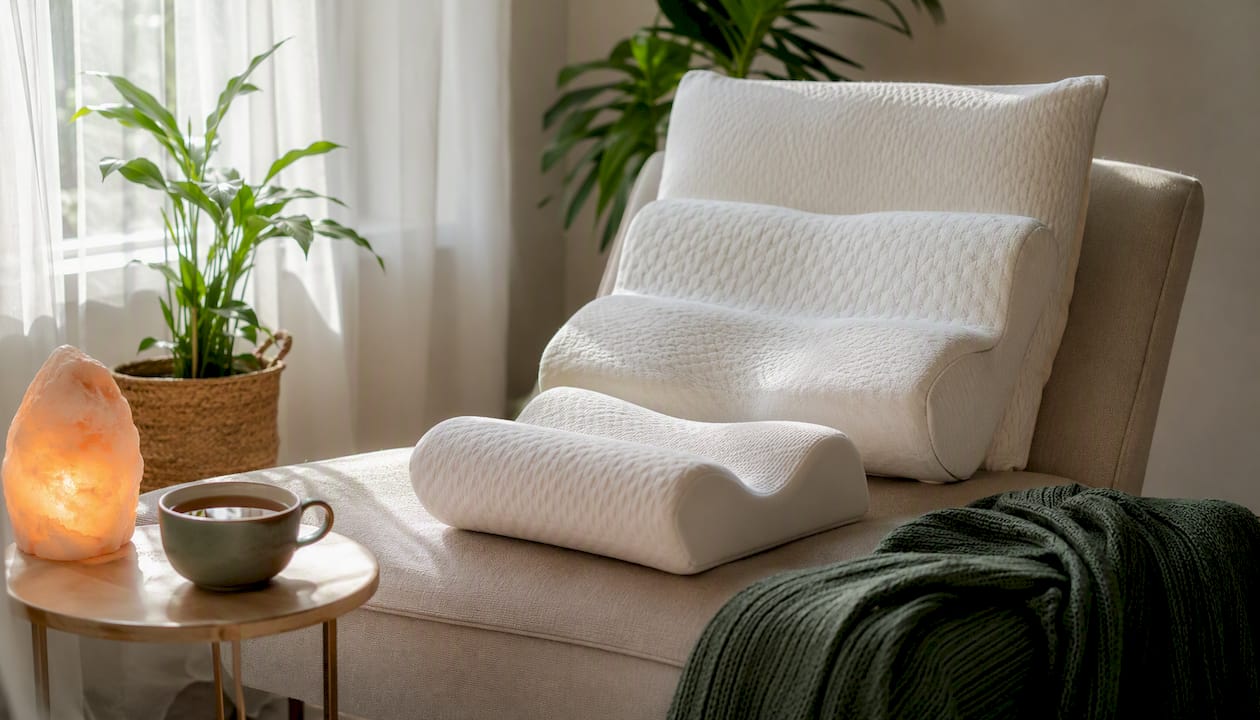
Lunix maps each device to a specific problem, which makes choosing straightforward. The heated air compression hand massager addresses hand and forearm stiffness directly. The percussion massager handles trapezius and shoulder knots. The infrared sauna blanket covers full-body fatigue. The orthopedic wedge pillow set supports overnight spinal alignment.
Features that make a real difference:
- Adjustable temperature control (38–45 °C range) so you stay within safe, effective parameters
- Multiple pressure settings (15–30 mmHg range) to match your comfort level on any given day
- Washable covers for easy hygiene and long-term use
- Touchscreen controls for simple one-handed operation when your hands are already in the device
- Safety zippers and automatic shutoffs that prevent overheating
Pro Tip: Use the heated compression hand massager for 5–10 minutes first, then follow with 1–2 minutes of percussion on any remaining shoulder or neck knots. Heat first, percussion second — that sequence gets the most from both devices.
Lunix’s educational resources on heated massage walk through device-specific protocols so you’re not guessing at settings.
A practical 5–12 minute after-work routine you can start tonight
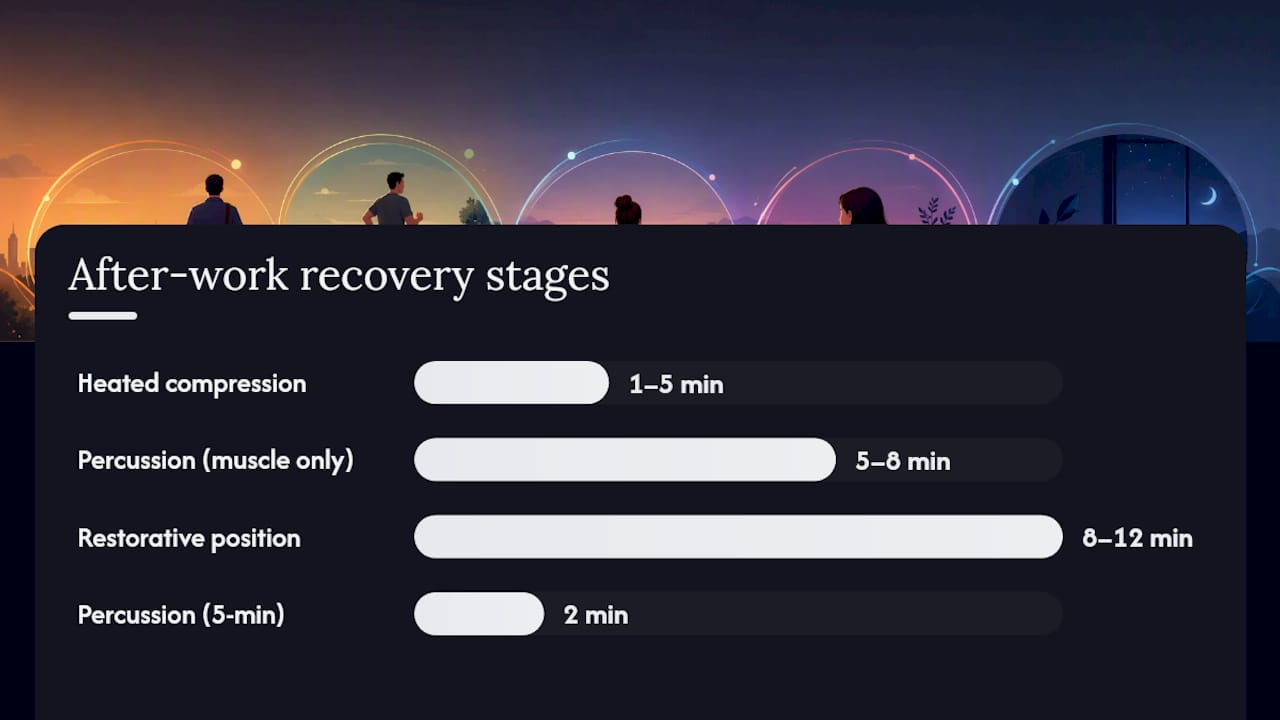
A 5–12 minute sequence mixing targeted heated compression, brief percussion, and a restorative position delivers reliable relief for most adults. Here’s how to structure it:
- Minutes 1–5: Heated compression on hands or lower legs. Slip on the hand massager or compression device and let it run at your preferred setting. Breathe normally. This is your warm-up for the tissue.
- Minutes 5–8: Percussion on traps and shoulders. Move the device slowly across the upper trapezius, spending no more than 10–20 seconds on any one spot. Physical therapists recommend keeping the device moving rather than holding it still.
- Minutes 8–12: Gentle mobility or restorative position. Neck rolls, shoulder circles, or simply lying on your orthopedic wedge pillow with your legs elevated. This is when warmed, loosened tissue responds best to movement.
For a 5-minute version: Skip step 3 and cut step 2 to 2 minutes. Use this on nights when you’re short on time but still want some relief.
For the full 12-minute version: Add a second round of heated compression on a second body area (e.g., calves after hands) before step 2.
Pro Tip: Never use a percussion device directly over a bony area or the front and sides of the neck. Stay on the muscle belly, keep the device moving, and follow the manufacturer’s time limits.
What to look for when buying an at-home decompression device
The single most important question: does this device target your primary body area and symptom? A hand massager won’t help your lower back. Start there, then check these:
- Temperature range and control: Look for adjustable settings in the 38–45 °C range with clear display readouts.
- Pressure levels: Adjustable compression (15–30 mmHg) lets you match intensity to your comfort on any day.
- Run-time and safety cutoffs: Automatic shutoffs prevent overheating during longer sessions.
- Attachments and coverage area: Percussion massagers with multiple head attachments cover more muscle groups.
- Washable covers: Non-negotiable for daily use and long-term hygiene.
- Warranty and return policy: A solid return window reduces purchase risk, especially for first-time buyers.
- Size and storage: Infrared sauna blankets need floor space; hand massagers fit in a drawer.
For adults 40–65 who prioritize safety and low-friction setup, start with a single targeted device (hand massager or percussion massager) before adding a full-body option like an infrared blanket. Simpler setups get used more consistently, and daily lifestyle habits for muscle recovery compound over time.
Safety rules and when to stop
Stop using any device and consult a clinician if you experience new or worsening pain, numbness, tingling, or skin changes during or after a session.
Clear contraindications and cautions:
- Do not use heated or compressive devices over open wounds, rashes, or active skin infections.
- Avoid hot compression devices if you have peripheral neuropathy or uncontrolled diabetes without provider clearance.
- Do not use percussion over the front or sides of the neck, directly over bones, or on acutely injured tissue.
- Limit per-spot percussion to 10–20 seconds; move the device continuously.
- For wedge pillows, clinical guidance stresses rehearsing how you get in and out of position and checking for pressure points, especially post-surgery.
A note on evidence limits: Most trials in this space used small samples, lab settings, and predominantly male cohorts. The safety and use parameters above reflect physical therapist guidance and manufacturer recommendations, not large-scale clinical trials. When in doubt, start at the lowest intensity setting and shorter session times, and escalate only when comfortable.
Signs to stop immediately: skin redness that doesn’t fade within 10 minutes, increased pain during use, or any numbness or tingling.
What relief looks like and when you’ll notice it
Many people notice reduced tightness and improved comfort within a single session. Measurable circulatory changes are typically short-term, and cumulative benefits build with consistent use.
- Within minutes: Reduced muscle tightness, improved local warmth, and a noticeable drop in perceived soreness.
- Same day: Better range of motion in the treated area and less residual tension by bedtime.
- Over days and weeks: Reduced baseline stiffness, improved sleep quality (especially with orthopedic pillow support), and possible vascular benefits with repeated compression use.
Individual results vary based on activity level, age, underlying conditions, and device quality. The review limitations noted earlier — small samples, lab settings — mean real-world outcomes may be more modest than trial effect sizes suggest.
Track your progress with a simple 1–10 stiffness scale before and after each session. If stiffness scores don’t improve after two weeks of consistent use, or if symptoms worsen, see a physical therapist or your primary care provider.
Recovery routines work best when they’re built to last
At Lunix, we see one pattern consistently: the adults who get the most from at-home decompression are the ones who keep it simple. A 5–10 minute routine with one or two devices, done most evenings, outperforms an elaborate setup that gets skipped because it takes too long. Short sessions, easy storage, washable covers — those aren’t minor conveniences. They’re the difference between a device that sits in a closet and one that actually helps you feel better week after week.
The evidence supports short, targeted sessions. Physical therapists support short, targeted sessions. And for adults 40–65 who are managing real schedules and real bodies, that’s exactly the kind of recovery that fits. If symptoms are persistent or worsening, a clinician should always be the next step.
Lunix devices built for post-work recovery
If you want a safe, straightforward way to try physical decompression at home, Lunix offers targeted devices built specifically for adults who need relief without a complicated setup.

Three devices that map directly to the most common post-work complaints:
- Lunix heated air compression hand massager for hand and forearm stiffness from typing and gripping
- Lunix percussion massager for trapezius and shoulder knots that build through the day
- Lunix orthopedic wedge pillow set for overnight spinal alignment and morning stiffness reduction
Every Lunix device comes with washable covers, adjustable settings, and safety features like automatic shutoffs. The return policy and warranty are designed to make your first purchase low-risk. Browse the full Lunix recovery collection and find the device that matches your primary symptom tonight.
Sources
- The Role of Heated Compression Therapy in Post-Exercise Recovery Across Age Groups and Sport Types
- Massage Guns: Benefits, How They Work, and How to Choose the Best One
- How to use a massage gun
- Benefits of an Orthopedic Pillow | Chiropractor Explains All
- Wedge Pillow After Surgery: 7 Essential Safety Tips