


TL;DR:
- Rest involves more than sleep; it requires addressing seven distinct types of recovery for optimal well-being. Identifying specific rest deficits and reframing rest as an energy investment help create sustainable, effective habits. Quality sleep and intentional daily practices support long-term health and sustained energy.
Most people assume feeling tired means they didn’t sleep enough. So they go to bed earlier, sleep longer, and still wake up exhausted. What is rest optimization, then? It’s the practice of intentionally restoring your energy across multiple dimensions of life, not just physical sleep. If you’ve been running on empty despite what looks like a decent night’s rest, you’re probably missing several key types of recovery your body and mind are quietly asking for. This article breaks down exactly what rest optimization means, how it works, and how you can start applying it today.
Table of Contents
- Key takeaways
- Understanding the seven types of rest
- The role of sleep in rest optimization
- Practical ways to integrate varied rest daily
- Common challenges in rest optimization
- My perspective on what most people miss
- How Lunixinc supports your rest and recovery
- FAQ
Key takeaways
| Point | Details |
|---|---|
| Rest goes beyond sleep | True recovery requires seven types of rest that target mental, emotional, sensory, social, creative, and spiritual depletion. |
| Sleep quality beats quantity | Consistent sleep cycles and wind-down routines matter more than simply logging more hours in bed. |
| Identify your deficit first | Pinpointing which type of rest you’re lacking allows you to make targeted changes with less overall effort. |
| Reframe rest as investment | Viewing rest as energy replenishment, not idle time, increases your consistency and reduces guilt. |
| Environment and tools help | Supportive recovery tools and intentional habits make all seven rest types easier to access daily. |
Understanding the seven types of rest
The American Psychological Association identifies seven distinct types of rest, each one addressing a different source of depletion. Sleep covers only one of them. Here’s what each type actually means for your day-to-day life.
- Physical rest covers both passive recovery (sleep, lying down) and active recovery (gentle stretching, walking, massage). Your muscles and nervous system need this to repair and reset.
- Mental rest means quieting the nonstop mental chatter. If you can’t stop replaying your to-do list at 2 a.m., you’re carrying a mental rest deficit. Breaks every 90 minutes, journaling, or even a short meditation practice can bring real relief.
- Emotional rest is about being able to express how you genuinely feel without filtering it for someone else’s comfort. Constant emotional labor drains you even when you’re not physically active.
- Sensory rest addresses the cumulative weight of screens, background noise, artificial light, and nonstop notifications. Your nervous system absorbs all of it, and it needs a break.
- Creative rest replenishes your sense of wonder. Exposure to beauty, whether it’s art, music, or time outdoors, reawakens the part of your brain that solves problems and generates ideas.
- Social rest recognizes that not all social time restores you. Time with people who drain your energy creates a deficit; time with people who feel easy and genuine fills you back up.
- Spiritual rest is the experience of feeling connected to something larger than yourself, whether through community, purpose, faith, or meaningful work.
Harvard Health confirms that mental rest is essential alongside physical recovery, and that most adults neglect it entirely. Persistent brain fog, emotional reactivity, and creative blocks are often signs of deficit in one or more of these categories, not a sign that you need more sleep.
Pro Tip: Take one week to note how you feel after different activities. If you regularly feel depleted after social events, journaling time, or work calls, you’ve just identified your most urgent rest deficits.
The role of sleep in rest optimization
Sleep is the foundation of physical rest, but it’s not a cure-all. Adults need 7 to 9 hours of sleep per night, yet nearly 3 in 10 Americans report regularly falling short of that. And a growing number of those who hit the number still don’t feel restored.
Why? Because sleep quality and cycle consistency determine how much repair actually happens. Your brain cycles through light sleep, deep sleep, and REM sleep throughout the night. Disrupting those cycles, whether through stress, alcohol, or irregular bedtimes, shortens the phases where the most critical recovery happens.
| Sleep factor | Low quality impact | High quality impact |
|---|---|---|
| Total hours | 5 to 6 hours, impairs focus | 7 to 9 hours, supports recovery |
| Sleep cycle consistency | Interrupted, fragmented repair | Uninterrupted cycles, full restoration |
| Wind-down routine | None, high cortisol at bedtime | Consistent, lower cortisol, faster sleep onset |
| Screen exposure before bed | Suppresses melatonin, delays sleep | Avoided, natural melatonin release |
APA research shows that sleep continuity and wind-down habits carry more weight than total time in bed. Here are four practical steps to improve your sleep quality starting tonight.
- Set a consistent bedtime and wake time, even on weekends. Your circadian rhythm responds to regularity more than any supplement or sleep aid.
- Begin a wind-down routine 30 to 60 minutes before bed. Dim the lights, put your phone face-down, and do something quiet. You can find a detailed bedtime routine framework that makes this easier to build.
- Keep your bedroom cool, dark, and quiet. Your body temperature drops during deep sleep, and a cooler room supports that shift.
- Avoid alcohol, heavy meals, and intense exercise within two to three hours of bedtime. Each one disrupts your deeper sleep stages even if you fall asleep easily.
Pro Tip: If you wake up at the same time each night, it often signals stress hormones spiking during a light sleep phase. A brief journaling session before bed can clear the mental load that triggers this pattern.
Psychology Today notes that consistent sleep habits tied to bedtime rituals and device-free periods improve both performance and well-being significantly over time.
Practical ways to integrate varied rest daily
Knowing the seven rest types is useful. Knowing how to fit them into a real, busy life is what actually changes things. The most effective approach starts with identifying your specific deficit rather than trying to overhaul everything at once.

Start by asking yourself a few honest questions. Do you feel mentally scattered even after a full night’s sleep? That points to mental or sensory rest. Do you feel emotionally flat or resentful? Look at emotional and social rest. Do you lack motivation or feel disconnected from your work? Creative and spiritual rest are likely low.
Once you know your deficit, you can make targeted changes. Here’s how different rest types fit into a realistic daily routine.
- Mental rest: Take two to three short breaks during the workday where you do nothing purposeful. No scrolling, no podcasts. Just a few minutes of quiet or a short walk without a destination.
- Sensory rest: Create at least one daily period free from screens and background noise. Even 20 minutes of silence meaningfully lowers your nervous system’s stress load.
- Emotional rest: Practice saying what you actually think in low-stakes conversations. Small acts of honesty reduce the cumulative weight of emotional filtering. You can explore step-by-step relaxation techniques that pair well with emotional decompression.
- Creative rest: Spend time weekly in spaces that feel beautiful or inspiring to you. This doesn’t require a trip to a museum. A park, a favorite playlist, or cooking a meal you enjoy counts.
- Social rest: Identify who in your life genuinely restores you versus who consistently drains you. Protect more time for the first group.
- Spiritual rest: Connect to a sense of purpose regularly. Volunteer work, faith communities, or simply reflecting on what your daily efforts contribute to can fill this.
Reframing rest as an energy investment rather than a productivity loss is the behavioral shift that makes all of this stick. When you see rest as something you earn back energy from, rather than something you’re giving time to, resistance drops and consistency grows.
Pro Tip: Block “recovery time” in your calendar the same way you’d block a meeting. Label it whatever feels right to you, but treat it as non-negotiable. Adults 40 and above will find these restorative daily habits especially useful for building that structure.
Common challenges in rest optimization
Most people don’t fail at rest because they’re lazy or undisciplined. They fail because of a few deeply rooted misconceptions.
The most common trap is confusing quantity for quality. If you slept eight hours but spent the last two hours before bed doom-scrolling, you likely disrupted your melatonin release and shortened your deep sleep. Eight hours of fragmented, cortisol-elevated sleep delivers far less restoration than six hours of clean, well-prepared sleep.
A second barrier is tying rest to productivity. Many adults feel legitimate guilt for resting because they associate it with falling behind. Research is clear that viewing rest as self-care prevents the psychological resistance that makes rest feel pressurized and counterproductive. Rest isn’t earned through exhaustion. It’s how you maintain the capacity to do good work.
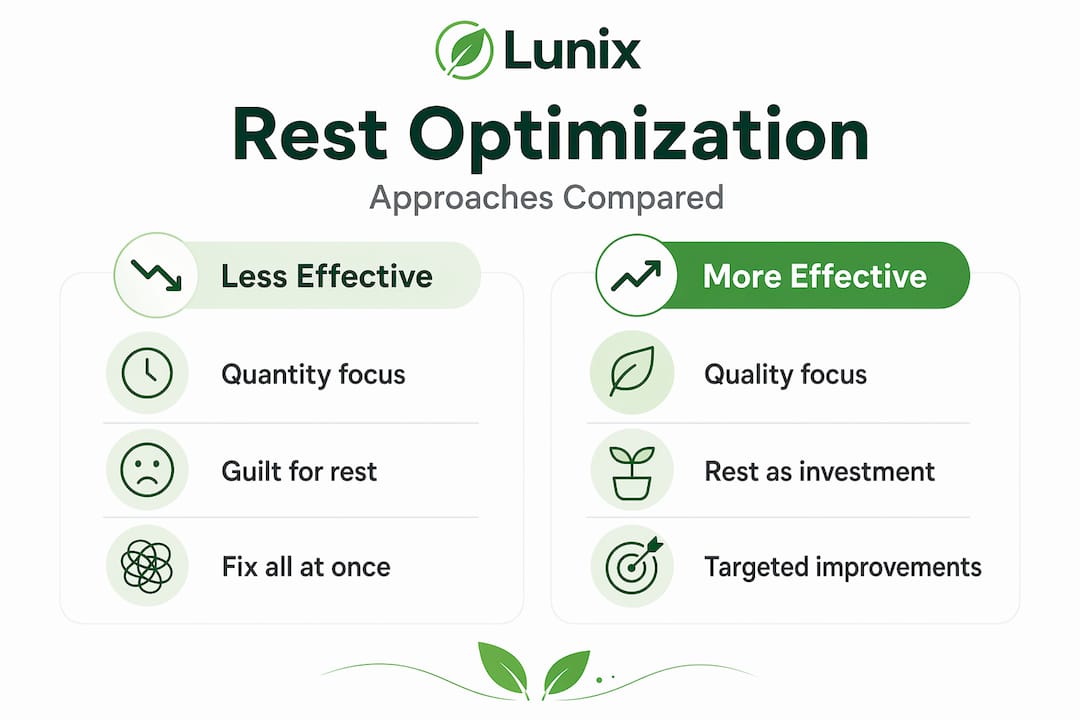
Here’s a quick comparison of less effective versus more effective approaches to common rest challenges.
| Challenge | Less effective approach | More effective approach |
|---|---|---|
| Persistent fatigue despite sleep | Sleep more hours | Identify which rest type is deficient |
| Difficulty switching off mentally | Watch TV until tired | Journaling or quiet wind-down routine |
| Low motivation and creativity | Push through with caffeine | Schedule creative and spiritual rest weekly |
| Social exhaustion | Avoid all social events | Curate time with restorative people only |
A third challenge is trying to fix everything at once. Rest optimization done well is targeted. The most efficient improvements come from identifying your primary deficit and addressing it first. Small, precise changes beat sweeping lifestyle overhauls that rarely last.
Finally, monitor your progress honestly. Track energy levels, mood, focus, and physical tension across two to three weeks as you experiment. If a specific change consistently improves how you feel, it’s working. If it doesn’t, look at a different rest category.
My perspective on what most people miss
I’ve watched a lot of well-meaning people follow the standard advice about rest and still feel chronically tired. More hours in bed. Earlier bedtimes. Weekend sleep-ins. None of it solved the problem because they were treating a seven-layer issue with a one-layer solution.
What I’ve learned is that the moment someone identifies their actual rest deficit, something shifts. Not just in their habits, but in how they relate to tiredness. They stop blaming themselves for a lack of willpower and start treating fatigue as useful data. That change alone removes an enormous amount of unnecessary stress.
I’ve also found that emotional and social rest are the most underestimated categories, especially for adults in their 40s and 50s managing careers, family, and community responsibilities. Sensory rest is a close third. Most people in this group are stimulated from the moment they wake up until the moment they fall asleep, and they genuinely do not recognize that relentless sensory input as a form of depletion.
My honest take is this: rest optimization is not a productivity hack. It’s a long-term health practice. The people who treat it that way are the ones who actually feel better six months from now. Start where you are, identify your biggest deficit, and give that one area consistent, patient attention. The return is real, and it compounds over time.
— Lunix
How Lunixinc supports your rest and recovery

At Lunixinc, we’ve built our recovery collection around one idea: your body and mind both need the right environment to truly restore. Whether you’re addressing physical tension after a long day or building the kind of structured wind-down routine that actually improves your sleep quality, having the right support makes the process easier and more consistent.
Our recovery solutions are designed for people who take their well-being seriously. From products that ease physical tension to resources that guide you through relaxation techniques, we’ve created a space where rest optimization becomes part of your daily life, not a separate project you have to find energy for. If you’re ready to move beyond generic rest advice and start recovering with intention, Lunixinc is here to support that next step.
FAQ
What is rest optimization exactly?
Rest optimization is the practice of intentionally meeting your body and mind’s recovery needs across multiple types of rest, not just sleep. It involves identifying deficits in physical, mental, emotional, sensory, creative, social, and spiritual rest and addressing them with specific habits.
How many hours of sleep do adults actually need?
Most healthy adults need 7 to 9 hours of sleep per night. However, sleep quality and cycle consistency matter as much as total duration.
Why do I still feel tired after a full night of sleep?
Tiredness after adequate sleep usually signals a deficit in one of the other six rest types, such as mental, emotional, or sensory rest. Sleep alone may not resolve all fatigue when other recovery needs remain unmet.
What is the fastest way to identify my rest deficit?
Notice how you feel after different activities across a week. Persistent brain fog points to mental or sensory rest gaps; emotional flatness suggests emotional rest needs; low creativity often reflects depleted creative or spiritual rest.
How do I make rest a consistent habit without guilt?
Reframe rest as energy replenishment rather than lost time. Research shows that viewing rest as self-care reduces psychological resistance and makes consistent rest habits easier to maintain long term.