


TL;DR:
- Your mental and physical states are in constant bidirectional communication, influencing each other’s functioning. Scientific research shows that practices like mindfulness, movement, and breathing can measurably improve stress, mood, and health in daily life. Building consistent habits that engage both mind and body enhances resilience and overall well-being, regardless of clinical diagnoses.
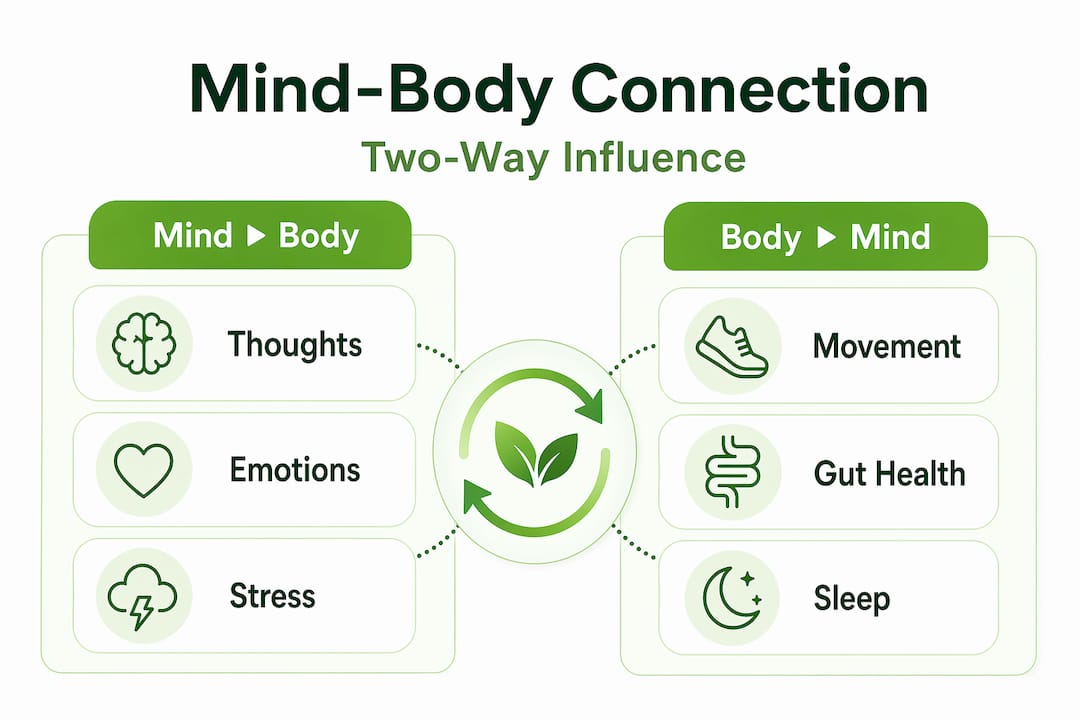
Your mind and body are not running parallel tracks. They are in constant conversation, and what is mind-body connection is one of the most practical things you can understand for your own health. Chronic stress tightens your shoulders. Grief slows your digestion. A burst of joy lifts your blood pressure, briefly, in a good way. That two-way traffic between your thoughts, emotions, and physical state is not metaphorical. It is measurable, well-researched, and highly relevant to how you feel day to day.
Table of Contents
- Key Takeaways
- What the mind-body connection actually is
- What the research actually shows
- The bidirectionality that most people miss
- Practical ways to strengthen your mind-body connection
- Common myths that hold people back
- My perspective on mind-body wellness
- Support your mind-body balance with the right recovery tools
- FAQ
Key Takeaways
| Point | Details |
|---|---|
| Mind and body are bidirectional | Mental states drive physical changes, and physical states shape your emotions and stress levels. |
| Science backs the connection | Mindfulness-based practices reduce perceived stress with measurable effect sizes in rigorous clinical studies. |
| Bidirectionality changes your approach | You can start with the mind or the body — both directions create real, reinforcing improvements. |
| Myths block progress | Mind-body connection is not “positive thinking.” It is a scientifically measurable process with clear mechanisms. |
| Small practices compound over time | Consistent breathing, movement, and sleep habits build resilience and improve quality of life meaningfully. |
What the mind-body connection actually is
The mind-body connection is the bidirectional relationship between your mental and emotional states and your physical body. When one shifts, the other responds. That is not philosophy. It is physiology.
Think of the gut-brain axis as one of the clearest examples. Your gut contains roughly 500 million nerve cells, and it communicates directly with your brain through the vagus nerve. This is why anxiety literally makes your stomach turn. It is also why a good meal can lift your mood. The relationship runs both ways.
The American Psychological Association uses the term psychosomatic to describe how psychological factors produce or influence physical symptoms. Tension headaches, stress-related skin flares, and fatigue from unresolved grief are all examples of this in everyday life. These are not imagined symptoms. They are real physical responses to mental states.
Here is what makes this personally relevant to you:
- Stress and immune function: Prolonged stress suppresses immune activity, which makes you more vulnerable to illness.
- Emotional states and cardiovascular health: Chronic negative emotions like anxiety and depression are linked to heart disease and high blood pressure.
- Physical pain and mental outlook: Persistent pain affects mood and motivation, while depression can lower your tolerance for physical discomfort.
- Sleep and mental clarity: Poor sleep degrades emotional regulation, and emotional turmoil disrupts sleep, creating a cycle that compounds over time.
“The mind and body are not separate. What affects one, affects the other.” — American Psychological Foundation
Understanding this changes how you approach your own health. It means that managing stress is not a luxury. It is foundational maintenance for your body.
What the research actually shows
The scientific evidence for mind-body synergy has strengthened considerably in recent years. A 2026 meta-analysis of 17 randomized controlled trials found that mindfulness-based interventions reduced perceived stress in non-clinical adults with an effect size of SMD = −0.53 post-intervention. That is a clinically meaningful reduction, achieved without medication and in people who had no formal diagnosis.
A separate 2026 randomized controlled trial on adults with generalized anxiety disorder found that an 8-week mindfulness program reduced anxiety severity, improved sleep quality, and enhanced cognitive function. These were not soft outcomes. They were measured using validated clinical tools.
The neuroscience adds another layer. Mindfulness training produces neuroplastic changes in the prefrontal cortex and amygdala, the brain regions responsible for emotional regulation and fear response. In plain terms, regular mind-body practice physically rewires the parts of your brain that control how you respond to stress.
| Practice | Primary benefit | Supporting evidence |
|---|---|---|
| Mindfulness meditation | Reduces perceived stress | Meta-analysis, SMD = −0.53 |
| 8-week mindfulness program | Lowers anxiety, improves sleep | RCT in generalized anxiety disorder |
| Physical movement | Regulates mood, calms nervous system | Endorphin and autonomic regulation research |
| Breathing techniques | Activates parasympathetic response | Vagal tone and HRV studies |
The APA’s stress and health research reinforces this picture. Psychological stress operates through biopsychosocial pathways that affect cardiovascular risk, sleep quality, and long-term mental health. Stress is not just a feeling. It is a physiological process with measurable downstream effects on your body.
Pro Tip: You do not need a clinical diagnosis to benefit from mind-body practices. Research confirms these approaches work in everyday, non-clinical adults. Starting small, even 10 minutes of mindful breathing daily, produces measurable results over weeks.
The bidirectionality that most people miss
Most people think of the mind-body relationship as one-directional. Stress makes you sick. End of story. But the more accurate picture is a feedback loop, and understanding that loop changes what you do about it.

Here is what bidirectionality means in practice. When you start a relaxation practice, the physical relaxation in your muscles sends calming signals to your brain. Your nervous system shifts toward its parasympathetic mode, and anxiety decreases. You started with the body, and the mind followed. The reverse is equally true. When you reframe a stressful thought in therapy or journaling, your cortisol levels drop and your muscles physically soften.
Multi-outcome research measures both psychological and physical improvements simultaneously to capture this feedback loop accurately. What this tells us is that the benefits of mind-body practices are not linear. They are compounding. Progress in one area accelerates progress in the other.
Some important nuances to hold onto:
- Starting from either direction works. Yoga addresses the body first. Cognitive reframing addresses the mind first. Both produce results on both sides.
- The feedback loop means small wins matter more than you think. A single good night of sleep improves emotional regulation the next day, which reduces stress, which improves the next night’s sleep.
- Measuring only mental OR only physical outcomes misses the full picture. Truly holistic health approaches track both simultaneously.
- Resilience is built at the intersection. People who actively cultivate both mental and physical health recover faster from illness, stress, and loss.
Pro Tip: When you are feeling emotionally stuck, try changing something physical first. A short walk, a cold splash of water on your face, or five slow belly breaths can shift your mental state faster than trying to think your way through it.
Practical ways to strengthen your mind-body connection
Building a stronger mind-body connection does not require a dramatic lifestyle overhaul. The research consistently points to consistent, moderate practices that fit into real life. Here are specific approaches organized from simplest to more involved:
-
Diaphragmatic breathing. Slow, belly-focused breathing activates the vagus nerve and shifts your nervous system toward calm. Try four counts in, hold for four, six counts out. Do this for five minutes before a stressful meeting or after a tense conversation.
-
Mindful movement. Walking, yoga, and dancing release mood-regulating endorphins and calm your nervous system. The key word is mindful. Pay attention to how your body feels while you move, rather than distracting yourself from it. Even a 20-minute walk done with full attention is a mind-body practice.
-
Body scan meditation. Lie down and mentally move through each part of your body from feet to head, noticing tension without judgment. This practice builds the kind of body awareness that helps you catch stress before it becomes a physical problem. Explore mindfulness meditation techniques to find the format that suits you best.
-
Sleep as a recovery practice. Sleep is not passive. It is when your brain processes emotional memories, regulates cortisol, and repairs tissue. Prioritizing 7 to 9 hours is one of the most direct investments you can make in mind-body wellness.
-
Journaling and emotional processing. Writing about stressful experiences for 15 to 20 minutes has been shown in multiple studies to reduce physiological stress markers. It is a low-barrier way to process the mental side of the loop.
-
Structured stress management. For adults navigating work pressure, family demands, and the physical changes that come with aging, a step-by-step stress management approach that integrates mind and body strategies produces more durable results than either approach alone.
None of these require special equipment or large time blocks. What they require is consistency and genuine attention to how your mind and body are speaking to each other.
Common myths that hold people back
A few misconceptions about mind-body connection are worth addressing directly, because they often stop people from engaging with these practices at all.
- “It’s just positive thinking.” The mind-body connection is not about forcing cheerful thoughts. It is a physiological process involving hormones, nerve signals, and measurable brain activity. Positive thinking is one small piece of a much larger and more concrete mechanism.
- “It’s not scientific.” The research base is now substantial. Meta-analyses, randomized controlled trials, and neuroimaging studies confirm the mechanisms and outcomes. This is not alternative medicine. It is evidence-based wellness.
- “It can replace medical treatment.” Mind-body practices complement medical care. They are not replacements. If you have a chronic condition, work with your doctor while also building these habits.
- “It works quickly.” Neuroplastic changes and physiological recalibration take weeks to months of consistent practice. Expecting fast fixes sets you up for disappointment. Expecting gradual, compounding change sets you up for success.
- “You need to be mentally unwell to benefit.” Mindfulness approaches are effective for non-clinical adults managing ordinary stress. You do not need a diagnosis. You need consistency.
My perspective on mind-body wellness
I’ve spent years working at the intersection of recovery, comfort, and well-being, and the clearest thing I’ve learned is this: most people treat their bodies as separate from their mental state, and that separation costs them.
I’ve seen people invest heavily in physical recovery, better mattresses, ergonomic supports, movement routines, while completely ignoring the emotional and mental loops driving their tension and poor sleep. The body work helps. But it works so much better when the mind is also part of the equation.
What I’ve found actually works is not dramatic. It is paying attention. When you start noticing that your shoulders tense when you open certain emails, or that your sleep worsens during high-stress weeks, you gain something more useful than any single remedy: a personal early warning system. The mind-body connection is not a concept to believe in. It is a feedback system to read and respond to.
My honest take is that the people who improve their health most consistently are the ones who approach it as an integrated system. They do not just fix their sleep OR manage their stress OR improve their nutrition. They work all channels, understanding that each one reinforces the others. Start with one practice. Be patient. And trust that the body responds to genuine attention over time.
— Lunix
Support your mind-body balance with the right recovery tools

Building a stronger mind-body connection starts with giving your body the environment it needs to restore and relax. At Lunixinc, our recovery solutions are designed to support exactly that. When your body recovers well, your mind follows. Better sleep, reduced physical tension, and genuine rest create the foundation for every mind-body practice you build on top of them. If you are ready to explore what that looks like in your own space, browse our self-care tips or visit our recovery collection to find tools that fit your lifestyle and well-being goals.
FAQ
What is the mind-body connection in simple terms?
The mind-body connection is the two-way relationship between your thoughts and emotions and your physical health. Mental states trigger physical responses, and physical states influence how you think and feel.
How does the mind-body connection affect physical health?
Chronic stress and negative emotions disrupt sleep and immune function, and are linked to cardiovascular risk. The biopsychosocial pathway means psychological stress has direct, measurable consequences for your body.
What are the best exercises for mind-body connection?
Mindful movement practices like yoga, walking with focused attention, and diaphragmatic breathing are among the most well-researched. They engage both the nervous system and mental attention simultaneously, producing benefits on both sides.
How long does it take to see benefits?
Research shows measurable changes in stress and anxiety within 8 weeks of consistent practice. Neuroplastic changes in the brain develop gradually with regular engagement rather than intense short-term effort.
Does mind-body connection work for people without a health diagnosis?
Yes. Meta-analyses confirm that mindfulness-based practices reduce stress meaningfully in non-clinical adults. You do not need a diagnosis to benefit from building a stronger mind-body relationship.