


TL;DR:
- Targeted stretching, self-massage, and heat or ice therapy are quick, effective methods to relieve muscle tension without needing a gym or prescription. Combining these techniques with light movement and relaxation exercises can improve recovery, especially after age 40 when muscle stiffness and slower circulation become common.
Six evidence-backed muscle tension relief examples you can start right now: targeted stretching, self-massage with a foam roller or massage stick, progressive muscle relaxation (PMR), heat or ice therapy, light movement, and vibration therapy. Each takes under 20 minutes and works without a gym or a prescription.
Quick-start list with timing:
- Stretching (neck, shoulders, hips): hold 20–30 seconds per stretch, 2–3 rounds. Best for chronic stiffness and posture-related tightness.
- Self-massage (foam roller or massage stick): 60–90 seconds per muscle group. Works well for post-workout soreness and daily desk tension.
- PMR (progressive muscle relaxation): 10–15 minutes, tense 5 seconds, release 10–30 seconds. Best for stress-driven tension and sleep trouble.
- Ice therapy: 15–20 minutes, first 24–72 hours after an acute injury. This limits inflammation.
- Heat therapy: 15–20 minutes after the acute window closes. Increases circulation and eases chronic stiffness.
- Light movement (walking, gentle cycling): 10–20 minutes the day after intense activity. Speeds recovery better than complete rest.
Table of Contents
- Why does muscle tension build up after 40?
- What does the research say about which methods work best?
- Step-by-step stretches for neck, shoulders, back, and hips
- Mobility and light-strength exercises that prevent tension from returning
- How to do progressive muscle relaxation (PMR) tonight
- Safe tool use for adults 40–65: foam rollers, percussion devices, and heat or ice
- Three timed routines you can start today
- When should you see a clinician instead of treating at home?
- Key Takeaways
- What Lunixinc actually believes about recovery tools
- Lunixinc recovery tools built for the techniques in this article
- Useful sources and further reading
Why does muscle tension build up after 40?
After 40, muscle elasticity naturally decreases and circulation slows, which means tension accumulates faster and clears more slowly than it did in your 30s. Add in long hours at a desk, stress that never fully switches off, and the occasional hard workout, and you have a reliable recipe for tight shoulders, a stiff lower back, and hips that protest every morning.
The main drivers:
- Overuse and repetitive strain: Holding the same posture for hours shortens muscles and restricts blood flow.
- Chronic stress: Sustained stress keeps muscles in a low-grade state of contraction, a domino effect of physical strain that compounds over days.
- Age-related changes: Reduced collagen and slower muscle protein turnover mean recovery from both exercise and daily tension takes longer.
- Deconditioning: Weaker postural muscles force surrounding tissues to compensate, creating secondary tension hotspots.
There are two distinct timelines to keep in mind. Immediate tension from a stressful day or a long drive responds quickly to stretching, PMR, or heat. Delayed-onset muscle soreness (DOMS) after exercise peaks at 24–72 hours and calls for a different approach: light movement and self-massage rather than complete rest.
What does the research say about which methods work best?
A randomized controlled trial published in Frontiers in Physiology compared several post-exercise recovery methods head-to-head. The findings give you a clear map for matching method to goal.
| Goal | Best Method | Runner-Up |
|---|---|---|
| Reduce inflammation (IL-6, CK) | Massage therapy | Cold-water immersion |
| Ease muscle stiffness and soreness | Massage therapy | Static stretching |
| Improve muscle reaction latency | Vibration therapy | Massage therapy |
| Increase range of motion | Static stretching | Massage therapy |
Cold-water immersion suppresses early inflammatory responses effectively, but may have drawbacks for long-term metabolic clearance if used indiscriminately. For most adults 40–65, massage and stretching are safer first choices, with vibration devices a strong add-on for neuromuscular recovery. Functional electrical stimulation (FES) also showed benefits in the trial but requires clinician guidance and is not a home self-care option.
Key finding: Researchers stress there is no single cure. The best results come from combining targeted methods: massage for inflammation, vibration for neuromuscular response, and static stretching for range of motion.
Pro Tip: Rotate two or three methods across a week rather than relying on one. Massage on day one, light stretching on day two, and a vibration session on day three gives your body varied recovery signals and prevents adaptation.
Step-by-step stretches for neck, shoulders, back, and hips
These six stretches cover the tension hotspots most common in adults 40–65. Move slowly, breathe through each hold, and stop immediately if you feel sharp or shooting pain.
- Neck side tilt: Sit tall, drop your right ear toward your right shoulder. Hold 20–30 seconds. Switch sides. Repeat twice. Modification: place one hand on the opposite shoulder for a gentle anchor.
- Doorway pec stretch: Stand in a doorway, arms at 90 degrees on the frame, step one foot forward until you feel a stretch across your chest. Hold 20–30 seconds, twice per side. Modification: lower your arms to 45 degrees if shoulders are sensitive.
- Cat-cow for upper back: On hands and knees, arch your back up (cat), then let it sag (cow). Move slowly for 10 cycles. Modification: do this seated in a chair, rounding and extending your spine.
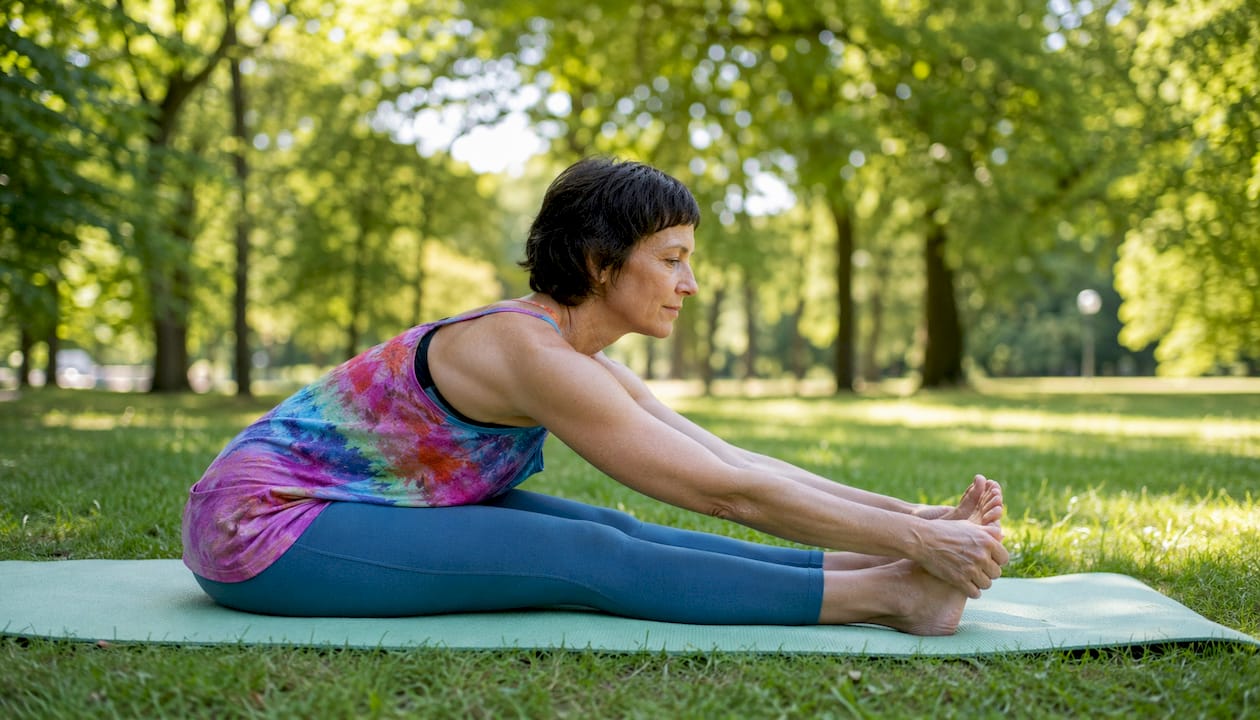
- Seated hamstring stretch with strap: Sit on the floor, loop a strap or towel around one foot, straighten the leg, and hold 20–30 seconds. Switch sides. Modification: keep a slight bend in the knee.
- Figure-4 hip stretch: Lie on your back, cross one ankle over the opposite knee, flex the foot, and gently press the crossed knee away. Hold 30 seconds per side. Modification: do this seated in a chair, crossing one ankle over the opposite thigh.
- Child’s pose for low back: Kneel, sit back toward your heels, and reach your arms forward on the floor. Hold 30–60 seconds. Modification: place a pillow between your thighs and calves for support.
For a deeper look at natural tension relief methods, Lunixinc has a full step-by-step guide worth bookmarking.
Mobility and light-strength exercises that prevent tension from returning
Stretching releases tension in the moment. These moves build the postural strength that keeps it from coming back.
Mobility moves (daily, no equipment needed):
- Thoracic rotations: Sit in a chair, cross your arms over your chest, rotate your upper body left and right 10 times per side.
- Hip hinges: Stand with feet hip-width apart, hinge forward at the hips (soft knees), return to standing. 2 sets of 10.
- Ankle circles: Seated, lift one foot and circle the ankle 10 times each direction. Helps lower-leg circulation.
Gentle strengthening (3 days per week):
- Band pull-aparts: Hold a light resistance band at shoulder height, pull it apart until arms are wide. 2 sets of 15.
- Scapular squeezes: Sit or stand, squeeze your shoulder blades together and hold 5 seconds. 2 sets of 12.
- Glute bridges: Lie on your back, knees bent, press through your heels to lift your hips. Hold 2 seconds at the top. 2 sets of 12.
Progress from bodyweight to a light resistance band when 2 sets of 15 feel easy. These exercises target the postural muscles that, when weak, force your neck and upper back to carry extra load all day. Recovery between training sessions benefits from physiotherapy-informed strategies that balance load and rest intelligently.
How to do progressive muscle relaxation (PMR) tonight
PMR is more than a relaxation exercise. With regular practice, you learn to detect early tension and cue your body to release it before it escalates into chronic pain, which is why Harvard Health and the VA both recommend it as a training tool, not just a one-time fix.
Standard PMR script (10–15 minutes):
- Lie down or sit comfortably. Close your eyes and take three slow breaths.
- Feet: Curl your toes downward, hold 5 seconds, release completely for 10–30 seconds. Notice the difference.
- Calves: Pull your toes toward you to tighten your calves, hold 5 seconds, release 10–30 seconds.
- Thighs and hips: Squeeze your thighs together, hold 5 seconds, release.
- Stomach and chest: Suck in your stomach and take a deep breath to tighten your chest, hold 5 seconds, release.
- Shoulders: Shrug them up toward your ears, hold 5 seconds, release and feel them drop.
- Hands and arms: Clench both fists and tighten your biceps, hold 5 seconds, release.
- Face: Squeeze your eyes shut and clench your jaw gently, hold 5 seconds, release.
The PMR protocol uses a tense-for-5-seconds, release-for-10–30-seconds sequence throughout. After a few weeks of practice, you can shift to a “release-only” version, skipping the tensing step entirely, which works just as well and suits readers with joint sensitivity or limited mobility. For a guided audio walkthrough, Lunixinc’s relaxation techniques guide walks you through the full sequence.
Safe tool use for adults 40–65: foam rollers, percussion devices, and heat or ice
Self-massage tools let you control exactly how much pressure you apply, which matters when professional deep-tissue work feels too intense on sore muscles.
Tool guidance:
- Foam roller: Roll slowly over the target muscle (not the joint), pausing on tender spots for 20–30 seconds. Avoid rolling directly on the spine.
- Massage stick: Use light-to-moderate pressure along the muscle belly. Good for calves, quads, and IT band.
- Percussion/vibration devices: Keep sessions to 60–90 seconds per muscle group. Vibration therapy is particularly effective for improving muscle reaction latency. Avoid bony areas, varicose veins, and inflamed tissue.
Heat vs. ice timing:
- Ice: Apply for 15–20 minutes within the first 24–72 hours after an acute injury to limit swelling and inflammation.
- Heat: Use after the acute window closes, or for chronic stiffness and general tightness. A warm bath, heating pad, or heated wrap all work.
Safety warning: Do not combine menthol-based topical creams (like Biofreeze or IcyHot) with an external heat source. Topical menthol plus heat can cause skin irritation or burns. Apply one or the other, not both at the same time.
Stop and consult a clinician if you: take blood thinners, have neuropathy or diabetes affecting sensation, or notice open wounds or active skin infections in the treatment area.
Pro Tip: For heated massage benefits without the burn risk, use a device that delivers controlled warmth, such as a heated air compression massager, rather than layering a topical cream under a heat pad.
Three timed routines you can start today
2-minute desk reset
- Neck side tilt, 20 seconds per side (40 seconds total)
- Scapular squeezes, 10 reps (30 seconds)
- Seated thoracic rotation, 10 reps per side (50 seconds)
10-minute post-workout recovery
- Light walk or gentle cycling, 3 minutes
- Foam roller on quads and calves, 90 seconds per leg
- Figure-4 hip stretch, 30 seconds per side
- Cat-cow, 10 slow cycles
- Seated hamstring stretch with strap, 30 seconds per side
20-minute evening relaxation
- Child’s pose, 60 seconds
- Doorway pec stretch, 30 seconds per side
- Foam roller on upper back, 2 minutes
- Full PMR sequence, 12 minutes
- Heat pad on lower back or shoulders, 5 minutes
Most people feel meaningful relief within the same session. DOMS-related soreness typically resolves within 48–72 hours with consistent light movement and self-massage. Repeat these routines daily for maintenance, giving the same muscle groups at least 48 hours between intense sessions.
When should you see a clinician instead of treating at home?
Home care works well for everyday tension and post-exercise soreness. These signs mean it’s time to call your doctor or physical therapist:
Red flags that need prompt medical attention:
- Sudden, severe pain that came on without a clear cause
- Numbness, tingling, or weakness in an arm or leg
- Loss of bowel or bladder control
- Swelling with warmth and redness over a joint
- Fever alongside muscle pain
- Unexplained weight loss with persistent pain
Timeline for home care:
- Try the techniques in this article for 48–72 hours.
- If pain is not improving or is getting worse, contact a clinician.
- If pain is severe from the start, skip home care and seek evaluation immediately.
Adults 40–65 on anticoagulants (blood thinners), or with diabetes-related neuropathy, should be especially cautious with percussion devices and ice therapy, since reduced sensation can mask tissue damage. When in doubt, a quick call to your doctor before starting a new tool is always the right move.
This article is general information, not medical advice. Confirm any new treatment approach with your healthcare provider, especially if you have a pre-existing condition.
Key Takeaways
Combining massage, stretching, and PMR gives you the broadest relief because each method targets a different mechanism: inflammation, stiffness, and stress-driven tension.
| Point | Details |
|---|---|
| Match method to goal | Use massage for inflammation, vibration for reaction latency, and static stretching for range of motion. |
| Ice first, heat later | Apply ice in the first 24–72 hours after acute injury; switch to heat for chronic stiffness afterward. |
| Move, don’t rest completely | Light walking or cycling the day after intense activity speeds recovery more than full rest. |
| PMR works best with practice | Tense 5 seconds, release 10–30 seconds nightly; after a few weeks, you can shift to a release-only version, skipping the tensing step entirely. |
| Lunixinc recovery tools | Percussion massagers, heated compression devices, and foam rollers from Lunixinc are designed for safe, controlled home recovery for adults 40+. |
What Lunixinc actually believes about recovery tools
The wellness industry loves to overcomplicate recovery. The honest truth is that the adults who feel the most consistent relief are the ones who pick two or three methods they can realistically do every day, not the ones who own every gadget on the market. What the research actually shows is that consistency with basic tools, a foam roller, a heating pad, a simple PMR routine, outperforms sporadic use of sophisticated equipment. Where devices genuinely earn their place is in making the consistent habit easier: a percussion massager you can use in 90 seconds while watching TV gets used; a complicated protocol that takes 45 minutes of setup does not. At Lunixinc, the focus is on tools that fit real life for adults 40–65, not tools that look impressive in a product photo. Safe, well-designed devices used regularly are what actually move the needle on chronic tension.
Lunixinc recovery tools built for the techniques in this article

If you’re ready to put these methods into practice with tools designed specifically for adults 40–65, Lunixinc’s recovery collection maps directly to what the research recommends. Percussion massagers deliver the vibration therapy shown to improve muscle reaction latency. Heated air compression devices provide controlled warmth for chronic stiffness without the burn risk of layering topical creams and heat pads. Foam rollers and massage accessories give you the pressure control that makes self-massage both tolerable and effective, even on the sorest days.
Every product in the Lunixinc recovery collection is built with safety features, including adjustable intensity and washable covers, so you can use them confidently at home. Browse the full collection and find the tools that match the routines above.
Useful sources and further reading
- Muscle aches: MedlinePlus Medical Encyclopedia — ice, heat, and massage guidance for muscle pain
- Frontiers in Physiology: Randomized Controlled Trial on Post-Exercise Interventions — massage, vibration, stretching, and cold-water immersion compared
- AAFP: Heat vs. Ice for Acute Musculoskeletal Injuries — clinical timing guidance
- Hospital for Special Surgery: DOMS and Light Movement — orthopedic perspective on movement vs. rest
- PMC: Self-Massage and Foam Rolling Research — pressure control and tolerability
- Harvard Health: Progressive Relaxation for Insomnia — PMR as a training tool
- VA Whole Health Library: Progressive Muscle Relaxation — clinical PMR protocol
- Poison.org: Topical Pain Relievers and Burns — menthol and heat safety warning
- Lunixinc: Types of Muscle Recovery Devices for Adults 40+ — device overview and use cases
- Lunixinc: Deep Tissue Relief Methods for Adults — safety guidance for deeper recovery work