


Want to feel calmer in the next 60 seconds? Try one of these: a 1-minute breath reset, a body scan mini, five-senses grounding, a mindful walk, a mindful eating check-in, a loving-kindness seed, movement awareness, or a sensory object focus. Each one takes less time than brewing a cup of coffee, and you don’t need a cushion, an app, or a quiet retreat to start.
Here’s the quick shortlist, with how-to and timing for each:
- 1-minute breath reset: Inhale for 4 counts, exhale for 6, repeat for about one minute. Use before a meeting or a hard conversation.
- Body scan mini: Close your eyes and mentally sweep from head to feet, noticing tension. Takes 2 to 3 minutes. Good before bed.
- Five-senses grounding: Name one thing you see, hear, smell, feel, and taste. Takes about one minute. Useful when anxiety spikes.
- Mindful walking: Feel each foot contact the ground for 20 steps. Takes 2 minutes. Good for a midday reset.
- Mindful eating check-in: Take a few bites in total silence, noticing texture and flavor. Takes about one minute. Works at any meal.
- Loving-kindness seed: Silently wish yourself or someone else well for 30 seconds. Good after conflict.
- Movement awareness: Stretch your arms overhead and notice the pull in your shoulders for 30 seconds. Good at a desk.
- Sensory object focus: Hold something in your hand (a pen, a mug) and study its weight and texture for 1 minute. Good when your mind is racing.
Pro Tip: Don’t aim for a perfect ten-minute sit on day one. Track one-minute wins instead. A checkmark on a calendar for “I did one thing today” builds the habit faster than an ambitious plan you abandon by Thursday.
Key Takeaways
Short, frequent mindfulness practices, done in one to fifteen minutes, build attention and lower stress more reliably than occasional long sessions.
| Point | Details |
|---|---|
| Start with one minute | A single minute of focused breathing can lower stress and sharpen clarity right away. |
| Match practice to temperament | Restless people often do better with movement; those with nighttime rumination benefit from body scans. |
| Consistency beats intensity | Three to five micro-practices daily build the skill faster than one long weekly session. |
| Wandering attention is normal | Noticing your mind drift and returning to the practice is the practice itself, not a failure. |
| Support the practice with recovery tools | Lunixinc’s recovery collection offers hand massagers, wedge pillows, and comfort tools that ease physical tension around your sessions. |
Table of Contents
- Comprehensive Mindfulness Exercises List by Category
- Four Guided Scripts You Can Follow Right Now
- How Often to Practice and Make It Actually Stick
- Bringing Mindfulness Into Groups and Classes
- What the Research Actually Says About Benefits
- Starting Beginners Off Without Overwhelming Them
- Supporting a Consistent Practice With the Right Tools
- Sources
Comprehensive Mindfulness Exercises List by Category
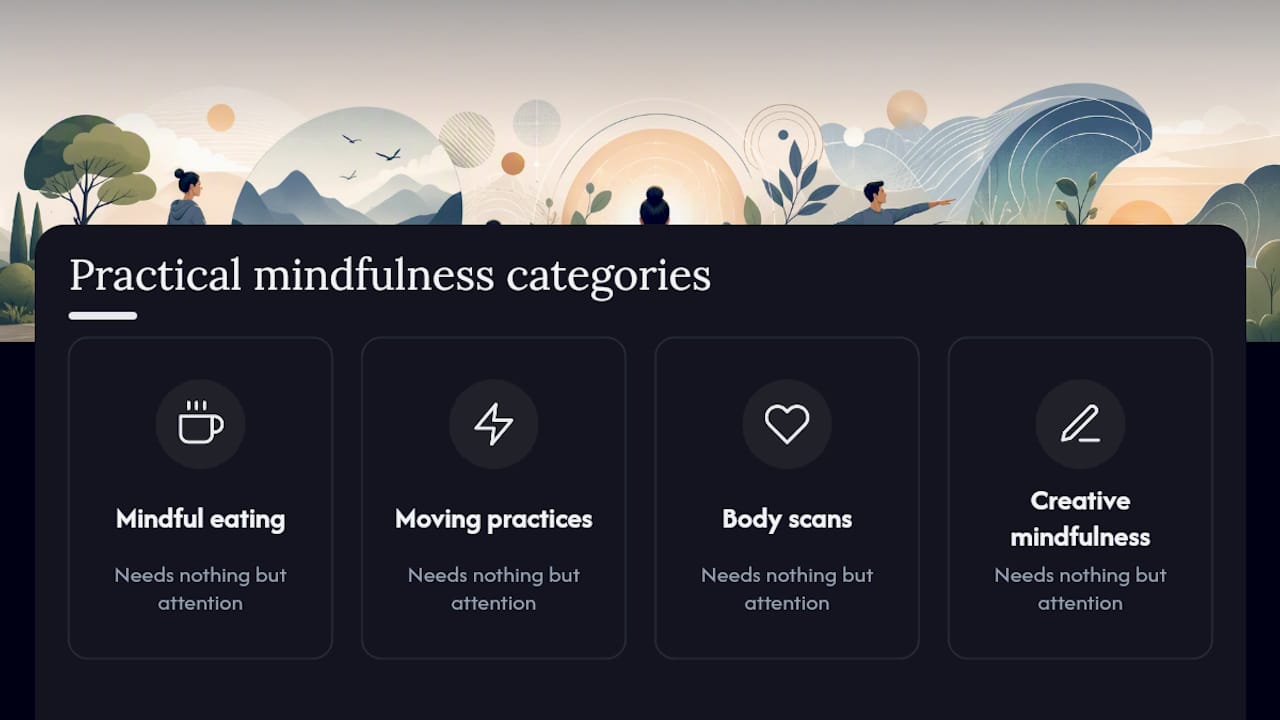
A useful mindfulness practices list isn’t just long, it’s organized so you can find the right tool for the moment you’re actually in. Below, exercises are grouped by type, each with quick steps, a duration label, and a note on who tends to benefit most. None require special equipment, and most adapt to a desk, a kitchen, or a commute. Clinical sources including Mind confirm that the most practical exercises, mindful eating, moving, body scans, and even coloring, work precisely because they need nothing but attention.
Breathing and quick anchors
1. Box breathing Inhale for 4 counts, hold for 4, exhale for 4, hold for 4. Repeat for a short period. Duration: Micro. Helps: Restless minds and pre-meeting nerves.

2. Counted breath Count each exhale from 1 upward, then start over if you lose track. Duration: Micro to short. Helps: Beginners who need a mental anchor.
3. The one-minute breathing space Notice your posture, take five slow breaths, then return to your task. This is the practice Mayo Clinic Connect recommends beginners start with, since it builds a habit without asking for much. Duration: Micro (1 minute). Helps: Anyone new to mindfulness or short on time.
4. Sighing exhale Take a deep breath in through the nose, then release a long, audible sigh out through the mouth. Repeat a few times. Duration: Micro. Helps: Sudden stress spikes, like before a difficult call.
Body awareness and body scans
5. Full body scan Lie down or sit comfortably. Move attention slowly from your scalp to your toes, pausing to notice sensation at each area without trying to change it. Duration: Longer. Helps: People who carry stress physically, and those winding down for sleep.
6. Three-point check-in Notice sensation in your jaw, shoulders, and hands, the three places most people unconsciously clench. Duration: Micro. Helps: Desk workers and anyone prone to tension headaches.
7. Progressive muscle release Tense one muscle group briefly, then release and notice the contrast. Work up from feet to face. Duration: Short. Helps: Those with racing thoughts at bedtime. A related step-by-step relaxation technique walks through the full sequence.
8. Grounding through the feet Press both feet flat on the floor and notice the contact point briefly before standing up. Duration: Micro. Helps: Anxious moments in public or at work.
Sensory and five-senses grounding
9. Five-senses scan Name multiple things you see, hear, touch, smell, and taste. Duration: Short. Helps: Panic or overwhelm; grounds you fast.
10. Texture focus Run your fingers over a nearby object and silently describe the texture. Duration: Micro. Helps: Restless attention that needs something concrete to hold onto.
11. Sound mapping Close your eyes and identify distinct sounds in the room. Duration: Micro. Helps: Anyone whose mind is stuck in the past or future.
12. Temperature awareness Notice the temperature of the air on your skin or hold a warm object and focus on the sensation. Duration: Micro. Helps: People who dissociate under stress.
Movement-based practices
13. Mindful walking Walk slower than usual, feeling heel, arch, and toe touch the ground with each step. Duration: Short. Helps: Restless types who find stillness uncomfortable. A dedicated guide on movement mindfulness covers more variations.

14. Barefoot grounding Stand or walk barefoot on grass, sand, or a bare floor, focusing entirely on the sensation underfoot. Grounding walks like this are detailed further in this barefoot walking guide. Duration: Short (5 minutes). Helps: People who feel mentally “foggy” or disconnected from their bodies.
15. Mindful stretching Move through a few basic stretches, paying attention to the pull and release in each muscle. Duration: Short. Helps: Morning stiffness and pre-sleep tension.
16. Stair or hallway walking meditation Walk a short fixed path back and forth, counting steps and noticing balance shifts. Duration: Short. Helps: Office workers without outdoor access.
Mindful eating and everyday tasks
17. The raisin exercise Eat a small piece of food slowly, noticing its color, smell, texture, and flavor before swallowing. Duration: Micro. Helps: People who eat on autopilot or emotionally.
18. Silent first bite Eat the first few bites of any meal without talking, phone, or screen. Duration: Micro. Helps: Busy adults who rarely sit down to eat.
19. Mindful dishwashing Notice water temperature, soap texture, and the motion of your hands while washing dishes, instead of letting the mind drift. Duration: Micro to short. Helps: Anyone using chores as a reset instead of a rush.
20. Mindful showering Focus on water temperature and sensation on skin early in your shower before your mind wanders. Duration: Micro. Helps: Morning anxiety before work.
Loving-kindness and compassion practices
21. Loving-kindness meditation (metta) Silently repeat phrases like “May I be safe, may I be at ease” for yourself, then extend them to others. Duration: Short. Helps: Self-criticism and interpersonal conflict.
22. Gratitude pause Name some things you’re grateful for right now. Duration: Micro. Helps: Low mood or a cynical mindset.
23. Compassionate self-talk When you notice self-criticism, pause and ask, “What would I say to a friend in this situation?” Duration: Micro. Helps: Perfectionists and anyone prone to harsh self-judgment.
Observer and visualization practices
24. Thought labeling When a thought arises, silently label it and let it pass without engaging. Duration: Short. Helps: Overthinkers and ruminators.
25. Clouds passing Visualize each thought as a cloud drifting across the sky, watching it appear and disappear. Duration: Short. Helps: Anxious thought spirals.
26. Anchor word Pick a single word and return to it silently whenever your mind wanders. Duration: Micro to short. Helps: Beginners who find open-ended meditation frustrating.
27. Body-as-container visualization Imagine your body as a container holding your breath; watch it fill and empty with each cycle. Duration: Short. Helps: People who feel scattered or ungrounded.
Creative and art-based mindfulness
28. Mindful coloring Color a simple pattern, focusing on color choice, pressure, and the sound of the pencil on paper rather than the finished result. Duration: Variable. Helps: People who find silent sitting too intense.
29. Mindful doodling Let your hand move freely across paper without a goal, watching lines and shapes form. Duration: Short. Helps: Restless hands and racing thoughts.
30. Mindful journaling Write about exactly what you notice right now, physically and emotionally, without editing. Duration: Short. Helps: People who process better in writing than in silence.
As the Mindful library points out, these practices work best when organized by context rather than by ideal duration. Keep a few from each group in your back pocket, and pull out whichever fits the ten minutes you actually have.
Four Guided Scripts You Can Follow Right Now
These four scripts turn the list above into something you can do immediately, no interpretation required. Two work well any time of day; one is built for the workplace, and one is designed to ease you into sleep.
1. The 1-minute breathing reset (workplace-friendly)
- Set a timer for 1:00.
- Sit up, feet flat on the floor, hands resting on your lap.
- Inhale through your nose for a count of 4.
- Exhale through your mouth for a count of 6.
- Repeat until the timer ends, then return to your task.
Troubleshooting: If your mind drifts to your inbox, that’s fine, just notice it and come back to the count. Do not judge the drift, simply redirect.
2. The 5 to 7 minute seated body scan (bedtime-friendly)
- Lie down or sit in a supported chair. Set a timer for 6:00.
- Close your eyes and take three slow breaths.
- Bring attention to your scalp and forehead, noticing any tension.
- Move slowly down through jaw, neck, shoulders, arms, chest, stomach, hips, legs, and feet, pausing 15 to 20 seconds at each.
- If you reach the end before the timer stops, rest attention on your breath.
Troubleshooting: Restless tonight? Skip ahead to just the shoulders, hands, and feet, three points instead of ten. A partial scan still counts.
3. The 5-minute mindful walk
- Choose a path, indoors or outside, and set a timer for 5:00.
- Walk at half your normal speed.
- Feel heel, then arch, then toe touch the ground with every step.
- When your mind wanders to your to-do list, silently say “walking” and refocus on your feet.
- End by standing still for 3 breaths before resuming your day.
Troubleshooting: If a slow pace feels awkward in public, walk at a normal pace but narrow your attention entirely to footfall sensation instead.
4. The 10-minute loving-kindness micro-practice
- Sit comfortably and set a timer for 10:00.
- Silently repeat: “May I be safe, may I be healthy, may I be at ease” for 2 minutes.
- Picture someone you care about and repeat the same phrases for them, 2 minutes.
- Picture someone neutral, like a coworker or a barista, and repeat the phrases, 2 minutes.
- Picture someone you find difficult, and if you can, extend the same wish, 2 minutes.
- Close with 2 minutes directed at “all beings everywhere.”
Troubleshooting: If the difficult-person step feels too hard right now, skip it and go straight to “all beings.” The practice still works without every step.
Pro Tip: Save these four scripts as a note on your phone. When motivation dips, having the exact words ready removes the friction of “figuring out what to do,” which is often the real reason a practice gets skipped.
How Often to Practice and Make It Actually Stick
Short daily practice beats occasional long sits, as mindfulness supports habit change and relapse prevention to build sustainable routines. That’s the single most important thing to know before you build a routine, and it’s backed by practitioner guidance that consistently favors frequency over duration, brief, frequent habits build the skill of attention faster than rare marathon sessions, according to Positivepsychology.
A realistic starting schedule looks like this: three to five micro-practices spread across your day (a breath reset before each meeting, a five-senses check during your commute), plus one slightly longer sit, 10 to 15 minutes, three to five times a week. That’s it. You don’t need an hour of silence to see change.
Habit stacking makes this stick without relying on willpower:
- Do a breath reset right after brushing your teeth.
- Do a body check-in between back-to-back meetings.
- Do a mindful eating pause before your first bite at lunch.
- Do a body scan right after getting into bed.
Track it simply: an X on a wall calendar, a habit app, or a sticky note by your coffee maker works fine. Complexity kills consistency faster than a busy schedule does.
Common obstacles have quick fixes. Restless mind during sits? Switch to a movement-based practice like mindful walking instead of forcing stillness, matching the exercise to your temperament matters more than following a script exactly, as noted in Psychology Today. Sleepy at night? Move your formal practice to morning and save body scans for actual bedtime, where drowsiness is a feature, not a bug.
Your first 30 days, simplified:
- Week 1: One 1-minute breath reset daily. Nothing else.
- Week 2: Add a five-senses grounding check during your commute or a break.
- Week 3: Add one 5 to 10 minute body scan before bed, three nights a week.
- Week 4: Add loving-kindness or mindful walking, whichever appeals more.
Pro Tip: If you miss a day, don’t restart the whole plan. Just do today’s practice. Mindfulness has no streak to protect, only a next moment to return to.
Bringing Mindfulness Into Groups and Classes
Group settings change the practice slightly, pacing needs to accommodate different comfort levels, and sharing should always be optional. These activities adapt well to classrooms, therapy groups, or team meetings.
- Paired mindful listening: One person speaks for 1 minute while the other listens without responding, then swap. Debrief: “What did you notice about the urge to interrupt?”
- Guided 3-minute breathing break: A facilitator counts breaths aloud for the group, everyone follows silently. Debrief: “What changed in your body?”
- Group body scan: Facilitator reads a slow scan script aloud, participants follow with eyes closed. Debrief: “Where did you hold the most tension?”
- Mindful movement circle: Group stands in a circle and mirrors one person’s slow stretch for one minute each. Debrief: “What was easy or hard to follow?”
- Shared mindful eating: Everyone eats one small snack in total silence for 2 minutes. Debrief: “What did you taste that you usually miss?”
- One-word check-in: Each person shares a single word describing their current state, no elaboration required. Debrief happens through the words themselves.
Keep sharing brief and always optional, silence is a valid response. A facilitator should also watch pacing closely; three minutes of silence can feel like ten to a nervous group. If you’re leading formal sessions, mindfulness therapy techniques offer more structure for clinical or classroom settings.
What the Research Actually Says About Benefits
Multiple clinical and nonprofit sources converge on the same finding: brief, focused breathing, body scans, and mindful walking measurably lower stress and sharpen attention. Mayo Clinic notes that even one minute of focused breathing can lower stress and improve clarity, a low bar that makes the practice genuinely accessible rather than aspirational.
One minute, measurable effect: A single minute of focused breathing can reduce stress and sharpen clarity, according to Mayo Clinic, one of the lowest time investments in wellness research with a documented benefit.
Peer-reviewed literature backs the pattern over longer timelines too. Regular mindfulness training correlates with reduced stress, lower anxiety, and fewer depressive relapses, with effects that strengthen the longer practice continues, per research summarized in PMC. Consistent daily practice sustained over several weeks tends to produce more durable change than a single strong session, echoing what Mindful.net reports about short, repeated practices done over time.
Be honest with yourself about the limits, too. Mindfulness is a skill you build, not a switch you flip. A body scan won’t erase a hard week, but it changes how you meet the next one. Evidence-backed benefits worth expecting:
- Lower perceived stress after consistent daily practice.
- Improved attention regulation and reduced mind-wandering.
- Reduced anxiety symptoms with sustained practice over weeks.
- Lower rates of depressive relapse among people with a history of depression.
Starting Beginners Off Without Overwhelming Them
The lowest-barrier way to introduce mindfulness is a one-minute breath reset paired with a weekly body scan, nothing more ambitious in the first two weeks. That combination gives someone a daily win they can actually complete alongside one deeper, restorative session they look forward to rather than dread.
If you’re naturally restless or pressed for time, skip formal seated practice altogether at first. Start with mindful walking or a three-point body check-in between tasks. The goal in week one isn’t depth, it’s proof to yourself that you can return your attention on command. That proof is what makes week three easier. Lunixinc’s take on mindfulness and stress relief digs further into why small, repeatable practices outperform ambitious ones for most beginners.
Supporting a Consistent Practice With the Right Tools
A mindfulness practice built on breath and attention doesn’t need equipment, but the right recovery tools can make the moments around your practice easier to protect. If your shoulders are locked up from a desk job, a body scan competes with real physical discomfort the whole time. That’s where a supportive setup, a heated massager to loosen a tense neck before a body scan, or a comfortable resting station for your evening wind-down, can remove friction rather than add it.

This is an adjacent option, not a requirement. You don’t need any product to practice mindfulness effectively, the exercises above work with nothing but attention. But if physical tension is what keeps pulling you out of stillness, it’s worth addressing directly. Lunixinc’s recovery collection is built around exactly that, tools designed to help your body settle so your mind has an easier time following. Browse the collection and see which piece fits the moment in your day that currently feels hardest to sit still in.
Sources
- Mindfulness exercises - Mayo Clinic
- Mindfulness exercises and tips | Mind
- Mindful
- PMC6437090
- Positivepsychology