


Right now, before you read another word, try this: sit back, close your eyes, and take one slow breath in through your nose for four counts, then let it out gently for four counts. That single breath just activated your body’s natural calming response. Even one minute of focused breathing can lower stress and improve mental clarity, according to Mayo Clinic guidance on mindfulness. Learning how to practice mindful breathing does not require an app, a meditation cushion, or years of experience. It requires a short amount of time and a willingness to notice what your breath is already doing.
Here is your immediate reset. Sit or stand comfortably, let your hands rest open in your lap, and follow these three steps:
- Settle. Plant your feet on the floor and soften your jaw.
- Sense. Notice the physical sensation of air entering your nose and leaving your mouth.
- Follow. Track one complete breath in and one complete breath out without changing anything.
That is it. A brief period of this, done consistently throughout your day, builds a real foundation for stress relief.
Pro Tip: Don’t try to slow your breath down on your first attempt. Just observe it as it is. Trying to control the breath immediately is the most common beginner mistake, and it creates tension instead of releasing it.
Table of Contents
- How do you practice mindful breathing step by step?
- Which mindful breathing techniques should you try first?
- When and where should you use mindful breathing during the day?
- Why does mindful breathing actually reduce stress and improve focus?
- What should you do when mindful breathing feels wrong?
- How do you build a two-week beginner practice plan?
- Ready-to-use scripts you can follow right now
- Key Takeaways
- The part most guides skip about making this stick
- How Lunix recovery products support your breathing practice
- Useful sources and further reading
How do you practice mindful breathing step by step?
The essential sequence is simple: settle your body, choose a point of attention, and gently return your focus whenever it drifts. The Greater Good in Action program at UC Berkeley describes mindful breathing as focusing attention on the inhale and exhale, which you can do sitting, standing, or lying down with eyes open or closed.
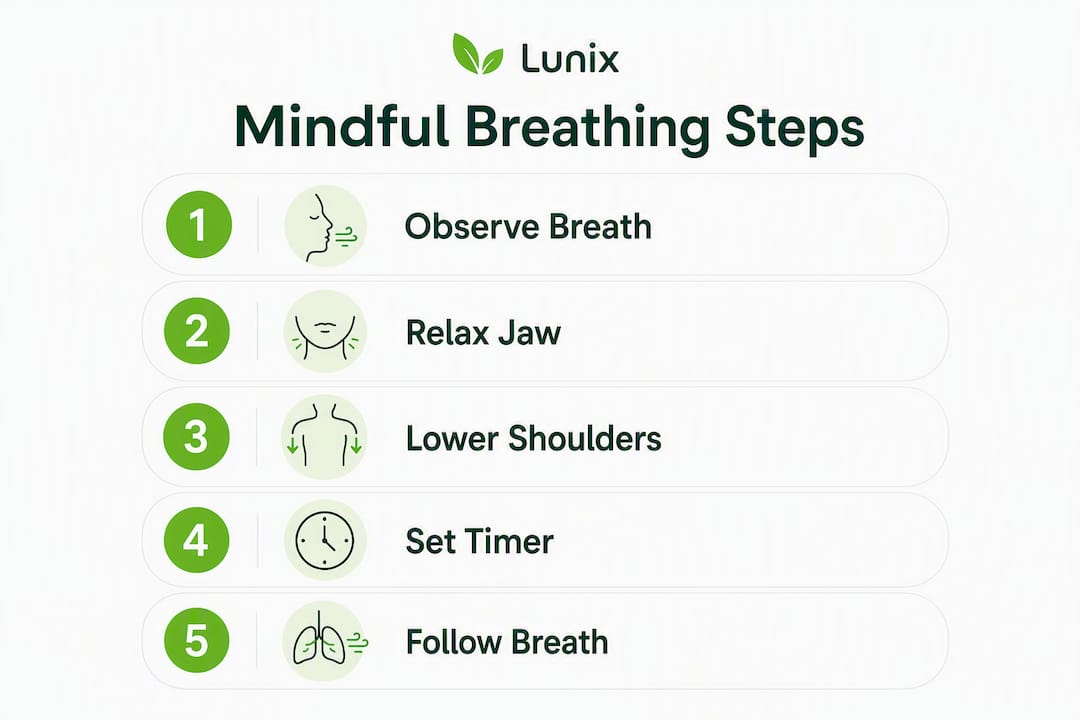
Follow these five steps each time you sit down to practice:
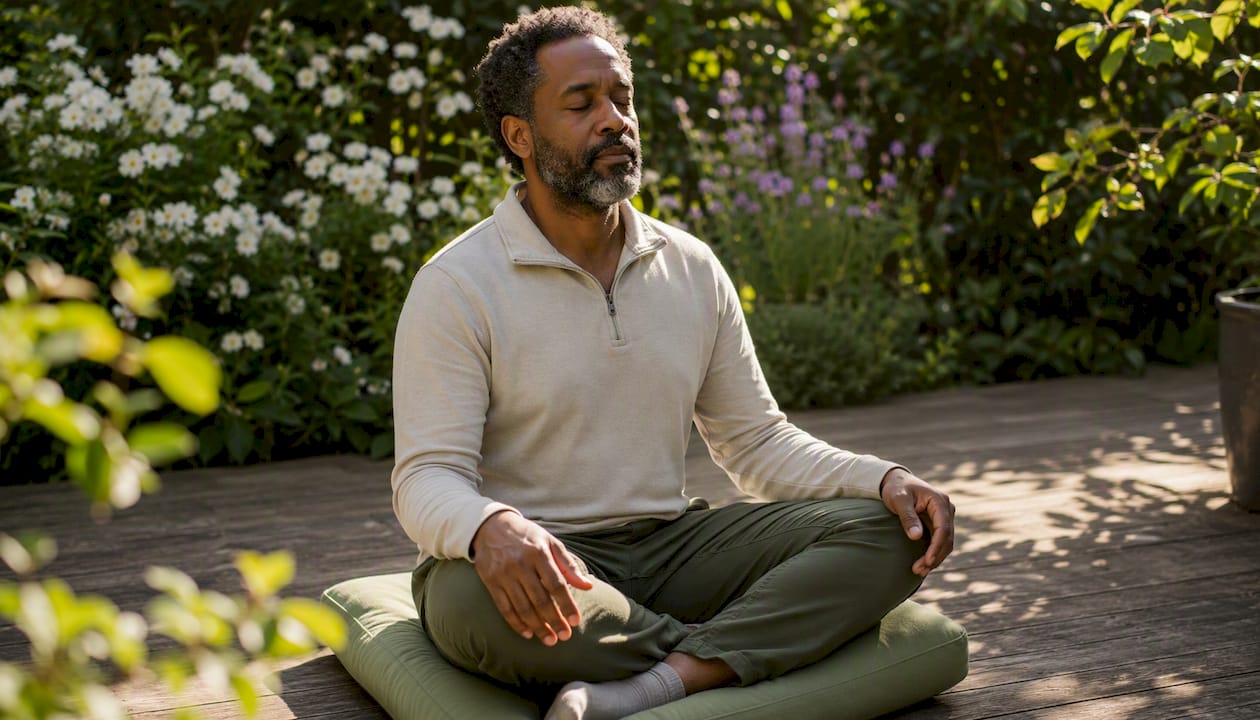
- Settle. Choose a comfortable position. Sit upright with your back supported, feet flat, and hands resting in your lap. You do not need to sit cross-legged on the floor.
- Soften. Do a quick body scan: unclench your jaw, drop your shoulders away from your ears, and release any grip in your hands.
- Sense. Bring your attention to the physical sensation of breathing. Notice the air at your nostrils, the rise of your chest or belly, or the slight pause between breaths.
- Follow. Track one full breath from start to finish. Then another. Let the breath move at its own pace.
- Return. When your mind wanders (and it will), simply notice that it wandered, and guide your attention back to the breath. No frustration needed.
A few hands-on checks help you know you are on track. After a minute, ask yourself: Is my jaw soft? Are my shoulders down? Is my belly moving, or is my breath shallow in my chest? Belly movement signals diaphragmatic breathing, which is the most calming pattern for your nervous system.
For session length, start with a short timer. Silent practice works well once you feel comfortable with the steps. If your mind races during the first few sessions, a guided meditation audio gives your attention an external anchor, which many beginners find easier than silence.
Pro Tip: Set your timer before you start so you are not tempted to check the clock. Checking the clock mid-session is the second most common beginner distraction, right after mind-wandering.
Which mindful breathing techniques should you try first?
There are several named techniques worth knowing. Each one suits a different moment, body type, and goal. Start with one, practice it for a few days, then try another.
| Technique | How to do it | Duration | Best for |
|---|---|---|---|
| Diaphragmatic (belly) breathing | Breathe in slowly through the nose, letting the belly rise; exhale fully through the mouth | 2–5 minutes | General stress relief, posture reset |
| Box breathing | Inhale inhale, hold, exhale, hold for equal counts; repeat for a few minutes | Before meetings, presentations, or high-stakes tasks | |
| 4-7-8 breathing | Inhale, hold, then a longer exhale | A short session | Sleep wind-down, anxiety relief |
| Breath counting | Count each exhale up to a number, then restart | Several minutes | Focus training, meditation beginners |
| Paced breathing (around six breaths per minute) | Inhale and exhale at a steady slow pace; repeat | Several minutes | Sustained calm, heart rate regulation |
A few notes on each:
- Diaphragmatic breathing is the best starting point for most people. Place one hand on your belly and one on your chest. The belly hand should rise more than the chest hand.
- Box breathing is widely used by athletes and first responders to restore focus. It involves inhaling, holding, exhaling, and holding in equal counts, repeated for a few minutes before a task or presentation.
- 4-7-8 breathing uses a longer exhale and a breath hold to slow the heart rate. It works well as a bedtime wind-down but is not ideal for people who feel anxious about holding their breath.
- Breath counting trains sustained attention. When you lose count, start again at one without judgment. That restart is the practice.
- Paced breathing at roughly six breaths per minute is associated with heart rate variability benefits in research settings. It takes a few sessions to find the rhythm, but most people settle into it naturally.
Safety note: If any technique that involves breath holds causes dizziness, lightheadedness, or increased anxiety, stop immediately. Simplify to natural breath awareness with no holds. If symptoms persist, consult a healthcare professional.
When and where should you use mindful breathing during the day?
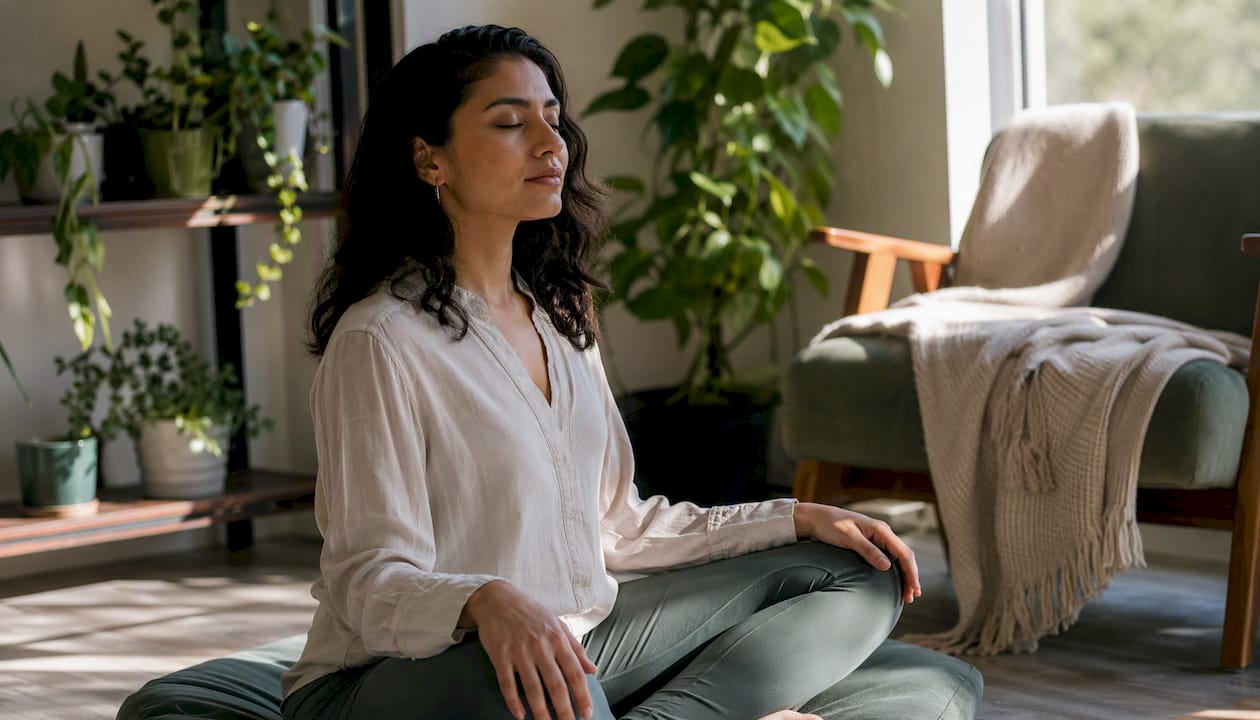
The highest-value moments are transitions: the gap before a meeting, the minute after you close a difficult email, the few seconds before you pick up your phone. These are the moments when your nervous system is already shifting gears, and a short breathing reset helps it shift in the right direction.
Mindful.net recommends tying breathing practices to clear triggers during the workday, such as before meetings or after completing a task, using short and repeatable routines rather than long sessions.
Here are three practical routines you can slot in today:
The 30-second email reset. Before you open your inbox in the morning, take three slow belly breaths. This sets a calmer baseline before the first stressor of the day arrives.
The 90-second meeting reset. Arrive one minute early and use the STOP method (covered in the scripts section below) before the call begins. Short breathing resets of about a minute to two minutes are effective before meetings and transitions; slightly longer sessions support focused work and longer relaxation sessions.
The 3–5 minute focus starter. Before a deep work block, sit quietly and follow your breath for three to five minutes using breath counting or paced breathing. Think of it as clearing the mental cache before loading a new task.
Choose your session length based on what comes next, not on how much time you think you “should” practice. A 90-second reset before a meeting is more useful than a 20-minute session you squeeze in once a week.
Why does mindful breathing actually reduce stress and improve focus?
The short answer: your breath is the one part of your autonomic nervous system you can consciously control, and that control creates a direct line to your stress response.
When you slow your exhale, you stimulate the vagus nerve, which signals the parasympathetic nervous system to dial down the fight-or-flight response. Heart rate drops, muscle tension eases, and the prefrontal cortex (the part of your brain responsible for clear thinking) regains access to working memory. That is the physiological chain that makes even a 60-second reset feel noticeably different from doing nothing.
The attention-training effect is equally important. The act of noticing that your mind has wandered and gently returning it to the breath is the core practice; each notice-and-return cycle strengthens the neural pathways associated with sustained attention. Over weeks, that translates into better focus during work and less reactivity to daily stressors.
The Lunix guide to breathing exercises and stress relief covers the physiological mechanisms in more depth if you want to understand the full picture. For a broader look at how mindfulness techniques interact with the stress response, the Lunix mindfulness and meditation overview is a useful companion read.
Disclaimer: Mindful breathing is general wellness practice, not a substitute for medical care. If you experience significant anxiety, panic attacks, or a diagnosed condition, speak with a healthcare provider before beginning a new breathing program.
What should you do when mindful breathing feels wrong?
Most beginners hit at least one of these five friction points. Each one has a simple fix.
- Mind keeps wandering. This is not a mistake. Label the thought (“planning,” “worrying”) and return to the breath. The notice-and-return is the practice itself, not a sign that you are doing it wrong.
- Breath feels shallow or forced. You are probably trying to control it too much. The NHS recommends letting the breath flow naturally rather than forcing it. Drop any effort to make it deeper or slower, and simply observe.
- Dizziness or lightheadedness. Stop the exercise, breathe normally, and sit quietly for a moment. This often happens when people over-breathe or hold their breath too long. Simplify to natural breath awareness with no counts or holds.
- Falling asleep. Sit upright rather than lying down, keep your eyes slightly open with a soft downward gaze, and shorten the session to five minutes or less until your body adjusts.
- Anxiety increases. Some people find breath focus initially heightens body awareness in an uncomfortable way. Switch to an open-eyes practice, focus on the sensation of your feet on the floor instead of your breath, and gradually reintroduce breath awareness over several sessions.
If any exercise causes significant discomfort, stop immediately. Persistent dizziness, chest tightness, or worsening anxiety are signals to consult a healthcare professional before continuing.
How do you build a two-week beginner practice plan?
Starting with a structured foundation of minimal daily practice in the first week and increasing time in the second week builds consistency without feeling overwhelming. Here is the exact schedule:
Week 1: Build the foundation (Days 1–7)
- Practice once per day, same time each day (morning works well for most people).
- Session length: 2–3 minutes of basic breath awareness or diaphragmatic breathing.
- Use a guided session if silent practice feels hard. Calm recommends starting with one-minute breath-awareness exercises and highlights that guided sessions help beginners stay present.
- Track only one metric: did you practice today? Yes or no.
- If you miss a day, restart the next morning without self-criticism.
Week 2: Extend and add informal practice (Days 8–14)
- Extend formal sessions to 5 minutes.
- Add one informal mindful moment per day: three breaths before your morning coffee, a 90-second reset before your first meeting, or a breath check after brushing your teeth.
- Try one new technique from the catalog above (box breathing or breath counting are good second-week choices).
- At the end of week two, count how many days you practiced and how many 60-second resets you completed. That number is your baseline.
Progress checkpoints: If you completed five or more days in week one, you are ready to extend. If you completed fewer than five, repeat week one before moving forward.
For a structured at-home workflow, the Lunix breathing exercise workflow guide offers a practical session structure you can follow alongside this plan. The UCLA Mindful Awareness Research Center also offers free guided audio sessions that work well for week-one beginners.
Pro Tip: Attach your practice to something you already do every day, like making coffee or sitting down at your desk. Habit researchers call this “habit stacking,” and it dramatically increases follow-through in the first two weeks.
Ready-to-use scripts you can follow right now
You do not need an app to get started. Read these scripts aloud or follow them silently.
60–90 second quick reset (VA.gov style)
Adapted from VA.gov mindful breathing scripts:
- Sit comfortably. Let your eyes close or soften your gaze downward.
- Take a natural breath in through your nose. Notice the air entering.
- Let the breath out slowly. Notice the air leaving.
- Take another breath in. Feel your belly or chest rise gently.
- Breathe out. Let any tension leave with the exhale.
- One more breath in. Follow it all the way in.
- Breathe out fully. When you are ready, open your eyes.
5-minute guided script
- Settle into your seat and let your hands rest open in your lap.
- Close your eyes. Take three natural breaths to arrive.
- Now breathe in slowly for a count of four. One, two, three, four.
- Breathe out for a count of four. One, two, three, four.
- Continue at your own pace. Each time your mind wanders, gently return to the count.
- After two minutes, release the count and simply follow the breath without numbers.
- Notice the pause between the inhale and the exhale. Rest there for a moment.
- For the final minute, let the breath return to its natural rhythm. No effort needed.
- When you are ready, take one deep breath, exhale fully, and open your eyes.
The STOP method (workplace reset)
The STOP method is a four-step framework for a quick stress reset between tasks:
- S — Stop. Pause whatever you are doing. Put down your phone or step back from the screen.
- T — Take a breath. One slow inhale through the nose, one slow exhale through the mouth.
- O — Observe. Notice your body: are your shoulders tight? Is your jaw clenched? What emotion is present?
- P — Proceed. Return to your task with a clearer, calmer state.
Use STOP between back-to-back meetings, after a difficult conversation, or any time you notice physical tension building. It takes under 30 seconds and requires no setup.
Key Takeaways
Consistent short breathing resets, practiced daily and tied to clear triggers, build the stress-relief and focus benefits of mindful breathing faster than infrequent long sessions.
| Point | Details |
|---|---|
| Start with 60–90 seconds | Even a 90-second reset before a meeting lowers stress and improves clarity, per Mayo Clinic. |
| Return to breath is the practice | Every time you notice your mind wandered and come back, you are strengthening attention. |
| Match length to the moment | Use 60–90 seconds for transitions and 3–5 minutes before focused work. |
| Follow the two-week plan | Week 1: brief daily sessions. Week 2: extend duration and add informal resets. |
| Lunixinc supports your setup | Lunixinc recovery products help you create a consistent, comfortable space to practice daily. |
The part most guides skip about making this stick
Early practice feels scattered. Your mind wanders after four seconds, you forget to breathe slowly, and you wonder whether you are doing it right. That is not a sign of failure. That is what week one looks like for almost everyone.
The mistake most people make is treating mindful breathing like a performance they need to pass. They grade themselves on how calm they felt or how few thoughts they had. Neither of those is the measure. The only measure is whether you showed up and returned your attention when it wandered.
Small habit anchors work better than willpower. Three breaths before your morning coffee costs nothing and builds a real association between that moment and a calmer state. A brief reset before your first meeting is more sustainable than a long session you squeeze in when you remember. Over time, these micro-practices compound in a way that a single long session never does.
One more thing worth saying: the physical environment matters more than most people expect. A comfortable chair, a quiet corner, even a specific cushion or blanket can signal to your nervous system that it is time to settle. That signal gets stronger with repetition. You are not just training your breath; you are training your surroundings to support you.
How Lunix recovery products support your breathing practice
Building a consistent breathing practice is easier when your body is comfortable and your space feels intentional. Lunixinc recovery products, including orthopedic wedge pillow sets and percussion massagers, are designed to help you settle into the kind of physical ease that makes breath awareness natural rather than forced.

A well-supported posture reduces the physical distractions that pull attention away from the breath. When your back is aligned and your muscles are relaxed, the settle-soften-sense sequence happens faster. Lunixinc’s recovery collection includes products built specifically for that kind of restorative comfort, whether you practice in the morning before work or wind down at night with a 4-7-8 session. Visit the Lunix blog for additional breathing scripts, mindful-breathing workflows, and step-by-step relaxation guides to complement your daily practice.
Useful sources and further reading
| Source | What it offers |
|---|---|
| Mayo Clinic — Mindfulness Exercises | Evidence-based overview of mindfulness and short breathing practices for stress relief |
| NHS — Breathing Exercises for Stress | Practical guidance on natural breath flow and safety; includes technique instructions |
| VA.gov — Mindful Breathing Script | Ready-to-use clinical-style scripts for 60–90 second and longer breathing sessions |
| Greater Good in Action — Mindful Breathing | UC Berkeley’s step-by-step practice guide with timing and posture guidance |
| SimplyPsychology — Mindfulness for Beginners | Two-week beginner plan with progression rules and consistency tips |
| Calm Blog — Mindfulness for Beginners | Accessible intro to breath awareness; recommends starting with one-minute exercises |
| Mindful.net — Breathing Techniques for Work | Workplace-focused routines tied to transitions and clear daily triggers |
| MindTastik — Mindful Breathing for Focus | Timing guidance for resets (60–90 seconds and 3–5 minutes) matched to different tasks |
| Today — Mindfulness Exercises for Beginners | STOP method explanation and workplace stress-reset techniques |
| Lunixinc — Breathing Exercise Workflow | At-home session structure and workflow for daily practice |
| Paul Stebles — Guided Meditations | Narrated guided sessions for beginners who prefer audio over silent practice |