


TL;DR:
- A wellness planner is a structured system that tracks daily, weekly, and monthly practices to improve physical and mental well-being. It involves consistent check-ins, reviews, and goal-setting, helping identify patterns and make targeted adjustments for lasting change. Using adaptable tools and routines, individuals can foster sustainable habits that enhance overall health across multiple domains.
A wellness planner process is a structured system that helps you track, review, and improve your physical and mental well-being through consistent daily, weekly, and monthly practices. Think of it as your personal health operating system, one that captures mood, sleep, nutrition, exercise, and stress in one place. Unlike a simple to-do list or a vague New Year’s resolution, this process uses habit science and pattern recognition to create real, lasting change. Tools like guided journals, habit trackers, and mood logs all play a role. When you follow a wellness planning guide built around your actual life, the results are both measurable and sustainable.
What are the core steps in a wellness planner process?
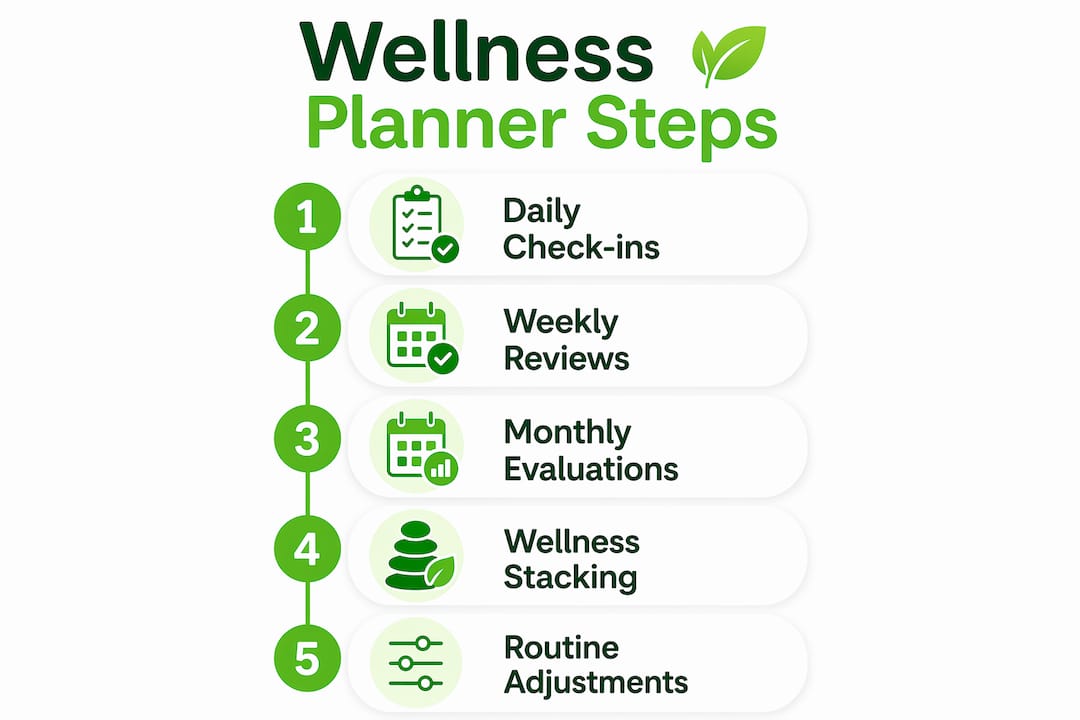
A well-structured wellness planner runs as a repeating three-layer cycle: daily check-ins, weekly reviews, and monthly evaluations. Each layer builds on the one before it, turning isolated data points into meaningful patterns. Here is how to put each layer into practice.

1. Daily check-ins (2 to 5 minutes)
Start each morning or evening by logging three to five key metrics: mood, sleep quality, energy level, hydration, and one physical activity note. Keep entries brief. A single word or a number on a scale of one to ten works perfectly. The goal is consistency, not literary depth.
2. Weekly reviews (15 to 20 minutes)
At the end of each week, scan your daily entries for recurring themes. Did your energy dip every Wednesday? Did sleep quality drop when you skipped your evening walk? This review is where your data starts talking. Adjust one or two small behaviors based on what you notice, then carry those adjustments into the next week.
3. Monthly evaluations (30 minutes)
Use the monthly layout to set three to five gentle intentions for the coming month, review whether last month’s intentions held, and note any seasonal shifts in your energy or mood. Research supports monthly wellness themes and seasonal reflections as a way to foster flexible, rhythm-aligned goal setting. This is not about grading yourself. It is about recalibrating.
4. Wellness stacking
Once the three-layer cycle feels natural, introduce wellness stacking. This technique involves attaching a new wellness habit to an existing daily behavior, such as logging your mood right after your morning coffee. Psychologists recommend focusing on that anchor for about two weeks before adding another habit. This approach cuts decision fatigue and builds routines that stick without requiring willpower.
Pro Tip: Set a recurring two-minute phone alarm labeled “wellness check-in” immediately after a habit you already do every day, like brushing your teeth. The anchor removes the need to remember, and the brevity removes the excuse to skip.
How can you customize your wellness planner process for different areas of well-being?
The NIH’s wellness toolkits frame wellness as unique to each individual, covering feelings, body, relationships, and environment. A personal wellness planner works best when it reflects that same multi-domain view rather than focusing only on physical fitness. Here is how to build that breadth without overwhelming yourself.
- Physical health: Track daily movement, sleep duration, and hydration. Even a simple tally of steps or a yes/no for a ten-minute walk gives you useful data over time.
- Mental and emotional wellness: Use mood logs and stress ratings. Pair these with brief journaling prompts like “What drained me today?” or “What felt good?” Consistent journaling enhances emotional processing and builds mindfulness over weeks.
- Nutrition awareness: Note what you ate and, critically, how you felt before and after eating. This combination of behavior and feeling data is what turns a food log into a genuine insight tool.
- Relationships and environment: Once a week, add one line about a meaningful connection or a change in your physical space that affected your mood. These entries often reveal patterns that pure health metrics miss.
- Gratitude and intention: End each day with one gratitude note. This takes thirty seconds and has an outsized effect on how you perceive your overall progress.
Rotate your focus areas monthly or seasonally to avoid tracking fatigue. You do not need to monitor every domain at maximum intensity all year. Spend one month deepening your sleep tracking, the next sharpening your nutrition awareness. This layered approach keeps the process fresh and relevant to where you actually are in life.
Pro Tip: Use your personalized wellness plan as a living document. Review which domains felt neglected at your monthly evaluation and rotate your focus accordingly. Flexibility is not a weakness in this process. It is the strategy.
What tools and techniques support consistent use of a wellness planner?
Choosing the right format and building smart habits around it determines whether your planner becomes a daily ritual or a forgotten notebook. Here is a direct comparison of the two main format options.
| Format | Best for | Key advantage | Main limitation |
|---|---|---|---|
| Physical planner or journal | Tactile learners, those who benefit from screen-free time | Stronger memory encoding through handwriting | Less portable, harder to search past entries |
| Digital app or spreadsheet | Data-driven users, frequent travelers | Easy pattern analysis, reminders, and syncing | Screen fatigue, notification overload |
Neither format is superior. The right one is whichever you will actually open tomorrow morning. Many people in the 30 to 55 age group find that a hybrid approach works well: a physical journal for daily reflections and a digital wellness tool for tracking metrics and setting reminders.
Beyond format, these techniques drive consistency:
- Anchor your entries. Attach your check-in to an existing routine, such as morning coffee or an evening wind-down. Micro habits anchored to daily behaviors reduce decision fatigue and make consistency achievable for busy schedules.
- Keep entries short. A two-sentence reflection beats a blank page every time. Set a five-minute maximum for daily entries so the task never feels like homework.
- Use an accountability partner. Share your weekly review with a friend, a coach, or a wellness community. External accountability increases follow-through significantly.
- Avoid the perfectionism trap. Consistency over perfection is the core principle of effective wellness journaling. Missing a day does not break the process. Abandoning the process does.
The most common mistake people make is overloading their planner at the start. Begin with three metrics, master those for two weeks, then add more. Treat your planner as a conversation with yourself, not a performance review.
How to interpret your wellness planner data and adapt your routines
Data without interpretation is just noise. The real power of a personal wellness planner emerges when you start connecting dots across your entries. Tracking both behavior and feelings, such as what you ate alongside your emotional state, helps identify triggers and supports genuine behavior change. This is the step most people skip, and it is the step that separates a useful planner from a dusty journal.
During your weekly review, look for three types of patterns. First, identify energy drains: days or situations that consistently leave you depleted. Second, spot energy sources: activities, foods, or interactions that reliably lift your mood or focus. Third, notice friction points: moments where you intended to follow a healthy behavior but did not. Each friction point is a design problem you can solve, not a character flaw.
When you spot a pattern, respond with a small, specific adjustment rather than a sweeping overhaul. If your data shows that skipping lunch leads to poor sleep, the fix is a calendar block for lunch, not a complete diet redesign. If your mood scores drop every Sunday evening, a ten-minute mindfulness ritual before the week begins might be all you need. Resources like mindfulness activities for stress relief can give you concrete options to test.
Seasonal reflection adds another layer of depth. At the end of each quarter, review your monthly evaluations together. You will often find that your energy, motivation, and stress levels follow seasonal rhythms. Aligning your wellness intentions with those rhythms, rather than fighting them, makes the whole process feel less like discipline and more like self-knowledge.
Pro Tip: Color-code your mood ratings in your weekly review: green for good, yellow for neutral, red for low. A visual scan of a week’s worth of color tells you more in ten seconds than re-reading every entry.
Key takeaways
A wellness planner process works because it turns daily observations into weekly patterns and monthly intentions, creating a self-correcting cycle that builds sustainable well-being over time.
| Point | Details |
|---|---|
| Three-layer cycle | Daily check-ins, weekly reviews, and monthly evaluations form the core structure of an effective process. |
| Wellness stacking | Attach new habits to existing behaviors and hold each anchor for two weeks before adding more. |
| Multi-domain tracking | Rotate focus across physical health, mental wellness, nutrition, and relationships to avoid burnout. |
| Consistency over perfection | Missing a day is normal. Reviewing patterns over time delivers the real insight, not daily flawlessness. |
| Data interpretation | Pair behavior tracking with feelings to identify triggers and make small, targeted routine adjustments. |
What I have learned from years of watching people use wellness planners
Most people start a wellness planner with the best intentions and abandon it within three weeks. The reason is almost never lack of motivation. It is that they treated the planner as a static record of goals rather than a living, iterative process. The moment you shift from “Am I hitting my targets?” to “What is my data telling me this week?”, the whole experience changes.
The science backs this up. Psychologists who study habit formation consistently point to architecture over intensity. A two-minute daily check-in you do every single day outperforms a thirty-minute deep-dive you do twice a month. The wellness habits checklist approach works precisely because it keeps the bar low enough to clear on your worst days.
What I find most encouraging is how quickly patterns become visible once you start. Within two to three weeks of consistent tracking, most people notice at least one connection they had never made before, like the link between poor sleep and afternoon sugar cravings, or between skipping movement and a drop in mood the following morning. That first “aha” moment is what turns a planner from a chore into something you actually look forward to.
Be patient with yourself. Wellness planning is not a sprint toward a finish line. It is a practice, and like any practice, it gets richer the longer you stay with it. Experiment freely. Drop what does not serve you. Keep what does. The planner belongs to you, not the other way around.
— Lunix
Support your wellness routine with Lunix recovery tools

A wellness planner process gives you the clarity to know what your body needs. Lunixinc’s recovery collection gives you the tools to act on it. Whether your planner reveals that you need better sleep, faster muscle recovery, or a dedicated wind-down ritual, Lunix recovery products are designed to fit directly into the routines you are already building. Every product is built around the same principle that drives great wellness planning: consistent, intentional care adds up to lasting results. Explore the Lunixinc recovery collection and give your wellness process the physical support it deserves.
FAQ
What is a wellness planner process?
A wellness planner process is a structured, repeating system of daily check-ins, weekly reviews, and monthly evaluations used to track and improve physical and mental well-being. It combines habit tracking, mood logs, and journaling to build mindfulness and sustainable health habits.
How long does it take to see results from wellness planning?
Most people begin noticing behavioral patterns within two to three weeks of consistent daily tracking. Meaningful routine adjustments and measurable well-being improvements typically emerge after one to two full monthly review cycles.
What should I track in a personal wellness planner?
Track mood, sleep quality, energy, hydration, and physical activity at a minimum. Adding emotional triggers alongside food and activity entries helps identify patterns that support deeper behavior change, as recommended by the NIDDK.
Is a physical journal or a digital app better for wellness planning?
Neither format is objectively better. Physical journals support memory encoding through handwriting, while digital tools make pattern analysis and reminders easier. Choose the format you will open consistently, or use a hybrid of both.
How do I stay consistent with my wellness planner?
Anchor your daily entry to an existing habit, keep entries under five minutes, and focus on reviewing patterns rather than achieving perfect daily scores. Wellness stacking, the practice of attaching new habits to established behaviors, is the most research-supported method for building long-term consistency.