


TL;DR:
- Most professionals neglect wellness as a foundation for sustained performance, leading to burnout and fatigue.
- Implementing structured weekly reviews, energy-based time-blocking, and targeted automation enhances productivity and health long-term.
You know that feeling when you finish a packed workday and realize you skipped lunch, forgot to move, and your brain feels like wet cement? That tension between output and well-being is not a personal failing. It is a design flaw in how most professionals structure their days. A strong productivity and wellness workflow treats your health not as something you earn after a productive week, but as the very foundation that makes sustained performance possible. This guide gives you the specific tools, habits, and sequence of steps to build that foundation, starting today.
Table of Contents
- Key takeaways
- Building your productivity and wellness workflow
- Step-by-step workflow design
- Common pitfalls when balancing productivity and wellness
- Measuring progress and verifying results
- My honest take on wellness and workflow after 40
- Support your workflow with Lunix recovery tools
- FAQ
Key takeaways
| Point | Details |
|---|---|
| Wellness is an input, not a reward | Treat sleep, movement, and recovery as prerequisites to high performance, not optional extras. |
| Weekly reviews drive real results | A 30-minute weekly review is linked to a 23% improvement in work performance. |
| Time-blocking protects cognitive energy | Scheduling deep work and recovery blocks prevents burnout and mental fatigue over time. |
| Automation reduces wasted hours | Targeted AI tools can save you roughly 2 hours weekly, freeing time for recovery. |
| Progress takes longer than you think | Habit formation takes a median of 59 to 66 days, so measure progress in months, not weeks. |
Building your productivity and wellness workflow
Before you change how you work, it helps to understand what you are working with. Your workflow is not just your task list. It is the full system that governs how you use your time, manage your energy, and structure your environment. When wellness is missing from that system, the cracks show up slowly and then all at once.
Tools and workspace basics
The right environment matters more than most professionals realize. A healthy workspace setup includes ergonomic seating, adequate natural light, and minimal visual clutter. These are not luxuries. Research consistently links ergonomic improvements to measurable productivity gains and significant reductions in physical discomfort.
On the digital side, a simple time-tracking tool (Toggl or Clockify work well) helps you see where your hours actually go versus where you think they go. Most professionals are shocked by the gap.
Here is a quick reference for what you need before implementing a workflow:
| Category | Tool or Practice | Why it matters |
|---|---|---|
| Workspace | Ergonomic chair, monitor at eye level | Reduces postural strain and fatigue |
| Time tracking | Toggl, Clockify, or calendar blocking | Exposes real time usage patterns |
| Task management | Todoist, Notion, or a paper capture system | Prevents cognitive overload |
| Recovery | Scheduled rest, movement breaks | Sustains focus across the full day |
| Metrics | Weekly mood, energy, and output notes | Guides iterative workflow adjustments |
Self-assessment before you start
Before you redesign anything, spend 20 minutes answering three honest questions. Where does your energy peak during the day? What types of tasks drain you fastest? And which wellness habits have you quietly let slip over the past year?
Sleep quality, physical activity, and stress regulation are the most consistent predictors of sustained workplace performance across all ages and industries. If any of those three are compromised, no productivity system will compensate for them long term.

Step-by-step workflow design
This is where most guides stop at theory. Here is the actual sequence to follow when designing your personal productivity and wellness workflow from scratch.
-
Start with a Sunday reset. Spend 30 minutes each Sunday reviewing the past week and planning the next. A structured weekly review tied to consistent habits is directly linked to a 23% improvement in work performance. Capture open loops, clear your inbox to zero, and set three priority outcomes for the week ahead.
-
Map your energy, then block your calendar. High-performing professionals schedule deep work during natural cognitive peak periods, typically 90 to 120 minutes long, followed by deliberate recovery. If you are sharper in the morning, protect that time aggressively for creative or complex work.
-
Build in micro-wellness rituals. Set a timer every 90 minutes to stand, hydrate, and take three slow breaths. These are not breaks from work. They are the fuel that keeps the work quality high. Pairing caffeine with L-theanine, for example, improves reaction time by 38 milliseconds, which is a meaningful boost for focused cognitive tasks.
-
Protect your focus blocks with entry rules. Close your inbox. Mute chat notifications. Put a status message up. Protecting focus blocks with deliberate entry rules is one of the simplest and most overlooked ways to preserve cognitive energy across a full workday.
-
Add one targeted automation. Pick a single repetitive task you do every week, whether that is formatting reports, scheduling meetings, or sorting emails, and automate it. Starting with one task prevents overwhelm while building your confidence to expand. With targeted AI tools, professionals save approximately 5.4% of weekly work hours. Over a full year, that adds up significantly.
-
End each day with a shutdown ritual. Write down your three wins, note tomorrow’s most important task, and physically close your laptop. This signals to your nervous system that the workday is done, which protects your recovery time.
Pro Tip: If you find yourself skipping wellness rituals during busy weeks, treat them exactly like client meetings. Put them in your calendar with a title, set a reminder, and do not move them unless something is genuinely urgent.
Common pitfalls when balancing productivity and wellness
Even with a well-designed system, most professionals hit the same predictable walls. Knowing these in advance saves you weeks of frustration.
-
Treating wellness as a reward. This is the most damaging pattern. When you tell yourself you will exercise once the project is done, wellness stays perpetually deferred. Intentional protected wellness time is not indulgent. It is what makes the project possible in the first place.
-
Over-collaboration creep. Meetings multiply when left unchecked. Excessive meetings and constant interruptions are documented contributors to burnout and reduced creative capacity. Audit your recurring meetings every month and ruthlessly cancel or shorten anything without a clear agenda.
-
Ignoring your natural energy cycles. Forcing deep work at 4 PM when you are naturally sluggish is a losing battle. Learning to work with your biology instead of against it is one of the most effective wellness productivity strategies available.
-
Incomplete task processing. Most productivity failures trace back to treating to-do lists as static inventories. Effective task management moves every item through four stages: capture, clarify, choose, and commit. Skipping this process leaves half-formed decisions floating in your head, which creates a low-grade mental drain all day long.
Pro Tip: Once a month, do a “calendar audit.” Look at the past four weeks and categorize every recurring commitment as either “high energy return” or “energy drain.” Eliminate or delegate at least one drain per month.
Measuring progress and verifying results
You cannot improve what you do not track. But tracking does not need to be complicated. A simple five-minute daily note covers the basics: your energy level from one to ten, how well you focused during your deep work block, and one thing you would adjust tomorrow. That data becomes remarkably useful after three or four weeks.
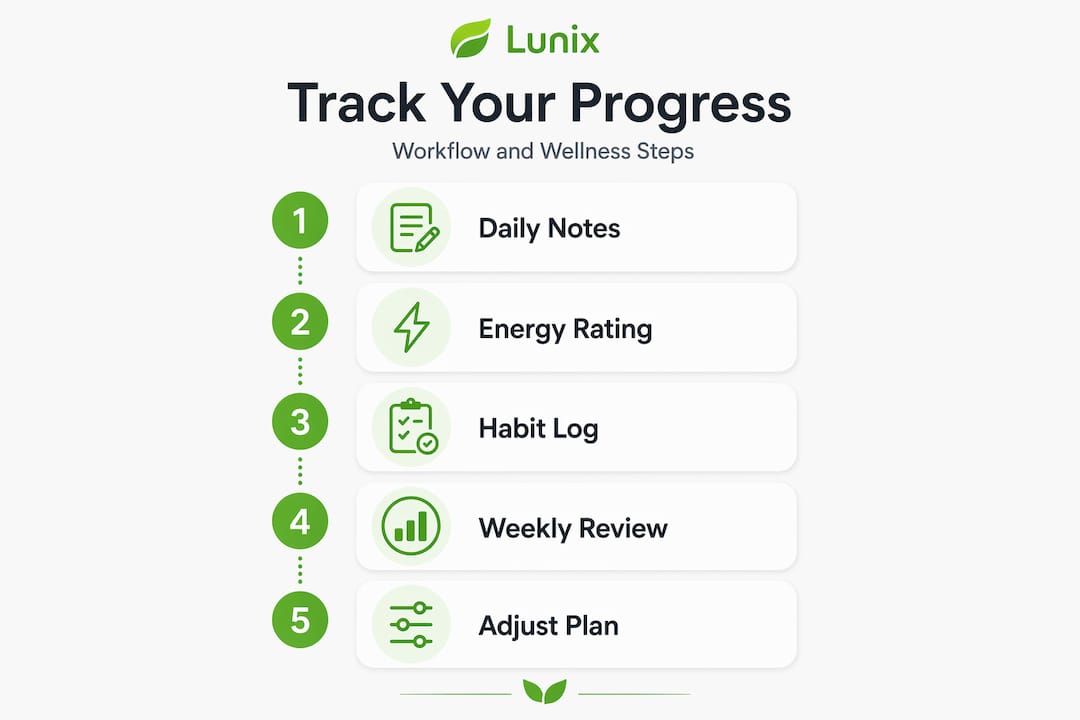
Here is what professionals typically see when they implement a structured productivity and wellness workflow:
| Metric | Before workflow | After 8 weeks |
|---|---|---|
| Daily energy level | Low by 2 PM | Sustained through 4 PM |
| Focus block completion | 40 to 60% of blocks completed | 75 to 85% completion rate |
| Meeting time per week | 12 to 15 hours | 7 to 9 hours |
| Physical movement per day | Fewer than 3,000 steps | 6,000 or more steps |
| Work satisfaction rating | 5 to 6 out of 10 | 7 to 9 out of 10 |
The numbers above reflect real patterns, not promises. Your specific results will vary based on your starting point and how consistently you apply the system.
A few key indicators to watch as you go:
- Are you finishing your deep work blocks without feeling depleted?
- Do you have energy for life outside work by 6 PM?
- Is your task list getting processed rather than growing endlessly?
- Are you sleeping more consistently?
Keep in mind that habit formation averages 59 to 66 days for consistent behaviors. Some complex habits take considerably longer. Patience is not optional. It is part of the process. Review your workflow and how to balance work and wellness every four weeks and make one small adjustment at a time rather than overhauling everything at once.
My honest take on wellness and workflow after 40
There is something I have come to believe deeply after years of working with wellness and productivity systems: the professionals who perform best in their 40s and 50s are not the ones grinding the hardest. They are the ones who figured out that recovery is the work.
I spent years treating my wellness habits as things I would get to eventually. Exercise after the deadline. Sleep after the launch. Rest after the quarter. What I found was that the productivity I was protecting by skipping those things was actually declining. The cost was invisible until it was not.
What changed things for me was treating a 20-minute walk or a full night of sleep not as self-care, but as inputs to cognitive function. Once I framed rest as performance infrastructure, it stopped feeling like something I had to justify. Mindfulness and meditation practices played a real role in that shift, helping me decompress between intense work sessions rather than carrying tension from one block to the next.
For professionals over 40, recovery takes longer and the stakes of ignoring it are higher. Your workflow has to be designed with that reality in mind, not built around the assumption that you can operate at 25-year-old capacity indefinitely. Rhythm matters more than intensity. Showing up consistently at 80% beats burning out at 100% every time.
— Lunix
Support your workflow with Lunix recovery tools

The physical side of your productivity and wellness workflow matters just as much as the mental planning. When your body is stiff, sore, or poorly rested, your attention span and decision-making pay the price. That is where Lunixinc comes in.
Lunixinc designs recovery and comfort products built specifically for the demands of modern professional life. From targeted muscle recovery tools to ergonomic support systems, these products are made to help your body restore after demanding days so you can show up fully the next morning. Explore the full Lunixinc recovery collection and find the tools that fit your space and your rhythm. Your body does the work. Give it what it needs to keep going.
FAQ
What is a productivity and wellness workflow?
A productivity and wellness workflow is a structured daily system that integrates work tasks with physical and mental health habits, treating both as connected rather than competing priorities. It typically includes time-blocking, recovery periods, and weekly reviews.
How long does it take to see results from a wellness workflow?
Most professionals notice improved energy and focus within two to three weeks, but meaningful habit formation takes a median of 59 to 66 days. Consistency over months, not days, drives lasting results.
How can automation help with workflow efficiency?
Targeted automation of repetitive tasks can save professionals approximately 2 hours per week, time that can be redirected toward recovery, deep work, or personal wellness habits.
What are the biggest mistakes professionals make with wellness in the workplace?
The most common mistake is treating wellness as optional, something to do once the work is done. Research shows that excessive meetings and poor task management are also major contributors to burnout and reduced output.
What wellness rituals fit into a busy professional workday?
Short rituals work best. A 90-minute timer for movement and hydration, a five-minute breathing practice between meetings, and a firm end-of-day shutdown routine are practical and research-supported ways to protect your energy without slowing your output.