


TL;DR:
- Work-wellness balance is crucial after 40 due to slower recovery and increased stress impacts.
- Incorporating small, intentional self-care practices into daily routines improves long-term health.
- Organizational support and environment play a vital role in achieving sustainable work-life balance.
You wake up already tired. Your calendar is packed before 9 a.m., your family needs you in the evening, and somewhere between the back-to-back meetings and the late-night emails, your own health keeps slipping to the bottom of the list. Sound familiar? For professionals in their 40s, 50s, and 60s, this isn’t just a bad week. It’s a pattern. The good news is that integrating wellness into a demanding career isn’t about overhauling your entire life. It’s about making smarter, more intentional choices that actually fit your schedule.
Table of Contents
- Why work-wellness balance matters more after 40
- Get set up: Tools, mindsets, and the right environment
- Step-by-step: Integrate wellness into the workday
- Fine-tune and overcome common challenges
- Beyond the checklist: What most work-wellness guides miss
- Take the next step toward recovery and balance
- Frequently asked questions
Key Takeaways
| Point | Details |
|---|---|
| Small actions count | Consistent micro-self-care and brief breaks prevent burnout better than major occasional efforts. |
| Flexibility is vital | Having autonomy over your schedule is strongly linked to improved mental health and work satisfaction. |
| Setup drives success | Creating supportive tools, environments, and mindsets makes balance sustainable long-term. |
| Systems beat solo effort | Both personal boundaries and workplace policies are needed for real, lasting work-wellness gains. |
Why work-wellness balance matters more after 40
The stakes change after 40. Your body recovers more slowly, your stress response is sharper, and the roles you carry at work and at home are often at their most demanding simultaneously. Many professionals in this age group find themselves managing senior-level responsibilities, supporting aging parents, and raising teenagers all at once. That’s a heavy load, and it takes a real toll on energy, mood, and long-term health.
Mental health survey findings from the American Psychological Association reveal how deeply work stress affects overall well-being, especially when employees feel they have little control over their schedules or workloads. Burnout in midlife isn’t just exhaustion. It’s a warning signal from your body that the current pace is unsustainable.
“The most important shift after 40 is recognizing that wellness is no longer optional. It’s the foundation that everything else depends on.” — Wellness professional insight
What makes this period especially tricky is that the traditional advice to “just slow down” doesn’t apply when you’re at the peak of your career. You can’t simply opt out of your responsibilities. What you can do is approach balance with the same strategic thinking you apply to your most important work projects.
Here’s what research confirms about midlife balance strategies: energy management, boundary setting, time-blocking, and protecting personal time become far more impactful in your 40s and beyond. These aren’t soft suggestions. They’re evidence-based tools.
Key reasons why work-wellness balance deserves serious attention after 40:
- Physical recovery slows. Muscles, joints, and your nervous system need more intentional care.
- Chronic stress compounds. Years of unmanaged stress increase the risk of cardiovascular disease, cognitive decline, and immune dysfunction.
- Caregiving duties peak. Many professionals are caught between aging parents and dependent children simultaneously.
- Senior roles bring more pressure. Greater responsibility often means fewer people to delegate to and more decisions to carry.
Incorporating practical self-care tips into your weekly routine isn’t indulgent. It’s necessary maintenance for the decades of performance still ahead of you.
Get set up: Tools, mindsets, and the right environment
Before you can change your habits, you need the right conditions. Think of this as laying the groundwork. Even the best strategy fails without the right environment, tools, and mindset supporting it.
The foundational mindset shift: Stop thinking about wellness as something you’ll get to when work quiets down. Work never fully quiets down. Instead, commit to small, consistent progress. A single 10-minute walk beats a one-hour workout you postpone for three weeks.
APA’s 2023 Work in America Survey found that work-life harmony is strongly tied to having autonomy and flexibility over how, when, and where you work. Lack of flexibility is directly linked to worse mental health outcomes. This matters because your setup, including your schedule, your workspace, and your employer’s policies, shapes what’s even possible for you.
Use this quick readiness checklist before you start building new habits:
| Area | What to assess | Ready? |
|---|---|---|
| Time | Do you have 15-20 min daily to protect? | Yes / No |
| Tools | Do you use a calendar or planner consistently? | Yes / No |
| Workspace | Is your desk ergonomically set up? | Yes / No |
| Employer | Does your company offer flexible work options? | Yes / No |
| Hydration | Are you drinking enough water throughout the day? | Yes / No |
| Mindset | Are you willing to start small and build gradually? | Yes / No |
If you answered “No” to several of these, that’s your starting point. A worksite health assessment from the CDC can help you understand what health-supporting resources your employer already offers or should offer.
Simple environmental upgrades also make a real difference:
- Adjust your physical workspace. A monitor at eye level, a supportive chair, and good lighting reduce fatigue significantly over long workdays.
- Hydrate proactively. Keep a water bottle visible on your desk. Workplace hydration tips suggest drinking 16 ounces before your morning coffee to start hydrated and sharp.
- Use a time-blocking app. Whether it’s Google Calendar, Notion, or a paper planner, schedule your wellness time the same way you schedule meetings.
- Set clear transition signals. A five-minute shutdown ritual at the end of the workday helps your brain shift from “work mode” to “recovery mode.”
Pro Tip: Before building new habits, spend one week tracking how you currently spend your time in 30-minute blocks. You’ll almost always find 30 to 60 minutes of low-value time that can be redirected toward your well-being. This insight alone is worth the effort.
Knowing how to juggle self-care in busy schedules starts with this kind of honest assessment. You don’t need more time. You need better decisions about the time you already have.
Step-by-step: Integrate wellness into the workday
Now comes the practical part. The goal here is integration, not addition. You’re not trying to squeeze more into an already full day. You’re embedding wellness into what you’re already doing.

Small self-care actions and brief breaks during the workday can prevent overload when schedules are tight. This approach, treating wellness as built-in rather than bolted-on, is what separates people who actually improve their health from those who buy gym memberships they never use.
Here’s a proven five-step method:
-
Evaluate your energy patterns. Spend a few days noticing when you feel sharp versus foggy. Most people have one or two peak hours in the morning and a natural dip in the early afternoon. Schedule your deepest work during your peak hours and lighter tasks, or movement breaks, during low-energy periods.
-
Block time like it’s a client meeting. Put your wellness time in your calendar as a non-negotiable appointment. Even 15 minutes for a walk or a stretching break counts. Protect it from meeting requests.
-
Set one clear boundary per week. Start with something manageable. No email after 7 p.m. No lunch eaten at your desk on Wednesdays. One boundary at a time builds the muscle of self-advocacy without overwhelming you.
-
Use micro-actions throughout the day. These are small wellness moves that take under five minutes. Stand and stretch between calls. Do a few shoulder rolls before a stressful meeting. Take three slow breaths when you feel tension rising. Research on burnout prevention shows that these small interruptions protect your mental and physical reserves over time.
-
Reflect and adjust weekly. Every Friday, ask yourself two questions: What helped me feel better this week? What drained me more than necessary? Use your answers to make one small tweak the following week.
| Integrated approach | Separated approach |
|---|---|
| Walk during a phone call | Save walks for after work only |
| Stretch at your desk between tasks | Wait for a dedicated workout session |
| Hydrate throughout the day | Drink water only with meals |
| Short breathing break before hard tasks | Push through tension without pausing |
| Healthy snack prepped the night before | Grab whatever’s in the vending machine |
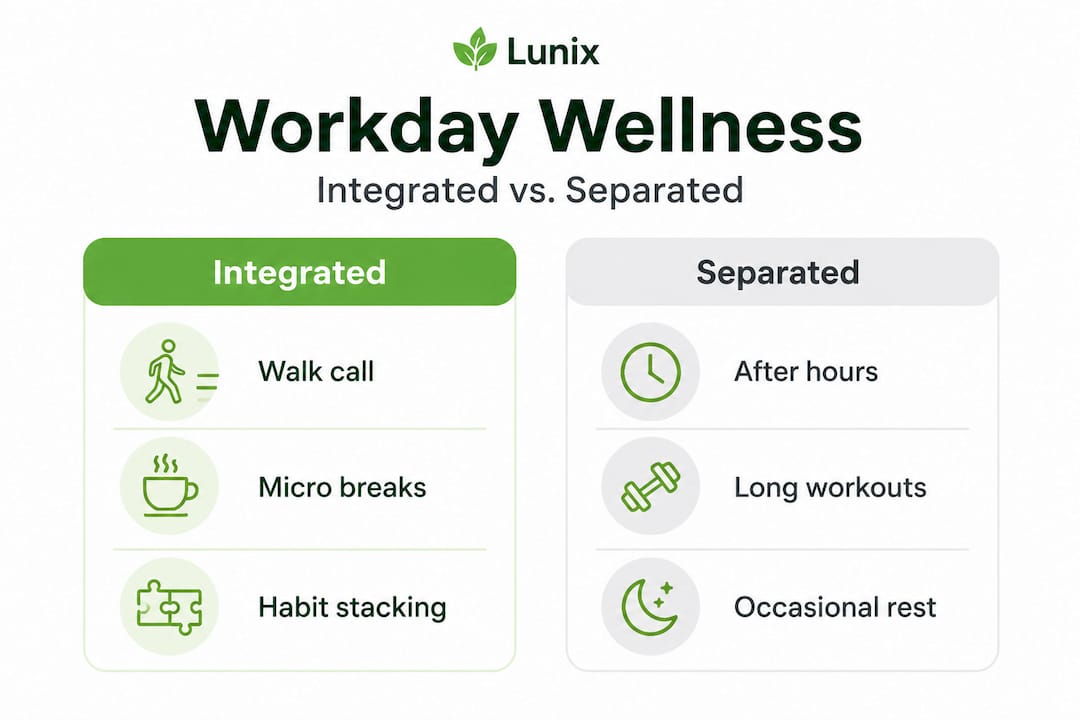
The integrated approach wins because it works with your schedule, not against it. Discover specific self-care strategies for busy people that complement this system.
Pro Tip: Pair new wellness habits with things you already do consistently. This is called habit stacking. For example, practice mindfulness and meditation techniques for two minutes right after you pour your morning coffee. Attach movement to your lunch break. Stack a quick gratitude note onto your end-of-day shutdown ritual. The habit you already have becomes the trigger for the new one.
Fine-tune and overcome common challenges
Even the best plan hits friction. Here’s where most people give up because they expect the path to be smooth. It won’t be. But most obstacles are predictable, and that means they’re manageable.
Common roadblocks and how to handle them:
- Schedule overload: When your calendar is maxed out, identify one meeting per week that could be an email instead. Reclaim that time for recovery.
- Guilt about taking breaks: Remind yourself that rest is part of performance. Athletes don’t skip recovery and expect to improve. Neither should you.
- Unsupportive supervisors: Document your productivity during periods when you prioritize your wellness. Numbers talk. Share evidence on the mental health value of flexibility if a conversation becomes necessary.
- Unrealistic expectations: Don’t try to change everything at once. Commit to one new habit for three weeks before adding another.
CDC guidance on burnout makes a critical point: work-life interventions work best as a system, not just individual coping strategies. Policies, workload design, and social support all matter. This means that if your organization’s culture actively works against wellness, individual tactics will only take you so far.
“When the system is broken, personal effort alone cannot fix it. The most sustainable change happens when individuals and organizations move together.”
When you’re feeling stuck, look beyond your own habits:
- Ask HR about Employee Assistance Programs (EAPs) or wellness stipends you may not be using.
- Request a formal conversation with your manager about workload design.
- Connect with colleagues who share your values. Collective norms shift organizational culture more than solo efforts ever can.
Verify that your approach is working by tracking three simple signals: your energy level by mid-afternoon, the quality of your sleep, and how present you feel in personal relationships. Improvement in even one of these is meaningful progress. Learning more about relaxing after work can help you protect your personal time even on the hardest days.
For deeper perspective on challenges after 40, the context of midlife transitions offers important reassurance that these struggles are universal and addressable with the right support.
Beyond the checklist: What most work-wellness guides miss
Here’s something that most wellness articles won’t say directly: personal discipline is not the main reason people fail at work-wellness balance. The real reason is that most professionals are trying to achieve individual calm inside systems that are structurally chaotic.
We’ve spent years watching highly motivated, genuinely committed people burn out not because they lacked willpower but because their organizations rewarded overwork, punished visible rest, and failed to design manageable workloads. No number of breathing exercises fixes a 60-hour workweek with no end boundary.
This is why we believe in advocating not just for personal habits but for organizational change. If you’re in a senior role, you have influence. Use it. Model boundary setting publicly. Protect your team’s personal time. Build wellness into your team’s operating norms, not just your own.
The research on home wellness tools reinforces this point: the environments we live and work in shape our behavior far more than our intentions do. Creating physical and organizational conditions that support recovery is not a luxury. It’s a leadership decision.
Lasting work-wellness balance is not a solo project. The professionals who thrive over the long run are those who combine smart personal strategies with the courage to demand better systems around them.
Take the next step toward recovery and balance
You’ve now got a clear, practical map for integrating wellness into your professional life. The next move is building the right environment to support it, both at work and at home.

Lunix designs recovery and comfort solutions built specifically for people who take their well-being seriously. Whether you’re winding down after a long day or building a home recovery routine that complements your work-life balance plan, our recovery tools are crafted to help your body restore, relax, and perform at its best. Explore everything we offer at Lunix and find the products that fit your lifestyle, not the other way around. Your well-being deserves more than good intentions. It deserves the right support.
Frequently asked questions
What is the first step to balancing work and wellness?
Start by evaluating your routine to identify which activities energize versus drain you, then block personal time directly into your calendar as a non-negotiable commitment.
How can I make self-care part of my busy workday?
Integrate brief wellness actions throughout your day rather than saving them for after hours. Short breaks, movement, and mindful breathing work even in the busiest schedules.
What if my manager doesn’t support flexible work options?
Use available EAP programs, track and document your performance data, and share evidence on how flexibility improves mental health to open a productive conversation with your supervisor.
What workday habits improve mental health the most?
Blocking focused work time, protecting personal time, walking during calls, and staying hydrated consistently improve focus, mood, and sustained energy throughout the day.
Are there workplace wellness tools to help with balance?
Yes. The CDC’s Worksite Health ScoreCard gives employers a structured checklist for implementing evidence-based health-promoting strategies across multiple wellness categories.
Recommended
- Top well-being improvement tips for adults 40-65 – Lunix
- Best wellness routines for lasting well-being in midlife – Lunix
- How Technology Enhances Wellness for Adults 40-65 – Lunix
- Finding Balance: How to Juggle Self-Care with a Busy Schedule – Lunix
- Somatic Therapy & Executive Stress Management | Dr. Danielle
- Why Women Over 40 Gain Weight Even With Exercise