


TL;DR:
- Setting wellness goals involves creating clear, measurable plans to improve health, especially for adults over 40. Using the SMART framework and habit stacking helps build sustainable routines that fit individual lifestyles, increasing long-term adherence. Regular review and a flexible mindset prevent setbacks from leading to failure, emphasizing consistency over perfection.
Setting wellness goals is the deliberate process of defining clear, measurable aims to improve your physical and mental health. For adults in their 40s, 50s, and 60s, this process carries real weight. Bodies change, priorities shift, and the old “push harder” approach often backfires. The good news is that about 80% of wellness resolutions fail by mid-February not because of weak willpower, but because of weak strategy. That means the fix is practical, not personal. Learning how to set wellness goals the right way, using frameworks like SMART goals and habit stacking, gives you a real path forward rather than another fresh start that fades.
What are SMART wellness goals and why do they work?
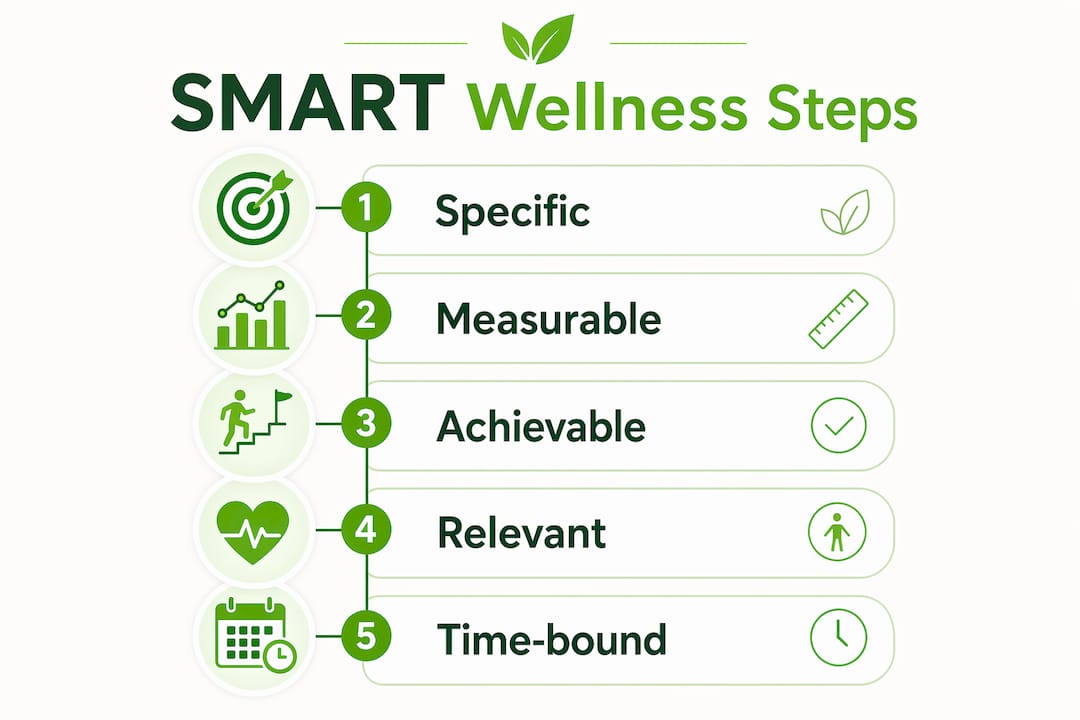
SMART wellness goals are defined by five criteria: Specific, Measurable, Achievable, Relevant, and Time-bound. Each element does a specific job. Together, they turn a vague wish into a working plan.
Here is what each element means in practice:
- Specific: Name the exact behavior. “Walk 30 minutes after dinner” beats “exercise more” every time.
- Measurable: Attach a number. “Drink 64 ounces of water daily” gives you something to check off.
- Achievable: Match the goal to your current fitness level, not your ideal one. A goal that challenges you without crushing you is the sweet spot.
- Relevant: The goal must connect to something you actually care about. If better sleep matters to you, build goals around sleep, not marathon training.
- Time-bound: Set a deadline or review date. “By the end of six weeks” creates urgency without panic.
Specificity in goal phrasing using precise action verbs improves both measurability and follow-through. “Walk,” “lift,” “stretch,” and “sleep” are action verbs. “Be healthier” is not. The language you use shapes the behavior you build.
For adults 40 and older, the NIH recommends at least 150 minutes of moderate physical activity per week, plus strength training for all major muscle groups at least two days per week. That standard gives you a concrete benchmark to build your SMART goals around, rather than guessing what “enough” looks like.
Pro Tip: Write your SMART goal as a full sentence before you commit to it. If you cannot read it aloud and picture yourself doing it, it is not specific enough yet.
How to choose wellness goals that fit your lifestyle
The right wellness goal for you is not the most popular one. It is the one that fits your actual life, not the life you plan to have someday.
Start with a self-assessment. Ask yourself what is already working, what feels draining, and what one change would make the biggest difference to your daily energy or comfort. Your “why” matters more than the goal itself. A person who wants to sleep better so they can be present with their grandchildren has a stronger motivator than someone chasing a number on a scale.
Once you know your why, use these steps to build goals that hold:
- Identify your keystone habit. Keystone habits are small but pivotal actions that trigger broader positive changes. For many adults, daily walking is a keystone habit. It improves mood, supports joint health, and often leads to better food choices without any extra effort.
- Use habit stacking. Habit stacking links a new behavior to an existing routine, reducing friction and willpower drain. After you brew your morning coffee, do five minutes of stretching. The coffee cue does the heavy lifting.
- Set goals at 50% of what feels reasonable. Starting at about half of what you think you can handle prevents early burnout and builds the consistency that compounds over time. Two short walks per week beats one ambitious workout you never repeat.
- Design your environment. Reducing friction is one of the most underrated wellness strategies. Put your walking shoes by the door. Keep a water bottle on your desk. Make the healthy choice the easy choice.
- Add, do not restrict. Crowding out negative habits by adding beneficial ones leads to better long-term results than focusing on what you cannot have. Add a vegetable to dinner before you think about cutting anything out.
Pro Tip: If a new goal requires buying something, rearranging your schedule, or relying on motivation, redesign it. The best wellness habits fit into your life as it already exists.
A personalized wellness plan built around your real priorities is far more durable than a generic program borrowed from someone else’s routine.
How do you set and track wellness goals step by step?
A clear process removes the guesswork from setting health objectives. Follow these steps to build a plan that moves from intention to habit.

Step 1: Write down your goal using the SMART format. Be specific about the behavior, the frequency, and the timeframe. “I will do 20 minutes of strength training three times per week for the next 90 days” is a complete goal.
Step 2: Set a 90-day milestone. Using 90-day milestones keeps urgency alive while leaving room to adjust for real-life changes like travel, illness, or family demands. Three months is long enough to see results and short enough to stay focused.
Step 3: Choose a tracking method. The best tracker is the one you will actually use. Options include:
- A paper journal with daily check-ins
- A free habit-tracking app on your phone
- A simple spreadsheet with weekly totals
- A wellness planner designed for busy adults over 40
Step 4: Schedule a weekly review. Pick one day each week to look at your progress. Ask two questions: Did I do what I planned? If not, what got in the way? This review takes five minutes and prevents small slips from becoming full stops.
Step 5: Adjust without guilt. Life changes, and your goals should too. Dropping from three workouts to two during a stressful month is not failure. It is smart adaptation.
The table below shows how to structure your 90-day wellness tracking cycle.
| Phase | Weeks | Focus | Review Action |
|---|---|---|---|
| Build | 1–4 | Establish the habit consistently | Check frequency, adjust if needed |
| Strengthen | 5–8 | Increase duration or intensity slightly | Note energy and mood changes |
| Sustain | 9–12 | Maintain and reflect on progress | Set next 90-day goal |
Home health tools and monitoring methods can support this tracking process, especially when you want to connect daily habits to measurable health outcomes.
Common mistakes in wellness goal setting and how to avoid them
The most common reason wellness goals fail is not a lack of effort. It is a flawed approach that sets you up to quit.
Watch for these patterns:
- All-or-nothing thinking. Missing one workout does not erase your progress. Treating a slip as total failure is the fastest way to abandon a goal entirely.
- Goals built on restriction. Telling yourself you cannot eat something, cannot sit down, or cannot rest creates fixation. Focus on what you are adding, not what you are removing.
- Goals that depend on motivation. Motivation is unreliable. Systems and environment are not. Build your goal around a routine, not a feeling.
- No plan for setbacks. Life will interrupt your routine. A coping plan, such as a shorter backup workout or a five-minute walk instead of 30, keeps the habit alive through disruption.
“A compassionate mindset that embraces flexibility and self-forgiveness is essential for long-term wellness goal adherence, especially amid life’s unpredictability. The ‘start again’ approach after a slip enhances consistency and prevents burnout far more effectively than self-criticism.”
The start-again approach treats every day as a fresh opportunity rather than a continuation of yesterday’s failure. That single mindset shift has more impact on long-term adherence than any specific goal structure. Pair it with a wellness habits checklist to keep your daily routine grounded even when motivation dips.
Understanding what a wellness plan actually involves can also help you avoid the trap of treating goal setting as a one-time event rather than an ongoing practice.
Key Takeaways
The most effective approach to setting wellness goals combines the SMART framework, habit stacking, and a flexible mindset that treats setbacks as normal rather than final.
| Point | Details |
|---|---|
| Use the SMART framework | Define goals that are specific, measurable, achievable, relevant, and time-bound for real results. |
| Start smaller than you think | Set goals at about 50% of what feels reasonable to build consistency without early burnout. |
| Stack habits onto routines | Link new behaviors to existing ones to reduce friction and make habits stick naturally. |
| Track with 90-day milestones | Review progress every three months to stay focused and adjust without losing momentum. |
| Adopt the start-again mindset | Treat every slip as a reset point, not a failure, to protect long-term adherence. |
What I have learned about wellness goals after 40
The advice I keep coming back to is this: the goal is not the point. The habit is the point.
When I was younger, I chased outcomes. Lose ten pounds. Run a 5K. Sleep eight hours. The goals were clear, but they were also brittle. One bad week and the whole structure collapsed. What changed my approach was realizing that the goal is just a direction. The daily behavior is what actually builds health.
After 40, the body gives you honest feedback faster than it did at 25. Recovery takes longer. Stress shows up in your joints and your sleep before it shows up anywhere else. That is not a problem to fix. It is information to use. The adults I see making real, lasting progress are not the ones with the most ambitious goals. They are the ones who show up consistently, adjust without drama, and treat their wellness routine as a non-negotiable part of the day, like brushing their teeth.
The chiropractic lifestyle change process offers a useful parallel here. Sustainable health changes come from gradual behavioral shifts, not dramatic overhauls. That principle applies whether you are working on movement, sleep, nutrition, or recovery.
My practical tip: pick one goal, make it almost embarrassingly easy, and do it every day for 30 days. Then build from there. Small and consistent beats big and sporadic every single time.
— Lunix
Lunixinc’s recovery tools and your wellness goals
Setting a goal is the first step. Having the right support makes the difference between a goal that fades and one that becomes part of your life.

Lunixinc designs recovery and comfort solutions specifically for adults who want their body to feel as good as their intentions. Whether you are working on better sleep, reduced muscle tension, or daily restoration, the Lunixinc recovery collection offers tools that fit directly into the habits you are building. For a broader look at how Lunixinc supports your health outcomes, the Lunixinc benefits page outlines the full range of wellness support available. Your goals deserve more than good intentions. They deserve the right environment to grow.
FAQ
What are wellness goals?
Wellness goals are specific, intentional aims you set to improve your physical and mental health. They cover areas like movement, sleep, nutrition, stress management, and recovery.
How do SMART goals apply to wellness?
SMART wellness goals are specific, measurable, achievable, relevant, and time-bound. This structure turns vague intentions like “get healthier” into clear plans like “walk 30 minutes five days per week for 90 days.”
How often should you review your wellness goals?
A weekly check-in and a full 90-day review cycle work well for most adults. The 90-day structure keeps goals flexible enough to adjust for life changes while maintaining enough urgency to stay on track.
Why do most wellness goals fail?
About 80% of wellness resolutions fail by mid-February due to poor strategy, not lack of willpower. Common causes include goals that are too vague, too ambitious, or built on restriction rather than addition.
What is the best way to track wellness goals?
The best tracking method is the one you will use consistently. Options include a daily journal, a habit-tracking app, or a structured wellness planner. Pair any method with a weekly review to catch problems early.