


Mindful eating is the practice of bringing full, nonjudgmental attention to what you eat, how it tastes, and how your body feels during a meal. This guide gives you everything you need to start today.
- Core benefit: Greater awareness of hunger and fullness cues, which naturally reduces emotional and binge eating over time.
- Not a diet: Mindful eating is a skills-based practice, not a set of food rules. There is no “right” or “wrong” food, only deeper awareness of your choices.
- What’s inside: Step-by-step exercises (including the classic raisin exercise), a 4-week starter plan, common pitfalls, and simple troubleshooting so you can build a lasting habit.
Key Takeaways
Mindful eating is a nonjudgmental awareness practice that, when applied consistently, reduces emotional eating, improves satiety recognition, and supports better mental health over time.
| Point | Details |
|---|---|
| Start with one micro-habit | The utensil-down technique or a single breath before eating builds awareness faster than overhauling every meal at once. |
| Distraction costs you | Brigham & Women’s reports that divided attention during meals may reduce digestive effectiveness by roughly 30–40%. |
| Evidence is encouraging | Trials link mindful eating to reduced emotional and binge eating; a systematic review connects it to better mental-health outcomes. |
| Four weeks builds a foundation | Progress through sensory awareness, pacing, mindful prep, and shared meals to make the practice sustainable. |
| Lunix supports the environment | Lunix recovery tools help reduce physical tension before meals, making it easier to arrive calm and present at the table. |
Table of Contents
- What mindful eating actually means (and how it differs from dieting)
- Why the research supports giving mindful eating a real try
- How to practice mindful eating: exercises and daily habits
- Common pitfalls and how to fix them quickly
- How to make mindful eating a lasting habit
- Meal planning and preparation that support mindful eating
- Lunix’s perspective: mindful eating as a foundation for whole-body wellness
- Lunix recovery tools that help you create a calmer eating environment
- Sources
What mindful eating actually means (and how it differs from dieting)
Mindful eating is a nonjudgmental, present-moment awareness of the physical and emotional sensations connected to eating. You notice the smell, texture, and taste of your food. You tune in to hunger and fullness signals. You observe thoughts and feelings about eating without labeling them as good or bad.
The core attitudes that make this practice work:
- Curiosity: Approach each meal as if tasting it for the first time.
- Nonjudging: Notice cravings or overeating without self-criticism.
- Patience: Change happens gradually; rushing the process undermines it.
- Beginner’s mind: Let go of assumptions about what eating “should” look like.
- Acceptance: Acknowledge what is happening in your body right now.
The contrast with dieting is worth spelling out clearly. A diet gives you external rules: eat this, avoid that, stop at this calorie count. Mindful eating gives you internal skills: the ability to recognize why you are reaching for food and how your body actually responds to it. As the Cleveland Clinic notes, it focuses on the “why” and “how” of eating rather than prescribing a specific plan. That distinction matters because skills stay with you; rules tend to break down under stress.
Why the research supports giving mindful eating a real try
The evidence for mindful eating is genuinely encouraging, though it is worth being honest about where the data is strong and where it is still developing.
- Multiple trials found that mindful-eating interventions were associated with reductions in emotional and binge eating across several study samples, a finding that holds up across different populations and formats.
- Harvard Health reports that slowing eating pace and increasing meal awareness can support weight management, though mindful eating is not a guaranteed weight-loss program.
- A systematic review published in European Psychiatry found that mindful and intuitive eating approaches are associated with lower disordered-eating symptoms and better mental-health outcomes across observational studies.
- Harvard T.H. Chan School of Public Health notes that the nonjudgmental attitude at the heart of mindful eating can reduce shame and guilt tied to emotional eating, which is one of the most underappreciated benefits.
- Mindful eating may support better digestion and gut-brain connection by reducing the stress response during meals.
A note on limits: Most trials are short-term and use self-reported data. Long-term, large-scale randomized controlled trials are still limited. Treat the evidence as a strong, coherent signal rather than a settled verdict.
Did you know? Brigham & Women’s Hospital reports that distracted eating is linked to overeating, and that when your attention is elsewhere during a meal, digestive effectiveness may drop significantly. Eating while scrolling your phone is not a neutral habit.
How long before you notice a difference? Most people report a shift in awareness within two to four weeks of consistent practice. Changes in eating behavior, such as eating more slowly or stopping closer to fullness, often follow within four to eight weeks. Weight-related changes, when they occur, tend to take longer and vary widely by individual.
| Behavior | Distracted eating | Mindful eating |
|---|---|---|
| Attention during meal | Split between food and screen/task | Focused on sensory experience |
| Digestion | Potentially reduced effectiveness | Supported by relaxed, present state |
| Satiety cues | Often missed or delayed | Recognized in real time |
| Emotional reactivity | Higher; eating may escalate stress | Lower; awareness interrupts automatic response |
How to practice mindful eating: exercises and daily habits
The raisin (or apple) exercise
This is the most widely taught entry point in mindful eating, used in clinical programs and described in detail by the VA Whole Health Library. You can do it with a single raisin, a grape, or a small piece of apple.
- Hold it. Place the food in your palm. Look at it as if you have never seen it before. Notice its color, shape, and texture.
- Smell it. Bring it close to your nose. What do you notice? Does your mouth respond?
- Place it on your tongue. Do not bite yet. Notice the weight, the texture, the temperature.
- Take one slow bite. Pay attention to the sound, the burst of flavor, the way it changes in your mouth.
- Chew slowly. Count ten full chews before swallowing. Notice the shift in texture and taste.
- Swallow with awareness. Follow the sensation as it moves down your throat.
- Pause. Sit with the experience for five seconds before reaching for more.
This exercise takes under three minutes and retrains your brain to slow down and pay attention. Most people are surprised by how much flavor they missed when eating on autopilot.
Seven daily mindful eating habits
These micro-practices work at any meal, even a rushed lunch:
- Sit down every time you eat. Standing at the counter while eating is one of the fastest ways to disconnect from fullness cues.
- Remove one distraction. You do not need to eliminate your phone entirely; start by turning the screen face-down.
- Put your utensil down between bites. This single habit slows your pace more reliably than any other technique.
- Chew each bite thoroughly. Aim for 15–20 chews before swallowing; this also supports digestion.
- Set a minimum meal length of 15–20 minutes. Your brain needs roughly 20 minutes to register fullness, so eating faster almost always means eating more.
- Take a gratitude pause before the first bite. One breath, one moment of acknowledgment. It shifts your nervous system from reactive to receptive.
- Single-task the meal. Treat eating as the activity, not the background to another activity. Cooking as a mindful practice can extend this awareness into food preparation as well.
A 3-minute mindful lunch (when time is short)
You do not need a quiet retreat to practice. Here is a compact routine for a busy workday:
- Before you open your container, take one slow breath in and out.
- Look at your food for five seconds. Notice colors and textures.
- Take your first bite slowly and chew it fully before reaching for the next.
- Put your fork or spoon down after every third bite.
- Halfway through, pause for ten seconds and check your hunger level on a scale of 1–10.
- Finish when you feel satisfied, not stuffed.
Pro Tip: If you only have time for one micro-action, make it the breath before the first bite. That single pause interrupts the automatic eating pattern and brings you back to the present moment, even on the most hectic days.
Common pitfalls and how to fix them quickly
Mindful eating is simple in concept but easy to derail in practice. Here are the mistakes most beginners make, and the straightforward fixes:
- Treating it like a diet. You start tracking “mindful” foods or feeling guilty for eating quickly. Fix: return to the Cleveland Clinic’s framing — this is about awareness of why and how, not a new set of rules about what.
- Perfectionism. You miss a mindful meal and decide the whole practice has failed. Fix: one unmindful meal is not a setback; it is just a meal. Start fresh at the next one.
- Expecting quick weight loss. You weigh yourself after two weeks and feel discouraged. Fix: measure progress by awareness and satisfaction, not the scale. Weight changes, when they occur, follow behavioral shifts that take months.
- Multitasking through meals. You put your phone down but keep mentally rehearsing your to-do list. Fix: use a physical anchor, like the sensation of the fork in your hand or the temperature of the food, to return your attention.
- Skipping meals and then overeating. Arriving at a meal ravenously hungry makes mindful eating nearly impossible. Fix: aim for three regular meals per day to keep hunger at a manageable level before you sit down.
Troubleshooting flow:
- Mind wanders during the meal? Notice it without judgment, then return your attention to one sensory detail: the taste, the texture, the temperature. This is the practice, not a failure of it.
- Perfectionism creeping in? Remind yourself that mindful eating is a skill, and skills improve with repetition, not with self-criticism.
- Emotional eating triggered? Pause and name the emotion before eating. You do not need to stop eating; you just need to know what is driving it. Our guide on understanding emotional snacking walks through this in more detail.
Mind-wandering during meals is completely normal, especially at the start. The moment you notice your attention has drifted is itself a moment of mindfulness. Treat it as a cue to return, not a reason to quit.
How to make mindful eating a lasting habit
One-off exercises do not build lasting change. Habit science does. Here are the tactics that actually work:
- Habit stacking: Attach a mindful-eating cue to something you already do reliably, like washing your hands before a meal. The existing habit triggers the new one.
- Environment design: Use a smaller plate to naturally moderate portion size without willpower. Keep distractions physically out of reach rather than relying on discipline.
- Cue-routine-reward: Your cue is sitting down; your routine is the gratitude breath and utensil-down practice; your reward is the genuine pleasure of tasting food more fully.
- Use reminders strategically: A sticky note on your dining table or a phone alarm labeled “one breath before eating” works better than relying on memory.
- Track mood and awareness, not calories. A simple journal entry after meals (“How hungry was I? How do I feel now?”) builds self-knowledge faster than any food log. For a broader framework, the wellness planner approach for busy adults offers practical scheduling tools.
Your 4-week starter plan
| Week | Focus | Micro-goal |
|---|---|---|
| Week 1 | Sensory awareness | Try the raisin/apple exercise once; take one breath before every meal |
| Week 2 | Pace and presence | Put utensils down between every bite at one meal per day |
| Week 3 | Mindful shopping and prep | Choose one ingredient at the grocery store with full attention; prep one meal without distractions |
| Week 4 | Social and shared eating | Practice at one family or shared meal; notice how conversation and pace interact |
Pro Tip: Measure your progress with a mood and awareness log, not a scale. After each meal, jot down two things: how hungry you were when you started, and how satisfied you feel now. Patterns emerge within two weeks and give you far more useful feedback than weight alone.
Most people notice meaningful shifts in awareness within the first month. If you find that emotional eating, binge eating, or food-related anxiety feels unmanageable, consider working with a registered dietitian or therapist who specializes in intuitive eating or cognitive behavioral approaches. Mindful eating is a powerful tool, but it is not a substitute for clinical support when disordered eating is present.
Meal planning and preparation that support mindful eating
How you shop and cook shapes how you eat, often more than any in-the-moment technique.
Shop with intention. Before you go to the store, take five minutes to plan meals around foods you genuinely enjoy and that make your body feel good. A list built on awareness rather than impulse reduces the chance of filling your cart with foods you eat mindlessly later.
Prep with presence. Chopping vegetables, stirring a pot, or arranging a plate can all be mindful acts. Notice the colors, smells, and textures as you work. This is not about making cooking a slow ritual; it is about staying present rather than mentally leaving the kitchen while your hands stay in it.
Plate your food. Eating directly from a bag or container removes visual cues about portion size. Plating your food, even a snack, creates a moment of pause and gives you a clearer sense of how much you are actually eating.
Build variety deliberately. A plate with different colors, textures, and flavors naturally slows you down because there is more to notice. Contrast, like something crunchy alongside something soft, keeps your attention engaged throughout the meal.
Adapt for dietary needs. Mindful eating works with any dietary pattern, whether you follow a plant-based diet, manage food allergies, or eat for a specific health condition. The practice is about awareness of your experience, not about which foods are on the plate. If you have allergies or restrictions, the prep stage is where mindful attention pays off most: reading labels carefully, noticing substitutions, and cooking with full attention to ingredients.
For family meals, involve everyone in at least one step of preparation. Children who help wash, stir, or arrange food tend to eat more slowly and with more curiosity. Even a two-minute “what do you notice?” conversation at the table before eating can shift the tone of a shared meal.
Lunix’s perspective: mindful eating as a foundation for whole-body wellness
Mindful eating does not exist in isolation. At Lunix, we see it as one of the most accessible entry points into a broader self-care practice, because it requires no equipment, no special schedule, and no prior experience. You already eat every day. The practice is simply about showing up differently for something you are already doing.
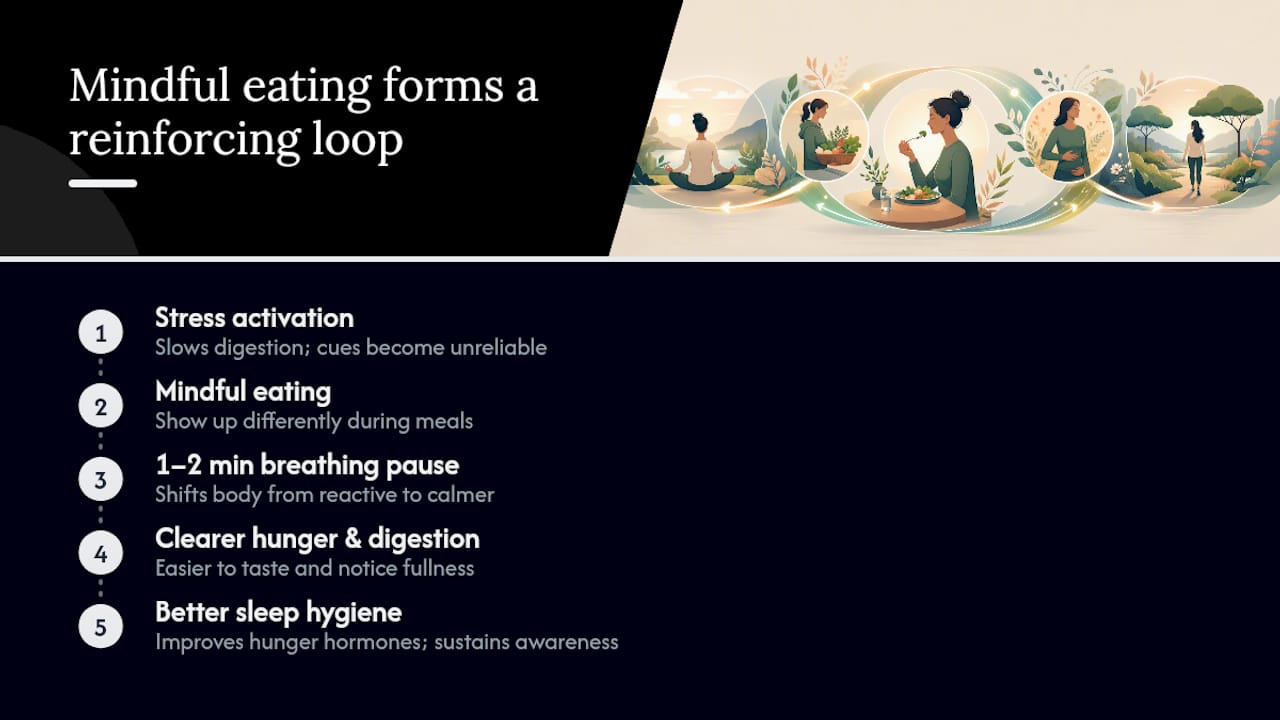
What we find genuinely compelling about mindful eating is how naturally it pairs with other stress-reduction habits. When your nervous system is activated by stress, digestion slows, hunger cues become unreliable, and emotional eating becomes far more likely. A mindful breathing pause of one to two minutes before a meal can shift your body from a reactive state to a calmer one, making it easier to taste your food, recognize fullness, and eat without the background noise of anxiety. This is not a theory; it is a practical pairing that costs nothing and takes less time than checking your phone.
Sleep quality matters here too. Poor sleep disrupts hunger hormones and makes mindful awareness harder to sustain. Pairing mindful eating with better sleep hygiene creates a reinforcing loop: you eat with more awareness, you feel better, and you sleep more soundly.
Lunix’s content library covers mindfulness and stress-reduction techniques that complement everything in this guide, from breathing resets to relaxation practices you can build into your daily routine.
Lunix recovery tools that help you create a calmer eating environment
Mindful eating is a skill you build through practice, not a product you buy. That said, the environment you eat in matters. Chronic tension, physical discomfort, and a body that never fully unwinds make it harder to arrive at a meal in a calm, present state.

Lunix’s recovery collection includes tools designed to help your body decompress before and after the demands of the day: percussion massagers, infrared sauna blankets, and red light therapy devices that support relaxation and physical recovery. A short recovery session before a shared family dinner, for example, can lower physical tension and make it genuinely easier to sit down, slow down, and be present for the meal. These products are adjuncts to your practice, not replacements for it. Think of them as part of the environment you are designing for better well-being. Browse the Lunix recovery collection to find what fits your routine.
Sources
These are the primary sources and trusted resources behind this guide, organized so you can go deeper on whichever angle matters most to you.
- Mindful Eating - The Nutrition Source
- Mindful eating - Cleveland Clinic
- Mindful eating may help with weight loss - Harvard Health
- Pmc
- Food for the Mind: A systematic review of mindful and intuitive eating approaches for mental health & wellbeing | European Psychiatry | Cambridge Core