


TL;DR:
- Wellness involves actively choosing habits that promote holistic health and overall fulfillment, especially during midlife transitions.
- It is a continuous process across eight interconnected dimensions, with improvements in one area supporting others over time.
Wellness is defined as the active, ongoing pursuit of choices, habits, and lifestyles that lead toward holistic health and optimal well-being, not simply the absence of illness. The Global Wellness Institute and Syracuse University both frame wellness as a dynamic, multi-dimensional process that requires intentional effort across every area of life. For adults between 40 and 65, understanding this definition of wellness is especially meaningful. Your body, relationships, work, and sense of purpose are all shifting during this life stage, and a clear framework for what wellness actually means gives you a real foundation to build on.
What is wellness and why does it matter at midlife?
Wellness is best understood as a process, not a destination. You are never simply “well” or “unwell.” Instead, you are constantly making choices that move you closer to or further from your personal best state of health and fulfillment. This is why the importance of wellness grows sharper as you move through your 40s, 50s, and early 60s. The decisions you make now about sleep, movement, relationships, and mental engagement compound over time in ways that profoundly shape your quality of life.
The World Health Organization defines health as a state of complete physical, mental, and social well-being, not merely the absence of disease. Wellness builds on that foundation by adding personal agency. You are not just a passive recipient of health outcomes. You are an active participant shaping them. That distinction matters because it shifts the focus from managing symptoms to building a life that supports your body and mind at every level.
Research from the University of Tennessee confirms that wellness is a dynamic, multi-dimensional process that evolves as life circumstances change. This explains why a wellness lifestyle that worked in your 30s may need recalibrating by your 50s. Your priorities, energy levels, social roles, and physical needs are different now, and your approach to well-being should reflect that.
What are the key dimensions of wellness and why do they matter?
The most widely used framework for understanding holistic wellness comes from SAMHSA, which identifies eight interconnected dimensions of wellness. Each dimension represents a distinct area of life that contributes to your overall health. Neglecting any one of them creates a ripple effect that weakens the others.

Here is a breakdown of all eight dimensions with practical examples relevant to adults in midlife:
| Dimension | What it involves | Example for adults 40-65 |
|---|---|---|
| Physical | Movement, sleep, nutrition, and body care | Daily 30-minute walks, consistent sleep schedule |
| Emotional | Resilience, self-awareness, and coping skills | Journaling, therapy, or mindfulness practice |
| Social | Meaningful relationships and community | Regular contact with friends, joining a group |
| Spiritual | Purpose, values, and meaning | Meditation, faith practice, or volunteering |
| Occupational | Satisfaction and engagement in work or purpose | Pursuing meaningful projects or mentoring others |
| Intellectual | Curiosity, learning, and mental stimulation | Reading, taking a course, or learning a skill |
| Environmental | Safe, supportive physical surroundings | Organizing your home for rest and recovery |
| Financial | Security, planning, and reduced money stress | Budgeting, retirement planning, reducing debt |
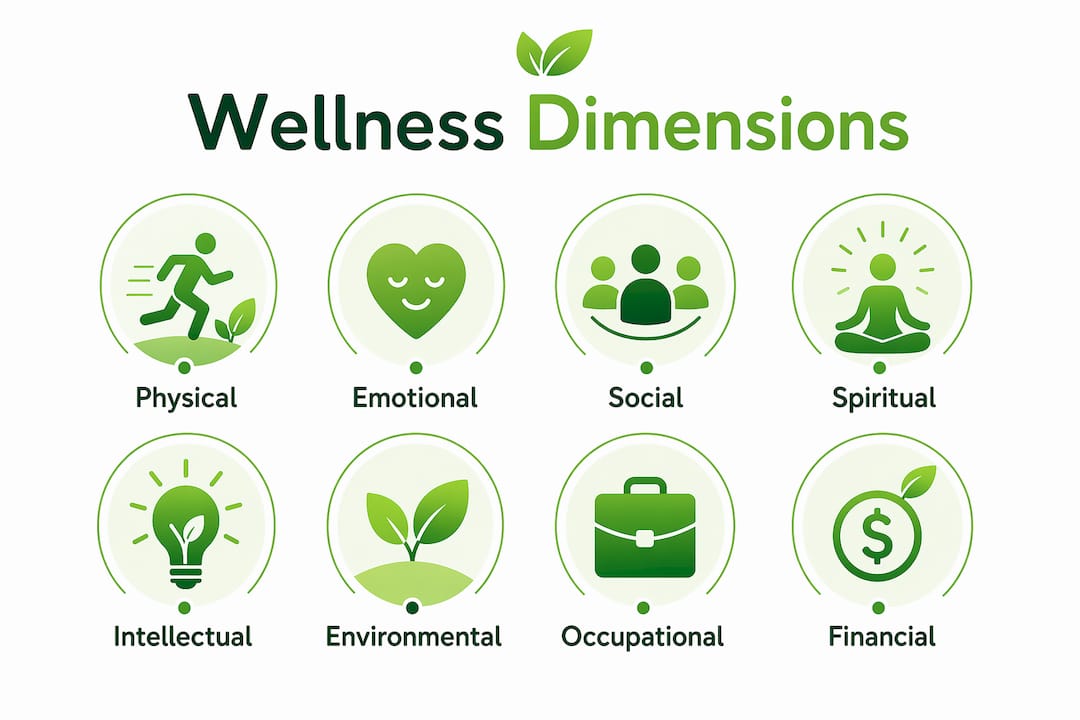
The key insight here is that these dimensions function as an interlocking system. When you improve your physical activity, your emotional regulation often improves alongside it. When financial stress drops, sleep quality tends to rise. The NIH confirms that improvement in one dimension frequently facilitates gains in others, which means small, consistent changes across multiple areas produce outsized results over time.
A common mistake is treating wellness as synonymous with physical fitness alone. Magellan Health’s analysis of SAMHSA-based wellness models shows that overlooking financial, occupational, intellectual, or spiritual dimensions significantly limits overall progress, even when physical health is strong.
Pro Tip: If you feel stuck in your wellness routine despite exercising regularly, check which dimensions you have been ignoring. Adding one small practice in an underdeveloped area, such as a weekly social connection or a new learning activity, often breaks the plateau faster than intensifying your physical routine.
How is wellness different from health, well-being, and similar terms?
These three terms are used interchangeably in everyday conversation, but they carry meaningfully different definitions. Understanding the distinctions helps you think more clearly about what you are actually pursuing.
-
Health is a state of physical, mental, and social functioning. The WHO’s definition emphasizes completeness across all three areas, but health is often discussed in clinical terms tied to the presence or absence of disease.
-
Wellness is the active process of making choices that move you toward your optimal state of being. According to eCampusOntario’s personal wellness framework, wellness reflects personal agency and is context-dependent. What “optimal” looks like for you is not the same as what it looks like for your neighbor.
-
Well-being is the broader subjective experience of living well. It includes life satisfaction, positive emotions, and a sense of meaning. Well-being is often measured in research studies and population surveys as an outcome, while wellness describes the practices and choices that produce it.
-
Quality of life captures the overall satisfaction a person feels across physical, emotional, social, and material domains. It is the widest lens of the four terms and is frequently used in healthcare policy and aging research.
The practical takeaway is this: health is a condition, wellness is a practice, well-being is an experience, and quality of life is an outcome. You build well-being and quality of life by practicing wellness consistently over time. This framing removes the pressure of achieving a fixed end state and replaces it with the more sustainable goal of making better choices, day by day.
What practical wellness strategies work best for adults 40-65?
The most effective wellness strategies for this age group combine physical consistency, emotional resilience, and social connection. The NIH emotional wellness toolkit provides a research-backed starting point with habits that are both accessible and proven to work across midlife.
Here are the core practices worth building into your daily life:
- Move for 30 minutes daily. Walking is the most accessible and sustainable form of physical activity for adults in this age group. It supports cardiovascular health, improves mood, and reduces the risk of chronic disease without placing excessive strain on joints.
- Prioritize 7 or more hours of sleep. Sleep is not a luxury. It is the primary recovery mechanism for your brain and body. Consistent sleep schedules regulate cortisol, support memory consolidation, and reduce inflammation.
- Practice mindfulness or body-based movement. Yoga and tai chi are particularly well-suited to adults 40-65 because they combine physical movement with breath awareness and mental focus. Both have documented benefits for stress reduction, balance, and emotional regulation.
- Build and maintain social connections. Community support is one of the most underrated wellness tools available. Strong social ties reduce cortisol levels, lower the risk of depression, and are associated with longer life expectancy.
- Develop coping skills rather than relying on willpower. The NIH emphasizes that emotional resilience depends on structured habits and community resources, not personal discipline alone. Identifying two or three reliable coping strategies before stress peaks is far more effective than trying to manage in the moment.
You can find a structured starting point in Lunixinc’s self-care guide for adults, which translates many of these principles into practical daily routines.
Pro Tip: Avoid building your entire wellness practice around one dimension. Adults who focus exclusively on physical health while neglecting emotional or social wellness often report feeling healthy but unfulfilled. Balance across at least four dimensions produces a noticeably stronger sense of overall well-being.
How do environment and social factors shape your wellness?
Individual choices matter enormously, but they do not happen in a vacuum. Your physical surroundings and social environment shape your behaviors in ways that are often invisible until you examine them directly. A home that supports rest and recovery, a neighborhood with walkable streets, and a social circle that values healthy habits all make wellness significantly easier to sustain.
The Global Wellness Institute makes this point clearly in its policy framework, noting that supportive environments are not optional extras. They are structural conditions that either enable or undermine personal wellness choices. This is why wellness policy at the community and organizational level matters as much as individual motivation.
“Wellness is influenced by social and physical environments, requiring wellness policy actions to create supportive conditions across communities.” — Global Wellness Institute
For adults in midlife, this means paying attention to the environments you spend the most time in. Is your bedroom set up to support deep sleep? Does your workspace allow for movement and posture changes throughout the day? Are the people around you reinforcing or eroding your wellness habits? These questions are not abstract. They have direct, measurable effects on your physical and emotional health. Lunixinc’s home wellness guide explores how your immediate living space can become one of your most powerful wellness tools.
Key takeaways
Wellness is an active, multi-dimensional practice that requires consistent choices across physical, emotional, social, and environmental areas to produce lasting well-being.
| Point | Details |
|---|---|
| Wellness is a process | It is an active pursuit of optimal well-being, not a fixed state you reach once. |
| Eight dimensions matter equally | Neglecting any dimension, including financial or spiritual, weakens overall progress. |
| Dimensions reinforce each other | Improving one area, like sleep or movement, creates positive effects across others. |
| Environment shapes behavior | Your physical and social surroundings either support or undermine your wellness choices. |
| Personalization is non-negotiable | What “optimal” means is unique to you and should guide your wellness strategy. |
Lunixinc’s take on wellness at midlife
The most honest thing I can say about wellness for adults in their 40s, 50s, and early 60s is this: the one-size-fits-all approach fails almost everyone. I have seen people follow every trending wellness protocol with discipline and still feel depleted, because they were optimizing the wrong dimensions for their actual life.
What I have found to be true is that wellness at midlife is less about adding more practices and more about clarifying what “optimal” actually means for you right now. Not five years ago, and not based on someone else’s definition. Your body, your relationships, your work, and your sense of meaning are all in a different place than they were at 35. Your wellness strategy needs to reflect that reality.
The adults who make the most meaningful progress are not the ones doing the most. They are the ones who have identified two or three dimensions that genuinely need attention and built small, sustainable habits around those specific areas. They treat wellness as a living system that needs periodic recalibration, not a checklist to complete.
My encouragement to you is to start with honest self-assessment. Which of the eight dimensions feels most neglected right now? Start there. One consistent change in an underdeveloped area will do more for your overall well-being than adding another supplement or fitness program to an already crowded routine.
— Lunix
Support your wellness with Lunixinc recovery tools

Physical recovery is one of the most overlooked dimensions of wellness for adults in midlife. You can walk daily, sleep consistently, and manage stress well, but if your body is not recovering properly between those efforts, the benefits accumulate more slowly. Lunixinc designs recovery products specifically to support this gap, with comfort and restoration solutions built for everyday use at home. Whether you are managing muscle tension, improving circulation, or simply creating a dedicated space for rest, Lunixinc’s recovery collection gives your body the support it needs to perform at its best. Explore the full range and find what fits your wellness lifestyle.
FAQ
What is the simplest definition of wellness?
Wellness is the active process of making choices that move you toward your best possible state of physical, emotional, and social health. It is a practice, not a condition.
What is holistic wellness?
Holistic wellness addresses all eight dimensions of well-being simultaneously, including physical, emotional, social, spiritual, occupational, intellectual, environmental, and financial health. No single dimension is treated in isolation.
How is wellness different from health?
Health describes your current state of physical and mental functioning, while wellness describes the ongoing choices and practices that shape that state over time. Wellness is the process; health is partly the outcome.
What are the most effective wellness strategies for adults over 40?
The NIH recommends daily movement of at least 30 minutes, consistent sleep of 7 or more hours, mindfulness practices such as yoga or tai chi, and strong social support networks as the most evidence-backed habits for this age group.
Why does environment matter for personal wellness?
Your physical and social surroundings directly influence the behaviors you can sustain. Supportive environments, from walkable neighborhoods to well-designed home spaces, reduce the effort required to make healthy choices consistently.