


TL;DR:
- Maintaining circadian rhythm health aligns your internal clock with natural light-dark cycles for optimal function.
- Consistent behaviors like morning light exposure, regular sleep, and meal timing improve sleep and metabolic health.
Circadian rhythm health means keeping your internal approximately 24-hour biological clock aligned with your daily behaviors and the natural light-dark cycle. The single most effective step you can take today: get outside for a short period of bright light soon after waking. That morning light signal travels from your retina to the suprachiasmatic nucleus (SCN), your brain’s master pacemaker, anchoring your entire day’s hormone and energy rhythm. When your internal clock and your daily habits stay in sync, sleep improves, metabolism runs more smoothly, and your body recovers more efficiently.
Pro Tip: No special equipment needed. Step outside with your coffee, sit near a bright window, or take a short walk. Overcast skies still deliver enough outdoor light to trigger the effect. Do this consistently for one week and notice the difference in your morning energy.
Table of Contents
- What is circadian rhythm health, and how does your body clock actually work?
- Why circadian rhythm health matters more after 40
- What are the primary zeitgebers, and how do you use them?
- How to improve your circadian rhythm health step by step
- When should you seek medical help for circadian misalignment?
- How to set up a circadian-friendly recovery space at home
- How circadian disruption affects your mental health
- How circadian rhythms change as you age
- Key Takeaways
- The timing shift that changed everything
- Lunix recovery products that support your circadian routine
- Useful sources and further reading
What is circadian rhythm health, and how does your body clock actually work?
Your body runs on an endogenous timing system with a roughly 24-hour cycle. The SCN, a small cluster of neurons in the hypothalamus, acts as the master pacemaker, coordinating sleep-wake cycles, hormone release, body temperature, digestion, and cognitive alertness. Think of it as the conductor keeping every organ on the same schedule.
Peripheral clocks exist in nearly every organ, including the heart, liver, kidneys, gut, and immune cells. These clocks respond not just to light but also to meal timing and exercise. When your central and peripheral clocks stay synchronized, your body processes glucose efficiently, repairs tissue on schedule, and releases hormones at the right time.
Circadian rhythm health, specifically, refers to three qualities of that system:
- Amplitude: how strong and consistent the daily peaks and troughs are (a flat rhythm is a disrupted one)
- Phase: whether your sleep, hormones, and digestion are timed correctly relative to the light-dark cycle
- Alignment: whether your behaviors (eating, moving, sleeping) match what your internal clocks expect
Your cortisol peaks in the early morning to promote alertness, melatonin rises in the evening to prepare you for sleep, and body temperature dips overnight to support deep rest. When those rhythms are on schedule, you feel it. When they are not, you feel that too.
Why circadian rhythm health matters more after 40
Chronic circadian disruption is linked to obesity, type 2 diabetes, hypertension, cardiovascular disease, mood disorders, and cognitive decline. The World Health Organization has classified shift work as a Group 2A probable carcinogen, reflecting the weight of evidence connecting long-term chronodisruption to serious disease.
For midlife adults, the stakes are concrete. Long-term night-shift exposure of 10 or more years has been associated with lower cognitive and memory scores in cohort studies of over 3,000 workers. Short-term disruption brings its own costs: poor wound healing, digestion problems, and persistent daytime sleepiness are among the near-term effects that accumulate quietly.
The 2025/2026 American Heart Association scientific statement on circadian health frames zeitgebers (the timing cues that reset your clock) as direct intervention points for cardiometabolic risk. That framing matters: it positions morning light, meal timing, and consistent sleep schedules not as nice-to-haves but as modifiable behaviors with measurable health consequences.
| Risk Area | Evidence Level | Practical Implication for Ages 40–65 |
|---|---|---|
| Obesity and metabolic syndrome | Strong (large cohorts) | Prioritize consistent meal windows and sleep timing |
| Type 2 diabetes | Strong | Avoid late-night eating; align meals with daylight hours |
| Cardiovascular disease | Strong (AHA statement) | Consistent wake time reduces blood pressure variability |
| Cognitive decline | Moderate-strong | Protect sleep timing; limit night-shift exposure |
| Mood disorders | Moderate | Morning light exposure supports mood regulation |
What are the primary zeitgebers, and how do you use them?
Zeitgebers are environmental and behavioral cues that synchronize your internal clocks. Light is the strongest, but it is far from the only one.

| Zeitgeber | Evidence Strength | Cost/Effort | Best Timing Window |
|---|---|---|---|
| Morning bright light | Very strong | Free | Within 60 min of waking |
| Consistent sleep/wake time | Very strong | Free | Daily, including weekends |
| Meal timing (earlier window) | Strong | Low | First meal within 1–2 hrs of waking |
| Daytime exercise | Moderate-strong | Low-moderate | Morning to early afternoon |
| Evening light reduction | Strong | Free-low | 2 hrs before bed |
| Cool bedroom temperature | Moderate | Low | At sleep onset |
A common misconception worth addressing: circadian health is not just about getting enough sleep hours. Alignment matters more than duration. You can sleep eight hours and still have a disrupted rhythm if your sleep timing shifts by two or more hours between weekdays and weekends, a pattern called social jetlag that can disrupt peripheral clocks as strongly as shift work.
Pro Tip: Meal timing is a powerful lever most people overlook. Aligning your eating window with daylight hours supports peripheral clock synchronization. Check out recovery nutrition timing for a closer look at how food timing affects metabolic recovery.
How to improve your circadian rhythm health step by step
Start with behavior, not devices. The evidence base for lifestyle timing changes is strong; optional tools amplify what you have already built.
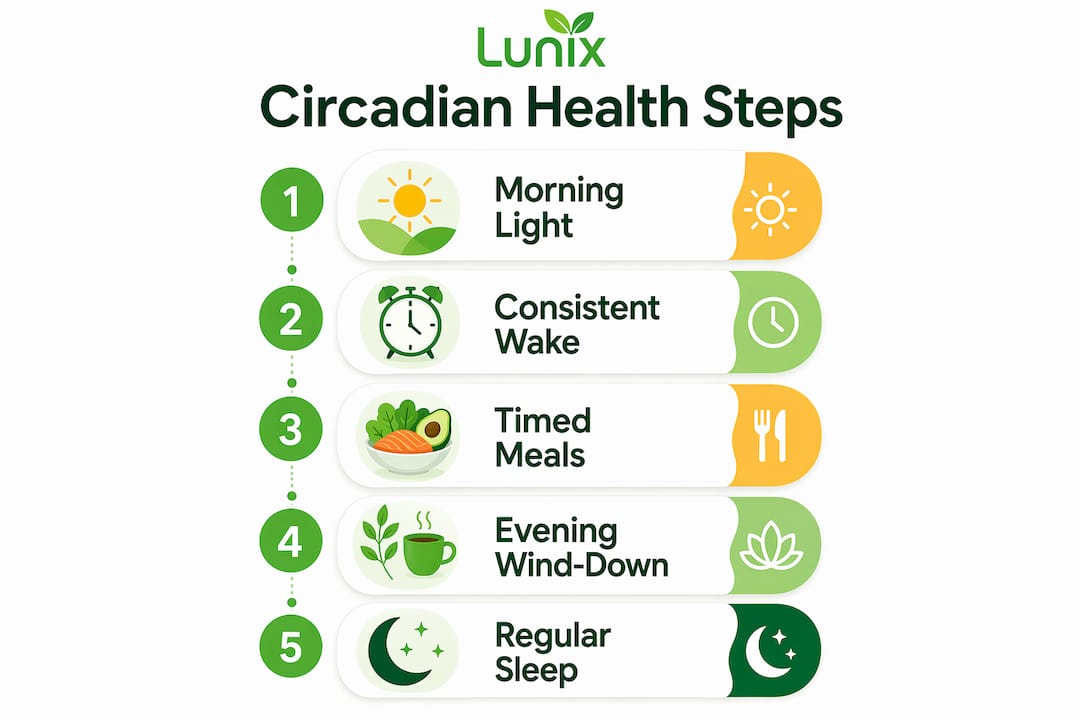
- Fix your wake time first. Choose a consistent wake time and hold it every day, including weekends. This single change anchors your entire rhythm faster than any supplement.
- Get morning light within 60 minutes of waking. Ten to twenty minutes outdoors is enough on most days. On short winter days, a 10,000-lux light therapy box used for 20–30 minutes can substitute.
- Eat your first meal within 1–2 hours of waking and close your eating window at least 2–3 hours before bed. Late-night eating shifts peripheral clocks out of sync with the SCN.
- Move during daylight hours. Morning or early-afternoon exercise reinforces the daytime phase of your rhythm. Vigorous workouts within 2 hours of bedtime can delay sleep onset.
- Dim lights and screens 2 hours before bed. Blue-spectrum light suppresses melatonin. Use warm-toned lighting in the evening and consider blue-light-filtering glasses if screen use is unavoidable.
- Keep your bedroom cool at a comfortable temperature. Body temperature naturally drops at sleep onset; a cool room supports that transition.
What to expect:
- Week 1: Morning grogginess often decreases; falling asleep at a consistent time becomes easier.
- Weeks 2–4: Energy levels stabilize across the day; midday slumps become less pronounced.
- Weeks 8–12: Measurable improvements in sleep timing consistency and, for many adults, metabolic markers like fasting glucose and blood pressure variability.
Wearables and apps can help you spot trends, but they measure sleep duration, not circadian phase. Focus on timing patterns (when you fall asleep, when you wake) rather than absolute scores. A consistent sleep midpoint is a more useful signal than a nightly “sleep score.”
For a detailed bedtime routine framework, Lunixinc has practical guidance built around the same timing principles.
When should you seek medical help for circadian misalignment?
Most people can improve their rhythm with lifestyle changes. Seek professional evaluation if you notice:
- Severe daytime sleepiness that persists after 4–6 weeks of consistent sleep timing
- An inability to fall asleep before 2–3 AM regardless of how tired you feel (possible delayed sleep-wake phase disorder)
- Waking consistently at 3–4 AM and being unable to return to sleep (possible advanced phase disorder)
- Significant mood changes, memory problems, or concentration difficulties alongside sleep disruption
- Long-term shift-work history combined with metabolic symptoms (weight gain, blood sugar irregularities)
Circadian rhythm disorders are frequently misdiagnosed as insomnia, and the treatments differ. Insomnia responds to cognitive behavioral therapy and sleep restriction. Circadian disorders respond to timed light therapy and gradual phase shifting. Sedative medications alone do not fix misalignment and can mask the underlying problem.
When you see a provider, bring a one-week sleep timing diary (bedtime, wake time, any naps), wearable data if you have it, and your current medication list. A sleep medicine specialist or your primary care physician can refer you to a sleep lab for actigraphy or dim-light melatonin onset testing if needed.
How to set up a circadian-friendly recovery space at home
Your environment either supports your clock or fights it. A few practical changes make a real difference:
- Morning: Open blackout curtains immediately on waking or step outside. Keep your phone charger outside the bedroom so the first light you see is natural.
- Evening: Switch overhead lights to warm-toned bulbs (2700K or lower) after 8 PM. A consistent pre-sleep routine signals your SCN that the sleep window is approaching.
- Bedroom temperature: Use breathable bedding and keep the room cool. Cooling toward sleep onset aligns with the body’s natural temperature drop.
- Recovery timing: Gentle heat or massage tools are most effective during the body’s transition phases. A percussion massager or heated compression device used in the early evening can ease muscle tension without raising core temperature enough to delay sleep. Red-light therapy for joints and hands fits naturally into a post-exercise or pre-bed wind-down window.
- Pillow and support: Orthopedic wedge pillows that keep the spine aligned reduce the micro-arousals that fragment sleep and blunt circadian amplitude over time.
Pro Tip: Pair your evening recovery routine with a consistent end time, not just a consistent start time. Your SCN responds to predictable patterns. Finishing your wind-down at the same time each night is as important as beginning it.
How circadian disruption affects your mental health
The connection between circadian misalignment and mental health is bidirectional. Disrupted rhythms increase the risk of depression and anxiety, and those conditions in turn further disrupt sleep timing and circadian amplitude. Circadian disruption increases the risk for neurologic and psychiatric disorders across the lifespan, including mood disorders and neurodegenerative conditions.
Evening chronotypes (“night owls”) face a compounded risk: their internal clock runs later than social and professional demands require, creating chronic misalignment that raises all-cause mortality risk compared with morning types. For midlife adults already managing stress, hormonal shifts, and metabolic changes, that misalignment adds a meaningful mental health burden.
Bright light therapy has shown benefit not only for seasonal affective disorder but also for non-seasonal depression, particularly when timed to the individual’s circadian phase. Melatonin, used at low doses and timed correctly (1–2 hours before the desired sleep onset), can shift phase without the dependency risks of sedatives.
How circadian rhythms change as you age
Circadian rhythms shift across the lifespan in predictable ways. Adolescents experience a biological phase delay, making early school start times genuinely misaligned with their clocks. Adults in midlife tend toward a phase advance, meaning the natural sleep window moves earlier. By the mid-60s, circadian amplitude often decreases, producing lighter, more fragmented sleep and a blunted cortisol morning peak.
For adults in the 40–65 range, this means the margin for error narrows. The same late-night habits that felt manageable at 30 produce more pronounced fatigue, metabolic disruption, and mood effects at 50. Consistent timing becomes more protective, not less, as the clock’s natural robustness declines. Sleep quality after 40 responds well to the same zeitgeber-based strategies, but consistency matters more than it did in earlier decades.
Key Takeaways
Circadian rhythm health depends on timing alignment, not just sleep duration, and small, consistent behavioral changes can produce measurable improvements in energy, metabolism, and mood within weeks.
| Point | Details |
|---|---|
| Alignment beats duration | Sleeping 7–8 hours at inconsistent times is less restorative than 7 hours at a fixed schedule. |
| Morning light is the strongest lever | 10–20 minutes of outdoor light within 60 minutes of waking anchors your entire daily rhythm. |
| Disruption carries real health risk | Long-term chronodisruption is linked to type 2 diabetes, cardiovascular disease, and cognitive decline. |
| Age narrows the margin | After 40, circadian amplitude naturally decreases, making consistent timing more protective than ever. |
| Lunixinc recovery tools fit the routine | Percussion massagers, red-light devices, and orthopedic pillows support circadian-aligned wind-down and recovery when used at consistent evening times. |
The timing shift that changed everything
Most midlife adults assume they need more sleep. What many actually need is better-timed sleep. A typical pattern looks like this: wake time drifts 45–90 minutes later on weekends, dinner happens at 9 PM, and screens stay on until midnight. Total sleep hours might be fine on paper, but the rhythm is fragmented.
The shift that tends to produce the most noticeable results is not adding sleep time but anchoring wake time. Hold the same wake time for two weeks, move dinner 90 minutes earlier, and get outside within the first hour of the day. By week four, most people report falling asleep faster and waking with noticeably more energy. By week eight to twelve, the changes feel self-reinforcing: the body starts signaling sleep at a consistent time without an alarm, and morning alertness arrives earlier and more reliably.
The takeaway is simple. Timing is a tool you already have. You do not need to overhaul your life; you need to anchor it.
Lunix recovery products that support your circadian routine
Behavior and timing come first. Once your morning light, meal windows, and consistent sleep schedule are in place, the right recovery environment amplifies those gains.

Lunixinc designs recovery tools built for exactly this kind of routine. Orthopedic wedge pillow sets keep your spine aligned through the night, reducing the micro-arousals that fragment sleep. Percussion massagers and heated air compression hand massagers ease tension during the evening wind-down window, supporting the body’s natural transition toward rest. Red-light therapy devices for hands, joints, and feet fit naturally into a post-exercise or pre-bed recovery sequence. Infrared sauna blankets, used in the early evening, can support the body’s temperature-drop transition toward sleep.
Every product is designed for consistent, timed use, which is exactly what circadian health requires. Browse the full Lunixinc recovery collection to find the tools that fit your evening routine and start building a recovery space your body can count on.
Useful sources and further reading
These are the primary references used throughout this article. Each is worth bookmarking if you want clinical detail or a source to share with your healthcare provider.
- Role of Circadian Health in Cardiometabolic Health and Disease Risk — American Heart Association, Circulation: The 2025/2026 AHA scientific statement linking zeitgebers to cardiometabolic outcomes; the most clinically current guidance available.
- Circadian Disruption and Human Health — PMC: A comprehensive bench-to-bedside review covering neurologic, psychiatric, metabolic, and cardiovascular effects of disruption.
- Sleep, Circadian Rhythms and Health — PMC: Covers long-term occupational risk, cognitive findings from large cohorts, and wearable data limitations.
- Physiology, Circadian Rhythm — StatPearls, NCBI Bookshelf: Concise clinical physiology reference; useful for understanding differential diagnosis of circadian disorders vs. insomnia.
- Circadian Rhythm: What It Is, How It Works and What Affects It — Cleveland Clinic: Accessible explainer on SCN function, social jetlag, and practical lifestyle guidance.
This article is for general informational purposes only and is not a substitute for professional medical advice. Consult your physician or a qualified sleep specialist for guidance specific to your health situation.