


TL;DR:
- Proper body alignment involves maintaining optimal skeletal and muscular positioning to promote efficient movement and reduce joint stress. Consistent exercises and awareness can correct common issues like forward head posture, rounded shoulders, and pelvic tilt within weeks. Developing strength, mobility, and posture habits enhances health, reduces pain, and supports overall well-being over time.
Body alignment is defined as the optimal anatomical positioning of your skeletal and muscular structures so that your body moves efficiently and joints experience minimal stress. When your head, shoulders, spine, hips, knees, and ankles stack correctly relative to each other, your muscles work less, your joints last longer, and your energy goes toward living rather than compensating for strain. For adults between 30 and 60, this matters more than most people realize. Decades of desk work, driving, and screen time quietly shift your body out of its natural position, creating a slow domino effect of physical strain. The good news is that understanding body alignment principles gives you the tools to reverse that pattern, often within weeks.
What are the fundamental principles of body alignment?
Body alignment, known in biomechanics as postural alignment, is not a fixed position you hold. It is a dynamic equilibrium that your body constantly negotiates to minimize joint stress and muscular effort. Think of it less like a statue and more like a well-tuned suspension system, always adjusting, never locked.
The central concept is the line of gravity. In ideal alignment, this imaginary vertical line passes through specific anatomical landmarks: the ear, the shoulder joint, the hip joint, the knee, and just in front of the ankle. When your body deviates from this line, muscles must work overtime to prevent you from falling, which is exactly where fatigue and pain begin.
Your spine plays the starring role. It has three natural curves: the cervical curve in the neck, the thoracic curve in the mid-back, and the lumbar curve in the lower back. These curves are not flaws. They distribute load across the spine the way an arch distributes weight in a bridge. Flattening or exaggerating any of these curves shifts load onto discs, ligaments, and muscles that were not designed to carry it alone.

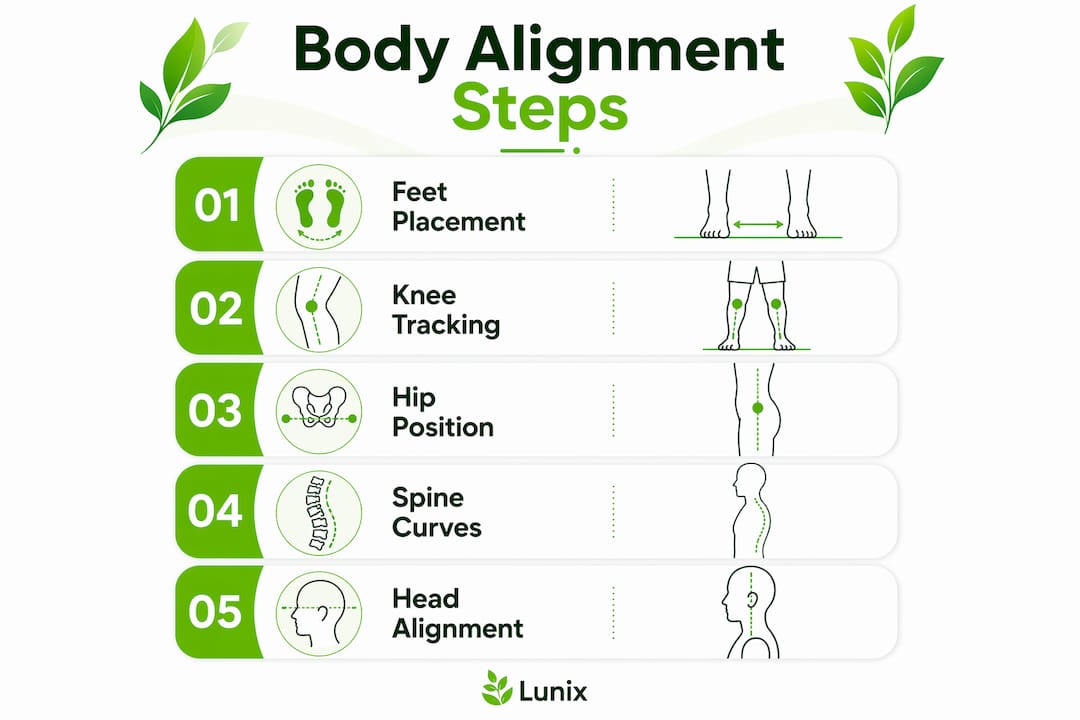
Alignment builds from the ground up, starting with foot placement, which influences knee tracking, which influences hip position, which influences spinal curves. Postural alignment uses foundational landmarks including the heels, sitting bones, scapula, and occipital ridge as reference points for assessing the full chain. This is why a foot that rolls inward can eventually contribute to lower back pain.
Pro Tip: When standing, check your feet first. If one foot turns out more than the other, your hip and lower back are already compensating. Correcting foot placement is the fastest way to start improving your overall alignment.
| Landmark | Ideal alignment point |
|---|---|
| Head and ears | Directly over the shoulder joint, not forward |
| Shoulders | Level and relaxed, not rounded or elevated |
| Spine | Natural S-curve maintained, not flattened |
| Hips and pelvis | Neutral tilt, not tipped forward or backward |
| Knees | Soft, not locked; tracking over second toe |
| Ankles and feet | Weight distributed evenly across the foot |
Common body alignment issues and how to recognize them
Most adults develop predictable misalignment patterns from the same root causes: prolonged sitting, repetitive movements, and weak postural muscles. Recognizing these patterns is the first step toward correcting them.
Forward head posture is the most widespread issue in adults who spend time at screens. Forward head posture adds 10 to 30 pounds of extra pressure on the cervical spine for every inch the head drifts in front of the shoulders. That is a significant load for your neck muscles to carry all day, and it explains why so many people experience chronic neck tension and headaches.
Rounded shoulders typically accompany forward head posture. When the chest muscles tighten and the upper back muscles weaken, the shoulders roll forward and inward. This compresses the shoulder joint, reduces breathing capacity, and contributes to upper back pain. You can check for this by standing naturally and looking at where your palms face. If they face backward rather than toward your thighs, your shoulders are likely rounded.
Anterior pelvic tilt is common in people who sit for long hours. The hip flexors shorten, the lower back arches excessively, and the glutes become underactive. This creates a characteristic posture where the belly pushes forward and the lower back curves inward more than it should. Over time, this pattern strains the lumbar discs and the sacroiliac joints.
Here are signs to watch for in your own daily life:
- Your chin juts forward when you look at a screen or phone
- One shoulder sits higher than the other in photos
- You feel lower back tightness after sitting for 30 minutes or more
- Your knees cave inward when you squat or walk downstairs
- You feel more comfortable slouching than sitting upright
Pro Tip: Take a movement break every 30 minutes of sitting. Even a 30-second stand and stretch resets your postural muscles and prevents the fatigue that causes alignment to collapse. A 5-minute walk every 45 to 60 minutes is even better.
How to improve body alignment: exercises and daily habits
Improving body alignment is not about forcing yourself into a rigid position and holding it. Posture is a capacity to be built through strength, control, and endurance. The goal is to develop muscles that can comfortably support good positioning across all your daily activities, not just when you are consciously thinking about it.
Here is a practical daily routine to build that capacity:
- Morning spinal reset (2 minutes). Lie on your back with knees bent. Gently flatten your lower back against the floor, hold for 5 seconds, then release. Repeat 10 times. This activates deep spinal stabilizers before your day begins.
- Couch stretch for hip flexors (2 minutes per side). Kneel with one knee on the floor and the other foot forward. Tuck your pelvis slightly and lean forward until you feel a stretch in the front of the hip. The couch stretch directly counteracts the hip flexor tightening caused by prolonged sitting.
- Hollow body hold for core stability (3 sets of 20 seconds). Lie on your back, press your lower back into the floor, and lift your arms and legs slightly off the ground. The hollow body hold trains the deep core muscles that stabilize your spine throughout the day.
- Wall angels for shoulder and thoracic mobility (10 reps). Stand with your back flat against a wall, arms bent at 90 degrees. Slowly slide your arms overhead while keeping your back and arms in contact with the wall. This retrains the shoulder blades to move correctly and opens the thoracic spine.
- Standing posture check (30 seconds, 3 times daily). Stand with feet hip-width apart, soften your knees, stack your hips under your shoulders, and let your head float upward. Hold for 30 seconds while breathing naturally. This builds the neuromuscular memory your body needs to default to better alignment.
Most people see noticeable improvement in body alignment with consistent practice within 4 to 6 weeks. That timeline is realistic and encouraging. You are not looking at years of rehabilitation. You are looking at a few weeks of deliberate daily habits.
| Exercise | Target area | Key benefit |
|---|---|---|
| Couch stretch | Hip flexors | Reduces anterior pelvic tilt |
| Hollow body hold | Deep core | Stabilizes lumbar spine |
| Wall angels | Shoulders, thoracic spine | Corrects rounded shoulders |
| Spinal reset | Lower back | Activates spinal stabilizers |
| Standing posture check | Full body | Builds postural muscle memory |
Pro Tip: Lateral breathing, where you breathe into the sides of your ribcage rather than just your chest, engages deep core muscles that support spinal alignment. Practice it during your hollow body holds for double the benefit.
What are the benefits of proper body alignment for health?
When your body is well aligned, bones bear weight efficiently, reducing the muscular effort required to hold you upright. This single mechanical fact has a cascade of positive effects on your health, energy, and quality of life.
The most immediate benefit most people notice is reduced pain. Proper postural health reduces strain on the joints and soft tissues that bear the brunt of misalignment, particularly in the neck, lower back, and knees. Less strain means less inflammation, and less inflammation means less pain over time.
Beyond pain relief, good alignment improves your breathing. When your thoracic spine is upright and your shoulders are back, your ribcage can expand fully. Slouching compresses the lungs and reduces oxygen intake, which contributes to afternoon fatigue and reduced mental clarity. Sitting upright is not just about appearance. It is about how much oxygen your brain receives.
The benefits extend further than most people expect:
- Reduced injury risk. Aligned joints move through their full range of motion without impingement, making sprains and strains less likely during exercise or everyday movement.
- Improved movement efficiency. When your body is balanced, you use less energy to walk, climb stairs, and carry groceries. This matters more as you move through your 40s and 50s.
- Better sleep quality. Alignment carries into your sleep posture. A body that holds better position during the day tends to rest in healthier positions at night, reducing morning stiffness.
- Increased confidence. Research in behavioral science consistently links upright posture with improved mood and self-perception. Your body position influences how you feel, not just how you look.
- Reduced work-related discomfort. For anyone spending hours at a desk, ergonomic alignment strategies directly reduce the cumulative strain that leads to chronic musculoskeletal complaints.
“Alignment is not about looking a certain way. It is about giving your body the mechanical advantage it needs to function without unnecessary wear.”
Key takeaways
Good body alignment is a dynamic, buildable capacity that reduces joint stress, prevents pain, and improves energy when practiced consistently through targeted exercises and daily awareness.
| Point | Details |
|---|---|
| Alignment is dynamic, not static | It is a constant equilibrium, not a fixed position you hold. |
| Build from the ground up | Foot placement influences knees, hips, and spine in a direct chain. |
| Common issues are correctable | Forward head posture, rounded shoulders, and pelvic tilt respond to targeted exercise within 4 to 6 weeks. |
| Exercises that work | Couch stretch, hollow body hold, and wall angels address the most common misalignment patterns. |
| Benefits go beyond posture | Good alignment improves breathing, reduces fatigue, lowers injury risk, and supports better sleep. |
Lunix’s take on alignment: build capacity, not rigidity
Here is something I have seen consistently: the people who struggle most with alignment are not the ones who ignore it. They are the ones who try too hard to hold a perfect position. Forcing a static posture creates tension rather than relieving it, and that tension is its own form of misalignment.
What actually works is building the strength and body awareness to move comfortably across a range of positions. When your core is strong, your hips are mobile, and your thoracic spine can extend freely, good alignment becomes your default. You stop having to think about it.
The other thing worth saying directly: alignment awareness and adaptability matter more than any single exercise. The goal is not to achieve perfect posture during your morning workout and then forget about it. It is to develop a relationship with how your body feels throughout the day, notice when something is off, and have the tools to address it. That is a skill, and like any skill, it gets easier with practice.
Start small. Pick one exercise from the list above. Do it for two weeks. Then add another. Consistency over intensity is the principle that actually produces lasting change.
— Lunix
Support your alignment with Lunix recovery solutions

Improving your body alignment takes consistent effort, and your body needs proper recovery support to make those changes stick. At Lunixinc, the Recovery collection is designed specifically to complement your alignment and mobility work. These products help your muscles relax, your joints decompress, and your body reset between sessions, so you can show up to your next workout or workday feeling restored rather than depleted. Whether you are working through tight hip flexors, a stiff thoracic spine, or general postural fatigue, Lunixinc offers solutions that fit naturally into your daily routine and support the progress you are building.
FAQ
What is body alignment in simple terms?
Body alignment is the positioning of your bones, joints, and muscles so that your body moves efficiently and places minimal stress on any single structure. Think of it as your body’s natural stacking order from feet to head.
How long does it take to improve body alignment?
Consistent practice produces noticeable improvement within 4 to 6 weeks. Daily exercises targeting the core, hips, and postural muscles are the most reliable path to faster results.
What affects body alignment the most?
Prolonged sitting, repetitive movements, and weak postural muscles are the primary factors that disrupt alignment. Understanding these biomechanical imbalances helps you identify which habits and exercises will have the greatest impact.
What are the best body alignment exercises for beginners?
The couch stretch, hollow body hold, and wall angels are three of the most effective starting points. Each targets a different common misalignment pattern and requires no equipment.
Is there one perfect posture everyone should aim for?
No. There is no single universal perfect posture. Good alignment is individualized and dynamic, meaning the goal is to build the strength and awareness to move well across many positions, not to hold one rigid stance.