


Yes, using a massage gun before bed can help you relax and fall asleep faster, but only if you keep the session short, gentle, and low intensity. Think five to ten minutes on major muscle groups at low speed, finishing with a minute of slow breathing before you turn off the lights. Skip it entirely if you have a clotting disorder, a recent injury, or any condition your doctor hasn’t cleared, and stop immediately if you feel numbness, tingling, or sharp pain.
TL;DR:
- Short, gentle percussion sessions can help reduce muscle tension and may slightly shorten the time it takes to fall asleep, especially with consistent use.
- The routine should last five to ten minutes, be conducted 20 to 30 minutes before bed, and focus on specific muscle groups with low speed and light pressure.
- Avoid using massage guns on bony or sensitive areas, and do not operate over the spine, front neck, open wounds, or if you have clotting issues or recent injuries.
- Quiet, lightweight devices with rounded, soft attachments and adjustable low speed are best suited for nighttime use.
- Running a two-week trial of the routine helps determine individual effectiveness, as current evidence supports only modest benefits without improving sleep architecture.
Table of Contents
- Can a Massage Gun Before Bed Actually Improve Sleep?
- Your 5 to 10 Minute Pre-Bed Massage Gun Routine
- What Should You Avoid When Using a Massage Gun at Night?
- What Makes a Massage Gun Bedtime-Friendly?
- Building a Full Wind-Down Routine Around It
- Bedtime sessions demand different priorities than a gym bag device, and that’s exactly what shapes how percussion tools are designed.
- A Personal Note on Trying This Routine
- Find a Bedtime-Friendly Massage Gun From Lunix
- Sources
- FAQ
Can a Massage Gun Before Bed Actually Improve Sleep?
The honest answer is: probably a little, and mostly indirectly. Percussion massage doesn’t put you into deep sleep the way a sedative might. What it does is loosen tight muscles and calm your nervous system enough that falling asleep becomes easier.
A systematic review on massage guns and percussive therapy found that these devices can meaningfully improve short-term range of motion and recovery-related outcomes. The same review found evidence for athletic performance gains is weak, and some protocols can temporarily blunt explosive power. That’s actually good news for a bedtime routine. You’re not trying to fire up your muscles for a workout. You’re trying to wind them down.
Here’s the mechanism worth understanding: tight, overworked muscles keep sending low-level “stay alert” signals to your brain. A short percussion session interrupts that signal. Reduced muscle tension nudges your body toward parasympathetic activation. That’s the “rest and digest” mode your nervous system needs to downshift before sleep. Lower perceived tension often means less mental noise, and less mental noise usually means it takes you less time to actually fall asleep.
Where the evidence gets thinner is sleep architecture itself. Nobody has data showing massage guns increase deep sleep or REM percentages. What limited research does exist points to something more modest and more useful in practice.
What the research actually supports: Short, gentle pre-bed percussion sessions can reduce perceived muscle tension, and in some small trials or anecdotal reports, shorten the time it takes to fall asleep. The effect size is small and the studies are limited, so treat this as a supporting tool, not a sleep cure.
A few honest caveats belong here:
- Most supporting studies are small, short-term, and carry real risk of bias.
- Nothing in the current evidence base shows massage guns directly boost deep-sleep or REM stages.
- Benefits tend to track with consistent, low-intensity use rather than one-off aggressive sessions.
If you want proof it’s working for you specifically, run your own two-week trial: same time, same routine, and track how long it takes you to fall asleep. That kind of self-experiment lines up with how researchers behind the same systematic review suggest people should approach percussion therapy given how young the evidence base still is.
Your 5 to 10 Minute Pre-Bed Massage Gun Routine
Timing matters here. Run your session about 20 to 30 minutes before you actually want to fall asleep. That buffer lets your heart rate settle back down before you’re lying in the dark trying to sleep.
Keep the whole thing under ten minutes. Longer sessions start to feel stimulating rather than calming, which works against the entire point of doing this at night.
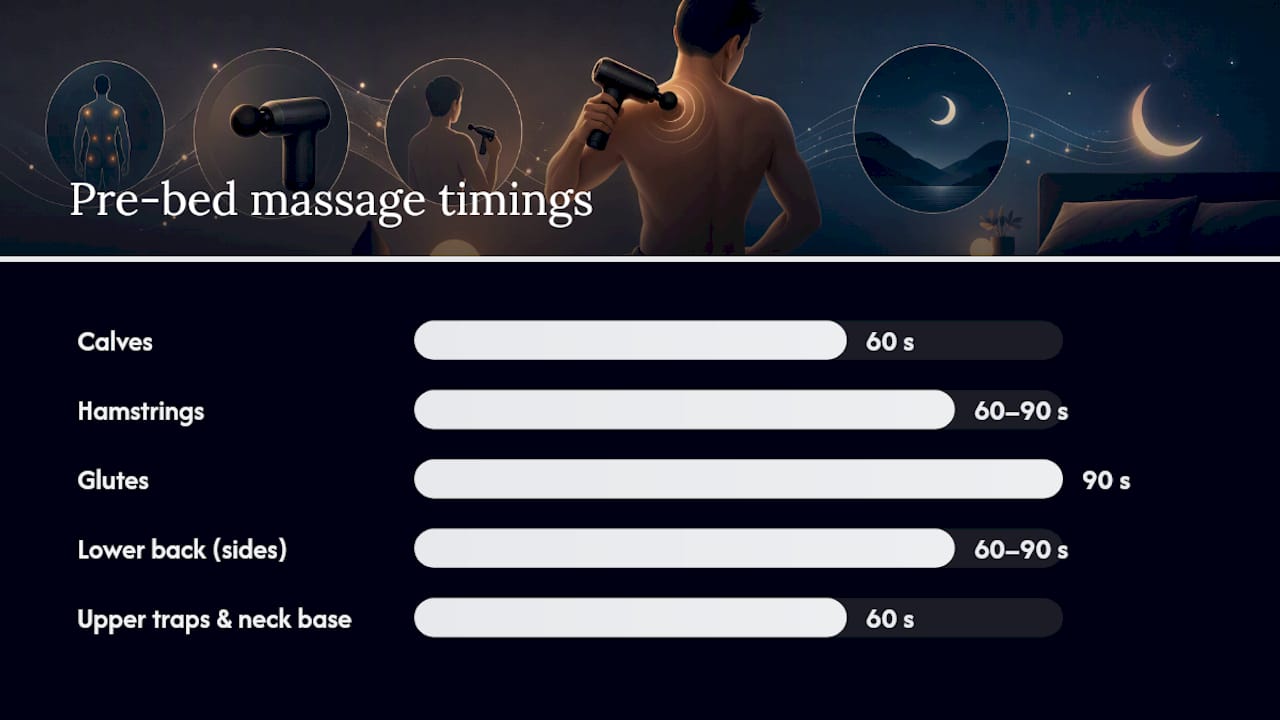
- Calves (60 seconds). Move the head slowly up and down the muscle belly. Never rest it on one spot.
- Hamstrings (60 to 90 seconds). Glide from just above the knee toward the glute, staying off the back of the knee joint itself.
- Glutes (90 seconds). These are large, forgiving muscles that tolerate a bit more time. Keep the device moving in slow sweeps.
- Lower back, sides only (60 to 90 seconds). Stay on the muscle tissue flanking the spine. Never run the device directly over the spinal column.
- Upper traps and base of the neck (60 seconds). Use light pressure here. This area holds a surprising amount of the day’s stress, but it’s also sensitive.
- Finish with 60 seconds of slow breathing. Inhale for four counts, exhale for six, eyes closed, device off.
On intensity: stay on low to mid speed settings and keep pressure light, roughly a 4 or 5 out of 10 on a personal effort scale. This is not the moment for the highest-frequency setting or a deep, stalling press into a knot. Percussion therapy experts specifically recommend shifting from an athletic “recovery” mindset to a “relaxation” mindset for evening sessions, favoring gentler, low-frequency work over the aggressive settings you might use post-workout. Save the high-frequency, hard-press settings for daytime recovery work, when longer applications above two minutes per muscle group at low frequencies below 40 Hz are more appropriate anyway.
Pro Tip: Dim the lights before you start the routine, not after. Starting in low light cues your brain that the wind-down has already begun, so the massage gun session reinforces a signal your body is already receiving instead of fighting against bright overhead light.
If you’re new to using a device attachment on specific muscle groups, a quick refresher on matching the right attachment to each body area will save you from guessing which head belongs where.
What Should You Avoid When Using a Massage Gun at Night?
Some conditions and body areas are off-limits regardless of the time of day, and nighttime relaxation isn’t a reason to relax the rules.
Skip the massage gun entirely, or get medical clearance first, if you have a blood-clotting disorder, deep vein thrombosis, a recent fracture, torn muscle or tendon tissue, or you’re on blood thinners. Active inflammation in a joint or muscle is also a reason to wait. University of Utah Health’s guidance on safe massage gun use is direct on this point: these devices aren’t safe on bony areas, the spine, major arteries like the front of the neck, or over open wounds, and anyone with clotting issues, fractures, or torn tissue should stay away from percussion work unless a clinician has cleared them.
Certain body zones stay off the map no matter how relaxed you’re trying to get:
- The spine itself, not just nearby muscle.
- The front of the neck, where major arteries sit close to the surface.
- Bony prominences like the shins, ankles, elbows, and collarbone.
- Open wounds, bruises, or any inflamed joint.
A few practical rules keep the routine safe night after night. Start every new area on the lowest setting before increasing intensity. Never park the device in one spot for more than about 30 seconds. Cap each muscle group at 60 to 120 seconds, which lines up with the same practical limits recommended for daytime use. Stop immediately if you notice numbness, tingling, or sharp pain rather than a dull, tolerable pressure.
Signal to watch for: If the device’s motor pitch changes or you hear an aggressive thud, that’s the gun stalling against tissue under too much pressure. Ease off the moment you hear it.
What Makes a Massage Gun Bedtime-Friendly?
Not every massage gun belongs on a nightstand. The specs that matter for a 10 p.m. session are different from the ones that matter at the gym.
Noise is the first filter. A device running under roughly 50 decibels is far more likely to stay quiet enough for a shared bedroom, while anything noticeably louder can undercut the relaxation effect you’re chasing before you even finish the routine. Devices in the borderline 55 to 65 decibel range can still work, but you’ll notice them, and so will anyone sleeping nearby. Real-world testing on massage guns for sleep-focused protocols points to sub-50 decibel operation paired with modest amplitude, roughly 0.47 to 0.63 inches, as the sweet spot for bedroom use.
Amplitude and stall force matter less than you’d think. A high stall force rating sounds impressive on a spec sheet, but for gentle relaxation work you don’t need a device built to muscle through a bodybuilder’s calf. Extreme stall force often correlates with a louder motor, which works against you here.
Ergonomics decide whether you’ll actually stick with it. A lighter device with a comfortable grip and a couple of soft attachment heads is easier to hold through a full ten-minute routine than a heavy one built for quick daytime bursts. Before buying, check a few things:
- Hold it for a full minute in-store or during a return window to feel real fatigue, not just showroom weight.
- Listen to it against your own arm or leg, not just running in the air, since contact noise is often louder than idle noise.
- Confirm it ships with at least one rounded, softer attachment head suited to sensitive areas like the neck and traps.
Building a Full Wind-Down Routine Around It
A massage gun works best as one piece of a wind-down sequence, not a standalone fix. Sequence matters: dim the lights first, put your phone away, then run your five to ten minute session, then shower or brush your teeth, then get into bed. Doing it in the opposite order, screen time right after the massage, tends to cancel out the calming effect.
Three or four nights a week is a reasonable cadence for most people. Every single night isn’t necessary, and using it as a nightly crutch for pain you haven’t addressed elsewhere is a sign to talk to a doctor rather than reach for higher intensity. University sleep resources note that improving sleep onset is usually multi-factorial, so treat this as one lever among several rather than the whole strategy.
Pairing the routine with something else amplifies the effect:
- A few slow stretches right after the massage gun session, while muscles are already loose.
- Box breathing (four seconds in, hold, six seconds out) during the final minute.
- Low, warm lighting rather than overhead light for the last 30 minutes before bed.
Pro Tip: Consistency beats intensity. A predictable, slightly boring nightly routine trains your brain to associate the massage gun’s hum with “it’s time to sleep” faster than an occasional intense session ever will.
Bedtime sessions demand different priorities than a gym bag device, and that’s exactly what shapes how percussion tools are designed.
Bedtime sessions demand different priorities than a gym bag device, and that’s exactly what shapes how Lunix builds its percussion tools. A compact, lighter frame matters more at 10 p.m. than raw power, since the device is typically held through a calm ten-minute routine rather than used for brief, intense muscle work after a workout.
A few features worth knowing about when evaluating devices for nightly use include quieter motor operation to stay unobtrusive in a shared bedroom, a compact, lighter body for easier handling through a full routine, softer, rounded attachment heads suited to sensitive zones rather than aggressive deep-tissue heads, and simple speed controls to maintain low settings without difficulty in dim light.
Pairing the right attachment with light pressure matters more than chasing the highest speed setting, especially on sensitive areas where restraint is important.
A Personal Note on Trying This Routine
Running a version of this routine for two weeks, calves and traps mostly, felt less like a “fix” and more like a nudge. Sleep onset felt a bit faster on the nights the routine actually happened, though skipping it didn’t wreck sleep either.
That’s the honest takeaway: this is a small, supportive habit, not a treatment for insomnia or a diagnosed sleep disorder. If sleep problems persist, consulting a doctor is recommended rather than increasing intensity.
Find a Bedtime-Friendly Massage Gun From Lunix
If quiet operation, a compact grip, and gentle attachment options are what you’re after for a nightly wind-down, that’s precisely the ground Lunix’s percussion lineup is built on. The LX28 Deep Tissue Massager pairs a lighter handheld design with multiple attachment heads, so you can switch from a firmer head for glutes to a softer round head for traps and neck without needing a second device.

Every feature mentioned throughout this routine, low noise, manageable weight, adjustable intensity, is the same criteria worth checking on the Lunix benefits page before you commit to a device for nightly use. Browse the lineup, compare attachment options against the body areas in tonight’s routine, and pick the one that matches how you actually plan to use it: gently, briefly, and consistently.
This article is general information, not a substitute for advice from a qualified doctor. Consult a qualified healthcare professional about your own circumstances before acting on anything here.
Sources
- Massage Guns: How to use them safely and effectively | University of Utah Health
- Systematic review on massage guns and percussive therapy (Frontiers/PMC)
- How to use a massage gun (Healthline)
- How to use a massage gun (Men’s Health expert commentary)
FAQ
When Should You Not Use a Massage Gun?
Avoid it if you have a blood-clotting disorder, a recent fracture, torn muscle or tendon tissue, active inflammation, or you’re on blood thinners, and always avoid the spine, front of the neck, bony areas, and open wounds.
Is It Okay to Get a Massage Before Bed?
Yes, a gentle massage before bed is generally fine for most healthy adults and often supports relaxation, as long as intensity stays low and sessions stay short.
What Is the Best Time to Use a Massage Gun for Sleep?
Roughly 20 to 30 minutes before you intend to fall asleep works best, giving your heart rate time to settle before you get into bed.
Do Massage Guns Break Up Knots?
Massage guns can temporarily reduce perceived muscle tightness and improve short-term range of motion, though they don’t physically “break up” a knot the way the term suggests.
Should I Use a Massage Gun at Night or Save It for After Workouts?
Both are fine, but the settings should differ: use higher intensity and longer per-muscle application for post-workout recovery, and switch to low intensity, short sessions for nighttime relaxation.