


TL;DR:
- Comfort science, based on Kolcaba’s theory, focuses on satisfying human needs across four contexts.
- It emphasizes proactive, holistic approaches to improve physical, emotional, social, and environmental well-being.
- Applying comfort assessments and small, intentional changes fosters better recovery, sleep, and overall health.
Most people treat comfort as something they either have or don’t have, like a light switch. But comfort science tells a very different story. Rooted in Kolcaba’s Comfort Theory, a middle-range nursing framework that defines comfort as the satisfaction of human needs across physical, psychospiritual, sociocultural, and environmental contexts, this field transforms how we understand and pursue well-being. If you’re over 40 and looking for a smarter, more intentional approach to daily health, comfort science gives you a real roadmap, not just a softer pillow.
Table of Contents
- What is comfort science? The theory and definition
- How comfort is measured: Tools and practical assessment
- Why comfort science matters: Health, wellness, and daily life
- Going deeper: Nuances, critiques, and integrating comfort science
- A fresh perspective: What most comfort advice gets wrong
- Enhance your life with evidence-based comfort solutions
- Frequently asked questions
Key Takeaways
| Point | Details |
|---|---|
| Comprehensive comfort framework | Comfort science organizes comfort into types and contexts, making it practical for everyday well-being. |
| Measurable and actionable | Comfort levels can be measured and improved using evidence-based tools applied in daily routines. |
| Proactive health benefits | Adopting comfort science helps prevent discomfort and boosts health-seeking and recovery behaviors. |
| Adaptable to your life | Comfort science is not rigid; it evolves with personal and cultural needs. |
| Beyond physical relief | True comfort involves physical, emotional, social, and environmental well-being working together. |
What is comfort science? The theory and definition
Comfort science is not a vague idea about feeling cozy. It’s a structured, evidence-based framework developed by nursing theorist Dr. Katharine Kolcaba. Her model defines comfort as the satisfaction of basic human needs in three distinct types and four specific contexts. Understanding this structure changes how you approach everything from sleep quality to emotional recovery.
The three types of comfort
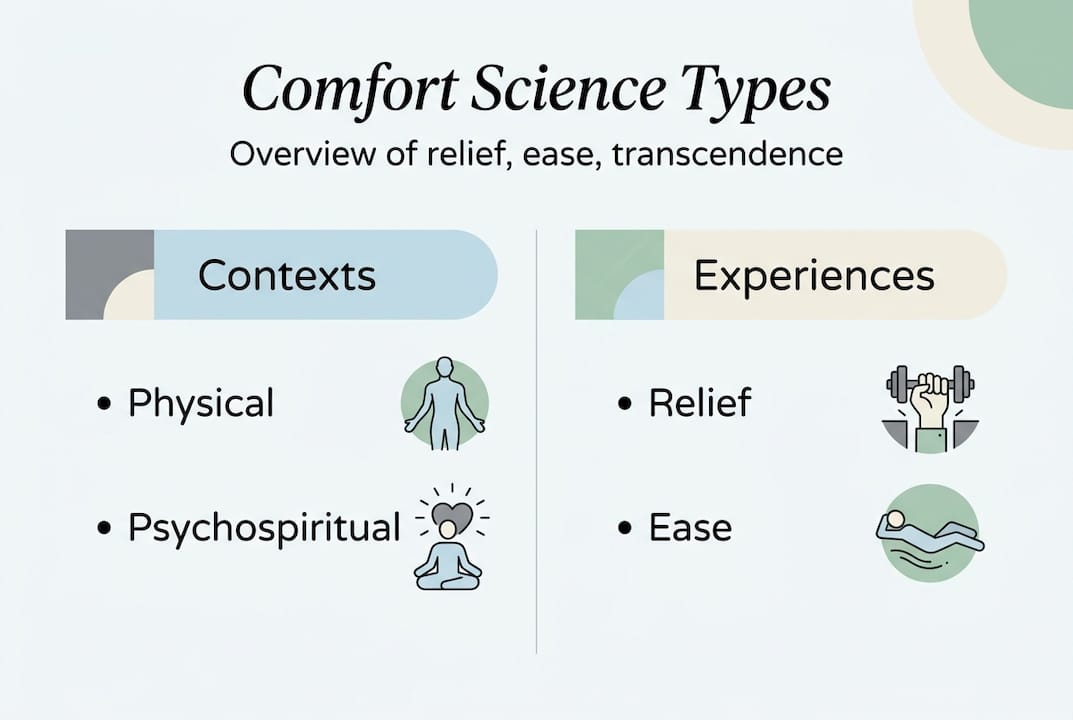
Kolcaba’s taxonomic structure organizes comfort into a 3x4 grid, crossing three types of comfort with four life contexts. This grid is used as a practical methodology for assessment, intervention, and reassessment. Here’s what each type means in plain terms:
- Relief: The state of having a specific discomfort addressed. Think of the relief you feel when lower back pain eases after proper lumbar support kicks in, or when anxiety lifts after a meaningful conversation.
- Ease: A calm, contented state with no specific discomfort to address. This is the quiet comfort of a morning without tension, a body that moves freely, and a mind that isn’t racing.
- Transcendence: The ability to rise above challenges or limitations. This is the most powerful type. It’s what happens when someone recovering from a knee injury finds confidence and motivation to keep moving forward despite physical setbacks.
The four contexts of comfort
Each of those three types plays out across four life contexts:
- Physical: Body sensations, pain levels, energy, and physical functioning.
- Psychospiritual: Your sense of self, meaning, purpose, emotional state, and connection to something larger than yourself.
- Sociocultural: Family dynamics, cultural traditions, social support, and interpersonal relationships.
- Environmental: Your surroundings, including lighting, temperature, noise, space, and the sensory quality of where you spend your time.
Comfort science taxonomy at a glance
| Type of comfort | Physical | Psychospiritual | Sociocultural | Environmental |
|---|---|---|---|---|
| Relief | Pain eased | Anxiety resolved | Conflict settled | Noise removed |
| Ease | No tension | Inner peace | Social belonging | Pleasant surroundings |
| Transcendence | Overcoming physical limits | Finding purpose | Community strength | Thriving in your space |
Understanding comfort’s role in healing becomes much clearer when you see how each cell in this grid affects your body and mind differently. For adults navigating recovery, aging, or high-stress lifestyles, applying this framework intentionally can shift outcomes significantly. You can also explore how comfort and recovery for 40+ specifically applies these principles to people who are actively maintaining peak performance in midlife and beyond.
How comfort is measured: Tools and practical assessment
Defining comfort is one thing. Measuring it is another. The real power of comfort science comes from its ability to take something as personal as “how you feel” and turn it into actionable, trackable data. Several validated tools make this possible.
The primary measurement tools
- General Comfort Questionnaire (GCQ): A 48-item tool developed by Kolcaba that measures comfort across all three types and four contexts. It captures subtle dimensions of well-being that standard pain scales miss entirely.
- Visual Analog Scale (VAS): A simple line-based tool where you mark your comfort level between two extremes. Widely used in clinical and home settings, it’s fast, reliable, and easy to repeat over time.
- Comfort Behaviors Checklist: An observational tool that tracks visible behaviors associated with comfort or discomfort. Especially useful for caregivers or for noticing patterns you might overlook in yourself.
These tools aren’t just for hospitals. Think of them as a health literacy upgrade for your daily life. When you use the logic behind these tools, even informally, you start noticing patterns you’d otherwise miss. For example, you might realize that your energy drops not because of poor sleep but because of low-quality social connection or a workspace that feels stressful and cluttered.
A good holistic comfort relaxation guide can help you apply these ideas at home without needing a clinical setting. You can also find interesting parallels in how comfort measures during labor are applied in real-time, personalized assessment to show how adaptive these tools can be when human needs are shifting rapidly.
Pro Tip: Try a simple daily self-check using the GCQ’s logic. Ask yourself: “Where am I feeling relief, ease, or transcendence today, and in which area of my life?” Physical, emotional, social, or your environment? You’ll be surprised what patterns emerge over just one week.
Why measurement matters for behavior change
Here’s something most people don’t realize: comfort isn’t just a passive state. It actively shapes what you do next. When you feel genuinely comfortable across multiple life contexts, research shows you’re far more likely to engage in health-promoting behaviors like regular movement, better nutrition, and consistent sleep habits. Comfort science turns self-care from guesswork into a feedback loop.
Why comfort science matters: Health, wellness, and daily life
Now let’s talk outcomes. Because understanding a theory is only valuable if it actually changes something for you.
Comfort science in action: With versus without
| Outcome area | Without proactive comfort | With proactive comfort |
|---|---|---|
| Pain management | Reactive, often delayed | Addressed early, less escalation |
| Sleep quality | Interrupted, unrestorative | Deeper, more consistent |
| Recovery speed | Slower, more setbacks | Faster, steadier progress |
| Stress levels | Frequent spikes, harder to regulate | More stable baseline, quicker recovery |
| Health-seeking behavior | Avoided or delayed | Actively pursued and maintained |
| Mood and motivation | Variable, often depleted | More resilient and sustained |
Proactive comfort enhances health-seeking behaviors like rehabilitation engagement and supports measurable improvements in daily living outcomes. This isn’t soft science. It’s a model with real, trackable results.
Everyday benefits you’ll actually feel
- Better sleep quality through both physical and environmental comfort improvements
- Improved mood and emotional regulation tied to psychospiritual ease
- Faster recovery from physical strain or injury when all four contexts are supported
- More consistent energy throughout the day as stress and discomfort stop draining your reserves
- Greater motivation to stay active and maintain healthy routines
If you want to explore comfort solutions for faster recovery or discover practical at-home comfort tips, the good news is that most changes are small and immediately actionable. You can also find more context in how comfort care at home applies these structured approaches to people navigating serious health challenges, showing just how broadly this framework scales.
A practical example
Imagine you’re dealing with persistent fatigue and mild back discomfort. Standard advice says: stretch more, sleep better. Comfort science asks a different set of questions. Is your physical environment adding to your tension? Is something draining your sense of purpose or meaning? Are your social connections supportive right now? Often, fatigue and physical pain have roots in multiple comfort contexts at once, and addressing only the physical one is why most quick fixes don’t stick.

Small, intentional changes in all four areas tend to create a ripple effect. Adjusting your chair and lighting might relieve physical tension. A short daily reflection practice might ease psychospiritual stress. Reconnecting with a friend might restore social comfort. Together, these shifts build genuine, lasting well-being.
Going deeper: Nuances, critiques, and integrating comfort science
Comfort science is powerful, but it’s not without its complexities. Knowing the nuances helps you use it wisely rather than expecting it to be a magic solution.
The proactive vs. reactive gap
Most people practice comfort reactively. They wait until something hurts, feels wrong, or becomes unbearable. Comfort science makes a compelling case for going proactive. Accurate assessment and cultural adaptation are essential for this model to work, and time constraints can make it harder to implement thoroughly in busy lives. Recognizing this honestly helps you set realistic expectations.
“The goal of comfort science is not simply to eliminate discomfort but to proactively build conditions that prevent it from taking root in the first place.”
This shift in thinking is significant. It means designing your daily environment, routines, and social habits before something goes wrong, rather than waiting to troubleshoot a crisis.
Critiques worth considering
Comfort science is broader than nursing alone, and that’s both a strength and a complication. Thermal engineers, environmental psychologists, and interior designers all study comfort from their own angles, often focusing narrowly on physical or sensory dimensions. Kolcaba’s framework adds the psychospiritual and sociocultural layers that physical-only models miss.
There’s also a fair critique about balance. Not all discomfort is harmful. Physical therapy can be uncomfortable. Growth requires challenge. Emotional resilience often builds through difficulty, not around it. Comfort science at its best doesn’t eliminate productive discomfort. It prevents unnecessary suffering while creating the stability you need to engage with necessary challenges.
Steps to integrate comfort science into your daily life
- Assess weekly across all four contexts. Spend five minutes noting how you’re doing physically, emotionally, socially, and environmentally. Look for patterns.
- Make one environmental change per week. Better lighting, less clutter, improved air flow, or a dedicated rest space. Small tweaks add up quickly.
- Prioritize psychospiritual nourishment. This might mean journaling, meditation, time in nature, or simply reading something meaningful. Don’t skip this layer.
- Strengthen social comfort deliberately. Check in with people who genuinely support you. Reduce time with relationships that consistently drain your energy.
- Support physical comfort with purpose-built tools. Comfort for healthy aging starts with the basics: posture support, quality rest surfaces, and recovery aids that fit your body’s changing needs.
- Revisit your approach every season. What worked in winter might not serve you in summer. Comfort needs are dynamic, not static.
Pro Tip: Think of your comfort routine as a living document, not a fixed checklist. Functional comfort at home means revisiting your setup as your body’s needs shift. And if you’re curious about the body’s need for touch and closeness, the physical comfort science behind physical connection is worth exploring too.
A fresh perspective: What most comfort advice gets wrong
Here’s something we’ve noticed. Most mainstream wellness advice focuses almost entirely on physical comfort. Buy a better mattress. Stretch your hip flexors. Get a standing desk. And while those things genuinely help, they represent only one-quarter of the picture that comfort science paints.
The real breakthrough comes when you start treating your psychospiritual, sociocultural, and environmental comfort with the same seriousness you give your physical aches. That means asking yourself not just “does my back hurt?” but “do I feel a sense of purpose today?” and “does my home environment help me recover or quietly drain me?”
We’ve also seen that people over 40 often make a specific mistake. They focus all their energy on managing existing discomfort reactively, the tight shoulder, the poor sleep, the low energy, without ever designing their environment and habits to prevent those issues from accumulating in the first place. Comfort science shifts the frame entirely. It says: build the conditions for well-being now, not after the discomfort becomes a problem.
The most empowering insight from this framework is that comfort is not passive. It’s not about sinking into a couch and doing nothing. It’s about actively creating the physical, emotional, social, and environmental conditions that let your body and mind perform, recover, and grow. Personalized comfort for sleep is a good example of this in action. When you take a thoughtful, science-backed approach to even one area of comfort, it tends to elevate everything else around it.
The people who get this right aren’t those who chase constant ease. They’re the ones who intentionally design their comfort baseline so they have the resilience to handle what life throws at them.
Enhance your life with evidence-based comfort solutions
Comfort science gives you the framework. Now it’s about finding the right tools to bring it to life at home.

At Lunix, we design recovery and comfort products that align with exactly what the science supports: targeted physical relief, purposeful rest, and environment-first thinking for daily recovery. Whether you’re managing an active lifestyle after 40 or simply want to build a smarter comfort routine, our solutions are built for real bodies and real lives. Explore the full range of Lunix comfort science solutions and find what fits your daily rhythm. Because comfort, when it’s designed thoughtfully, doesn’t just feel better. It changes what you’re able to do.
Frequently asked questions
What are the main types of comfort in comfort science?
Comfort science identifies three main types: relief, ease, and transcendence, each experienced across physical, psychospiritual, sociocultural, and environmental contexts for a complete picture of human well-being.
How is comfort different from simple relaxation or pain relief?
Comfort science is broader and more holistic than relaxation or pain relief, because it includes emotional, social, and environmental well-being alongside physical sensations, and it draws from multiple disciplines.
What practical steps can I take to apply comfort science at home?
Start by assessing your comfort across all four contexts weekly, then implement one small, intentional change in each area to build cumulative improvement over time.
Is comfort science only relevant in healthcare settings?
Not at all. Proactive comfort principles apply directly to daily routines, home environments, and personal wellness practices, making this framework relevant and valuable far beyond clinical care.
Does comfort science consider cultural or personal differences?
Yes. Cultural adaptation is essential to comfort science, and the model is designed to be tailored to individual, family, and cultural needs rather than applied as a one-size-fits-all solution.