


TL;DR:
- Daily movement, even in small amounts, significantly reduces the risk of premature death and chronic diseases after age 40. Incorporating brief, regular activities like walking or chair stands improves multiple body systems, enhances mental health, and strengthens social bonds. Consistency and integrating movement into daily routines are key to maintaining long-term health and functional independence.
Daily movement is defined as the consistent practice of physical activity integrated into your everyday routine, and it is one of the most powerful tools you have for protecting your health after 40. Physical inactivity causes 41 million deaths annually, accounting for 74% of global deaths from chronic conditions like cardiovascular disease and cancer. Federal guidelines recommend at least 150 minutes of moderate aerobic activity weekly plus two days of muscle strengthening for significant health benefits. The good news is that you do not need to overhaul your life to see results. Small, consistent steps produce real, measurable change.
Why daily movement matters: mortality risk and chronic disease
The most striking evidence for daily movement comes from mortality research. A study tracking 14,288 participants over nearly 13 years found that adding as little as 5 minutes of moderate daily physical activity can prevent approximately 1 in 10 premature deaths. That is not a rounding error. It means a single short walk after lunch carries genuine life-extending weight.
The greatest gains come from the first shift. Moving from complete sedentary behavior to light daily activity produces the highest relative reduction in all-cause mortality risk. You do not need to run a 5K to benefit. Getting off the couch and walking around the block already puts you ahead of the curve.
Regular physical activity directly reduces your risk of heart disease, type 2 diabetes, and several cancers. Daily movement serves as a primary intervention for over 25 chronic conditions. That number puts the importance of physical activity in sharp perspective: no single medication addresses that many conditions simultaneously.
| Health outcome | Effect of regular movement |
|---|---|
| Cardiovascular disease | Significantly reduced risk |
| Type 2 diabetes | Improved insulin sensitivity |
| Certain cancers | Lower incidence rates |
| All-cause mortality | Up to 1 in 10 premature deaths prevented |
| Chronic disability | Delayed onset and reduced severity |
- Movement lowers blood pressure and resting heart rate over time.
- Regular activity reduces inflammatory markers linked to chronic disease.
- Even light movement breaks the metabolic harm caused by prolonged sitting.
- Consistent activity supports healthy weight without extreme dietary restriction.
Pro Tip: Set a phone reminder every 90 minutes to stand and move for 5 minutes. This single habit interrupts the physiological harm of prolonged sitting and adds up to meaningful daily activity totals.
How does movement affect your body’s systems?
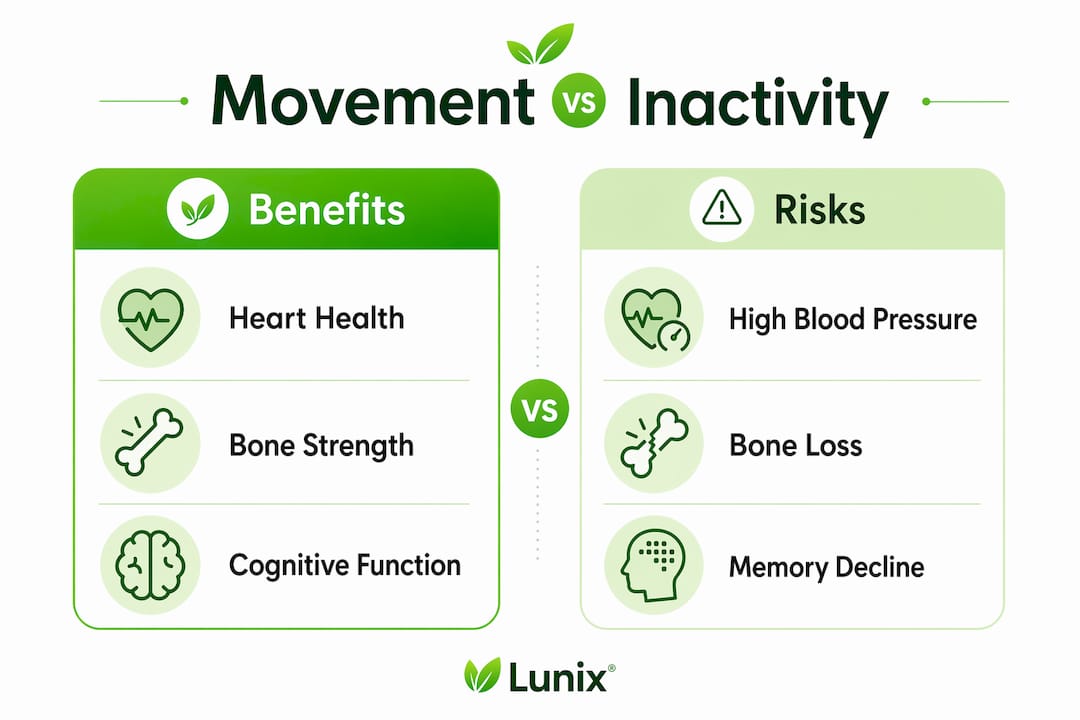
Movement functions as a systems-level intervention that regulates multiple biological processes at once. Humans evolved for 6–8 hours of daily locomotion. When you sit for most of the day, your body does not simply rest. It begins a slow, measurable decline across multiple systems.

At the cellular level, movement triggers mechanotransduction and myokine signaling. In plain terms, your muscles release chemical messengers when they contract, and those messengers travel through your bloodstream to reduce inflammation, regulate blood sugar, and support brain health. This is why physical activity improves insulin sensitivity and cardiovascular function at the same time.
Your musculoskeletal system benefits directly from regular movement. Bone density stays higher in people who move daily, and muscle strength declines far more slowly. Functional movements like chair stands and balance drills preserve independence and reduce fall risk, which becomes critically important after 50. These are not gym exercises. They are the same motions you use to get out of a car or carry groceries.
The neurological effects are equally significant. Regular activity enhances cognitive function, sharpens memory, and supports emotional stability. Movement is one of the most reliable tools available for improving sleep quality and maintaining bone density. Better sleep means better recovery, clearer thinking, and more energy the next day.
| Body system | Effect of daily movement | Effect of inactivity |
|---|---|---|
| Cardiovascular | Lower resting heart rate, better circulation | Increased plaque buildup, higher blood pressure |
| Musculoskeletal | Preserved strength and bone density | Muscle loss, joint stiffness, fracture risk |
| Metabolic | Stable blood sugar, healthy weight | Insulin resistance, weight gain |
| Neurological | Sharper cognition, better mood | Cognitive decline, increased depression risk |
Pro Tip: Pair movement with an existing habit. Do 10 chair stands while your coffee brews, or take a 5-minute walk after every meal. Habit stacking makes consistency far easier than scheduling separate workout blocks.
What are the psychological and social benefits of moving daily?
The mental health case for daily movement is just as strong as the physical one. Structured physical activity reduces depression by 17% and slows cognitive aging. That reduction is clinically meaningful and comparable to some therapeutic interventions, without the side effects.
Movement also builds self-esteem and a sense of capability. When you complete a walk, a yoga session, or even a set of mobility exercises for midlife health, you reinforce the belief that you are someone who takes care of your body. That belief compounds over time and shapes your broader health behavior.
The social dimension of physical activity is underappreciated. The UNESCO International Charter on Physical Activity identifies movement as a key driver of social well-being, community cohesion, and psychological resilience. Group walks, fitness classes, and recreational sports all create social bonds that reduce isolation, which is itself a significant health risk in midlife.
- Movement reduces cortisol, the primary stress hormone, within minutes of starting.
- Regular activity improves sleep onset and sleep depth, which directly supports mood.
- Social movement activities like group walks or dance classes reduce loneliness.
- Physical capability builds confidence that carries into professional and personal life.
- Consistent movement creates a positive feedback loop: you feel better, so you move more.
How can adults 40–65 build more movement into each day?
The biggest barrier to daily movement is not motivation. It is structure. Most adults in this age group have full schedules, and carving out a 60-minute gym block feels impossible. The solution is not a bigger block of time. It is short, frequent movement bouts woven into what you already do.
Exercise snacking, meaning short bursts of movement spread across the day, carries an adherence rate of over 82% compared to longer, less frequent workout sessions. That gap matters. The best exercise routine is the one you actually follow. A 5-minute walk three times a day beats a 45-minute gym session you skip four days a week.
Here are practical ways to build daily movement into your routine without restructuring your life:
- Walk during phone calls. Stand up and move every time you take or make a call. Most adults spend 30–60 minutes daily on phone conversations.
- Use the stairs as a default. Stair climbing builds leg strength, improves cardiovascular fitness, and takes no extra time.
- Practice chair stands. Rise from your chair without using your hands, 10 repetitions, twice a day. This single exercise preserves the leg strength needed to prevent falls.
- Add a post-meal walk. A 10-minute walk after eating stabilizes blood sugar and aids digestion. It is one of the most metabolically efficient habits you can build.
- Try balance drills while waiting. Stand on one foot while brushing your teeth or waiting for the kettle. Balance training reduces fall risk significantly in adults over 50.
- Stretch during screen time. Gentle neck rolls, shoulder circles, and hip flexor stretches during TV time address the posture damage caused by prolonged sitting.
- Schedule movement like a meeting. Block 10-minute movement windows in your calendar at 10:00 AM, 1:00 PM, and 3:00 PM. Treat them as non-negotiable.
If you want to stay active without a gym, these micro-habits are your most reliable path. They require no equipment, no commute, and no special clothing. They just require showing up consistently.
Pro Tip: Track your movement in 5-minute blocks rather than total hours. Seeing that you moved 8 times today feels more motivating than noting you only hit 40 minutes. Small wins build momentum.
Key Takeaways
Daily movement is the single most accessible intervention for reducing premature death, managing chronic disease, and maintaining physical and mental function in adults aged 40–65.
| Point | Details |
|---|---|
| Five minutes changes outcomes | Adding just 5 minutes of moderate daily activity can prevent 1 in 10 premature deaths. |
| Start light, gain most | Moving from sedentary to light daily activity produces the largest relative drop in mortality risk. |
| Movement heals multiple systems | Regular activity regulates blood sugar, bone density, cognition, and mood simultaneously. |
| Exercise snacking works | Short movement bouts spread across the day achieve over 82% adherence, far higher than long sessions. |
| Social movement multiplies benefits | Group-based physical activity builds community ties and reduces isolation alongside physical health gains. |
Movement is the medicine most of us keep postponing
I have watched the same pattern repeat across years of working in wellness: people wait for the “right time” to get serious about their health. They plan to start after the holidays, after the project ends, after the kids leave home. By the time the right time arrives, the body has already paid a price that takes twice as long to recover from.
What the research makes clear, and what I find genuinely encouraging, is that the threshold for benefit is far lower than most people assume. You do not need to be an athlete. You do not need a gym membership or a personal trainer. You need five consistent minutes more than you had yesterday. That is the actual science, not a motivational slogan.
The mindset shift that matters most is treating movement as maintenance, not punishment. Your car needs regular oil changes not because something is wrong, but because that is how you keep it running. Your body works the same way. Movement mindfulness — the practice of paying attention to how your body feels as you move — makes that maintenance feel less like a chore and more like a conversation with yourself.
The adults I have seen thrive in their 50s and 60s are not the ones who trained hardest in their 40s. They are the ones who moved consistently, recovered well, and never stopped. That consistency is available to you right now, today, in five-minute increments.
— Lunix
How Lunixinc supports your daily movement goals
Building a daily movement habit is only half the equation. Recovery is the other half, and it is where most adults aged 40–65 fall short.

When your muscles and joints recover well, you move more the next day. When recovery is poor, soreness and stiffness become the reasons you skip movement altogether. Lunixinc designs recovery solutions specifically to support that cycle, helping your body restore after activity so you can show up again tomorrow. From targeted muscle relief to comfort tools that fit into your existing routine, Lunixinc products are built for adults who take their long-term health seriously. Explore the full recovery collection and give your body the support it needs to keep moving.
FAQ
How much daily movement do adults over 40 need?
Federal guidelines recommend at least 150 minutes of moderate aerobic activity weekly, plus two days of muscle strengthening. That breaks down to about 22 minutes of movement per day, a manageable target for most adults.
Can short bursts of movement really make a difference?
Yes. Exercise snacking, meaning short movement bouts spread across the day, achieves over 82% adherence and produces measurable metabolic and cardiovascular benefits. Even 5 minutes of moderate activity can prevent approximately 1 in 10 premature deaths when practiced consistently.
What types of movement are best for adults aged 40–65?
Walking, chair stands, balance drills, and light resistance training are the most effective and accessible options. Functional movements that mimic daily tasks preserve independence, reduce fall risk, and maintain the strength needed for healthy aging.
Does daily movement improve mental health?
Structured physical activity reduces depression by 17% and supports cognitive function, sleep quality, and emotional resilience. The UNESCO International Charter on Physical Activity also identifies movement as a key driver of social well-being and community cohesion.
What happens to the body when you stop moving regularly?
Inactivity triggers physiological decline across multiple body systems, including loss of muscle strength, reduced bone density, worsening insulin sensitivity, and increased cardiovascular risk. The body evolved for 6–8 hours of daily locomotion, and extended sedentary periods reverse that baseline rapidly.