


TL;DR:
- A women’s self-care workflow includes daily, weekly, and monthly routines tailored to midlife that promote physical, mental, and emotional well-being. Building consistent habits like hydration, regular wake times, movement, and mindfulness creates stability and prevents burnout despite hormonal fluctuations. Regular review and adaptation of routines support long-term resilience, with physical recovery playing a critical role in overall wellness.
A self-care workflow for women is a structured set of daily, weekly, and monthly routines designed to protect physical, mental, and emotional health without requiring a complete life overhaul. For women aged 40–65, this kind of structure matters more than ever. Hormonal shifts, changing energy levels, and competing responsibilities make random, sporadic self-care far less effective than a repeatable system. The good news: small consistent habits like hydration, movement, and sleep routines outperform intense short-term resets every time. This article gives you a practical framework you can start this week.
What daily habits form the foundation of a self-care workflow for women?
The strongest women’s wellness routines are built on what experts call daily anchors: short, repeatable habits that take 5–15 minutes and create a stable foundation for everything else. Think of them as the load-bearing walls of your routine. Remove them and the structure weakens. Keep them consistent and everything else becomes easier to maintain.
A 3-tiered self-care structure of daily anchors, weekly resets, and monthly check-ins is the framework most recommended for women in midlife. The daily tier is where you build the most momentum. Here are the four anchors worth prioritizing:
- Hydration first thing. Drink 12–16 oz of water before coffee or food. This one habit supports blood sugar regulation, digestion, and energy levels before the day even starts.
- Consistent wake time. Your circadian rhythm responds to regularity more than sleep duration. Waking at the same time daily, even on weekends, stabilizes cortisol patterns and improves sleep quality over time.
- Brief movement. A 10-minute walk, a short yoga flow, or even five minutes of stretching counts. The goal is circulation and nervous system activation, not a workout.
- A mindful pause. Small habits of 5–10 minutes of intentional breathing or quiet reflection measurably reduce stress. This is not optional for women managing high-demand schedules.
The key to making these stick is anchoring them to habits you already have. Drink water while the coffee brews. Do your stretches right after brushing your teeth. Habit formation averages about three weeks but fluctuates during hormonal transitions like perimenopause, so biological alignment matters more than sheer willpower.
Pro Tip: Pick one anchor to start, not four. Attach it to something you already do every morning. Once it feels automatic, usually within two to three weeks, add the next one.
How can weekly and monthly resets prevent burnout?
Daily habits keep you stable. Weekly and monthly practices keep you from quietly running on empty. Weekly resets help you recover, plan ahead, and catch stress signals before they become health problems. Monthly check-ins give you the wider view: are your habits still working, or do they need adjusting?
A weekly reset does not need to be elaborate. The most effective ones include:
- Calendar review. Look at the week ahead and protect at least one block of time for yourself. Schedule it like a meeting.
- Grocery prep. Eating well is a self-care strategy, not a chore. Prepping a few basics on Sunday reduces decision fatigue and supports blood sugar stability all week.
- Stress check. Ask yourself one honest question: what drained me most this week? The answer tells you where to adjust.
- An early night. One night per week where you prioritize sleep over screens resets your nervous system more than most supplements.
Monthly check-ins work differently. They are less about doing and more about assessing. Take 20–30 minutes once a month to review your energy levels, your workload, and whether your current habits are actually serving you. Women who treat their wellness routine as a living system, not a fixed program, report far better long-term adherence.
Here is how the three tiers compare:
| Tier | Frequency | Time Required | Primary Benefit |
|---|---|---|---|
| Daily anchors | Every day | 5–15 minutes | Stability, energy, stress reduction |
| Weekly resets | Once per week | 30–60 minutes | Recovery, planning, early stress detection |
| Monthly check-ins | Once per month | 20–30 minutes | Habit adjustment, emotional balance, burnout prevention |
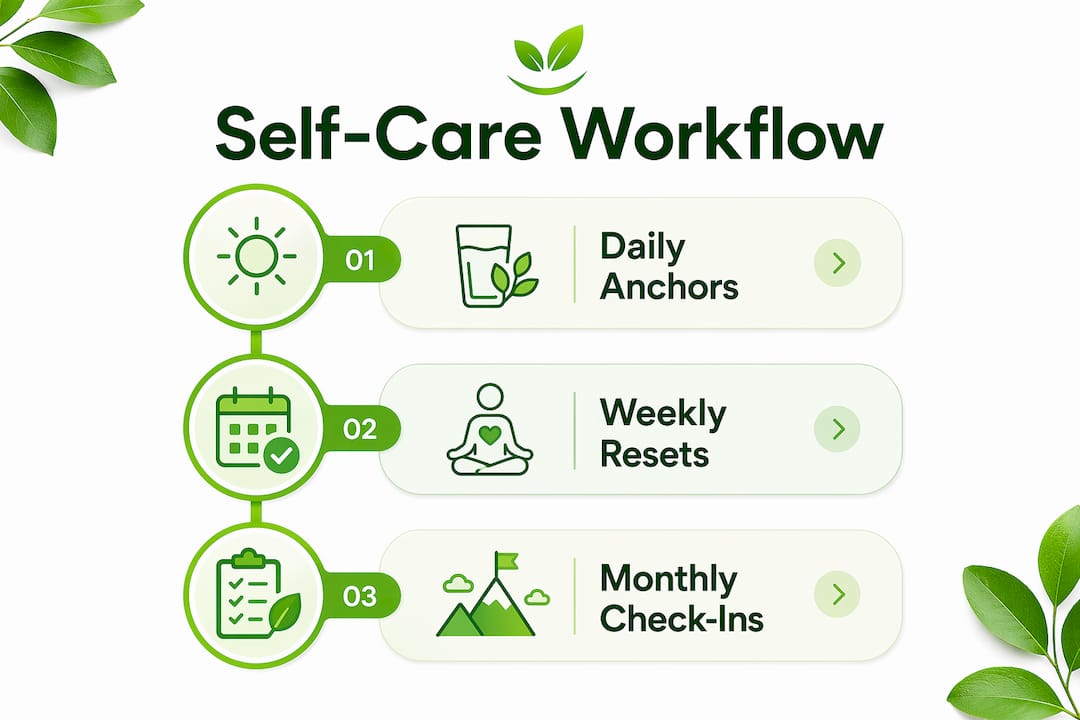
The table above shows a clear pattern: the less frequent the practice, the more strategic it becomes. Daily habits build the floor. Weekly and monthly practices raise the ceiling.
How to tailor your routine around hormonal changes in midlife?
Personalized wellness has replaced the one-size-fits-all model for good reason. The femtech industry is valued at $66.2 billion in 2025, reflecting how much demand exists for health tools that account for women’s unique biology. But the most effective self-care strategies for women in perimenopause and beyond do not come from an app. They come from self-awareness.
Here is what actually matters during midlife hormonal transitions:
- Nervous system regulation over intense exercise. High-intensity workouts can spike cortisol in women whose hormones are already fluctuating. Gentle movement, breathwork, and adequate rest often deliver better results.
- Blood sugar stability. Skipping meals, eating high-sugar foods, or going long stretches without protein destabilizes mood and energy. This is a hormonal issue, not just a nutrition one.
- Sleep quality as a non-negotiable. Poor sleep amplifies every other symptom of hormonal change. Protecting sleep is one of the most direct self-care investments you can make.
- Flexible scheduling. 73% of women report reduced output during menstruation regardless of objective performance. Scheduling lighter demands during low-energy phases is not weakness. It is strategy.
The concept of cycle syncing, which involves adjusting food, exercise, and work intensity to match hormonal phases, has real value as a framework for self-awareness. However, cycle syncing should be used for self-awareness rather than rigid compliance, especially during midlife transitions when cycles become irregular or stop entirely. Use it as a lens, not a rulebook.
Pro Tip: Keep a simple weekly energy log. Rate your energy and mood on a 1–5 scale each morning. After four weeks, patterns emerge that no app can predict for you.
For women navigating these shifts, a midlife wellness plan that prioritizes nervous system recovery and physical restoration will always outperform a generic fitness program.
What mistakes derail a self-care routine, and how do you fix them?
The most common reason self-care routines fail is that women build them for their ideal self rather than their real self. Planning for an idealized version of yourself leads to early abandonment, guilt, and the false belief that you are simply not a “routine person.” You are. The routine was just the wrong size.
Here is how to troubleshoot the most common breakdowns:
- Your routine is too ambitious. If you miss it two days in a row, you feel like you have failed. Define a minimum viable routine: the two or three habits you will protect no matter what. Everything else is a bonus.
- You treat rest as a reward. Rest is not what you earn after productivity. It is what makes productivity possible. Reframing self-care as essential for preventing burnout shifts motivation and improves adherence.
- You never prune. A routine that worked at 45 may not work at 55. Review it. Drop what no longer serves you. Add what your body is asking for now.
- You rely on motivation. Motivation is unreliable. Structure is not. Anchor your habits to time and place, not to how you feel that morning.
“Effective self-care for busy women is often invisible: protecting sleep, saying no, and maintaining blood sugar rather than spa days or rigid routines.” — K.E.Y. to Mind and Body
The women who sustain their self-care plan long-term are not the ones with the most discipline. They are the ones with the most realistic expectations and the willingness to adapt without guilt.
Key takeaways
A sustainable self-care workflow for women in midlife requires daily anchors, weekly resets, and monthly check-ins built around real life, not an idealized version of it.
| Point | Details |
|---|---|
| Use a 3-tier structure | Combine daily anchors, weekly resets, and monthly check-ins for lasting results. |
| Start with one anchor | Attach a single daily habit to an existing routine before adding more. |
| Adapt to hormonal shifts | Prioritize nervous system regulation and sleep quality during midlife transitions. |
| Define your minimum routine | Identify two to three non-negotiable habits to protect when life gets demanding. |
| Treat your routine as a living system | Review and adjust monthly so your habits stay relevant as your needs change. |
What Lunixinc has learned about self-care that most guides miss
Most self-care content focuses on what to add: more habits, more tools, more structure. What we have found, working closely with women in midlife, is that the real shift is subtraction. The women who thrive are not doing more. They are doing less, better, and with far less guilt about it.
The mindset piece is where most routines quietly collapse. Women in their 40s and 50s have spent decades prioritizing everyone else. Treating self-care as a necessity rather than an indulgence feels uncomfortable at first. It can even feel selfish. But women report better adherence when self-care is viewed as a mandatory buffer against burnout, not a luxury they have to earn.
What we also see consistently: physical recovery is the most underrated pillar. Women invest in nutrition, movement, and mindfulness practices, but they underestimate how much their body needs dedicated restoration time. Muscle tension, poor circulation, and disrupted sleep compound each other in a way that no amount of journaling fully addresses. Physical comfort and recovery are not separate from emotional wellness. They are the foundation of it.
The other thing worth saying plainly: you do not need a perfect routine. You need a resilient one. A routine that bends without breaking when life gets complicated is worth ten times more than a beautiful morning protocol you abandon by week three. Build for your real life. Adjust without apology. That is the whole practice.
— Lunix
Support your wellness routine with Lunixinc recovery tools
Your self-care workflow deserves physical support, not just good intentions. Lunixinc designs recovery and comfort products specifically to help your body restore, relax, and feel its best between the demands of daily life.

Whether you are winding down after a long day, managing muscle tension, or simply carving out dedicated restoration time, the Lunixinc recovery collection offers tools built for exactly that. Each product is designed to fit naturally into the daily and weekly self-care practices you are already building. For women in midlife, physical recovery is not a bonus. It is a core part of any self-care strategy that actually works. Explore the collection and find what your body has been asking for.
FAQ
What is a self-care workflow for women?
A self-care workflow for women is a structured system of daily, weekly, and monthly habits designed to protect physical, mental, and emotional health consistently. It differs from a generic routine by being intentionally tiered and adaptable to real-life demands.
How long does it take to build a self-care routine?
Habit formation averages about three weeks but can take longer during hormonal transitions like perimenopause. Consistency and biological alignment matter more than the number of days.
What are the best daily self-care tips for women over 40?
The most effective daily habits include consistent wake times, morning hydration, brief movement, and a short mindful pause. These five-to-fifteen-minute anchors stabilize energy, mood, and stress levels across the day.
How do hormonal changes affect a women’s wellness routine?
Hormonal shifts in perimenopause and menopause affect sleep quality, energy, and stress tolerance. Prioritizing nervous system regulation, blood sugar stability, and flexible scheduling helps women maintain their routine through these transitions.
How do i know when to adjust my self-care plan?
Review your routine monthly. If you are consistently skipping habits, feeling drained, or your energy patterns have shifted, it is time to prune what is not working and replace it with something better suited to where you are now.