


For most healthy adults, 2 to 4 sauna blanket sessions per week is the practical sweet spot for wellness, recovery, and better sleep. Some people build up to daily short sessions once they’re well acclimated, but that’s a progression, not a starting point. Start low on time and temperature, hydrate before and after every session, and check with a clinician first if you’re pregnant or manage a heart or blood pressure condition.
TL;DR:
- Beginners should start with two sauna blanket sessions weekly, lasting 15 to 20 minutes at low temperatures, and reassess after two weeks.
- For general wellness, three to four sessions per week of 20 to 30 minutes help build routine and sustained benefits.
- Recovery-focused use should align with training load, ideally right after workouts, and not exceed five sessions per week.
- Gradually increase session duration and temperature every few weeks, adding no more than 5 to 10 minutes or one extra session per week.
- Hydrate well before and after sessions, and stop immediately if experiencing dizziness, nausea, chest pain, headache, or fainting.
Table of Contents
- Sauna Blanket How Often: Weekly Schedules by Goal
- How Do You Safely Increase Sauna Blanket Frequency?
- What’s the Right Session Length and Temperature?
- Hydration and Safety Rules You Shouldn’t Skip
- Does Sauna Blanket Frequency Actually Change the Benefits?
- How Should You Fit Sauna Sessions Around Workouts?
- What Lunix Has Learned From Real Sauna Blanket Use
- Where This Article’s Guidance Comes From
- Why We Think Most People Overthink Frequency
- Start Your Sauna Routine With the LX17
- Sources
- FAQ
Sauna Blanket How Often: Weekly Schedules by Goal
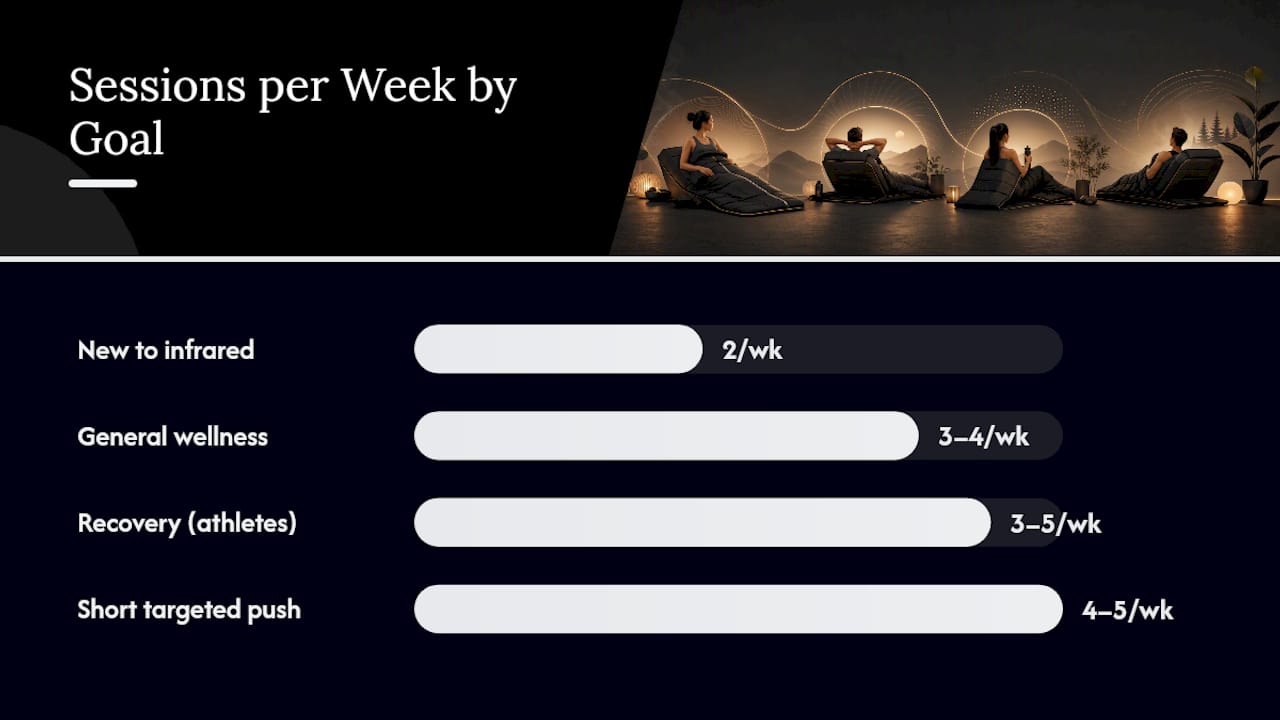
The honest answer to “sauna blanket how often” depends less on some universal number and more on what you’re trying to get out of it. Sleep support, muscle recovery, and general relaxation all call for slightly different rhythms, and the research on heat exposure backs that up. Reviews of sauna bathing link repeated weekly sessions, often in the 3 to 5 sessions per week range, to measurable cardiovascular and recovery benefits. That’s the range most infrared sauna blanket guidance borrows from, scaled down for a home device.
If you’re brand new to infrared heat, keep it simple:
- 2 sessions per week
- 15 to 20 minutes per session
- Low temperature setting
- Reassess how you feel after 2 weeks before adding anything
For general wellness and maintenance once you’ve adjusted, most people land on:
- 3 to 4 sessions per week
- 20 to 30 minutes per session
- Consistent timing (same days, similar time of day) to build a routine your body recognizes
If recovery is the goal, athletes and regular exercisers often do best with a schedule built around training load, not the calendar:
- Sauna 3 to 5 times per week, timed right after a workout
- Rehydrate before getting into the blanket, not just after
- Skip a session if you’re already running a fever or nursing an injury that heat could aggravate
For a short, targeted push (say, a 2 to 4 week stretch before an event, or while testing whether sauna sessions help a specific issue like tight shoulders or restless sleep), 4 to 5 sessions per week can work, provided you’re monitoring how your body responds the entire time.
Whichever plan you pick, track a few things as you go: sleep quality, muscle soreness the next morning, hydration status, and how hard the session felt relative to your energy that day. Two weeks of consistent tracking tells you more than any generic frequency chart.
How Do You Safely Increase Sauna Blanket Frequency?
Acclimation is the part most people skip, and it’s the part that determines whether you stick with this long term. Clinician guidance consistently points to the same starting formula: 15 to 20 minutes, a couple of times a week, before you touch the dial on either time or heat.
Here’s a simple progression that works for most beginners:
- Weeks 1 to 2: 15 to 20 minutes at a low temperature (around 110 to 120°F), twice a week.
- Weeks 3 to 4: If you’ve had no lightheadedness, excessive fatigue, or skin irritation, move to 20 to 30 minutes, 3 times a week.
- Month 2 and beyond: Add frequency or duration in small steps, never both at once.
The rule that keeps people out of trouble is this: add no more than 5 to 10 minutes at a time, or one extra session per week, whichever you’re adjusting. If anything feels off, pause the increase for a week rather than pushing through it.
Set-up matters just as much as the schedule. Preheat the blanket for 8 to 10 minutes before you get in, lay it flat on a stable surface, and use a thin towel as a barrier between your skin and the interior lining.
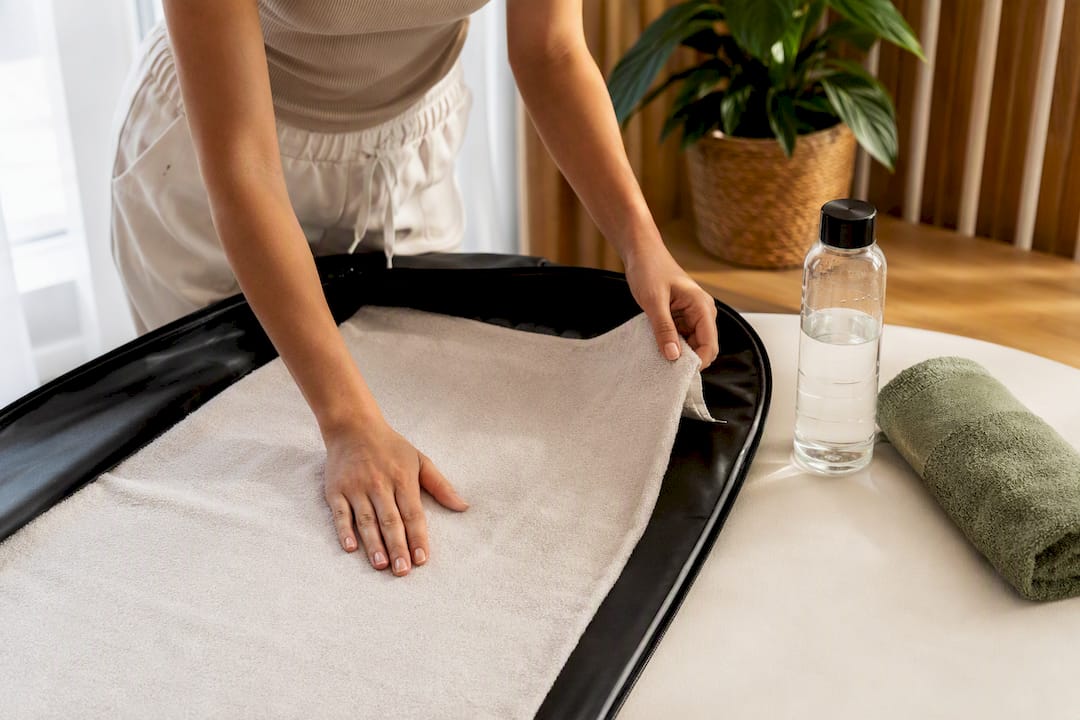
Pro Tip: Keep a water bottle within arm’s reach before you zip in. Getting up mid-session to grab water is more disruptive, and honestly more tempting to skip, than just having it there from the start.
What’s the Right Session Length and Temperature?
Duration and heat work together, and the mistake most beginners make is cranking both up at once. Keep them separate variables.
- Beginners: 15 to 20 minutes per session
- Typical ongoing use: 30 to 45 minutes once you’re acclimated
- Upper limit: avoid going past 60 minutes unless you’re monitoring closely and have weeks of consistent tolerance behind you
Temperature follows the same logic. Start in the lower range, roughly 110 to 130°F, and only push higher once your body has proven it handles the lower end without dizziness or excessive fatigue. A systematic review of sauna bathing notes that many clinical protocols actually use shorter sessions of around 15 to 20 minutes, relying on repetition over the weeks rather than one long, intense sit, to produce benefit. That’s a useful reality check if you’re tempted to think longer is automatically better.
Sweat loss adds up faster than people expect. One field study of far infrared sessions recorded sweat rates near 0.46 liters per hour under some conditions, which is a meaningful fluid loss for a 30 to 45 minute session.
Timing matters beyond just the session itself. If you’re using the blanket to wind down for sleep, finish 60 to 120 minutes before bed. That window lets your skin and core temperature drop back down, which lines up with your body’s natural sleep-onset process rather than fighting against it. If you’re pairing sessions with workouts, sauna after training tends to serve recovery better than sauna before it. If you do use it pre-workout, keep the session short and hydrate well beforehand.
Hydration and Safety Rules You Shouldn’t Skip
Heat exposure pulls fluid out of your body faster than you’d think, and that’s the main safety variable to manage as frequency climbs.
Drink 16 to 20 ounces (roughly 500 to 600 mL) of water before a session and the same amount after. If you’re sweating heavily, or using the blanket daily, add electrolytes to that routine rather than relying on plain water alone. Research on heat therapy and thermoregulation underscores how much fluid balance affects your body’s ability to handle repeated heat exposure safely.
Stop a session immediately if you notice any of these:
- Dizziness or lightheadedness
- Nausea
- Chest pain
- Severe headache
- Fainting or near fainting
Certain conditions call for a conversation with a clinician before you start at all: pregnancy, cardiovascular disease, uncontrolled high blood pressure, a recent cardiac event, or use of medications like antihypertensives or diuretics that already affect fluid balance.
| Safety checklist item | Why it matters |
|---|---|
| Never sleep inside the blanket | Prevents overheating you can’t respond to |
| Use a towel barrier | Reduces direct skin contact with the lining |
| Keep your phone within reach | Lets you call for help if something feels wrong |
| Set a timer | Keeps sessions from running long by accident |
| Start low on temperature and duration | Gives your body time to adapt safely |
Does Sauna Blanket Frequency Actually Change the Benefits?
Frequency is the lever that turns a nice relaxation habit into something with measurable effect, but the size of that effect depends on the goal.
- Sleep: Sessions 2 to 4 times a week, timed ahead of bedtime, support the natural cooling process your body uses to fall asleep.
- Recovery: Post-workout sessions 2 to 5 times a week are linked to reduced perceived soreness in heat therapy research.
- Metabolic support: Some studies use more frequent short-term protocols, but sauna use works as an adjunct to diet and exercise, not a replacement for either.
It’s worth being direct about the evidence gap here. Most of the strongest data on cardiovascular and longevity benefits comes from traditional Finnish sauna studies, not portable infrared blankets specifically. The physiology overlaps, but a home blanket and a full sauna cabin aren’t identical exposures, and long-term trials on consumer infrared blankets are still limited.
How Should You Fit Sauna Sessions Around Workouts?
Training load should drive your sauna schedule more than a fixed weekly number.
- Default to post-workout sessions. Heat after training supports relaxation and eases perceived soreness better than heat beforehand, and you’ll want to rehydrate before stepping into the blanket, not just after.
- If you train 4 to 6 times a week, put sauna sessions on your lighter training days or right after non-maximal efforts, not after your hardest lift or longest run.
- Build a simple micro-schedule: heavy training day, no sauna; moderate training day, sauna after; rest day, sauna if you want a relaxation session. That pattern prevents the fatigue from stacking on top of itself.
Matching frequency to training load, rather than a flat daily habit, is one detail recovery-focused heat research keeps circling back to.
What Lunix Has Learned From Real Sauna Blanket Use
We built the LX17 portable infrared sauna blanket around the same acclimation principle this article keeps coming back to: start low, stay consistent, and let your body set the pace. The LX17 comes with a trial period intended to help new users determine if the frequency fits their sleep and recovery goals. Two weeks is roughly enough time to run the beginner schedule and know whether the frequency you picked actually fits your sleep and recovery goals, without committing to it blind.
We’ve also put together plain-language resources on post-workout sauna blanket use and on HSA reimbursement for sauna blankets, since cost and insurance questions come up almost as often as frequency questions do. Product setup, warranty terms, and safety documentation are listed on the LX17 product page itself, worth a read before your first session.
Where This Article’s Guidance Comes From
The frequency ranges, hydration numbers, and safety flags in this guide are pulled from peer-reviewed heat therapy research and clinician-quoted starter protocols, not marketing copy. A few sources carried the most weight in shaping the recommendations above:
- The cardiovascular and other health benefits of sauna bathing: a review
- Heat therapy and thermoregulation in health and disease
- Sauna bathing and health: a systematic review and meta-analysis
- Do Sauna Blankets Really Work? Here’s What a Doctor Says
Why We Think Most People Overthink Frequency
Here’s the thing about “sauna blanket how often” as a question: most people ask it wanting a single magic number, and the honest answer is that consistency beats intensity almost every time. A person doing 3 moderate sessions a week for two months will get more out of it than someone doing daily sessions for ten days and then quitting when they feel drained.
We’d also push back gently on the instinct to treat more frequency as automatically better. The research behind sauna bathing benefits was built on repeated, moderate exposure over time, not maximum exposure right out of the gate. Daily use has a place for some experienced users, but it’s the finish line of an acclimation process, not the entry point. If you’re new to this, the boring 2 to 3 sessions a week plan you actually stick with will outperform the ambitious daily plan you abandon after a rough night’s sleep.
The other overlooked piece is timing relative to sleep. People chase frequency numbers while ignoring that a session at 9 PM for someone going to bed at 10 PM is working against their own biology. Get the timing window right first. Frequency optimization means much less if the clock is wrong.
— Lunix
Start Your Sauna Routine With the LX17
If you’re ready to test a frequency schedule instead of just reading about one, the LX17 portable infrared sauna blanket comes with a 14-day trial, long enough to run a full beginner schedule and see how your sleep and recovery actually respond.

Before your first session, check the features that support regular use, including a washable cover, safety zipper for quick exits, and touchscreen controls to adjust temperature. Follow the acclimation and hydration guidance in this article, and if you manage a heart condition, high blood pressure, or you’re pregnant, get clearance from a clinician before you start. When you’re ready to see the full lineup or check current availability, visit Lunixinc to get started.
This article is general information, not a substitute for advice from a qualified doctor. Consult a qualified healthcare professional about your own circumstances before acting on anything here.
Sources
- The cardiovascular and other health benefits of sauna bathing: a review
- Heat therapy and thermoregulation in health and disease
- Sauna bathing and health: a systematic review and meta-analysis
- Do Sauna Blankets Really Work? Here’s What a Doctor Says
FAQ
Do Sauna Blankets Reduce Cortisol?
Heat exposure is linked to relaxation responses that can lower perceived stress, and sauna bathing research points to broader physiological benefits from repeated heat exposure. Direct cortisol data specific to portable infrared blankets is limited, so treat stress relief as a plausible, well-supported benefit rather than a guaranteed biochemical outcome.
What Is the 200 Rule for Saunas?
The “200 rule” isn’t a term used in the sauna research or clinician guidance reviewed for this article. If you’ve seen it referenced elsewhere, treat it as an informal rule of thumb rather than an established clinical standard, and stick to the duration and temperature ranges covered above instead.
Does a Sauna Blanket Burn Fat?
Sauna blankets raise heart rate and cause significant fluid loss through sweat, which can create a temporary drop on the scale, but that’s water weight, not fat loss. Sauna use works best as an adjunct to diet and exercise, not a standalone weight-loss method, and evidence directly tying infrared blanket use to fat loss is limited.
Does Sauna Help Burn Belly Fat?
There’s no strong evidence that sauna sessions, blanket or traditional, target fat loss in a specific area like the belly. Any weight-related changes from sauna use are mostly fluid shifts from sweating, and spot-reducing fat through heat exposure isn’t supported by the sauna research reviewed here.
How Many Times a Week Should I Use a Sauna Blanket?
Most healthy adults do well with 2 to 4 sessions per week, adjusting up or down based on goals and how their body responds. Beginners should start at 2 sessions a week for 15 to 20 minutes before considering any increase.