


Infrared sauna blankets can deliver meaningful passive-heat benefits: better circulation, eased muscle soreness, deeper relaxation, and some measurable sleep gains in short trials. The evidence is real but limited, drawn mostly from small studies, and it does not back the bigger promises floating around wellness marketing. Sweat loss and hormone shifts are documented; broad “detox” and lasting fat loss are not.
TL;DR:
- Sweat loss from a 60-minute sauna blanket session is about 1.3 liters, mainly water, with no proven impact on long-term fat loss or toxin removal.
- Small trials suggest improved circulation, muscle recovery, and sleep quality, but these benefits are modest and require regular, sustained use over weeks or months.
- Risks like dehydration and overheating are preventable, but certain groups such as pregnant individuals and those with heart conditions should seek medical clearance before use.
- Larger, long-duration studies are needed to confirm sustained health benefits, as current evidence relies on limited, short-term trials.
- Sauna blankets are best used as part of a broader recovery and relaxation routine, not as a quick fix for weight loss or medical issues.
Table of Contents
- How Infrared Sauna Blanket Benefits Work Compared to a Traditional Sauna
- Does a Sauna Blanket Improve Circulation and Muscle Recovery?
- Can a Sauna Blanket Help You Sleep Better?
- What Sauna Blanket Claims Aren’t Backed by Evidence?
- Who Should Avoid Sauna Blankets or Talk to a Doctor First?
- How to Use a Sauna Blanket for the Best Results
- What Do the Clinical Trials on Sauna Blankets Actually Show?
- Do the Benefits of a Sauna Blanket Last Over Time?
- Who Benefits Most From Using a Sauna Blanket?
- Our Take on Where Sauna Blankets Fit in a Wellness Routine
- Try the Lunix LX17 for Evidence-Aligned Heat Therapy
- Sources
How Infrared Sauna Blanket Benefits Work Compared to a Traditional Sauna
A sauna blanket wraps you in layers embedded with far-infrared emitters, which warm your tissue directly instead of heating the air around you the way a traditional sauna room does. That distinction matters for comfort: you feel warmth build from the inside out, which is part of why many people tolerate a 60-minute session in a blanket better than 20 minutes in a 170°F sauna room.
The physiological response is measurable. One acute-response trial found that a 60-minute session at roughly 75°C raised sublingual body temperature from 36.8°C to 38.2°C, while participants lost an average of 1.3 liters of sweat.
- Far-infrared wavelengths penetrate tissue rather than just warming surrounding air.
- Core temperature and heart rate rise gradually over the session.
- Lower ambient heat makes longer sessions more tolerable for many users.
Statistic: A single 60-minute session pushed core temperature up approximately 1.4°C and triggered significant sweat loss.
Does a Sauna Blanket Improve Circulation and Muscle Recovery?
Heat exposure triggers nitric oxide release, which relaxes blood vessel walls and improves blood flow. That vasodilation is the physiological backbone behind most circulation claims tied to infrared heat, and it shows up consistently across small trials on far-infrared textiles.
Muscle recovery benefits follow the same logic. More blood flow to sore tissue can ease stiffness and support the post-workout recovery process, and some trial data shows modest improvements in grip strength and reaction time after consecutive nightly sessions.
Where people get it wrong is calorie burn. Passive heat does raise heart rate and energy expenditure briefly, similar to light cardio, but that is not the same as burning fat.
- Vasodilation from heat exposure supports short-term blood flow gains.
- Modest recovery signals appear in small trials, not dramatic strength gains.
- Sweat is water loss, not fat loss, and the scale reflects that difference by the next morning.
Statistic: One controlled study linked far-infrared blanket use to measurable improvements in vascular markers and grip strength after consecutive nights of use.
If you are chasing sustained weight change, understanding the actual science behind sauna-driven calorie burn will save you from a frustrating scale-watching habit.
Can a Sauna Blanket Help You Sleep Better?
Sleep is where the strongest data currently lives. A 14-day double-blind trial in older adult males found significant increases in blood serotonin, melatonin, and nitric oxide, alongside measurable improvements in deep sleep and REM sleep duration after nightly use of a far-infrared blanket.
The same DAZZEON αSleep study tracked vascular health and muscle function alongside sleep hormones, giving a fuller picture of what nightly passive heat can plausibly do for the body over two weeks.
| Trial finding | Result | Duration |
|---|---|---|
| Melatonin and serotonin | Significant increase | 14 nights |
| Deep sleep and REM stages | Measurable improvement | 14 nights |
| Sample size | males over 45 | Single trial |
The mechanism makes sense outside the lab, too. Warmth triggers parasympathetic activation, the body’s rest-and-digest switch, and a pre-sleep temperature drop after you remove the blanket mimics the natural thermal cue your body uses to signal bedtime.
- Hormone shifts were statistically significant but measured in a small, male-only group.
- Relaxation response likely compounds with consistent nightly use.
- Expect modest, not dramatic, sleep-quality gains if you are outside that studied demographic.
What Sauna Blanket Claims Aren’t Backed by Evidence?
“Detox” is the word doing the most damage in sauna blanket marketing. Sweat does carry trace metals out of the body, but there is no solid evidence that sweating clears toxins at an organ level, and experts examining these claims consistently push back on the broader detox narrative.
Study quality is the second issue worth understanding before you trust a bold claim. The trials behind the sleep and circulation findings involved small samples, ran for just 14 days or a single session, and in at least one case studied only males over 45. A systematic review of infrared therapy notes real promise for certain musculoskeletal conditions but calls for research specific to blankets rather than whole-body sauna cabins.
Here’s what would actually move the needle on confidence:
- Trials with mixed-sex cohorts across a wider age range.
- Studies running months, not days, to test whether benefits hold or fade.
- Direct comparisons between blanket sessions and traditional sauna rooms on the same outcomes.
- Larger sample sizes that can rule out chance findings.
Pro Tip: Treat any claim promising rapid, sustained weight loss from a sauna blanket as a red flag. The honest version of this story is “temporary water loss plus modest recovery and relaxation benefits,” and that’s still worth having.
Who Should Avoid Sauna Blankets or Talk to a Doctor First?
Dehydration and overheating are the two risks that show up most often, and both are preventable with basic precautions. Fainting can happen if you stand up too quickly after a session, since blood vessels stay dilated for a few minutes after you step out.
Certain groups face higher risk and should get clearance from a clinician first:
- Pregnant individuals, due to core temperature sensitivity for fetal development.
- Anyone with unstable cardiovascular disease, including recent heart events.
- People with implanted electronic devices like pacemakers.
- Those with certain neurological conditions affecting heat regulation or fainting risk.
- Anyone who has been drinking alcohol, since it impairs temperature regulation and judgment.
Statistic: A 60-minute session can produce sweat loss around 1.3 liters, roughly the volume of a large water bottle, which is why hydration before and after matters as much as the session itself.
Stop a session immediately if you feel dizzy, nauseated, or unusually lightheaded, and rehydrate slowly rather than gulping cold water.
How to Use a Sauna Blanket for the Best Results
Start low and short. Beginners generally do well starting around 110 to 120°F for 20 to 30 minutes, working up toward 140 to 150°F and 45 to 60 minutes as tolerance builds over a few weeks.
- Wear light, breathable clothing or a thin cotton layer between skin and blanket for hygiene.
- Hydrate with 16 to 20 ounces of water beforehand, and rehydrate with electrolytes afterward.
- Use it two to four times a week for relaxation goals, or after workouts for recovery-focused sessions.
- Wipe down the interior lining after each use and wash any removable liner regularly.
- Time evening sessions an hour or two before bed to use the post-session temperature drop as a sleep cue.
Pro Tip: Pair a session with the heat therapy techniques used for pain and stress relief rather than treating the blanket as a stand-alone fix. Heat works best as one piece of a recovery routine, not the whole routine.
What Do the Clinical Trials on Sauna Blankets Actually Show?
Three data points anchor almost everything reliable we know about sauna blanket benefits, and each one has a clear scope.
The 14-day double-blind trial found significant hormone and sleep-stage improvements, but the sample was small and limited to older males, so it cannot speak for women or younger adults yet. The acute physiological study showed a single 60-minute session at about 75°C raised sublingual temperature by 1.4°C and produced roughly 1.3 liters of sweat loss, confirming the thermoregulatory load is real and substantial even in one sitting. The broader DAZZEON αSleep dataset layered in vascular and muscle function measurements alongside the sleep findings.
“Statistically significant improvements in deep sleep and REM sleep durations” appeared after just two weeks of nightly use in the trial cohort, alongside increases in serotonin, melatonin, and nitric oxide.
- Short-term physiological effects are well documented across all three sources.
- Long-term health outcomes remain untested at scale.
- Larger, longer, more diverse trials are the missing piece, not a lack of plausible mechanism.
The honest takeaway: the biology behind these benefits is sound, and the early data is encouraging. It just hasn’t been tested long enough or broadly enough to promise results for every body type or age group.
Do the Benefits of a Sauna Blanket Last Over Time?
Nobody has run a multi-year trial on sauna blankets, so any claim about long-term outcomes has to lean on what we know about heat therapy and cardiovascular health more broadly. Journalistic syntheses connecting frequent sauna bathing to modest cardiometabolic benefits suggest that consistency, not intensity, is what compounds results, and that pattern likely extends to accessible passive-heat tools like blankets when used regularly.
Relaxation and sleep benefits appear to follow a similar use-it-or-lose-it pattern. The hormone and sleep-stage gains documented in the 14-day trial were measured during active use, not after stopping, so there is no evidence yet that benefits persist once sessions taper off. That mirrors what shows up with most passive interventions: exercise, stretching routines, even meditation habits fade in effect once the habit stops.
Muscle recovery benefits likely behave the same way. Improved blood flow during a session helps that day’s soreness, but there is nothing to suggest the vascular improvement banks up for future workouts without continued sessions.
The practical implication is straightforward. If you are using a sauna blanket for sleep, stress, or recovery, think of it less like a one-time fix and more like a habit you maintain, similar to how a stretching routine only keeps you flexible while you keep doing it. Two to four sessions a week, sustained over months, is a more realistic model for durable benefit than an occasional deep dive followed by long gaps. Maintenance, not intensity, appears to be what keeps these effects active.
Who Benefits Most From Using a Sauna Blanket?
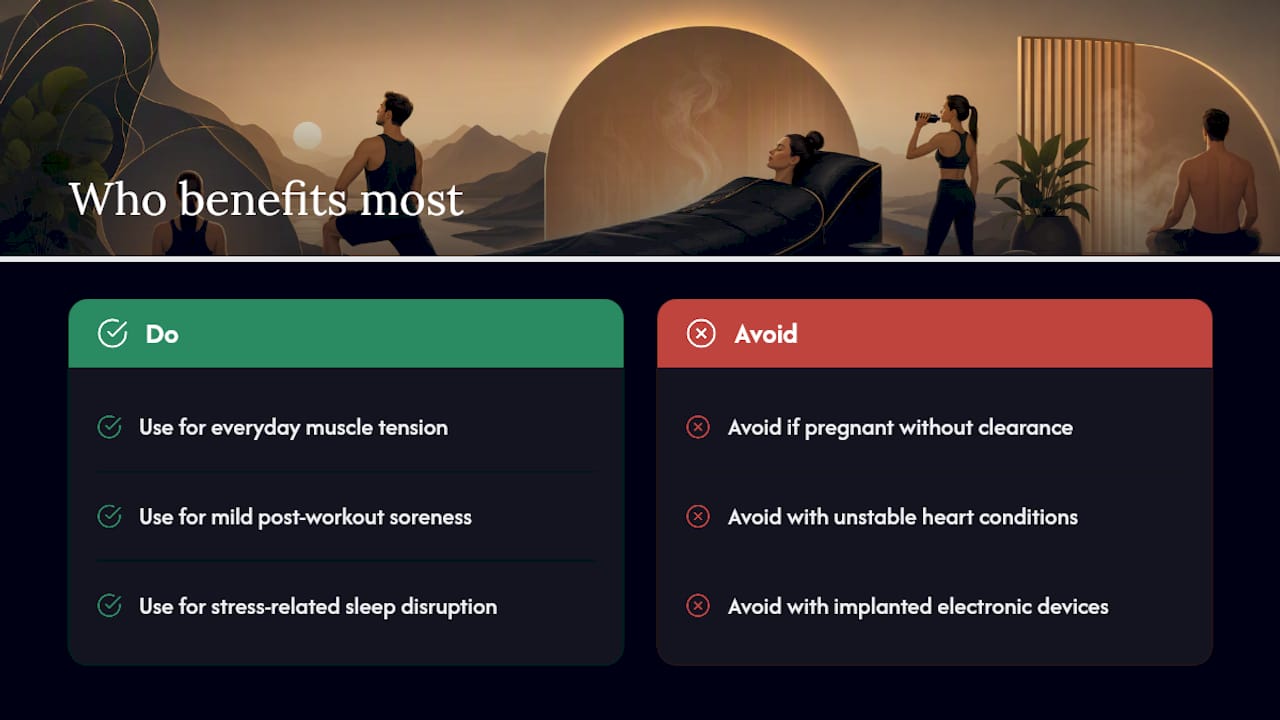
Adults dealing with everyday muscle tension, mild sleep disruption, or stress that shows up as physical tightness tend to see the clearest, most relatable benefits. If you sit at a desk most of the day and carry tension in your shoulders and lower back, the combination of heat-driven blood flow and forced relaxation time can address both the physical and mental side of that tension in one session.
People recovering from moderate exercise loads, rather than elite athletes managing acute injuries, are a strong fit too. The recovery signal in the research is real but modest, which matches someone easing post-workout soreness better than someone rehabilitating a torn muscle.
Older adults dealing with mild circulation concerns may see benefit as well, since the vasodilation mechanism behind these blankets is the same one at work in the 14-day trial’s older male cohort. That said, this is also the group most likely to carry cardiovascular risk factors, so clearance from a doctor matters more here than for a healthy 30-year-old.
Sauna blankets are a poor fit for anyone expecting rapid, visible weight loss or a substitute for cardiovascular exercise. They are also not appropriate, without medical guidance, for pregnant individuals, people with unstable heart conditions, or those with implanted electronic devices, regardless of how appealing the relaxation benefits sound. The best-fit user is someone treating heat exposure as one recovery and relaxation tool among several, not a cure for a specific medical condition.
Our Take on Where Sauna Blankets Fit in a Wellness Routine
Lunixinc built its infrared line, including the LX17 sauna blanket, around the same conservative read of the evidence laid out here. We treat heat exposure as a complement to good sleep habits, regular movement, and a post-workout recovery routine, never a substitute for clinician-guided care.
— Lunix
Try the Lunix LX17 for Evidence-Aligned Heat Therapy
If you want passive heat benefits without the guesswork of temperature dials and safety uncertainty, the LX17 Portable Infrared Sauna Blanket is built with safety zippers, touchscreen temperature controls, and a washable liner designed specifically for the beginner protocols outlined above.

The Lunix Benefits page breaks down what the LX17 is designed to support, from muscle recovery to relaxation, with the same evidence-first framing you found throughout this piece. If you have a cardiovascular condition, are pregnant, or use an implanted device, review the included safety instructions and talk to your doctor before your first session. Otherwise, check out the LX17 product page today to see if it fits your recovery routine.
Sources
This article is general information, not a substitute for advice from a qualified doctor. Consult a qualified healthcare professional about your own circumstances before acting on anything here.
- The Impact of DAZZEON αSleep® Far-Infrared Blanket on Sleep, Blood Pressure, Vascular Health, Muscle Function, Inflammation, and Fatigue - PMC
- Digitalcommons
- PubMed entry for 14-day far-infrared blanket trial