


EMF from a quality sauna blanket usually measures in the low single digits of milliGauss, far under the ICNIRP public exposure guideline of 2,000 mG. That gap doesn’t mean every blanket on the market is well built or well tested. Skip anything labeled “EMF-free,” ask for published lab results before you buy, and put your real attention on hydration, session length, and known contraindications.
TL;DR:
- Most sauna blankets produce EMF levels between 0.1 and 4 mG, which is far below the 2,000 mG safety limit set by ICNIRP.
- Reliable EMF reductions come from grounded copper shielding and layered materials like jade or tourmaline, with transparent testing details crucial to verify claims.
- The main health risks for users are overheating, dehydration, and skin burns, not electromagnetic exposure, especially when following safety guidelines.
- Key questions before buying include requesting lab-reported mG figures, shielding descriptions, and controller emission data; vague claims like “EMF-free” should be avoided.
- Proper use involves preheating, short sessions, hydration, and skin protection, especially for pregnant or health-compromised individuals who should consult a doctor beforehand.
Table of Contents
- What Does “Sauna Blanket EMF” Actually Mean?
- How Do Manufacturers Actually Lower EMF?
- Is EMF the Real Risk, or Are You Worrying About the Wrong Thing?
- What Should You Ask Before Buying a Low-EMF Sauna Blanket?
- How Do You Use a Sauna Blanket Safely, Start to Finish?
- Why Lunix Puts Transparency Ahead of Marketing Claims
- Try a Sauna Blanket Built Around Published Specs, Not Slogans
- Sources
- FAQ
What Does “Sauna Blanket EMF” Actually Mean?
Every electric heating device produces two kinds of fields: electric fields and low-frequency magnetic fields, often called ELF-EMF (extremely low frequency electromagnetic fields). The magnetic component is what gets measured in milliGauss, or mG, and it’s the figure you’ll see on a spec sheet or in a reviewer’s lab report.
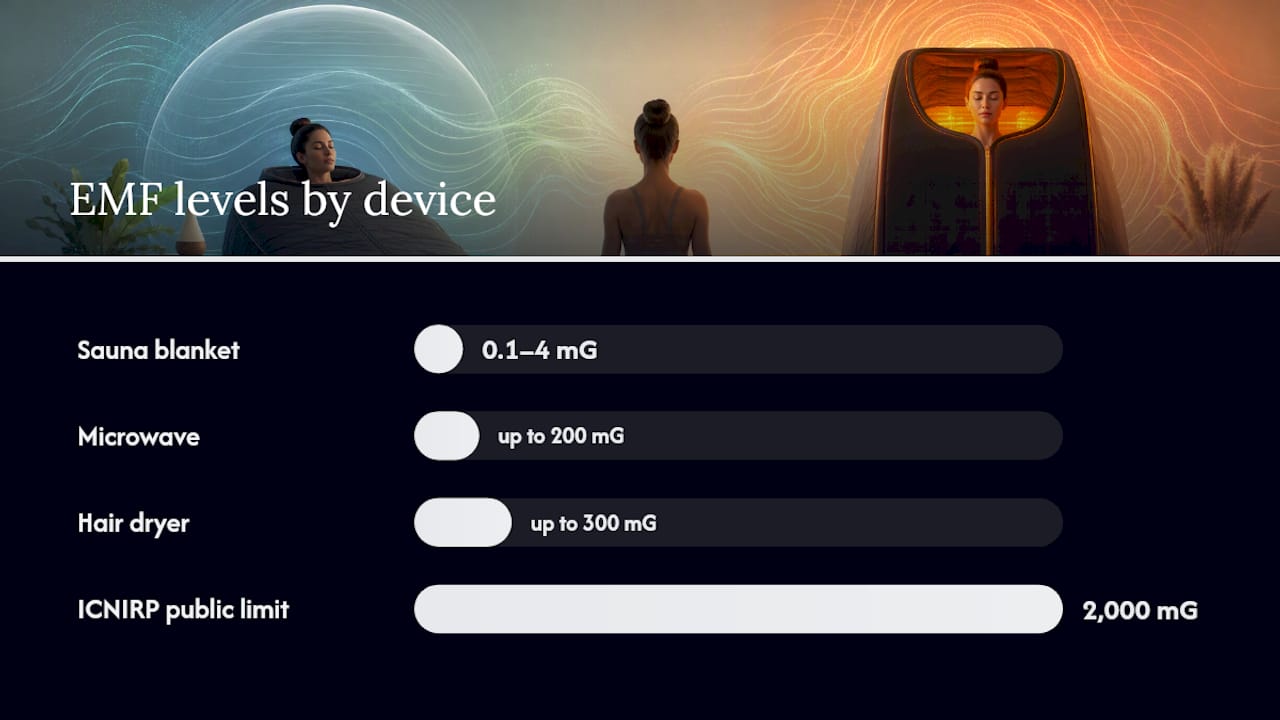
Here’s how the numbers usually stack up. A well-built infrared sauna blanket typically reads somewhere between 0.1 and 4 mG at the body surface. Compare that to your hair dryer (up to 300 mG close to the motor) or a microwave (up to 200 mG a few inches away), and the sauna blanket starts to look almost trivial by comparison. The ICNIRP threshold for public exposure sits at 2,000 mG, which puts even a “high” blanket reading nowhere close to a limit regulators actually worry about.
Where readings get murky is in how they’re taken. A few variables change the number substantially:
- Distance from the source. A reading taken two inches above the fabric will look very different from one taken with the meter pressed flat against it.
- Surface versus mid-air measurement. Some manufacturers test at skin contact; others test a few inches away, which produces a lower and less honest number.
- Blanket body versus controller. The heating panels and the control unit are two separate EMF sources, and they don’t behave the same way.
Before you trust any published figure, ask for the meter type used, the distance from the source, and the name of the testing lab. Vague claims without those three details are marketing copy, not data.
How Do Manufacturers Actually Lower EMF?
The honest answer is engineering, not slogans. A handful of design choices genuinely reduce magnetic field output, and understanding them helps you tell a real safety feature from a sticker on a box.
Grounded copper shielding, sometimes marketed as Faraday-style shielding, works by routing stray magnetic fields to ground instead of letting them radiate toward your body. It’s a proven electrical engineering principle, not a wellness buzzword, and it’s one of the few claims worth taking at face value when a brand backs it with test data.
Stone and crystal layers, like jade or tourmaline, play a different role. These materials retain heat efficiently, which lets the heating element run at lower continuous power to hit the same temperature. Lower power draw tends to mean lower EMF output, but it’s a side effect of the design, not a certified health guarantee.
The controller is the detail most buyers overlook. Independent testing on sauna blankets has repeatedly found that controller units emit higher EMF than the blanket body itself, which means a “low EMF” claim about the blanket fabric can quietly ignore the box sitting a foot from your torso.
Real transparency looks like this:
- Published third-party lab reports with a named lab
- Distance-specific readings for both the blanket and controller
- A spec sheet that describes the shielding method, not just a percentage claim
Pro Tip: Ask the seller directly for the controller-distance chart. If they can’t produce one, that silence tells you more than any marketing page will.
Is EMF the Real Risk, or Are You Worrying About the Wrong Thing?
Here’s the reframe worth sitting with: the ELF-EMF a sauna blanket produces is a minor concern next to the risks that actually send people to urgent care. Infrared saunas heat the body directly and can produce effects comparable to moderate exercise, and no harmful effects have turned up with sensible use, though researchers agree larger studies are still needed.
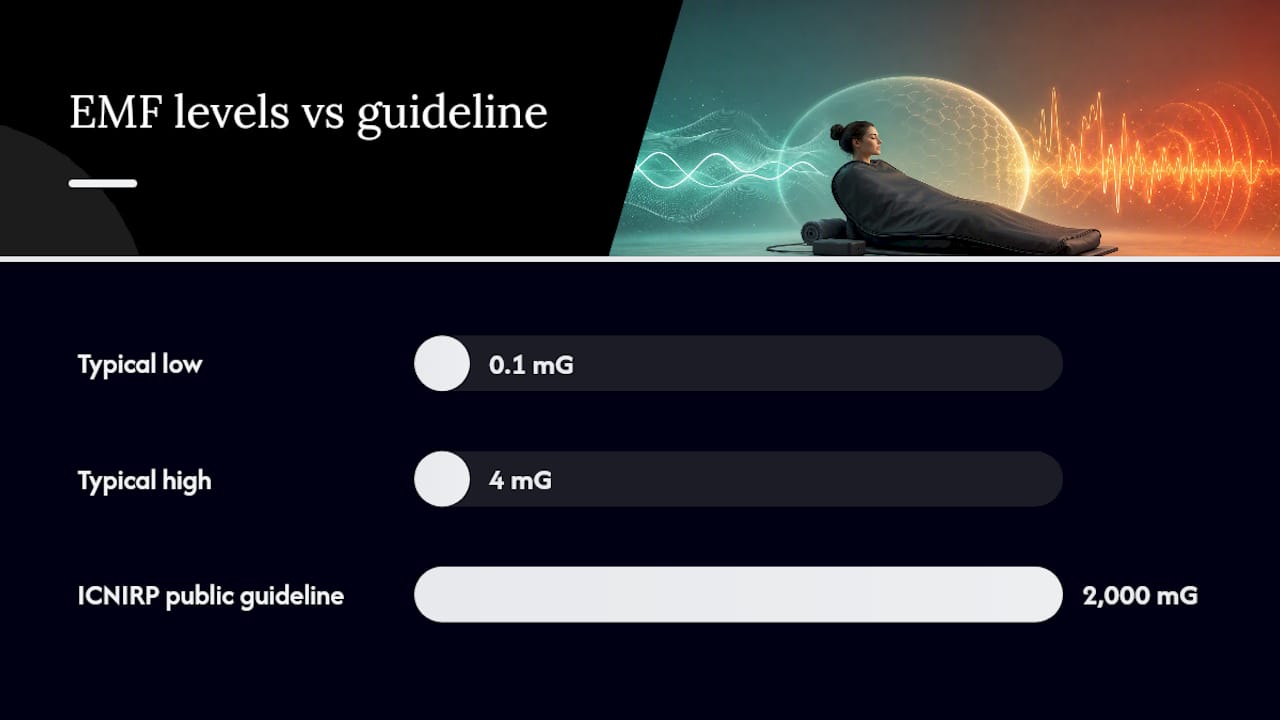
By the numbers: typical blanket readings fall between 0.1 and 4 mG. The public exposure guideline set by ICNIRP is 2,000 mG.
For most healthy adults, the real risks are overheating, dehydration, and skin burns, not electromagnetic exposure. A few habits cut that risk substantially:
- Preheat before you get in. Let the blanket reach temperature for 10 to 15 minutes so you’re not lying against a cold panel that then spikes.
- Start conservative on time and heat. Ten to fifteen minutes at a moderate setting is plenty for a first session.
- Use a towel or cotton liner between your skin and the polyurethane surface to reduce direct contact and sweat buildup.
- Hydrate before and after, since experts point to fluid loss and temperature regulation as the more meaningful variable in preventing a “sauna hangover,” not the marginal EMF gap between two well-made blankets.
Pregnant people, anyone with a cardiovascular condition, and people on medications that affect blood pressure or hydration should talk to a clinician before starting sauna blanket sessions. This isn’t a formality. Heat stress interacts with those conditions in ways a generic product label can’t account for.
What Should You Ask Before Buying a Low-EMF Sauna Blanket?
Treat this like an interview, not a purchase. A brand that welcomes these questions is telling you something different than one that deflects them.
Run through this checklist before you check out:
- Published mG figures, with the testing lab named
- Separate readings for the controller and the blanket body, taken at a stated distance
- A written description of the shielding method (grounded copper, layered design, etc.)
- Basic wiring and grounding information for the internal heating elements
- A clear warranty and return policy
- Material safety documentation for the interior lining
Ask sellers directly: “Can you send me the lab report and the distance the readings were taken at?” A credible seller answers in specifics. A seller who repeats “EMF-free” without producing data is telling you the claim is marketing language, not a physical possibility for any electric heating device.
Red flags worth walking away from: no published figures anywhere on the site, a total absence of safety or contraindication guidance, and any claim that the product produces zero measurable field. Zero isn’t achievable with current heating technology, and a brand that claims it either doesn’t understand the physics or is hoping you won’t ask.
Balance the EMF checklist against usability. A blanket with excellent shielding but a stiff zipper you can’t operate quickly in a moment of overheating isn’t actually the safer product. Look for an easy-exit zipper and sensible preheat behavior alongside the low-EMF specs.
Pro Tip: Save the seller’s written answers to your questions. If a product ever needs a warranty claim, that documentation is useful leverage.
How Do You Use a Sauna Blanket Safely, Start to Finish?
- Before you start: drink a glass of water, set the blanket on a flat, heat-resistant surface, and lay a towel or cotton liner across the inner panel.
- Preheat for 10 to 15 minutes before getting in, rather than climbing in cold and cranking the heat.
- Keep your first sessions short, around 10 to 15 minutes, and watch for dizziness, nausea, or unusual heart rate. Stop immediately if any of those show up.
- Cool down gradually after you exit, and rehydrate with water or an electrolyte drink.
- Seek medical attention if you feel faint, develop a headache that doesn’t resolve, or notice skin irritation that persists after the session.
Check cables and connections periodically for wear, and never fold the unit while it’s still warm. Both habits prevent the two hazards that matter more than EMF: contact burns and wiring damage over time.
Pro Tip: Keep a water bottle within arm’s reach during every session. Reaching for it mid-session is a small habit that prevents the dehydration issues that cause most sauna blanket complaints.
Why Lunix Puts Transparency Ahead of Marketing Claims
Lunixinc built its approach around a simple idea: readers deserve real numbers, not reassurance words. That means favoring published specs over vague safety badges and treating hydration, session length, and contraindications as seriously as the EMF conversation itself, because the evidence on infrared therapy supports real benefits without needing to oversell them.
If you’re weighing a purchase, Lunixinc offers a 14-day trial period and guidance on HSA reimbursement for sauna blankets, which matters more to most buyers than a fraction-of-a-milligauss difference between two well-shielded products. For readers who train regularly, there’s also a dedicated guide on using a sauna blanket after a workout for recovery.
The category doesn’t need more fear-based marketing. It needs buyers who know what a lab report actually says.
— Lunix
Try a Sauna Blanket Built Around Published Specs, Not Slogans
Lunixinc is the direct route for readers who want the safety-first approach this article just walked through, without hunting across five different sites for lab reports and controller data. The LX17 Portable Infrared Sauna Blanket comes with a 14-day trial window, so you can test session comfort and heat response at home before committing. It also qualifies for HSA reimbursement guidance if you’re using pretax health dollars for the purchase.
If you’ve read this far, you already know what questions to ask any brand. Take the next step and check the LX17’s spec sheet and trial terms directly on the product page before you decide.
This article is general information, not a substitute for advice from a qualified doctor. Consult a qualified healthcare professional about your own circumstances before acting on anything here.
Sources
- Best infrared sauna blankets — Medical News Today
- Infrared sauna: Expert Q&A — Mayo Clinic
- EMF-free sauna blanket guide — The Well Vetted
FAQ
Are Sauna Blankets Safe to Use?
For most healthy adults, infrared sauna blankets are safe when used as directed, with overheating, dehydration, and burns as the main risks to manage rather than EMF exposure.
Do Sauna Blankets Reduce Cortisol?
There’s limited peer-reviewed research specifically on sauna blankets and cortisol or detox claims, and most benefit claims are extrapolated from broader infrared sauna and exercise research rather than dedicated blanket studies.
What Sauna Has the Lowest EMF?
No single product holds a universal “lowest EMF” title, since readings vary by testing distance and method, but blankets with grounded copper shielding and published third-party lab reports tend to show the most trustworthy low-EMF results.
Is It True There’s Almost No Research on Sauna Blankets?
Largely, yes. Reviewers and journalists note there’s essentially no peer-reviewed research specific to sauna blankets, with most claims borrowed from traditional sauna and infrared therapy studies, so it’s reasonable to stay skeptical of bold detox or weight-loss promises.
Should I Trust an “EMF-Free” Label?
No. That label is technically impossible for any electric heating device, and a seller using it without published lab data is prioritizing marketing over transparency.