


Red and near-infrared photobiomodulation can ease neuropathic pain for some people as a noninvasive adjunct, but it is not a proven cure. The clinical evidence leans encouraging yet remains limited and inconsistent, built mostly on small trials with different devices and dosing. Talk to your clinician before starting, and keep your standard neuropathy care in place while you try it.
TL;DR:
- Most evidence for red light therapy suggests short-term pain relief in neuropathy, but proof of nerve regeneration or long-term benefits remains lacking.
- Dosing in the 40 J/cm² range delivered over 10 to 20 minutes, several times weekly for 6 to 12 weeks, is typical for potential effectiveness.
- Near-infrared light penetrates deeper tissues than red light, making it more suitable for nerve areas farther from the skin surface.
- Safety is generally good, but proper eye protection and device specifications are essential, especially to prevent burns or skin reactions.
- Clinical trials face recruitment challenges, and results vary widely depending on device quality, protocol, and individual factors.
Table of Contents
- How Red Light Therapy for Neuropathy May Affect Nerve Function
- What Does the Research Actually Say About Red Light for Nerve Pain?
- What Are the Typical Wavelengths and Dosing Protocols?
- Is Red Light Therapy Safe? Side Effects and Who Should Be Cautious
- Who Should Consider Red Light Therapy for Neuropathy?
- How Long Until You See Results, and What Should You Expect?
- Should You Buy a Home Device or Get Treatment in a Clinic?
- Lunix’s Take on Red Light Therapy for Nerve Pain
- Our Honest Opinion on Where This Field Stands
- Try Red Light Therapy at Home the Right Way
- Sources
How Red Light Therapy for Neuropathy May Affect Nerve Function
Photobiomodulation is the process behind red light therapy: specific wavelengths of light interact with a light-absorbing molecule inside your cells called cytochrome c oxidase, sitting in the mitochondria. When that molecule absorbs red or near-infrared light, your cells tend to produce more ATP, the energy currency that keeps nerve tissue functioning and repairing itself. That shift also appears to modulate reactive oxygen species, which play a role in the inflammation that often accompanies nerve damage.
There’s a second mechanism worth knowing about: light exposure can trigger nitric oxide release from cells, which relaxes blood vessels and improves microcirculation. For someone with diabetic peripheral neuropathy, where poor blood flow to the feet is often part of the problem, better circulation to starved nerve tissue is a big part of the theoretical appeal.
Wavelength matters here. Red light (roughly 600 to 700 nanometers) tends to stay closer to the skin surface, while near-infrared light (roughly 780 to 900 nanometers) penetrates deeper. That’s why near-infrared shows up so often in devices targeting feet and other areas where nerves sit further from the surface.
Dose matters just as much as wavelength. Researchers measure it in joules per square centimeter (J/cm²), and the dose-response curve isn’t a straight line. This is sometimes called the Arndt-Schulz principle, and it partly explains why one protocol helps and another, using the same device on the same body part, does nothing.
- Chromophore: cytochrome c oxidase, triggering increased ATP production
- Circulatory effect: nitric oxide release and vasodilation
- Penetration: near-infrared light reaches deeper tissue than red light
- Dosing: response follows a non-linear curve, not “more is always better”
Pro Tip: If a device’s marketing only mentions wavelength and skips irradiance or J/cm² output entirely, treat that as a red flag. Dose is at least as important as color.
What Does the Research Actually Say About Red Light for Nerve Pain?
The best available synthesis comes from a systematic review of low-level light therapy for diabetic peripheral neuropathy, which concluded that photobiomodulation may offer real benefit but that the supporting trials are too small and too different from one another to call the case closed. That’s the honest state of the science right now: a plausible signal, not a settled answer.
Smaller trials add texture to that picture. A 2026 pilot randomized trial of local photobiomodulation therapy tracked 26 participants through a 12-session protocol and found short-term reductions in neuropathic pain intensity within the treatment group. That’s a genuinely useful data point, but a 26-person pilot study isn’t built to prove anything definitively. It’s a hint, not a verdict.
Not every attempt to answer this question has gone smoothly. A Mayo Clinic-led Phase III trial testing Monochromatic Near-infrared Photoenergy for painful peripheral neuropathy, registered on Clinicaltrials, used a documented protocol of 43.2 J/cm² delivered over 30 minutes through contact pads. The trial was terminated due to low enrollment. That single fact tells you something important about this field: recruiting enough patients into a rigorous, long-term light therapy trial is genuinely hard, which is a big reason the evidence base still has holes in it.
Photobiomodulation’s clinical signal shows up most consistently as symptomatic relief rather than reversal of nerve damage. Trials rarely measure pain, sensation, and function the same way twice, which makes stacking results across studies difficult.
Reviews consistently flag this heterogeneity problem: different devices, different wavelengths, different session counts, different outcome measures.
Here’s the practical takeaway if you’re weighing whether to try it:
- Short-term pain relief is plausible and reported in multiple small studies
- There’s no solid proof that red light therapy regenerates damaged nerve fibers
- Results vary enormously by device quality, protocol, and individual physiology
- Large, definitive trials remain scarce partly because they’re difficult to run
What Are the Typical Wavelengths and Dosing Protocols?
Most devices studied or marketed for neuropathy fall into two wavelength bands. Red light in the 600 to 700 nanometer range addresses surface tissue, while near-infrared in the 780 to 900 nanometer range is generally preferred for feet and other areas where nerves run deeper. Practitioner protocols for feet often recommend treating the whole foot, plantar and dorsal surfaces alike, since neuropathy symptoms rarely stay confined to one small patch.
- Session length: Most reported protocols run 10 to 20 minutes per area, several times a week.
- Dose range: Trials and clinical guides commonly cite doses in the range documented by the MIRE trial protocol, around 40 J/cm² per session, though exact targets vary by device and body region.
- Trial length: Give any protocol 6 to 12 weeks before deciding whether it’s working, tracking pain scores, sleep quality, and walking tolerance along the way.
- Frequency: Three to five sessions weekly shows up often in the research, though your clinician may adjust based on your response.
Don’t borrow a protocol built for arthritis or skin conditions and assume it applies to nerve pain in your feet. The tissue depth, dosing, and treatment area are different problems entirely.
Pro Tip: Keep a simple weekly log rating pain from 0 to 10, noting sleep disruption and how far you can comfortably walk. Without a baseline, you won’t know if week eight is actually better than week one.
Is Red Light Therapy Safe? Side Effects and Who Should Be Cautious
Red light therapy carries a favorable safety profile compared to many pain interventions. Institutional voices back this up: MD Anderson’s clinical overview describes it as low risk and noninvasive, with early research pointing to reduced inflammation and improved circulation. That doesn’t mean risk-free, though.
- Mild, temporary redness or warmth at the treatment site is the most common side effect
- Eye injury is a real risk with high-powered devices, so wear proper eye protection every session
- Burns can occur with poorly regulated devices, especially those lacking cooling or automatic shutoff
- Photosensitizing medications can increase skin reaction risk and should be discussed with your prescriber
- Open wounds, active infections, and recent cancer treatment call for a direct conversation with your oncologist before use
Before buying any device, check for published irradiance specs, a manual with real dosing guidance, and some reference to clinical protocols rather than vague marketing claims. Our safety guidance and contraindication checklist walks through what to verify, and this clinical breakdown of contraindications is worth reading if you’re managing other health conditions alongside neuropathy. If you notice blistering, worsening pain, or any skin change that concerns you, stop and check in with your doctor.
Who Should Consider Red Light Therapy for Neuropathy?
The people most studied, and most likely to see benefit, are those with diabetic peripheral neuropathy or chemotherapy-induced peripheral neuropathy, particularly when symptoms are early to moderate rather than advanced. If your symptoms are mild burning, tingling, or aching rather than complete numbness, you’re closer to the profile that responded in trials.
Seek urgent medical evaluation first, not light therapy, if you notice any of these:
- New or worsening weakness in your feet or legs
- Any open sore, ulcer, or wound on the foot, especially if you have diabetes
- Rapidly spreading numbness or symptoms moving up the leg
- Signs of infection around any skin break
Red light therapy works best folded into an existing plan, not as a replacement for it. Pair it with glucose management, physical therapy, and whatever medications your doctor has prescribed, and loop your provider in on which device and protocol you’re using.
How Long Until You See Results, and What Should You Expect?
Trial data suggests most people who respond notice initial changes within 4 to 8 weeks, with clearer effects, if they’re coming, showing up by 8 to 12 weeks. Individual variation is significant. Some small studies report reductions in pain measures by a moderate amount, though sample sizes are small enough that those numbers should be read as a rough signal rather than a guarantee for your case.
- Pain, burning, and tingling sensations are the symptoms most likely to respond
- Long-standing numbness and severe nerve fiber loss are far less likely to reverse
- Track a consistent metric weekly (pain score, sleep quality, walking distance) rather than judging day to day
- If you see zero meaningful change by 12 weeks of consistent use, it’s reasonable to consider it a non-responder trial and revisit with your clinician
Should You Buy a Home Device or Get Treatment in a Clinic?
Clinic-based treatment offers calibrated devices and professional oversight, which matters most if you have complicated feet: active ulcers, altered sensation that makes you unable to feel a burn forming, or you’re currently undergoing cancer treatment. A provider can also adjust your protocol in real time based on how you’re responding.
At-home devices win on convenience and, over months of regular use, cost. If you’re leaning toward buying, run through this checklist before you spend anything:
- Confirmed wavelength output, ideally with red and near-infrared options for depth
- Published irradiance figures, not just “medical grade” marketing language
- Enough power to reach meaningful J/cm² doses in a reasonable session time
- Safety features: automatic timers, cooling, and clear eye-protection guidance
- A manual or company resource that cites real protocols rather than vague promises
Our cost comparison of in-clinic sessions versus home devices breaks down the math in more detail, and it’s worth reviewing before committing either way. If you go the clinic route first, ask directly about device wavelength, published irradiance, and how many other patients with your condition they’ve treated.
Lunix’s Take on Red Light Therapy for Nerve Pain
Lunixinc builds smart recovery products, and part of that work means publishing straight answers about what light therapy can and can’t do, not just what sells devices. We design red light therapy devices for hands, feet, and joints to meet the same specification standards you should demand from any product: documented wavelength, measurable irradiance, and real dosing guidance instead of vague claims.
We don’t position red light therapy as a cure for neuropathy, and neither should anyone selling you a device. It’s an adjunct. Used alongside your existing medical care, and discussed with your clinician first, it’s a reasonable tool to add to your routine, not a replacement for the care you’re already getting.
Our Honest Opinion on Where This Field Stands
The evidence on red light therapy for neuropathy sits in an unusual spot: strong enough that dismissing it outright would be intellectually lazy, weak enough that treating it as settled science would be dishonest. That tension is the whole story, and most coverage of this topic picks one side and ignores the other.
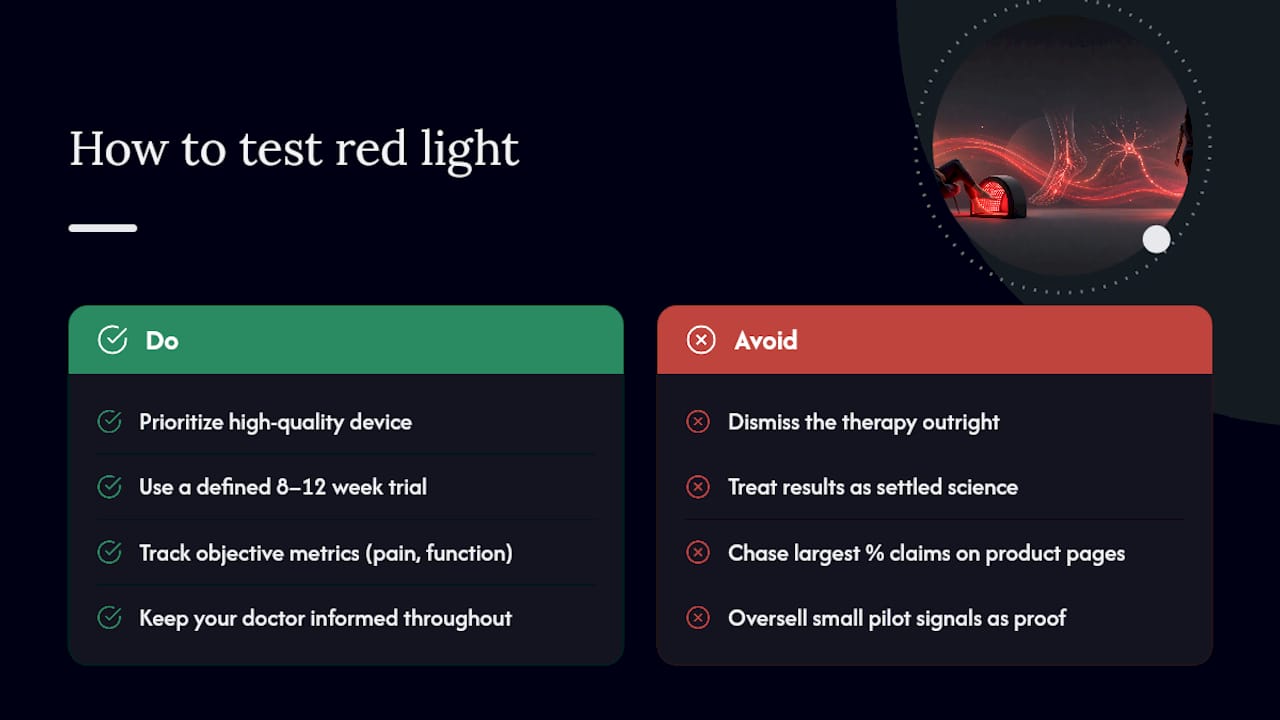
Where conventional advice falls short is in the false binary it offers: either “this cures nerve damage” or “this is snake oil.” Neither is true. The Mayo Clinic trial’s termination for low enrollment says less about whether the therapy works and more about how hard it is to study rigorously over years. Small pilot signals, like the 2026 pilot trial’s short-term pain reductions, deserve real weight without being oversold as proof.
What you should prioritize first is device quality and a defined trial period, not chasing the biggest promised percentage on a product page. Give it 8 to 12 weeks, track real metrics, and keep your doctor in the loop the entire time.
— Lunix
Try Red Light Therapy at Home the Right Way
If you’ve decided a home device makes sense for your situation, Lunixinc’s red light therapy devices for hands, joints, and feet are built around the same specification standards covered above: documented wavelength output, measured irradiance, and clear dosing guidance instead of marketing fluff.

Before you buy anything, compare specs against the checklist in this guide and bring your protocol plan to your clinician, especially if you’re managing diabetes, active wounds, or ongoing cancer treatment. Once you’ve confirmed a device fits your needs, you can browse the full Lunix product lineup and start a clinician-approved trial period at home.
Sources
For deeper reading, see the systematic review on photobiomodulation for diabetic neuropathy, MD Anderson’s clinical overview, the MIRE trial registry entry, and our own guide on red light therapy for plantar fasciitis.
This article is general information, not a substitute for advice from a qualified doctor. Consult a qualified healthcare professional about your own circumstances before acting on anything here.
- Low level light therapy/photobiomodulation for diabetic peripheral neuropathy (systematic review)
- Does red light therapy work for peripheral neuropathy? — UT MD Anderson
- Clinicaltrials
- Pilot randomized trial of local PBMT (2026) — Springer