


Yes, photobiomodulation can reduce knee pain, but only when the device delivers near-infrared wavelengths at doses backed by clinical research. The strongest evidence sits with knee osteoarthritis, where trials show measurable pain and function improvements over a 4 to 8 week course. Getting there depends on two choices you control:
- Choose a device that emits near-infrared light in the 780–860 nm range, not just visible red light
- Follow established dosing (session length, frequency, and total course duration) instead of guessing at exposure time
Skip either one and you’re rolling dice with your results.
Key Takeaways
Red light therapy reduces knee pain most reliably when near-infrared wavelengths (780–860 nm) are delivered at WALT-recommended doses over a 4 to 8 week course.
| Point | Details |
|---|---|
| Wavelength matters most | Near-infrared (780–860 nm) penetrates deeper into knee joint structures than red light alone. |
| Dose drives outcomes | Aim for at least 4 joules per point, following WALT guidelines, to avoid underdosing. |
| Give it real time | Expect mild relief by week 2 but judge true results at 4 to 8 weeks of consistent use. |
| Safety checks come first | Skip RLT with active cancer, lupus, epilepsy, pregnancy, or photosensitizing medications without medical clearance. |
| Lunix aligns with the evidence | The LX19 and similar wrap-style Lunix devices are built around the same NIR wavelength and dosing ranges the research supports. |
Table of Contents
- What the Research Says About Red Light Therapy for Knee Pain
- How Red and Near-Infrared Light Actually Work on Joint Tissue
- Wavelengths, Dose, and Session Timing That Match the Evidence
- Who Should Skip Red Light Therapy, and Why
- What to Expect Week by Week
- Bringing Clinical Protocols Into Your Living Room
- What I’d Actually Do With a Painful Knee
- A Home Device Built Around the Same Evidence
- Sources
What the Research Says About Red Light Therapy for Knee Pain
The clinical picture is more encouraging than skeptics assume, but it’s not uniform. A Frontiers systematic review on photobiomodulation therapy for knee osteoarthritis found statistically significant reductions in pain and gains in function, provided the trials used adequate dosing parameters. That qualifier matters more than most summaries admit.
One of the more striking data points: in a randomized trial of elderly patients with degenerative knee osteoarthritis, both red and infrared treatment groups saw pain reductions exceeding 50% compared to placebo after a self-applied, 15-minute, twice-daily regimen over just 10 days. Treated patients also went significantly longer before needing retreatment.
Not every trial lands that cleanly. Some studies report null or marginal results, and the gap usually traces back to three culprits:
- Dosing variation, where underpowered devices or rushed sessions never deliver enough energy to the joint
- Wavelength mismatches, using red light alone when near-infrared penetration is what the knee needs
- Inconsistent trial quality, including small sample sizes and short follow-up windows
Heterogeneity like this is exactly why the phrase “red light therapy doesn’t work” and “red light therapy works” can both show up in headlines about the same body of research. The devil is in the dose.
How Red and Near-Infrared Light Actually Work on Joint Tissue
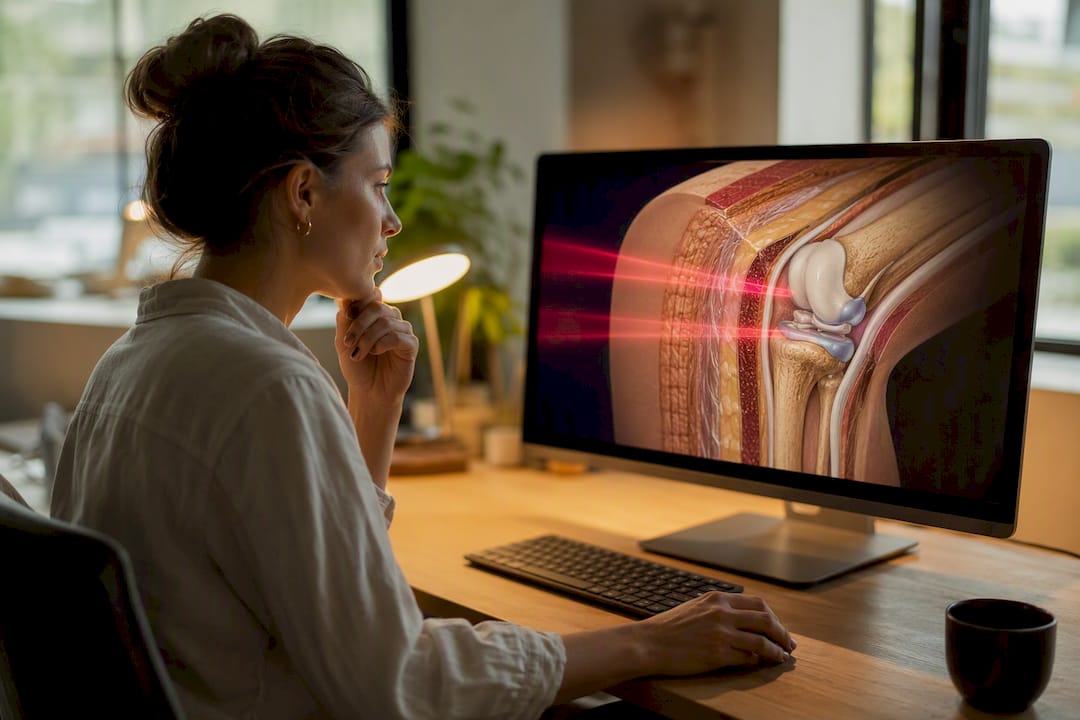
The knee is a demanding target. It’s got cartilage, synovial fluid, tendons, and a fat pad all layered over bone, and light has to reach the cells that matter to do any good. Here’s the mechanism, stripped of jargon.
Red and near-infrared photons get absorbed by cytochrome c oxidase, an enzyme inside mitochondria. That absorption boosts ATP production, the cell’s energy currency, which supports repair processes and reduces oxidative stress. Researchers including Dr. Praveen Arany have described this pathway as the biological basis for photobiomodulation’s downstream effects: improved blood flow, nitric oxide release, and modulation of inflammatory signaling.
The light itself doesn’t heal the knee. It nudges mitochondria to work more efficiently, and that efficiency shows up later as less swelling, better circulation, and measurable pain relief.
Two practical takeaways follow directly from this mechanism:
- Better circulation delivers more oxygen and nutrients to stressed joint tissue, which can ease stiffness over time
- Anti-inflammatory signaling changes explain why benefits often build gradually rather than appearing after one session
This is also why wavelength and dose aren’t cosmetic details. Cytochrome c oxidase only responds within specific light windows, and if the light can’t reach the tissue at sufficient intensity, the enzyme never gets the signal.
Wavelengths, Dose, and Session Timing That Match the Evidence
Near-infrared light between 780 and 860 nm penetrates deeper into joint structures than visible red light in the 630–660 nm range, which is why researchers consistently recommend NIR as the primary wavelength for knee applications. Red light still has a role, mostly for superficial skin and shallow tissue, so a device combining both bands covers more ground than either alone.
Dosing follows guidelines from the World Association for Laser Therapy, which recommend at least 4 joules per point at 780–860 nm, with many trials using 4 to 8 joules per point for meaningful clinical effect. That’s different from joules per square centimeter, which measures energy density over an area rather than at a specific treatment point. Confusing the two is a common reason people underdose without realizing it.
Here’s a practical protocol structure that lines up with the research:
- Treat both the medial and lateral sides of the patella, not just one midline spot, since multi-point positioning improves the odds that energy reaches deeper joint structures
- Run sessions for 10 to 20 minutes, depending on device irradiance, up to five times weekly
- Commit to a full course of 4 to 8 weeks before judging results, then shift to a lighter maintenance schedule
For device type, a wrap or contact-style pad that stays snug against the knee tends to outperform a stand-off panel for this specific joint, mostly because it holds position and skin contact steady through the whole session. Panels offer more flexibility for treating multiple body areas but require you to hold still, which hurts consistency.
Pro Tip: Check your device’s irradiance (measured in mW/cm²) before assuming a longer session equals a bigger dose. A weak panel run for 20 minutes can still deliver less energy than a strong wrap run for 10.
Who Should Skip Red Light Therapy, and Why
Red light therapy isn’t universally appropriate. Skip it, or check with a clinician first, if you have active cancer, lupus, epilepsy, are pregnant, or take photosensitizing medications, since light exposure can interact with these conditions in ways that aren’t fully predictable.
Dosing also isn’t a “more is better” situation. Research describes a biphasic dose-response, meaning both too little light and too much can blunt the benefit. Overdoing sessions doesn’t accelerate healing. It can stall it.
A few safety habits protect you regardless of device:
- Wear eye protection during sessions, especially with higher-powered panels
- Never treat an unexplained lump, mole, or lesion without a clinician’s evaluation first
- Stop immediately and seek medical advice if you notice unusual redness, burning, or swelling after a session
What to Expect Week by Week
Patience matters here. Most people notice mild relief within 1 to 2 weeks of consistent sessions, but the functional gains that matter most, easier stairs, less morning stiffness, better tolerance for walking, tend to show up between weeks 4 and 8.
Track progress with something concrete rather than a vague sense of “feeling better”:
- Log a simple 0 to 10 pain score before and after each week
- Note functional markers like how many stairs you climb without discomfort or how long you can stand
- If you see zero change by week 6 to 8, that’s your signal to reassess with a doctor rather than push through indefinitely
Bringing Clinical Protocols Into Your Living Room
Lunixinc built its red light devices around the same wavelength and dosing logic covered here, not around marketing shortcuts. Translating a clinical protocol into home use means paying attention to details researchers actually measure.
- Use a built-in timer so sessions match the 10 to 20 minute windows tied to real dose ranges
- Choose a wrap-style fit that keeps consistent contact with the medial and lateral knee, similar to the LX19 Red Light Joints device
- Clean the contact surface between sessions and check warranty terms before committing to months of use
What I’d Actually Do With a Painful Knee
If this were my knee, I’d get a baseline assessment first, then commit to a genuine 4 to 8 week trial of near-infrared therapy before judging it. Reassess with real markers, not vibes. Pair it with physical therapy and weight management rather than expecting light alone to carry the whole load, and if pain persists past two months without progress, that’s the point to loop in a doctor for imaging or other interventions.
— Lunix
A Home Device Built Around the Same Evidence
Most people trying red light therapy for the first time face a real tradeoff: clinic sessions offer supervised dosing but add up fast in cost and time, while cheap consumer panels often skip the wavelength and irradiance specs that actually drive results. Lunixinc closes that gap by building devices around the same near-infrared range and dosing logic covered in the clinical research above, not a generic “red light glow.”

The LX19 Red Light Joints device wraps directly around the knee, holding steady contact through a full session instead of requiring you to sit motionless in front of a panel. If you’re weighing the economics of ongoing clinic visits against a one-time home device purchase, the cost comparison breakdown lays out the numbers plainly. Ready to see if a wrap-style fit matches your knee and routine? Visit the LX19 product page to check specs, session timing, and current availability.
This article is general information, not a substitute for advice from a qualified doctor. Consult a qualified healthcare professional about your own circumstances before acting on anything here.
Sources
- Current advances of photobiomodulation therapy in treating knee osteoarthritis (Frontiers, 2023)
- Improvement of pain and disability in elderly patients with degenerative osteoarthritis of the knee treated with narrow-band light therapy (PubMed)