


Red light therapy is safe for most healthy adults when used short-term and according to device directions, with no evidence it causes cancer the way UV exposure does. That said, safety isn’t automatic. A few precautions matter more than the rest:
- Wear the eye protection your device recommends, every session.
- Skip it if you’re on photosensitizing medication or have a photosensitive condition, unless a clinician clears you.
- Follow the manufacturer’s session length and distance guidance exactly.
The short-term picture is reassuring. What happens after months or years of daily home use is still an open question, and that’s exactly why a quick conversation with a dermatologist before you start is worth the ten minutes it takes.
Key Takeaways
Red light therapy is safe for most adults in the short term when used exactly as directed, but long-term daily use still lacks standardized safety data.
| Point | Details |
|---|---|
| Short-term safety is solid | Major medical organizations agree it’s safe short-term, with no evidence of cancer risk. |
| Mild side effects are common | Expect occasional redness or irritation; blistering signals overuse, not normal response. |
| Certain groups need clinician input | Photosensitive conditions, certain medications, prior skin cancer, and pregnancy all warrant a conversation first. |
| Skin tone affects dosing | Darker skin tones face higher risk of persistent pigment change and should start low and slow. |
| Device choice matters | Lunixinc designs devices around clear wavelength specs and session guidance to support safer at-home use. |
This article is general information, not a substitute for advice from a qualified doctor. Consult a qualified healthcare professional about your own circumstances before acting on anything here.
Table of Contents
- Understanding Red Light Therapy Safety: What the Treatment Actually Does
- What Do Medical Experts Say About Red Light Therapy Risks?
- Common Side Effects and When Red Light Therapy Becomes Risky
- Who Should Talk to a Doctor Before Trying Red Light Therapy
- Clinical-Grade vs. At-Home Devices: What Changes Safety-Wise
- How Long Should a Red Light Therapy Session Last?
- Does Skin Tone Change the Safety Calculation?
- A Safety Checklist Before You Buy a Home Device
- How Lunix Approaches Safer At-Home Red Light Devices
- A Publisher’s Note on Using Red Light Therapy Responsibly
- Choosing a Device Built Around Safe, Guided Use
- Sources
Understanding Red Light Therapy Safety: What the Treatment Actually Does
Red light therapy works through photobiomodulation: cells absorb specific wavelengths of light, mostly in the 630 to 660 nanometer (red) and 810 to 850 nanometer (near-infrared) ranges, and that absorption triggers changes in mitochondrial activity. It shows up in three main device types: LED face masks, handheld wands, and larger panels meant for joints, back, or full-body use.
The safety story starts with physics. Red and near-infrared light are non-ionizing, meaning they lack the energy to damage DNA directly. That’s the fundamental difference from ultraviolet light, which is ionizing and a proven skin cancer driver. This distinction is why dermatologists treat red light therapy as a fundamentally different risk category than tanning beds or unprotected sun exposure.
Common uses include:
- Skin appearance, including fine lines, tone, and mild acne
- Wound healing and post-procedure skin recovery
- Muscle and joint pain, stiffness, and exercise recovery
None of these applications involve the wavelengths responsible for sunburn or UV-driven mutation, which is the starting point for every safety claim that follows.
What Do Medical Experts Say About Red Light Therapy Risks?
The consensus among major medical organizations is consistent: red light therapy appears safe for short-term, as-directed use, but the long-term picture is incomplete. The American Academy of Dermatology states that side effects are typically mild, temporary redness and irritation being the most common, and that there’s no current evidence linking it to cancer. Cleveland Clinic echoes this, calling the treatment noninvasive and generally safe when used as directed, while noting explicitly that long-term safety data are limited.
Long-term safety of frequent, unsupervised at-home use has not been established, largely because existing trials lack standardized dosing and long-duration follow-up. That gap is not a reason to avoid the therapy. It’s a reason to use it deliberately, log your sessions, and stay in touch with a clinician if you’re treating a medical condition rather than a cosmetic concern.
Clinical trials registered on Clinicaltrials and indexed on PubMed have tested red light therapy across wavelengths, fluence levels, and session frequencies, but that heterogeneity is precisely the problem. Two studies calling themselves “red light therapy” might use wildly different power outputs and treatment schedules, which makes pooling their safety data difficult.
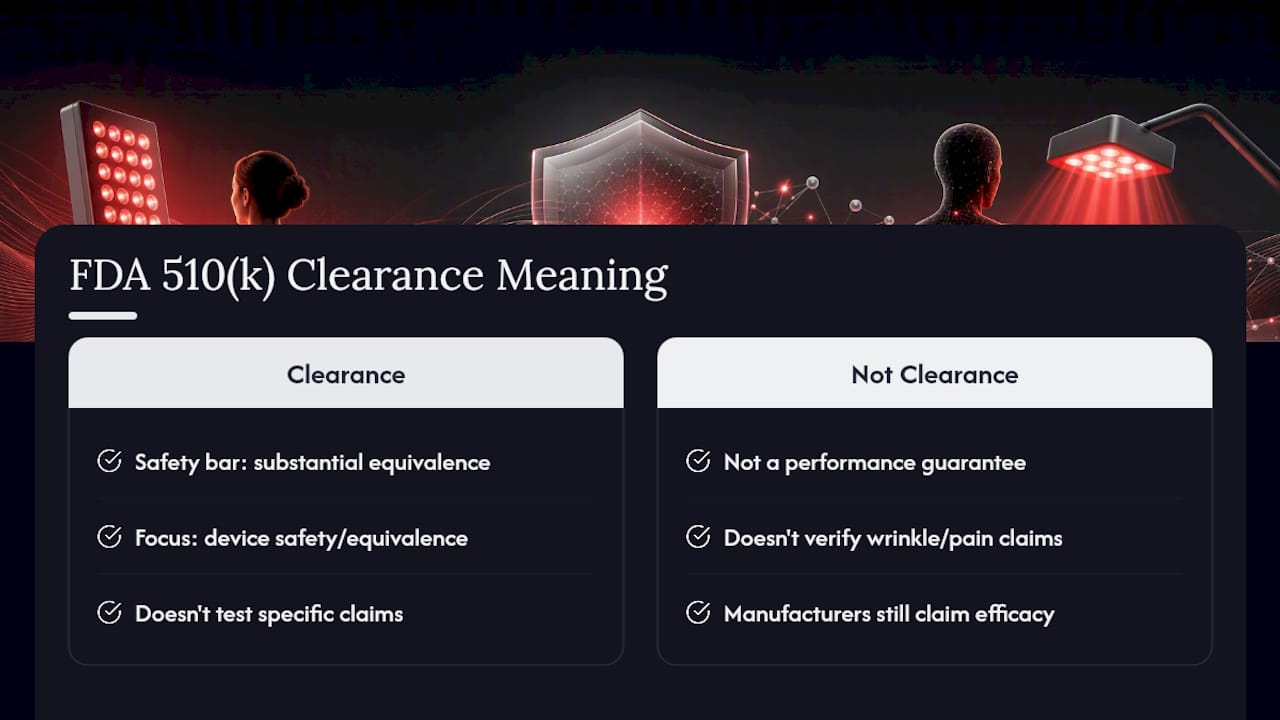
Then there’s the FDA clearance question, which trips up more consumers than any other label on the box. FDA 510(k) clearance means a device has been shown to be substantially equivalent to an already-legally-marketed device in terms of safety, not that the FDA has verified specific efficacy claims a brand makes about wrinkle reduction or pain relief. Clearance is a safety and equivalence bar, not a performance guarantee.
Common Side Effects and When Red Light Therapy Becomes Risky

For most users, side effects stop at mild and temporary. WebMD and the AAD both point to the same short list: transient redness, mild discomfort, and occasional irritation that fades within hours.
The risk profile changes when intensity or duration climbs beyond what a device is designed for, or when someone extends a session because “more must be better.” That assumption is where things go wrong.
- Redness and mild tightness: the most frequent complaint, usually resolves same-day
- Blistering or burns: linked to excessive intensity, prolonged exposure, or malfunctioning equipment
- Persistent hyperpigmentation: more likely with repeated overexposure, especially on already-irritated skin
- Retinal exposure: a real concern with high-powered panels and masks used without proper eye protection
Pro Tip: Never substitute regular sunglasses for the eye protection that ships with your device. Sunglasses block UV and visible glare, not the specific near-infrared wavelengths that can reach the retina at close range.
Who Should Talk to a Doctor Before Trying Red Light Therapy
A handful of situations should prompt a conversation with a clinician before your first session, not after you notice a problem; to learn more, see who should avoid it.
- Photosensitive conditions like lupus, or a history of unusual reactions to light
- Photosensitizing medications, including certain antibiotics, retinoids, and some acne treatments, which can amplify skin sensitivity to light
- A personal history of skin cancer or significant eye disease, where a physician should weigh in before you add another variable
- Pregnancy or breastfeeding, where evidence is too limited to make a confident call either way
None of these automatically rule out red light therapy. They just mean the decision shouldn’t be made alone, based on a product page or a five-star review.
Clinical-Grade vs. At-Home Devices: What Changes Safety-Wise
Clinical devices used in dermatology offices are calibrated instruments. Output, wavelength, and dosing are controlled, and a provider oversees the session, which makes results and risk more predictable. At-home devices are a different animal: power output and wavelength accuracy vary widely from one product to the next, and Harvard Health notes that this variability is exactly why choosing a well-specified device and following its instructions matters as much as the therapy itself.
FDA clearance narrows that variability somewhat but doesn’t erase it. Here’s the distinction worth remembering:
- FDA-cleared means a device met a safety and equivalence standard, not that it’s clinically proven to deliver a specific cosmetic or medical outcome
- Clinic devices typically deliver higher, more consistent output under supervision
- Home devices trade some potency and consistency for convenience and lower cost, which is a reasonable trade-off if you respect the manufacturer’s limits
| Factor | Clinical Devices | At-Home Devices |
|---|---|---|
| Output consistency | Calibrated, provider-monitored | Varies by manufacturer |
| Oversight | Dermatologist or provider present | Self-managed |
| Typical cost | Higher per session | Lower over time |
| Best fit for | Medical conditions, complex skin | Maintenance, mild cosmetic goals |
If cost is part of your decision, it’s worth comparing session pricing against home device ownership before committing to either path.
How Long Should a Red Light Therapy Session Last?
Dosing is the least settled part of red light therapy science, and any source that hands you one universal number is oversimplifying. That said, conservative ranges show up repeatedly across clinic protocols and trials.
- Most consumer protocols run 10 to 20 minutes per session, three to five times a week, for facial or targeted joint use.
- Start at the lowest intensity and shortest duration your device allows, then increase gradually only if your skin tolerates it.
- Keep a simple log of session length, frequency, and any skin reaction, so you can spot a problem before it compounds.
The reason dosing guidance stays this loose comes down to study design. Trials vary in wavelength, fluence, and session frequency, which means researchers can’t yet point to one dosing schedule as the proven standard. Treat published ranges as a starting point, not a prescription.
Does Skin Tone Change the Safety Calculation?
Yes, and this is one of the most consistently underemphasized points in consumer marketing. The American Medical Association specifically flags a higher risk of persistent redness, hyperpigmentation, and blistering in patients with darker skin tones, particularly with mask-style devices held close to the face.
- Darker skin tones: start with shorter, lower-intensity sessions and increase gradually rather than following a generic protocol
- Children and older adults: use a more conservative approach and involve a clinician when treating anything beyond minor cosmetic concerns
- Everyone: patch test on a small area for a few sessions before committing to full treatment
Pro Tip: Photograph the patch-test area before your first session and again 48 hours later. Side-by-side photos catch subtle pigment changes that are easy to miss in the mirror.
A Safety Checklist Before You Buy a Home Device
Choosing a device well is most of the safety equation, since a well-built product with clear guidance does a lot of the risk reduction for you before you ever press the power button.
- Confirm FDA-cleared labeling, along with published wavelength and power specs rather than vague marketing language.
- Check that eye protection is included and that recommended session durations are stated clearly in the manual.
- Patch test first, keep a simple log, and stop immediately if you notice blistering, persistent redness, or unusual pain.
- Choose clinician-based treatment instead of a home device if you have a photosensitive condition, a history of skin cancer, or a complex skin diagnosis.
Pro Tip: If a product page can’t tell you its exact wavelength in nanometers, that’s a red flag worth taking seriously, not a minor omission.
How Lunix Approaches Safer At-Home Red Light Devices
Lunixinc builds red light devices around the parts of safety that are actually controllable: clear wavelength specs, defined session guidance, and targeted designs rather than one-size-fits-all panels. The LX23 hand device and LX19 joint device are built for specific body areas rather than broad, high-intensity exposure.
- Documented wavelength and power specs on every product page
- Session guidance built into the device experience, not buried in fine print
- Educational content addressing photobiomodulation basics alongside product details
A Publisher’s Note on Using Red Light Therapy Responsibly
The evidence supports cautious optimism, not blind enthusiasm. Red light therapy has a good short-term safety record, and that’s genuinely reassuring if you’re considering it for skin or joint recovery. But “safe short-term” and “safe indefinitely at any dose” are two different claims, and the research hasn’t caught up to answer the second one yet.
Treat your first few weeks as an experiment, not a routine. Watch your skin’s response, respect the lowest effective dose, and loop in a dermatologist if anything about your situation, medication, skin tone, or medical history adds complexity. Lunix’s own product pages and educational content are built to support that kind of careful use, not replace it.
— Lunix
Choosing a Device Built Around Safe, Guided Use
If you’re weighing at-home options against clinic visits, the honest trade-off is convenience versus supervision. That’s exactly the gap Lunixinc designs for: devices with published wavelength specs, defined session guidance, and body-specific targeting instead of a single high-powered panel meant to do everything.

The LX16 therapy belt is built for targeted joint and muscle use with clear usage guidance rather than guesswork, and it pairs well with the patch-test approach outlined above. If you’re still deciding whether a home device or clinic sessions make more sense for your budget and goals, the cost comparison breakdown walks through both paths side by side. When you’re ready to start with a device designed around clear specs and safer defaults, visit Lunix to browse the current lineup and find the one that matches where you want to start.
Sources
- Is red light therapy right for your skin? — American Academy of Dermatology
- Red light therapy for skin care — Harvard Health
- Red Light Therapy: Benefits, Side Effects & Uses — Cleveland Clinic
- Red Light Therapy: Effectiveness, Treatment, and Risks — WebMD
- 6 things patients should know about red light therapy — American Medical Association