


Short answer: yes, in many cases. Red and near-infrared light, the mechanism behind photobiomodulation, can measurably reduce inflammation when the wavelength, dose, and consistency line up. That is the honest, evidence-backed bottom line on red light inflammation relief, and it comes with real caveats.
The effective window sits roughly between 630 and 850 nanometers, and most people need consistent sessions over several weeks, not a single treatment, to notice a difference. Photobiomodulation is not a cure for torn cartilage or advanced joint degeneration. It works best as a recovery tool that calms the inflammatory response your body is already running, which is why devices like the Lunix line focus on daily, low-heat exposure rather than one-off blasts.
Here’s what to do with that information right now:
- Track your symptoms (pain level, swelling, stiffness) before you start, so you can actually measure change.
- Follow the dosing guidance printed on your device rather than guessing at session length.
- Talk to a clinician first if you have an autoimmune condition, are pregnant, or take photosensitizing medication.
Quick fact: A WebMD review of 11 studies on red light therapy found mostly positive results for pain tied to inflammation, though the authors called for more standardized trials before drawing firm conclusions.
Key Takeaways
Red light therapy reduces inflammation through mitochondrial signaling and cytokine modulation, but the effect depends entirely on correct wavelength, dose, and consistent use over weeks.
| Point | Details |
|---|---|
| Wavelength range matters | Effective devices operate between 630 and 850 nm, with red light for shallow tissue and near-infrared for deeper joints. |
| Mechanism is immune, not just thermal | Light reduces IL-1β, IL-18, and TNF-α while raising IL-10, calming inflammation rather than masking pain. |
| More light is not better | The biphasic dose response means overexposure can blunt results, so stick to your device’s recommended session length. |
| Results take weeks, not days | Most documented regimens run 2 weeks of consistent sessions before meaningful change appears. |
| Lunix offers targeted device families | The LX23, LX19, and LX16 devices target hands, joints, and torso inflammation with measured wavelength output for home use. |
Table of Contents
- How Does Red Light Therapy Reduce Inflammation at the Cellular Level?
- What Does the Research Say About Light Therapy for Inflammation?
- Which Conditions Actually Improve With Red Light Therapy?
- What Wavelength and Dose Actually Work for Inflammation?
- Is Red Light Therapy Safe, and Who Should Avoid It?
- How Do You Choose a Red Light Device That Actually Works?
- What Are Some At-Home Red Light Protocols for Inflammation?
- Lunix Devices Built for Inflammation Recovery
- What the Research Really Tells Us About Light and Healing
- Ready to Build a Consistent Red Light Routine?
- Frequently Asked Questions
- Sources
How Does Red Light Therapy Reduce Inflammation at the Cellular Level?
Red and near-infrared light doesn’t warm tissue into feeling better the way a heating pad does. It triggers a specific chain of events inside your cells, and that chain is what separates real photobiomodulation from a glorified lamp.
The light gets absorbed by cytochrome c oxidase, an enzyme sitting in your mitochondria’s inner membrane. Mitochondria are the energy factories inside nearly every cell in your body, and cytochrome c oxidase is a key gatekeeper in that energy production line. When it absorbs light in the red to near-infrared range, cells often produce more ATP, the fuel that powers repair and normal function. That absorption also releases nitric oxide that had been bound up and blocking the enzyme, which improves local blood flow, and it generates a brief, controlled burst of reactive oxygen species that acts as a signal rather than as damage. Mechanistic reviews describing this chromophore absorption and downstream signaling point to this cascade as the biological engine behind PBM’s effects.

What happens next is where the anti-inflammatory action actually shows up. Photobiomodulation appears to shift the balance of signaling molecules your immune cells release. A 2023 Frontiers study found that daily red and near-infrared exposure in mice downregulated IL-1β and IL-18, two cytokines strongly tied to acute inflammation, while upregulating IL-10, an anti-inflammatory signal that helps dial the immune response back down. Similar mechanistic work has flagged reductions in TNF-α, another major driver of swelling and tissue irritation. Rather than numbing pain the way a topical analgesic does, PBM seems to work upstream, calming the immune signaling that causes the pain and swelling in the first place.
That upstream action explains why researchers increasingly describe PBM as an immunomodulator rather than a simple pain reliever. It also explains why results build gradually. You’re not blocking a nerve signal for a few hours. You’re nudging a cellular process that needs repeated exposure to shift measurably.
Here’s the part device shopping guides tend to skip: more light is not always better.
- Low to moderate doses of red and near-infrared light tend to stimulate mitochondrial activity and reduce inflammatory markers.
- Doses that are too high or sessions that run too long can flip that response, suppressing the very repair processes you’re trying to trigger.
- This pattern is well documented as a biphasic dose response, meaning there’s a real ceiling on “more is better” thinking with this therapy.
That biphasic curve is the single most misunderstood part of red light therapy. People assume doubling their session time doubles their benefit. The research says otherwise: past a certain irradiance and duration, you’re wasting time at best and blunting your results at worst.
What Does the Research Say About Light Therapy for Inflammation?
The evidence base for red light inflammation relief is genuinely encouraging, but it’s also uneven, and any honest guide has to say so plainly. Some conditions have solid backing. Others rest on animal data and small human trials that haven’t been replicated at scale.
Start with the human clinical picture. The WebMD review of 11 studies on red light therapy reported mostly positive outcomes for pain associated with inflammation across a range of applications, from joint discomfort to muscle soreness. The catch, which the reviewers stated directly, is that protocols varied so much between studies (different wavelengths, different session lengths, different devices) that pooling the results into one clean recommendation isn’t really possible yet. That’s a common theme across this field: individual studies look good, but the field hasn’t converged on a single standardized protocol the way it has for, say, physical therapy dosing.
Animal research fills in some of the mechanistic gaps that human trials can’t ethically or practically test. A widely cited regimen used 30 minutes of red and near-infrared exposure daily, five days a week, over two weeks, and it produced measurable changes in anti-inflammatory cytokines along with reduced markers of neuroinflammation. That regimen has become something of a reference point for researchers designing human dosing schedules, since it’s specific enough to replicate and long enough to capture a real cumulative effect.
Regular red and near-infrared exposure prior to an inflammatory challenge downregulated IL-1β and IL-18 while upregulating IL-10 in mice, a pattern consistent with a genuine anti-inflammatory shift rather than a placebo-driven pain response.
That finding, from the same Frontiers 2023 research, matters because it used a pre-treatment design. The mice received light before inflammation was triggered, which points toward a genuine biological effect on immune signaling rather than something that could be explained away as expectation or reporting bias.
Where does the evidence run thinnest? Arthritis research is a good case study. Reviews focused specifically on PBM for arthritis describe promising symptom relief in multiple trials, but the same reviews flag wide variability in wavelength, dose, and treatment duration across studies. Effect sizes swing depending on those choices, which means a device or protocol that worked in one trial might underperform in another simply because the parameters didn’t match.
A few patterns hold up across the stronger studies:
- Tendinopathy and soft tissue recovery tend to show more consistent benefit than degenerative joint disease.
- Regimens lasting two or more weeks outperform single-session or short-course protocols in almost every trial that compared them.
- Studies using devices with documented, measured irradiance produce more reliable results than those using unspecified or inconsistent light sources.
Cleveland Clinic sums up the state of the field about as fairly as anyone: RLT shows real promise for reducing inflammation and supporting healing, but the clinic is direct that more randomized trials are needed and that people with medical conditions should loop in a clinician before relying on it. That’s not a hedge to dismiss. It’s the accurate state of a field that’s moving fast but hasn’t finished standardizing itself.
Which Conditions Actually Improve With Red Light Therapy?
Not every ache responds the same way, and setting realistic expectations up front saves you from disappointment three weeks into a protocol. The conditions with the best track record share one thing in common: they involve active, ongoing inflammation that light can influence, rather than structural damage that light physically cannot repair.
Osteoarthritis sits near the top of the list for symptom management. Multiple trials referenced in arthritis-focused PBM reviews show reduced pain and stiffness, though the therapy doesn’t regrow cartilage or reverse joint space narrowing. Rheumatoid arthritis patients sometimes use red light as an adjunct alongside their prescribed medication, targeting flare-related swelling rather than the underlying autoimmune process. Tendonitis, particularly in the elbow and shoulder, tends to respond well because it’s fundamentally a localized inflammatory and repair problem, which is exactly what PBM’s cellular mechanisms are built to influence.
Carpal tunnel syndrome and general hand or wrist inflammation are common home-use targets, and the non-invasive approaches to carpal tunnel that pair red light with ergonomic changes tend to outperform light therapy used alone. Muscle recovery after exercise or minor strain shows some of the most reproducible results in the literature, likely because the inflammation involved is acute and self-limiting rather than chronic. Wound healing is another area where PBM has real support, since the same mitochondrial boost that eases joint pain also appears to accelerate tissue repair at the cellular level.
Pro Tip: Keep a simple weekly log rating your pain from 1 to 10 and noting swelling or stiffness. Inflammation relief from light therapy builds gradually, and without a log, it’s easy to miss real progress because you’re comparing today to yesterday instead of today to three weeks ago.
Here’s where you need to manage expectations honestly:
- Red light will not reverse bone spurs, torn ligaments, or advanced cartilage loss.
- It will not replace surgery when surgery is medically indicated.
- It generally helps most with pain, swelling, and recovery speed, not with restructuring damaged tissue.
Realistic outcomes look like this: less morning stiffness, faster bounce-back after a workout, reduced swelling around a tendon, and in many cases, less reliance on over-the-counter pain medication. Those are meaningful wins. They’re just different from a cure.
What Wavelength and Dose Actually Work for Inflammation?
Getting the mechanism and the evidence right doesn’t help you if your device is set up wrong. This is the part most buying guides gloss over, and it’s the difference between a therapeutic session and an expensive nap under a red bulb.
Wavelength is where accuracy matters most. The therapeutic window generally falls between 630 and 850 nanometers. Red light, in the 630 to 660 nm range, penetrates skin and shallow tissue effectively and works well for surface-level concerns like minor wounds and skin-adjacent inflammation. Near-infrared light, in the 780 to 850 nm range, penetrates deeper and is generally the better choice for joints, deep muscle tissue, and tendons. Stanford Medicine’s clinical commentary makes a point worth repeating: effectiveness depends on precise wavelength output, and home devices vary enormously, so a device without a stated wavelength spec is a guess, not a treatment.
Irradiance, measured in milliwatts per square centimeter (mW/cm²), tells you how much light energy is actually reaching your skin. This number matters more than most marketing copy suggests, because it’s the variable that determines both your session length and whether you’re anywhere near the biphasic sweet spot.
- Low irradiance devices (under 30 mW/cm²) typically require longer sessions, often 15 to 30 minutes, to deliver an effective dose.
- Moderate irradiance devices (30 to 100 mW/cm²) generally work well in the 10 to 20 minute range for most joint and muscle applications.
- Higher irradiance clinical-grade devices can achieve therapeutic dosing in 5 to 10 minutes, which is part of why clinic treatments run shorter than home sessions.
Frequency matters as much as any single session’s parameters. Most of the regimens with documented results use daily or near-daily exposure, typically 3 to 5 times a week, sustained for two to six weeks before evaluating results. That mirrors the animal-model schedule of 30 minutes daily, five days a week, for two weeks that produced measurable cytokine shifts, a pattern that has informed how many human protocols are structured today.
A few dosing principles worth committing to memory:
- Consistency beats intensity. A moderate dose done daily outperforms an intense dose done sporadically.
- Respect the biphasic curve. Once you’ve hit your device’s recommended session length, stopping is the right call, not pushing longer for a stronger effect.
- Deeper tissue targets (knees, shoulders, lower back) generally need near-infrared wavelengths and longer sessions than shallow targets like hands or skin.
- Give any regimen at least two to three weeks before judging whether it’s working. Cellular-level change is cumulative, not immediate.
Quick fact: The biphasic dose response documented across PBM research means overexposure doesn’t just waste time. It can actively blunt the anti-inflammatory benefit you’re trying to achieve.
Is Red Light Therapy Safe, and Who Should Avoid It?
Red light therapy has a strong safety profile compared to most inflammation treatments, but “generally safe” doesn’t mean “safe for everyone in every situation.” A few groups need to slow down and check with a clinician first.
Mild, temporary side effects are the most common experience: slight skin redness, a warm sensation, or mild eye strain if you skip protective eyewear. These typically resolve within hours. More serious concerns are rare but worth knowing. Anyone taking photosensitizing medications (certain antibiotics, acne treatments like isotretinoin, or some antidepressants) should talk to a doctor before starting, since these drugs can amplify skin sensitivity to light exposure.
Contraindications and caution groups include:
- Pregnant individuals, particularly for treatment near the abdomen, should get clinician approval first.
- People with active skin cancer or a history of photosensitive skin conditions need medical guidance before use.
- Anyone with an implanted device (pacemaker, spinal stimulator) should confirm safety with their prescribing physician.
- People on photosensitizing medications should check with a pharmacist or doctor before regular sessions.
Cleveland Clinic’s guidance is consistent on this point: RLT is generally well tolerated, but medical conditions and medications warrant a conversation with a clinician before you build a regular habit around it. Related clinical guidance on arthritis and red light use echoes that most people tolerate it well, but flags that anyone with an active flare or unclear diagnosis should get evaluated before self-treating.
Pro Tip: Always wear the protective eyewear that ships with your device, even for hand or joint sessions where your eyes aren’t the target. Stray light exposure adds up over months of regular use, and the retina is more sensitive to cumulative light exposure than most people assume.
Stop and reassess if you notice worsening pain, unusual swelling, or skin changes after a session. That’s not a sign to push through. It’s a sign the dose, wavelength, or your underlying condition needs a second look from a professional.
How Do You Choose a Red Light Device That Actually Works?
Plenty of red light products on the market glow convincingly and do almost nothing therapeutically. The gap between a real photobiomodulation device and a decorative heat lamp comes down to a handful of measurable specs, not marketing language.
- Confirm the wavelength is stated in nanometers, ideally within the 630 to 850 nm range, not described vaguely as “red light” with no number attached.
- Check for a published irradiance figure in mW/cm², since this tells you whether the light is strong enough to matter at your treatment distance.
- Look at the treatment area size relative to your target. A device sized for a hand won’t deliver a useful dose to a shoulder.
- Ask whether the device is continuous or pulsed, and note that both approaches show benefit in research, but the specs should be disclosed either way.
- Verify basic safety certification and build quality, since a device that overheats or delivers inconsistent output undermines the entire protocol.
A common mistake worth naming directly: assuming heat equals effectiveness. Devices that get noticeably hot are often relying on thermal comfort rather than delivering a genuine dose of the target wavelength, and heat alone doesn’t trigger the mitochondrial signaling that drives inflammation relief.
Cost is where the clinic-versus-home decision usually gets made. Clinic-based PBM or low-level laser sessions typically run higher per visit and deliver higher irradiance in a shorter window, which makes sense for acute flare-ups or when you want supervised, targeted treatment. Home devices cost more upfront but pay for themselves once you’re doing multiple sessions a week over a period of months, which is the realistic timeline this therapy usually requires. A closer look at the cost differences between clinic sessions and home devices breaks down where the break-even point tends to fall for regular users.
The practical rule of thumb: choose a clinic session for an acute issue you want addressed quickly under professional supervision, and choose a home device for a chronic or recurring issue where consistency over weeks and months matters more than any single high-intensity session.
What Are Some At-Home Red Light Protocols for Inflammation?
Reading about mechanisms and dosing only gets you so far. Here are three practical regimens built around the parameters the research actually supports, adapted for common inflammation complaints.
1. Knee osteoarthritis. Use near-infrared light in the 780 to 850 nm range, positioned directly over the joint. Run 15 to 20 minute sessions, five times a week, for at least four weeks before evaluating results. Pair sessions with light range-of-motion exercises, since movement plus light therapy tends to outperform either approach alone for joint stiffness.
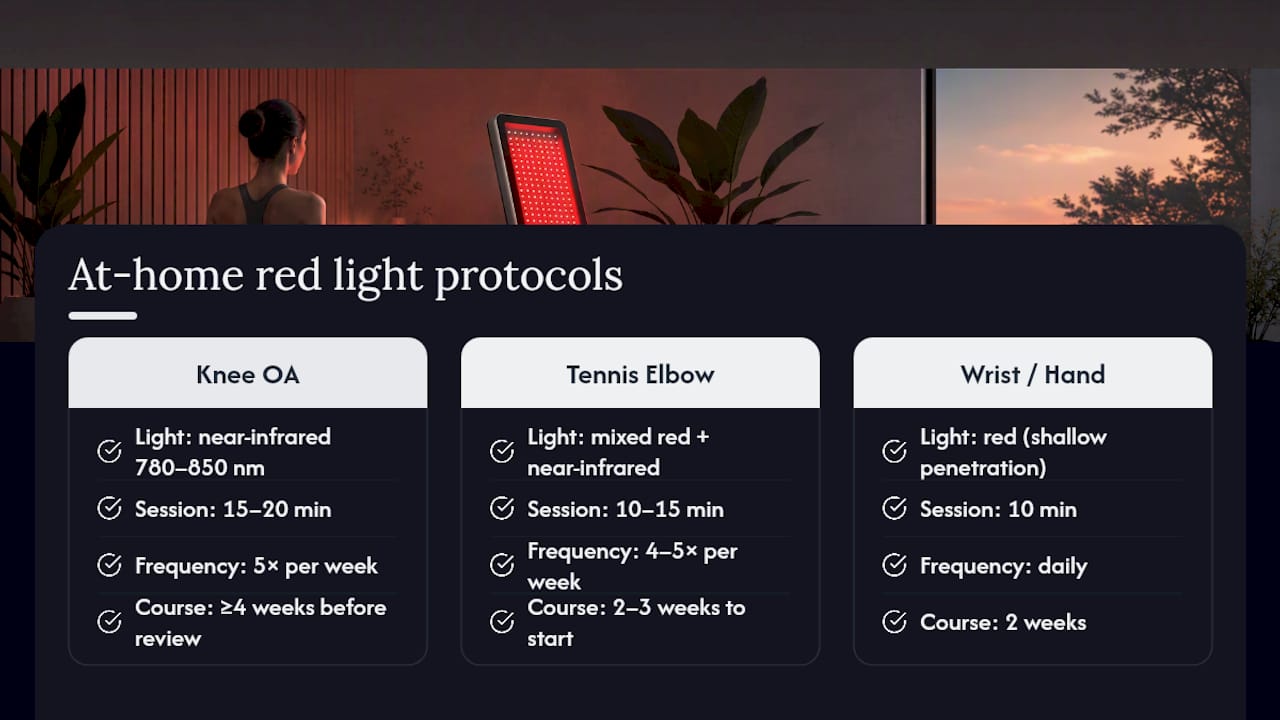
2. Lateral epicondylitis (tennis elbow) or tendonitis. A mixed red and near-infrared device works well here, since tendons sit close enough to the surface to benefit from red light’s shallower penetration while still needing near-infrared’s deeper reach. Sessions of 10 to 15 minutes, four to five times a week, for two to three weeks is a reasonable starting course, adjusted based on your device’s irradiance.
3. Wrist and hand inflammation, including carpal tunnel symptoms. Shorter sessions of 10 minutes generally suffice given the shallow tissue depth, done daily for two weeks. Combining this with the ergonomic adjustments covered in guidance on non-invasive carpal tunnel treatment tends to produce better outcomes than light therapy alone.
Across all three regimens, the same tracking discipline applies. Rate your pain and stiffness weekly, note swelling changes, and photograph visible inflammation if relevant so you’re not relying on memory alone.
Pro Tip: If you see zero change after three full weeks of consistent sessions, that’s the signal to reassess, not to push through for another month. Check your wavelength and irradiance specs first, since an underpowered device is the most common reason people quit before results appear.
Combining red light therapy with physical therapy or a structured exercise plan consistently outperforms light therapy alone in the research on tendinopathy and joint recovery. Light calms the inflammatory environment; movement rebuilds strength and range of motion around it. One without the other leaves real benefit on the table.
If symptoms worsen at any point, whether that’s sharper pain, new swelling, or skin irritation, stop the protocol and check in with a clinician rather than adjusting the dose yourself. That’s a different situation from slow or absent progress, which usually just means the parameters need tuning.
Lunix Devices Built for Inflammation Recovery
Lunix designs its red light devices around the same principle this article has walked through: targeted wavelength, measured output, and consistent daily use beat a stronger single dose used sporadically. Each device family targets a specific inflammation pattern rather than promising to do everything at once.
- The LX23 Red Light Hand targets wrist, hand, and finger inflammation, the kind common with carpal tunnel symptoms and repetitive strain, using a treatment area sized for that specific application.
- The LX19 Red Light Joints device is built for knees, elbows, and shoulders, the deeper joint targets where near-infrared penetration matters most.
- The LX16 Red Light Therapy Belt covers larger torso and lower back areas, useful for broader muscular inflammation or recovery after intense activity.
For readers weighing the math on committing to a home device versus repeat clinic visits, the breakdown on red light therapy cost across sessions versus home devices walks through where the numbers typically land for someone planning several sessions a week over a few months.
None of this replaces medical care for diagnosed conditions. It’s a recovery tool meant to sit alongside good clinical guidance, not instead of it.
What the Research Really Tells Us About Light and Healing
The conventional advice on red light therapy tends to split into two unhelpful camps: breathless claims that it fixes everything, or dismissive shrugs that call it a placebo with good marketing. Neither holds up against the actual mechanistic and clinical data.
What the research supports is narrower and more useful than either extreme. Photobiomodulation is a genuine immune modulator with a real, if incomplete, evidence base, and it rewards patience and precision over intensity. The biphasic dose response is the detail most guides skip entirely, and it’s the one that determines whether someone gets real relief or wastes two months under a light that’s either too weak or run too long.
Prioritize the boring stuff first: confirmed wavelength, known irradiance, consistent scheduling. Skip the devices that hide their specs behind vague marketing language. The people who see the best results aren’t the ones with the most powerful device. They’re the ones who stuck with a correctly dosed routine long enough for the cellular changes to accumulate.
Ready to Build a Consistent Red Light Routine?
If this article convinced you that consistency and correct dosing matter more than raw intensity, the next step is picking a device built around those specs instead of guessing with an unmarked light. Lunixinc’s recovery collection includes red light devices designed for specific inflammation targets, hands, joints, and larger muscle groups, each with stated wavelength ranges instead of vague “red light” labeling.

That specificity is the practical advantage here. Rather than buying a generic panel and hoping it covers your knee, your wrist, and your lower back equally well, you can choose a device sized and calibrated for the area actually causing you trouble. The LX23, LX19, and LX16 each target a different recovery need, which means you’re not paying for coverage you don’t use or under-dosing the area you do. Browse the recovery collection and match a device to the inflammation pattern this guide helped you identify.
Frequently Asked Questions
How quickly does red light therapy reduce inflammation? Most people notice initial changes within two to three weeks of consistent sessions, though animal studies showing measurable cytokine shifts used regimens as short as two weeks of daily exposure. Chronic conditions typically need four to six weeks before results stabilize.
What’s the difference between red light and near-infrared light for inflammation? Red light, around 630 to 660 nm, penetrates shallow tissue and works well for skin and surface-level inflammation. Near-infrared light, around 780 to 850 nm, reaches deeper into muscle and joint tissue, making it the better choice for knees, shoulders, and lower back complaints.
Can red light therapy replace anti-inflammatory medication? It can reduce reliance on medication for some people, particularly for mild to moderate pain and swelling, but it shouldn’t be stopped or swapped in for prescribed treatment without a clinician’s input, especially for autoimmune or advanced structural conditions.
Is red light therapy safe to use every day? Daily use is common in the regimens with the strongest results, and most people tolerate it well. Anyone on photosensitizing medication, pregnant, or managing an active skin condition should confirm safety with a doctor first.
Do cheap red light devices work as well as clinical ones? Not always. Effectiveness depends on documented wavelength and irradiance, not price alone. A budget device with clear, accurate specs can outperform an expensive one that hides its output numbers behind marketing claims.
This article is general information, not a substitute for advice from a qualified doctor. Consult a qualified healthcare professional about your own circumstances before acting on anything here.
Sources
- Red light therapy: What the science says — WebMD
- Frontiers study on red/NIR light and inflammation (animal-model regimen)
- Mechanisms and applications of the anti-inflammatory effects of photobiomodulation — PubMed Central
- Frontiers in Neuroscience 2023 study on red/NIR PBM