


Yes, red and near-infrared light can ease hand pain, morning stiffness, and even soften some visible aging on your skin, but it works gradually. Most people who benefit see changes over four to eight weeks of consistent sessions, not overnight. It helps some hand conditions more reliably than others, and it’s not a substitute for a clinician’s diagnosis if your symptoms are severe or worsening.
TL;DR:
- Red and near-infrared light therapy can reduce hand stiffness and pain, but results typically appear after four to eight weeks of regular use.
- Effective treatment depends on combining wavelengths: red for surface tissue and near-infrared for deeper joint and tendon issues.
- Conditions like osteoarthritis and tenosynovitis respond best, with moderate improvements in stiffness, flexibility, and tissue repair documented in clinical trials.
- Home devices should disclose specific wavelengths and irradiance levels, with glove or wrap designs offering more consistent coverage than handheld wands.
- Consistency, proper protocol duration, and device coverage are more critical for success than maximum device power.
Table of Contents
- How Red Light Therapy Works on Hand Pain and Stiffness
- Which Hand Conditions Respond Best to Red Light Therapy
- What the Clinical Research Actually Shows
- Building a Red Light Therapy Routine for Your Hands
- Is Red Light Therapy Safe for Your Hands?
- What to Look for in a Hand Red Light Therapy Device
- Sample Routines to Try for Four to Eight Weeks
- Why Consistency Matters More Than Intensity
- Lunix Devices Built for Hand Pain Relief and Rejuvenation
- Sources
How Red Light Therapy Works on Hand Pain and Stiffness
Your cells contain mitochondria, the tiny structures that produce the energy your tissues need to function and repair themselves. Red and near-infrared light get absorbed by a specific enzyme inside those mitochondria called cytochrome c oxidase, and that absorption kicks off a chain reaction: more ATP production, calmer inflammatory signaling, and increased collagen synthesis. This process is called photobiomodulation, and it’s the mechanism behind most of what red light therapy claims to do for hands.
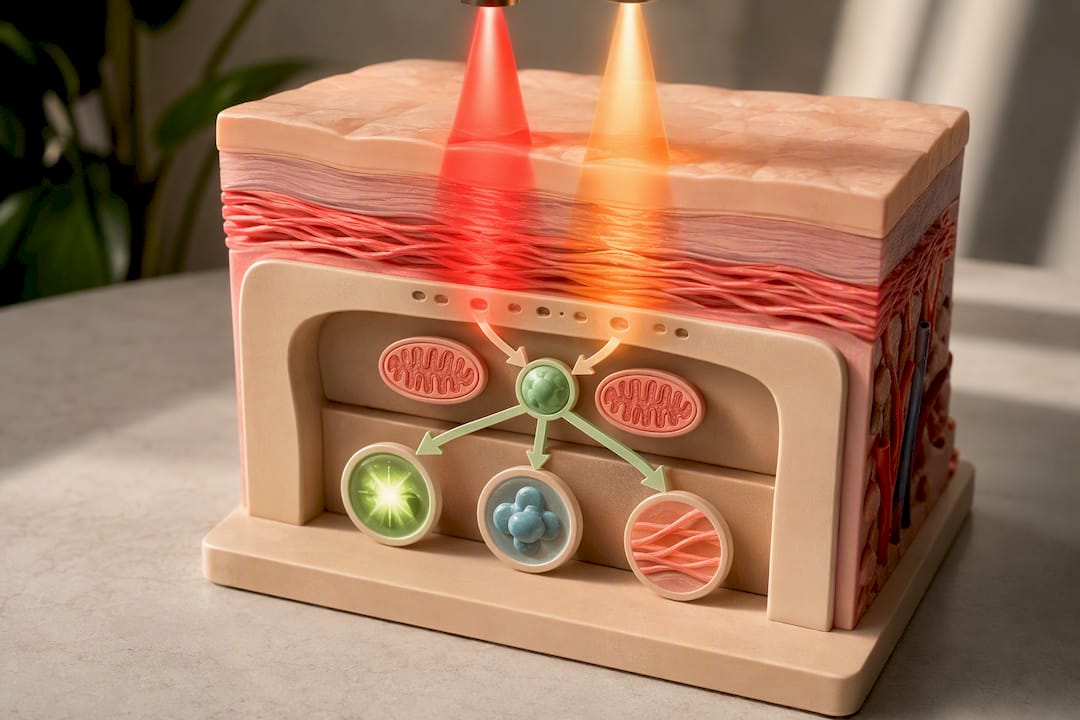
The wavelength matters more than people realize. Red light in the 630 to 670 nanometer range tends to work on skin and surface tissue, which is exactly why it shows up in conversations about easing inflammation near the surface. Near-infrared light, typically 800 to 850 nanometers, penetrates deeper and reaches joint capsules, tendons, and connective tissue below the skin. Your hands have both problems to solve at once: superficial skin changes and deeper joint or tendon issues, which is why devices built for hands often combine both wavelengths rather than relying on just one.
At the cellular level, here’s what’s happening during a session:
- Mitochondria absorb photons and ramp up ATP output, giving cells more energy to repair damaged tissue.
- Inflammatory markers around irritated joints and tendons tend to decrease, which is part of why stiffness eases.
- Fibroblasts in the skin get stimulated to produce more collagen, which shows up over weeks as smoother texture.
- Local blood flow improves slightly, helping deliver oxygen and nutrients to tissue that’s trying to recover.
The practical takeaway: red alone can help skin texture on the back of your hands, but if you’re dealing with joint pain in your knuckles or a stiff tendon, you want a device that also delivers near-infrared. Penetration depth isn’t infinite either. Even NIR light loses intensity as it travels through tissue, which is part of why session duration and device output both matter so much for actual results, not just wavelength.
Which Hand Conditions Respond Best to Red Light Therapy
Not every hand complaint responds the same way, and knowing where the evidence is strongest helps you set realistic expectations before you start.
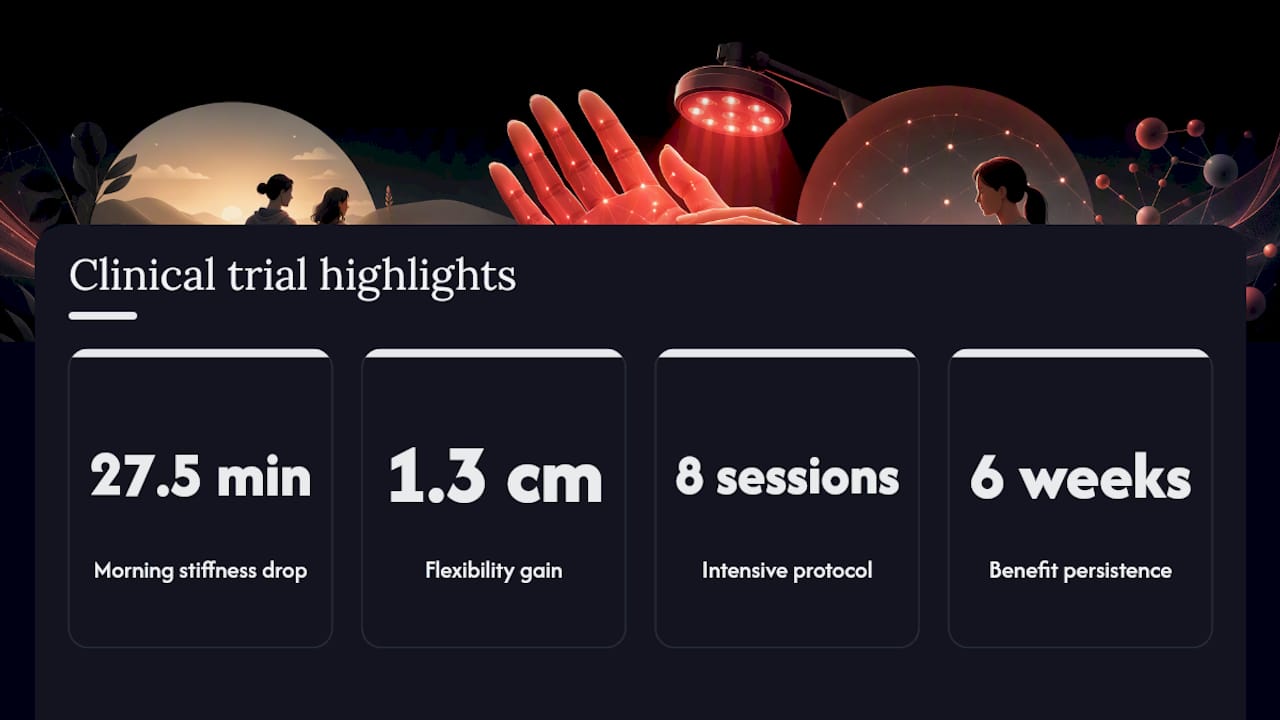
Osteoarthritis in the finger joints has the most consistent research behind it. A Cochrane review of low-level laser therapy for hand osteoarthritis found that treated patients experienced morning stiffness reduced by an average of 27.5 minutes and gained about 1.3 centimeters of hand flexibility compared with placebo. That’s a meaningful functional difference for someone who struggles to make a fist first thing in the morning.
Tenosynovitis and tendon-related pain also show real promise, especially for people who haven’t gotten relief from NSAIDs. A clinical trial on LEDT for NSAID-refractory tenosynovitis found clinically significant drops in pain and stiffness scores, alongside increased type III collagen expression in tendon tissue, a sign the therapy may support actual tissue repair rather than just masking discomfort.
Skin aging on the hands responds more modestly. Dermatologist-reviewed coverage of red light therapy for hands notes real improvements in texture and mild collagen stimulation with consistent use, but the same sources are clear that red light won’t correct volume loss or established pigmentation like age spots. Those issues usually need other interventions.
Where the evidence gets thinner: rheumatoid arthritis flares tied to systemic autoimmune activity, and any case involving advanced joint erosion or deformity. Light therapy can calm symptoms, but it isn’t documented to reverse structural joint damage once it’s occurred. If your hands show visible joint changes or you’ve had a new, sudden onset of swelling, that’s a conversation for a rheumatologist first.
What the Clinical Research Actually Shows
The strongest piece of evidence for hand osteoarthritis comes from that Cochrane-level review, and it’s worth sitting with the number for a second: a 27.5 minute reduction in morning stiffness isn’t a marketing claim, it’s a measured outcome across randomized, placebo-controlled trials.
By the numbers: Randomized trials on hand osteoarthritis found low-level light therapy cut morning stiffness by roughly 27.5 minutes and improved flexibility by about 1.3 cm compared with placebo groups.
A separate single-center study looked at a more intensive protocol using high-density LED irradiation. Patients underwent eight sessions, 18 minutes each, twice-weekly for four weeks. The results showed significant pain reduction compared to baseline, and notably, that improvement was still measurable six weeks after the last session ended. That persistence matters. It suggests the benefit isn’t just a temporary numbing effect during treatment, it’s a change that outlasts the sessions themselves.
The tenosynovitis trial used a lighter touch: multiple sessions twice per week over several weeks. Even at that reduced frequency, patients reported clinically significant relief with no adverse events recorded, and researchers documented increased collagen markers in the treated tissue.
Here’s where honesty matters. These studies are genuinely encouraging, but they share common limitations you should factor into your expectations. Sample sizes in most hand-specific trials run small, often a few dozen participants rather than several hundred. Devices used across studies vary in wavelength, power output, and treatment distance, which makes it hard to say “this exact home device will replicate that exact clinical result.” And most follow-up windows stop at six to eight weeks, so we don’t have strong long-term data on what happens after six months or a year of use.
What that means practically: expect the kind of outcome these trials showed, meaningful, not miraculous, symptom relief within four to eight weeks, with the caveat that maintaining a home device’s output and consistency is what determines whether you land inside or outside that range. The evidence supports treating red and NIR light as a legitimate adjunct for hand pain and stiffness, not a cure, and not a replacement for medical care if your condition is progressing.
Building a Red Light Therapy Routine for Your Hands
Translating clinical protocols into something you’ll actually do at home comes down to four variables: wavelength, session length, frequency, and how the device covers your hand.
Wavelength. Look for a device offering red light in the 630 to 670 nm range for skin-level benefits, and near-infrared in the 800 to 850 nm range for joints and tendons. If you’re mainly targeting knuckle stiffness or tendon pain, don’t settle for a red-only device.
Session length and frequency. Across the clinical trials referenced above, session times ranged from 18 to 20 minutes, with frequency landing between twice weekly and five times weekly depending on the protocol. A synthesis of published protocols generally lands on 10 to 20 minutes per session, three to five times a week, as the range where trial-level improvements tend to show up. Fewer than three sessions a week and you’re likely stretching the timeline for results well past eight weeks.
Course length. Give any protocol four to eight weeks before deciding whether it’s working. That mirrors the trial windows above almost exactly, and it’s long enough for collagen remodeling and inflammatory changes to become noticeable rather than theoretical.
Here’s a simple way to structure your first course:
- Week 1 to 2: Start with three sessions per week, 15 to 18 minutes each, covering the full hand including knuckles and the dorsal (top) surface.
- Week 3 to 4: If tolerated well, increase to four or five sessions weekly, especially if you’re targeting a flare rather than general maintenance.
- Week 5 to 6: Track stiffness duration and grip comfort. Most trial-documented improvements are apparent by this point.
- Week 7 to 8: Reassess. If you’re seeing progress, taper to two to three sessions weekly for maintenance. If you see no change at all, that’s a signal to talk to a clinician rather than push the same protocol longer.
On device format: gloves and mitt-style devices tend to outperform handheld wands for one simple reason, coverage consistency. A wand requires you to manually move it across every joint and hold still long enough at each spot, which most people don’t do accurately session after session. A glove or wrap delivers even exposure across all your finger joints and the back of the hand simultaneously, which also makes it easier to actually sit through the full session length instead of cutting it short.
Pro Tip: Skip topical retinoids or other photosensitizing products on your hands for a few hours before a session. They can increase skin sensitivity to light and are more likely to cause irritation than to enhance results.
Is Red Light Therapy Safe for Your Hands?
The safety data across hand-specific trials is genuinely reassuring. The tenosynovitis study reported no adverse events at all across its treatment course, and general overviews of red light therapy describe it as generally well tolerated for home use, though clinical-grade devices used in research settings are typically more powerful than most consumer units. That gap matters when you’re comparing your at-home results to a clinical trial’s outcomes.
That said, low risk isn’t zero risk, and long-term data beyond several months of continuous use is still limited. A few situations call for caution or a conversation with your doctor before you start:
- Active malignancy near the treatment area, since stimulating cellular activity in or near cancerous tissue isn’t something you want to do without medical guidance.
- Photosensitizing medications, including certain antibiotics and acne treatments, which can make skin react unpredictably to light exposure.
- Pregnancy, where data on light therapy is limited enough that clinician input is the safer default.
- Implanted electronic devices, such as pacemakers, where device manufacturers often recommend medical clearance first.
Skin-specific caution matters too. Don’t use red light therapy over open wounds, active infections, or unexplained rashes without medical advice first, and stop if you notice unusual redness, itching, or swelling that doesn’t fade shortly after a session. For a fuller breakdown of who should hold off and why, Lunixinc’s contraindications guide walks through specific scenarios, and a broader look at what the safety evidence actually shows is worth reading before your first session if you’re on any regular medication.
What to Look for in a Hand Red Light Therapy Device
Marketing claims are easy to make and hard to verify, so focus on the specs that actually predict whether a device will do anything.
- Wavelength disclosure. A legitimate device lists its exact wavelengths, not vague phrases like “clinical-grade light.” You want to see numbers in the 630 to 670 nm and 800 to 850 nm ranges.
- Irradiance in mW/cm². This measures how much light energy actually reaches your skin per second. Combined with session time, it determines your total dose in J/cm², which is the number that actually correlates with trial outcomes.
- Manufacturer transparency. Companies willing to publish their irradiance and dosing data at the treatment surface are giving you something to verify, rather than asking you to trust a glowing product photo.
- Form factor built for hands. A 10 J/cm² protocol used for plantar fasciitis shows how dosing logic translates across body parts, but hands specifically need even coverage across small, irregular joints, which panels and wands struggle with compared to glove-style designs.
Small joints like the ones in your fingers sit close to the surface, so red wavelengths alone can often reach them effectively. Larger structures or anyone with more tissue depth over the joint benefit more from near-infrared’s deeper reach, which is why a dual-wavelength device gives you more consistent results across different hand shapes and conditions than a single-wavelength unit.
Lunixinc’s hand-specific devices, including the LX23 and LX19, are built around these exact specs: disclosed dual-wavelength output, glove or wrap form factors for even coverage, and dosing designed to land within the ranges shown to produce results in the trials above.
Pro Tip: If a product page won’t tell you the irradiance or wavelength range, treat that as a red flag, not a minor omission. Those two numbers are what separate a therapeutic device from a warm light with good branding.
Sample Routines to Try for Four to Eight Weeks
Pick the routine that matches your primary goal, since skin maintenance and active pain relief call for different intensities.
- Skin-focused routine: Three sessions weekly, 12 to 15 minutes each, using red light concentrated on the dorsal hand and finger skin. Track progress with a photo every two weeks under consistent lighting, since texture changes are gradual and easy to miss day to day.
- Pain-flare protocol: Five sessions weekly during an active flare, 15 to 18 minutes, combining red and NIR across affected joints. Log your pain on a simple 0 to 10 scale (VAS) before and after each session, plus how many minutes your morning stiffness lasts.
- Combined maintenance protocol: Three sessions weekly once symptoms improve, alternating focus between joint coverage and skin exposure depending on which concern is more active that week.
For any of these, track three simple numbers: your morning stiffness duration in minutes, a pain score from 0 to 10, and how comfortably you can complete a grip task like squeezing a soft ball. Reassess at the four-week mark. If stiffness and pain scores haven’t budged at all, that’s more informative than pushing forward blindly, and it’s worth a conversation with a clinician about whether something else is driving your symptoms. If you’re seeing improvement, four more weeks at the same frequency typically consolidates the gain, after which most people can drop to a lighter maintenance schedule of two to three sessions a week.
Why Consistency Matters More Than Intensity
Most people evaluating red light therapy for their hands ask the wrong first question. They want to know which device is strongest, when the better question is which device they’ll actually use three to five times a week for two straight months. The trials showing real results, the 27.5-minute stiffness reduction, the six-week persistence of pain relief, weren’t testing occasional use. They were testing disciplined, scheduled sessions over a defined course.
That’s the gap between what red light therapy promises in headlines and what it delivers in practice. It’s not a passive fix you apply once and forget. It rewards the same kind of routine-building that actually improves most chronic hand discomfort: showing up consistently, tracking honestly, and giving the biology time to do its slow work.
We’d also push back gently on the idea that any single wavelength does everything. Red-only devices marketed heavily for skin benefits will underdeliver for someone with knuckle pain from osteoarthritis, and NIR-heavy joint devices without red output leave skin-level benefits on the table. The dual-wavelength approach isn’t a marketing flourish, it’s a direct response to the fact that your hand has both shallow skin tissue and deeper joint structures that need different light to respond.
Lunixinc builds its hand and joint devices around this evidence rather than around whichever wavelength is cheaper to manufacture, because a device that only solves half the problem isn’t solving the problem you actually have.
— Lunix
Lunix Devices Built for Hand Pain Relief and Rejuvenation
If the routines above sound worth trying, the next question is simply which device fits how you plan to use it. Lunixinc designs its hand therapy line specifically around the dual-wavelength, full-coverage approach the research supports, rather than a single spot-treatment wand.

The LX23 Red Light Hand Pain Relief Device is a glove-form unit built for exactly the four-to-eight-week protocols outlined above, delivering even red and near-infrared coverage across knuckles, fingers, and the dorsal hand in one session rather than requiring you to reposition a wand joint by joint. The LX19 Red Light Joints Therapy Device extends similar coverage logic to broader joint areas if your discomfort isn’t limited to your hands. The LX33 Hand Massager with Red Light Therapy combines heated compression massage with integrated red light, a solid pick if you want mechanical relief and photobiomodulation in a single session rather than running two separate routines.
If you’re deciding between them: choose the LX23 if hand pain and stiffness are your main concern, the LX19 if you need joint coverage beyond just your hands, and the LX33 if you want massage and light therapy combined for convenience. First-time users should check the warranty and return policy details before purchasing, and it’s worth reviewing the contraindications guide beforehand if you’re on any regular medication. Visit Lunixinc to compare specs and find the device that matches your routine.
Sources
The clinical findings referenced throughout this guide come from peer-reviewed trials and systematic reviews, alongside Lunixinc’s own safety resources for readers who want more detail before starting a routine.
- Low-level laser therapy for hand osteoarthritis (Cochrane / trial listing)
- Effects of LEDT on hand stiffness and pain in NSAID-refractory tenosynovitis
- Red light therapy: Effectiveness, treatment, and risks — WebMD