


Yes, you can use a massage gun on your hands, but only with real limits. Keep the intensity low, choose a soft attachment, and spend most of your time on the forearm muscles that actually control your fingers and grip rather than pounding away at your palm. Follow that one rule and a massage gun becomes a smart tool for desk-driven hand fatigue instead of a risky one.
TL;DR:
- Use low intensity and soft attachments, focusing primarily on the forearm muscles to relieve hand fatigue safely.
- Avoid applying the massage gun over the wrist crease, knuckles, open wounds, or areas with reduced sensation to prevent injury.
- Limit each spot treatment to 5 to 10 seconds and keep overall session times between 3 and 5 minutes to prevent overdoing it.
- Percussion therapy mainly benefits muscle fatigue and may not relieve nerve-related conditions like true carpal tunnel syndrome.
- Consider purpose-built hand massagers with gentle settings and ergonomic designs for safer and more effective relief.
Table of Contents
- Where Not to Use a Massage Gun on Your Hands
- How to Use a Massage Gun on Hands and Forearms
- Best Attachments and Settings for Delicate Hand Tissue
- Can a Massage Gun Help With Carpal Tunnel or Tendonitis?
- A 3 to 5 Minute Desk Routine You Can Do Right Now
- What the Evidence Says About Percussion Therapy for Hands
- Why Lunix Recommends a Gentle, Forearm-First Approach
- Choosing a Hand Massager Built for This Approach
- Sources
- FAQ
Where Not to Use a Massage Gun on Your Hands
Your hand is packed with small bones, tendons, and nerves sitting close to the surface, so a few spots are simply off-limits.
- Never run the head directly over the wrist crease, where major arteries and nerves sit close to the surface.
- Skip bony prominences like knuckles, the base of the thumb, and finger joints.
- Avoid open wounds, fresh scars, or any area near a recent fracture.
- Stay off skin with reduced feeling, since you won’t get accurate pain feedback.
Massage guns can cause real harm when used over arteries, nerves, fractures, or open wounds, which is why sports physiotherapists specifically warn against bony and vessel-rich regions. That caution matters most right at the wrist, where nerves and vessels run unusually close to the skin.
Pro Tip: If you feel sharp pain, numbness, or tingling, stop immediately. If numbness lingers, your grip feels weaker over several days, or you have a clotting disorder, check with a doctor before continuing.
Keep the intensity at a “comfortably uncomfortable” low to moderate level on a 10-point scale, and never push past what feels like firm pressure. Limit each spot to short bursts rather than lingering, since prolonged pressure on the hand’s smaller structures increases risk without adding benefit.
How to Use a Massage Gun on Hands and Forearms
Most hand pain from typing, gaming, or gripping tools doesn’t start in your fingers. It starts in the forearm muscles that pull on the tendons running into your hand. That’s why the smartest hand-relief routine barely touches the palm.
- Get stable first. Rest your forearm flat on a table or your thigh, palm up, so your wrist isn’t bearing weight or bending awkwardly.
- Find the flexors. Run your fingers along the inside of your forearm, from the elbow crease toward the wrist. That soft muscle mass is your flexor group, the one doing most of the work when you grip a mouse or steering wheel.
- Glide, don’t hover. Move the massage gun slowly along the length of the muscle, following the direction of the fibers. If you hit a tight, ropey spot, switch to small cross-fiber or circular motions instead of pressing harder.
- Flip and repeat on the extensors. Turn your arm over and treat the top of the forearm the same way. This is the muscle group that gets neglected but is just as responsible for hand fatigue.
- Finish light, if at all, on the palm. If your palm itself feels tight, use short, gentle passes with a soft head for a brief time.
Spend short periods per spot on the forearm, and keep the entire session brief per side. Clinician-led demonstrations consistently point out that treating the forearm origin points relieves hand and wrist pain more effectively than working the palm alone), which matches what most desk workers actually need.
Pro Tip: Use short 5 to 10 second bursts, then pause and make a fist or stretch your fingers. If your range of motion improves or the ache eases, you’re on the right track. If nothing changes after two passes, move to the next spot instead of grinding on one area.
Best Attachments and Settings for Delicate Hand Tissue
The right head matters as much as the right spot. Forearm muscle bellies can handle a small flat or round attachment, since there’s enough tissue to absorb the impact. The palm and finger sides are a different story: thin skin over bone calls for a pneumatic, air-filled cushion or a soft round head that spreads pressure instead of concentrating it.
- Use small flat or round heads on the meaty part of the forearm flexors and extensors.
- Use air-filled or soft silicone attachments on the palm and finger sides.
- Skip bullet and fork attachments entirely on hands. They’re built for deep, targeted pressure that thin tissue can’t absorb safely.
- Start on the lowest speed setting every time, and only move up if it stays comfortable after 10 seconds.
- Stick to low or medium speed for hands. High speed is rarely appropriate this close to bone and nerve.
Grip the device by its handle, not the head, and keep your wrist neutral while you work. That small adjustment reduces fatigue in your own hand and gives you better control over how much pressure you’re actually applying. For a broader breakdown of which heads suit which muscle groups, this guide to massage gun attachments is worth a look before your next session.
Can a Massage Gun Help With Carpal Tunnel or Tendonitis?
Here’s the distinction that matters: most desk-related hand pain is muscle fatigue, not nerve damage, and a massage gun can genuinely help the first kind.
Tight forearm flexors from hours of typing or gripping a controller can mimic carpal tunnel symptoms without any actual nerve compression. Loosening those muscles often eases the tingling and stiffness. True carpal tunnel syndrome, caused by pressure on the median nerve, is a different problem, and percussion therapy won’t fix compression at the source.
- See a clinician if numbness persists overnight or wakes you up, since night pain is a classic sign of nerve entrapment.
- Watch for progressive weakness in your grip over days or weeks rather than temporary fatigue.
- If you do seek care, report when symptoms started, what triggers them, and exactly where the numbness spreads (which fingers, palm side or back of the hand).
A 3 to 5 Minute Desk Routine You Can Do Right Now
You don’t need a quiet room or a foam mat for this. Just five minutes at your desk covers it.
- Warm up (30 seconds): Gentle, slow glides along your forearm flexors on the lowest setting.
- Work the flexors (30 to 60 seconds): Focus on the inside of the forearm, closer to the elbow.
- Work the extensors (30 to 60 seconds): Flip your arm and repeat on the top of the forearm.
- Palm, if needed (15 to 30 seconds): Soft head only, light pressure.
- Finish (30 seconds): Make a fist, then spread your fingers wide five times, and notice whether the stiffness eased.
If your hands feel especially sore that day, cut every step in half and swap to your softest attachment. Reviewers who tried daily short sessions found that moderate, consistent use produced better results than occasional long sessions, and it also keeps you from overdoing it on a bad day. For more on fitting this into a workday, the desk-friendly massage gun techniques guide covers positioning in more depth.
What the Evidence Says About Percussion Therapy for Hands
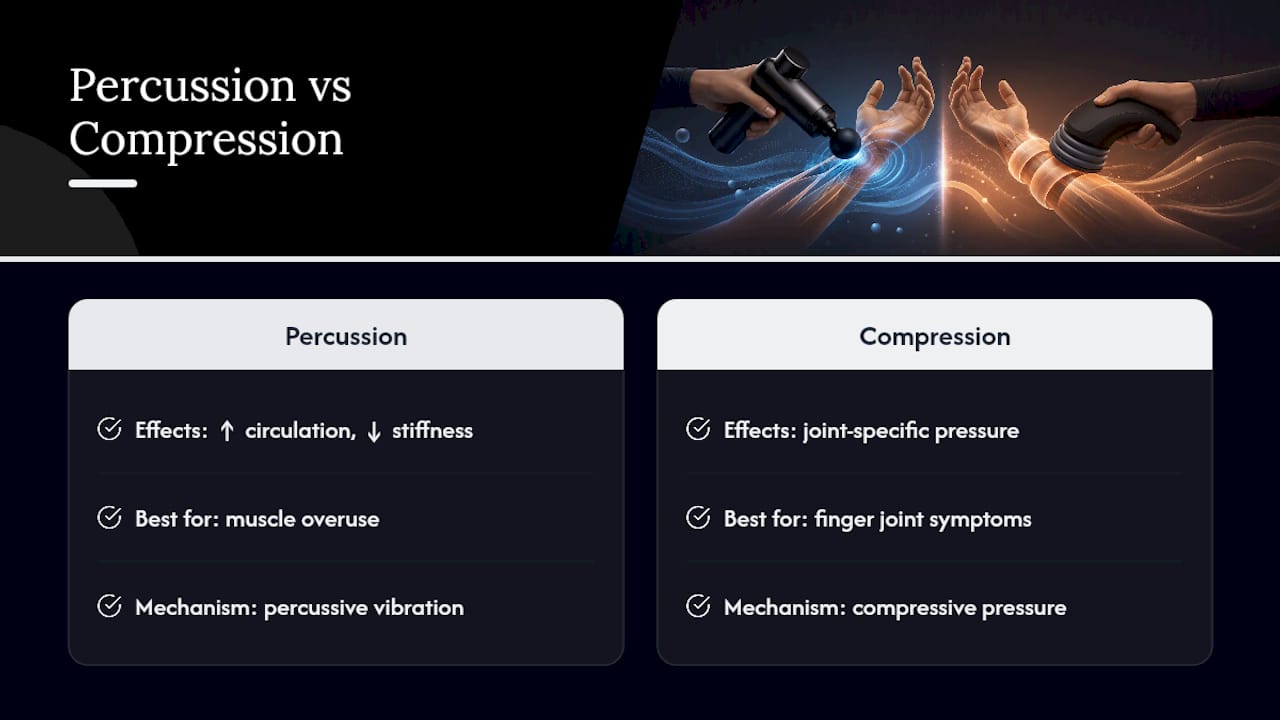
The case for percussion therapy on overuse hand pain isn’t guesswork. Reviewers note that percussion therapy improves circulation and reduces stiffness when used at appropriate speeds, which lines up with why a forearm-first approach works for typing and gripping fatigue. Compression-style hand devices treat finger joints differently than percussion does, so if your symptoms are concentrated in the joints themselves rather than the muscles, a dedicated hand massager built for that purpose may serve you better.
Why Lunix Recommends a Gentle, Forearm-First Approach
Hand pain from screens and controllers rarely needs aggressive pressure. It needs consistency, the right attachment, and a device that lets you dial down intensity without losing control. That’s the thinking behind treating the forearm before the palm.
One caution stands above the rest: if numbness or weakness gets worse instead of better, stop and see a clinician.
— Lunix
Choosing a Hand Massager Built for This Approach
If reading through all these positioning and timing details makes you want a device that’s already built for gentle, precise work, that’s exactly the gap a purpose-made hand massager fills. Instead of adapting a full-size percussion gun with careful attachment swaps, a device designed specifically for hands starts you at the right intensity and shape from the first use.

Look for three things when you shop: reliable low-speed modes you can trust near sensitive tissue, an ergonomic grip that doesn’t strain your own hand while you use it, and soft, contoured attachment surfaces built for palms and fingers rather than repurposed from a body-sized tool. The LX33 Hand Massager pairs gentle compression with red light therapy for wrist and carpal tunnel discomfort, while the broader Hand Massagers collection covers a range of grip styles and intensity levels if you want to compare features side by side. Browse the collection and pick the mode profile that matches how sore your hands actually get.
Sources
FAQ
Can I Use a Massage Gun on My Hands?
Yes, but treat it as a delicate area. Favor low intensity, soft attachments, and spend most of your time on the forearm muscles feeding into your hand rather than the palm itself.
Where Should I Never Use a Massage Gun?
Avoid the wrist crease, knuckles, open wounds, fresh scars, and any spot with reduced sensation. Sports physiotherapists flag bony areas and regions with major arteries or nerves as the highest-risk zones on the entire body.
Do Massage Guns Actually Break Up Muscle Knots?
They loosen tight, overworked muscle fibers and improve blood flow to the area, which can ease the tension that feels like a knot. Percussion therapy is understood to improve circulation and reduce stiffness, though it works on muscle tissue rather than dissolving anything literally.
Are Hand Massagers Good for Your Hands?
Purpose-built hand massagers can be a better fit than a full-size percussion gun for finger and joint discomfort, since compression-style devices are designed to treat joints differently than percussion. Lunix’s hand massager lineup includes both compression and gentle percussion options depending on where your discomfort sits.
How Long Should I Use a Massage Gun on One Spot?
Stick to 30 to 60 seconds per forearm muscle and no more than 15 to 30 seconds on the palm if you use it there at all. A full session on one hand should stay within 3 to 5 minutes.