


Yes, carpal tunnel massage can genuinely ease pain, numbness, and tingling for many people with mild-to-moderate symptoms, though it works best as one part of a bigger plan rather than a cure on its own. Your first move should be the Madenci Hand Massage Technique (MHMT), a three-minute self-massage routine backed by clinical research. Pair it with a wrist splint at night and a few changes to how you work, and see a clinician if numbness keeps spreading or your grip keeps weakening.
TL;DR:
- Targeted massage focusing on the transverse carpal ligament can nearly quadruple grip strength improvements compared to general massage.
- The Madenci Hand Massage Technique (MHMT) is a quick, structured routine performed twice daily that can help reduce symptoms when combined with splinting and activity adjustments.
- Evidence shows manual therapy and self-massage are effective for mild-to-moderate carpal tunnel syndrome but should not replace clinical evaluation if symptoms worsen or nerve damage is suspected.
- Releasing tension in the forearm, shoulder, and chest helps alleviate wrist symptoms since these areas are part of the mobile kinetic chain involved in carpal tunnel issues.
- Consistency over weeks, not intensity, delivers the best results, with minimal risk when self-massage is avoided over open skin or in cases of circulatory or nerve impairment.
Table of Contents
- What Does the Research Say About Massage for Carpal Tunnel Syndrome?
- How Do You Do the Madenci Hand Massage Technique?
- Which Forearm and Shoulder Releases Support the Wrist?
- How Do You Safely Add Nerve- and Tendon-Gliding Exercises?
- When Should You Avoid Massage or See a Doctor?
- What Does a Weekly Carpal Tunnel Care Plan Look Like?
- Our Take on At-Home Carpal Tunnel Massage
- A Simple Adjunct Worth Having on Hand
- Sources
- FAQ
What Does the Research Say About Massage for Carpal Tunnel Syndrome?
You don’t have to take this on faith. A systematic review and meta-analysis published in the Journal of Hand Therapy pooled data from 14 studies covering 1,110 patients and found that manual therapy, massage, and acupuncture significantly reduced symptom severity and pain scores in mild-to-moderate carpal tunnel syndrome (CTS) compared to doing nothing. The pooled analysis even showed measurable improvement in sensory nerve conduction velocity, which is the kind of objective marker that’s hard to fake with a placebo effect.
Here’s what the research shows across different massage approaches:
- Targeted vs. general massage: A randomized pilot study found that massage focused specifically on the transverse carpal ligament and flexor tendons produced a clear grip-strength increase, compared to a smaller increase for general, untargeted massage over the same period.
- Therapist-led sessions: One clinical trial using 30-minute massages twice weekly for six weeks recorded improvements on standard tests like Phalen’s and Tinel’s signs, with changes showing up as early as two weeks in.
- Self-applied routines: Research on a specific self-massage method found it was reliable, reproducible, and practical enough for patients to do on their own at home, without a therapist in the room. That study is part of why self-massage has moved from “nice idea” to something clinicians actually recommend.
The number worth remembering: targeted massage nearly quadrupled the grip-strength gains of general massage in that pilot trial. This is why where you press matters as much as whether you press at all.
None of this means massage replaces medical care. Clinical guidance from Cleveland Clinic frames massage and home-based techniques as part of an early conservative plan, sitting alongside splinting and activity changes rather than standing in for them. Think of massage as the daily maintenance that keeps things from getting worse while your other strategies do their slower work underneath.
How Do You Do the Madenci Hand Massage Technique?
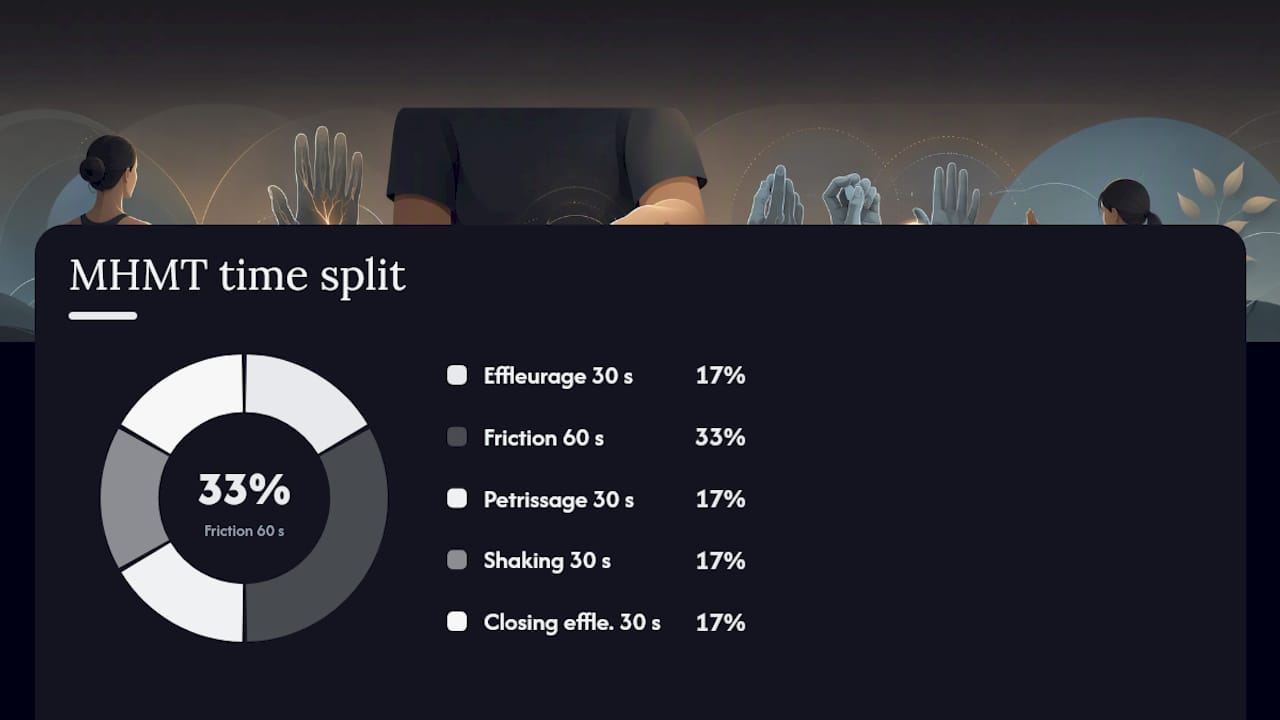
The Madenci Hand Massage Technique (MHMT) is a structured, three-minute sequence documented in clinical research as an add-on to standard splinting for carpal tunnel syndrome. It’s built from five massage strokes performed in order, each timed to the second. You don’t need oil, tools, or a therapist. You need a clock and about three minutes.
Here’s the full sequence:
- Effleurage, 30 seconds. Using your opposite hand, glide your palm and fingers gently from your fingertips up across your palm, over your wrist, and up your forearm toward your elbow. Keep the pressure light, like you’re smoothing lotion into the skin. This warms up the tissue and gets circulation moving before deeper work.
- Friction, 60 seconds. Using your thumb, apply firmer, small circular strokes directly over the carpal tunnel area (the base of your palm, just below your wrist crease) and along the thenar eminence, the fleshy pad at the base of your thumb. This is the longest step because it targets the transverse carpal ligament and the tendons that run underneath it, the exact structures the targeted-massage trial found made the difference in grip strength.
- Petrissage, 30 seconds. Switch to a kneading motion, squeezing and rolling the muscle of your forearm and palm between your thumb and fingers, similar to kneading dough. Work from your wrist up toward your elbow.
- Shaking, 30 seconds. Gently shake your hand and wrist loose, letting it go floppy. This sounds almost too simple, but it helps release the guarding tension that builds up during the friction step.
- Closing effleurage, 30 seconds. Repeat the same light gliding strokes from step one, moving from fingertips to elbow, to signal to your nervous system that the routine is done and to help drain any fluid buildup.
Switch hands and repeat the full sequence on the other side, even if only one hand has symptoms. Compensatory tension has a way of creeping into the “good” hand when you favor the sore one.
Pro Tip: Do the MHMT right before you start any repetitive task, like typing, knitting, or using tools. Warming up the tissue beforehand seems to blunt the strain that builds during the activity itself, rather than only treating it afterward.
Aim for once or twice daily. Morning and evening works well for most people, though if your symptoms flare specifically after work, add a midday round too. If any step causes sharp pain rather than a dull, working-through-it ache, ease off the pressure on the friction step first. That’s the deepest stroke in the sequence and the one most likely to feel like too much on a bad day.
Which Forearm and Shoulder Releases Support the Wrist?
Your wrist doesn’t work in isolation, and neither does the pain. Massage therapy practice consistently points to the kinetic chain: compensatory tension in the forearm, shoulder, and chest tends to feed right back down into wrist symptoms, which is why treating the wrist alone sometimes only gets you halfway there.
Start with the forearm, where the flexor tendons run:
- Long flexor strokes: Using your opposite thumb or the heel of your hand, run slow, firm strokes along the underside of your forearm, from wrist to elbow crease, following the direction of the muscle fibers.
- Cross-fiber friction: Where you find a tight band or a spot that feels “stuck,” press with your thumb and move it perpendicular to the muscle fibers, back and forth in short strokes. This targets adhesions that can form between the flexor tendons and the transverse carpal ligament.
- Trigger points: Common spots sit about two to three finger-widths below the elbow crease on the inside of the forearm. Press with steady thumb pressure and small, slow circles for 20 to 30 seconds, easing off if you feel tingling shoot into your fingers.
Then work upstream to the shoulder and chest:
- Pectoral self-release: Press your fingertips into the muscle just below your collarbone, near the shoulder joint, and hold with gentle pressure for 20 to 30 seconds on each side.
- Shoulder rolls: Slow, deliberate rolls, five in each direction, loosen the upper trapezius, a muscle that tightens up fast when you spend hours hunched over a keyboard.
Pro Tip: If you sit at a desk most of the day, do the pectoral and shoulder release before the forearm work, not after. Releasing tension at the top of the chain first often makes the forearm strokes feel noticeably less tender.
How Do You Safely Add Nerve- and Tendon-Gliding Exercises?
Gliding exercises move the median nerve and flexor tendons through their natural range without stretching them to a painful end point. They complement massage rather than replace it, and they come with a real caveat worth taking seriously.
Try this sequence, done slowly and without forcing any position:
- Straight wrist glide: Hold your hand up with fingers straight and wrist neutral, like you’re about to wave. Hold for 3 to 5 seconds.
- Hook fist: Bend your fingers into a hook shape while keeping your knuckles straight. Hold for 3 to 5 seconds.
- Full fist: Curl your fingers into a complete fist, thumb tucked outside. Hold for 3 to 5 seconds.
- Tendon glide table: Straighten fingers, then bend only at the middle knuckles, then curl fully into a fist. Hold each position briefly.
- Median nerve glide: Extend your wrist and fingers back gently, then use your other hand to add a slight, painless stretch to the thumb. Hold for 3 to 5 seconds and release.
Repeat each position 5 to 10 times, once or twice daily. Stop immediately if you feel tingling, sharp pain, or increased numbness rather than a mild stretch. Mayo Clinic specifically warns that overdoing nerve glides can irritate the median nerve, and recommends learning the movements from a hand therapist first if your symptoms are moderate to severe rather than mild.
Sequencing matters here. Do your gliding exercises after the MHMT, once the tissue is warmed up and the initial guarding has eased, not before.
When Should You Avoid Massage or See a Doctor?
Self-massage is low-risk for most people, but it isn’t risk-free in every case. Skip massage entirely over any area with open skin, a visible rash, active infection, or a recent fracture that hasn’t fully healed. If you have a circulatory condition like a blood clot history or uncontrolled diabetes affecting sensation in your hands, check with a doctor before starting any self-massage or nerve-glide routine.
Watch for these red flags, which mean it’s time to stop self-treating and get evaluated:
- Numbness that keeps spreading or has become constant rather than coming and going
- Visible muscle wasting at the base of your thumb, which signals nerve damage progressing beyond irritation
- Dropping objects because your grip is genuinely failing, not just feeling weak
- Severe pain that wakes you repeatedly at night, even with a splint on
A meta-analysis of 1,110 CTS patients supports manual therapy for mild-to-moderate cases specifically. That’s an important distinction. If your case has progressed past “mild-to-moderate,” massage alone is unlikely to be enough, and delaying a clinical evaluation can let nerve damage advance further than it needs to.
Round out your routine with the basics that clinics consistently recommend alongside massage: a rigid night splint to keep your wrist neutral while you sleep, a cold pack for 10 to 15 minutes after flare-ups, and short-term over-the-counter NSAIDs for acute inflammation, used as directed rather than as a daily habit. Our guide to early signs and at-home support walks through how to fit splinting into a daily routine without it feeling like a hassle.
What Does a Weekly Carpal Tunnel Care Plan Look Like?
Consistency beats intensity here. Trial data on grip-strength gains found objective improvement showing up after 2 to 7 sessions, which means a realistic plan is measured in weeks, not days.
A sample weekly structure:
- Morning: Three-minute MHMT on both hands before starting work or repetitive chores.
- Midday (if desk-based): A 5 to 10 minute break every hour, including wrist shakes and a quick forearm stroke.
- Evening: MHMT again, followed by nerve and tendon glides, then the night splint goes on before bed.
- Weekly check-in: Rate your numbness, pain, and grip strength on a simple 1 to 10 scale in a notebook or phone app to spot trends.
| Element | Frequency | What to track |
|---|---|---|
| MHMT self-massage | 1 to 2 times daily | Ease of pressure tolerance, tingling during friction step |
| Nerve/tendon glides | 1 to 2 times daily | Pain vs. stretch sensation, range of motion |
| Night splint | Every night | Morning stiffness or numbness on waking |
| Symptom log | Weekly | Pain score, numbness frequency, grip on simple tasks |
Give it four to six weeks before judging whether it’s working, since that’s the window most of the cited trials used to detect change. If your log shows no movement by then, or symptoms worsen, that’s your cue to loop in a hand therapist rather than push harder on your own. For a more detailed structured program, see our safe hand therapy at home guide.
Our Take on At-Home Carpal Tunnel Massage
Most advice about carpal tunnel relief either oversells massage as a fix or dismisses it as a feel-good distraction. Neither is honest. The research is specific: targeted pressure on the transverse carpal ligament and flexor tendons produces measurably better grip-strength outcomes than vague, general rubbing, and consistency across weeks matters more than any single “perfect” session.
What we’d push back on is the idea that massage needs to be complicated to work. A three-minute routine, done daily with real attention to where you press, outperforms sporadic 30-minute sessions squeezed in once a week. That’s exactly why products designed for daily, low-effort hand and wrist care, like a heated compression hand massager, earn a place in a conservative-care routine. They make the “daily” part realistic on nights when your hands are too tired to do thorough manual work yourself.
— Lunix
A Simple Adjunct Worth Having on Hand
Doing the MHMT with your own hands works, but on a long workweek, consistency is often the first thing to slip. That’s where a dedicated device earns its place, not as a replacement for the technique, but as backup for the nights your hands are too tired to do the work themselves.

The Lunix LX33 Hand Massager combines heated air compression with red light therapy, giving your palm and wrist a consistent, hands-free session that mirrors the warming and kneading steps of manual massage without requiring you to have the grip strength or free hand to do it yourself. For anyone managing symptoms in both hands at once, that’s a real practical gap it fills. It’s built as an adjunct to the routines in this guide, not a substitute for splinting, activity changes, or a clinician’s evaluation when red flags show up. If you want to see how it fits into a daily plan alongside the MHMT and nerve glides, visit the LX33 product page to check availability and get started.
Sources
- Effect of three traditional conservative treatment techniques on patients with mild-to-moderate carpal tunnel syndrome: A systematic review and meta-analysis - Journal of Hand Therapy
- Comparison of a Targeted and General Massage Protocol on Strength, Function, and Symptoms Associated with Carpal Tunnel Syndrome: A Randomized Pilot Study
- Reliability and efficacy of the new massage technique on the treatment in the patients with carpal tunnel syndrome - PMC
- How to relieve carpal tunnel pain without surgery - Cleveland Clinic
FAQ
Can Carpal Tunnel Be Massaged Out Completely?
Massage can significantly reduce symptom severity and pain in mild-to-moderate cases, but it isn’t a guaranteed cure, especially once nerve damage or muscle wasting has set in. It works best combined with splinting and activity changes rather than alone.
Is There a Pressure Point That Relieves Carpal Tunnel Symptoms?
The most effective target isn’t a single point but the area over the transverse carpal ligament at the base of your palm, just below the wrist crease, along with the thenar eminence at the base of your thumb. The MHMT’s friction step focuses directly on this region.
How Do You Unpinch the Carpal Tunnel Nerve at Home?
You can’t physically “unpinch” the nerve through massage alone, but targeted massage combined with nerve-gliding exercises and a night splint reduces the pressure and irritation around it for many people with mild-to-moderate symptoms. Persistent pinching with numbness or weakness needs clinical evaluation.
What Should You Avoid Doing With Carpal Tunnel Syndrome?
Avoid repetitive wrist bending without breaks, sleeping with your wrist curled under you, and pushing through sharp pain during massage or gliding exercises. Skip massage entirely over open skin, infection, or acute severe weakness, and don’t ignore progressive numbness or dropped objects.
How Often Should You Do the Madenci Hand Massage Technique?
Once or twice daily works well for most people, ideally before starting repetitive tasks like typing. The full sequence takes about three minutes per hand and includes effleurage, friction, petrissage, shaking, and a closing effleurage.