


A floor couch can be easy on your back, but only if it holds the natural curve of your lower spine. Sitting low with nothing behind you tends to flatten that curve. The fix is a backrest at the right height and angle, a seat that is neither too soft nor too thick, and a setup that lets you change position often. At Lunix we design recovery and comfort products around that idea, and this guide shows you how to apply it at home.
TL;DR
- Sitting on the floor flattens the lower-back curve more than standing does, so a floor couch needs a real backrest, not just a soft seat.
- Look for back support that reaches your shoulder blades, a gentle recline, and a firm cushion rather than a very thick one.
- Keep your ears, shoulders and hips stacked, and put a small cushion or rolled towel behind your lower back.
- Change position every 30 minutes or so. Even a well-designed seat works best when you move.
- Back pain that lingers, spreads down a leg or comes with numbness needs a doctor, not a better cushion.
Table of Contents
- Why the floor is harder on your back than it looks
- What good floor couch back support looks like
- How to sit on a floor couch so your back stays happy
- Setting up a floor couch for the whole family
- Finding firm, shaped support with Lunix
- Our point of view on floor seating
- When back discomfort deserves a doctor
- FAQ
- Sources
Why the floor is harder on your back than it looks
Your lower spine has a gentle inward curve called lumbar lordosis. It acts like a spring, spreading the load of your upper body across the discs and muscles of your back. When you sit without support, that curve tends to flatten or reverse.
The floor exaggerates this. A radiographic study of floor sitting found that lumbar lordosis dropped by 72.9% compared with standing, and that most of the loss happened at the lowest two levels of the spine. The authors concluded that sitting with the curve preserved matters if you want to avoid aggravating low back pain.
A 2023 biomechanical modeling study points the same way. It found that floor sitting placed more pressure on the soft center of the spinal discs than slumped sitting in a chair did, because the reduced lordosis drove the highest pressure increases. Its conclusion is encouraging: an upright posture with the lumbar curve maintained lowers that pressure.
In plain terms, the problem is rarely the floor itself. It is the slump that happens when your pelvis rolls backward and nothing catches your back. A floor couch with good support gives your spine something to lean on, so the curve stays closer to where it wants to be.
If you want a deeper look at what a normal and an excessive curve look like, this explainer on lumbar lordosis and what to do about it is a clear starting point.
The unsupported-sitting trap
You are most at risk when you do something that pulls your head forward, such as using a laptop or phone. In a 2022 study of people working on computers, sitting on a sofa or floor cushion without a backrest produced severe neck bending and excessive low-back flexion. The authors do not recommend working that way. They suggest adding a backrest to floor cushions and arm or table support to sofas to reduce the load on the neck and low back.
That is a useful rule for any floor seat: if you will sit for more than a few minutes, you want a backrest, and if your hands are busy, you want your arms supported too.
What good floor couch back support looks like
Most design guidance is written for office chairs, but the body does not care what the seat is called. The same principles carry over to a low couch.
1. A backrest that matches your spine
The U.S. Occupational Safety and Health Administration (OSHA) explains that a seat without a suitable backrest will not give adequate lumbar support or keep the spine’s natural S-shape. It recommends a support whose outward curve fits the small of your back, and a recline of at least 15 degrees from vertical.
On a floor couch, that translates to a back that tilts slightly rather than standing straight up or leaning far back. A slight recline lets the backrest share your weight so your lower back muscles can relax.
2. Enough height behind you
A classic Utah State University Extension guide to choosing a comfortable chair says the back should be tall enough to support your shoulder blades. For relaxing, a back about three inches above the shoulder blades feels comfortable. It also warns that an extreme scoop in the back can roll your shoulders forward until muscles strain.
So skip the deep bucket shape. You want support that is shaped, not wrapped around you.
3. A seat you do not sink into
The same guide notes that seats set too low put your hips below your knees and distort the lower back, which is a recipe for backache. It puts the ideal seat depth for most people at around 20 inches, and says your torso should sit at 90 degrees or more to your thighs.
Floor couches sit low by nature, so you can help the geometry along. Sit with your hips at or slightly above knee level, using a firm cushion if needed, and make sure the seat is deep enough that your back actually meets the backrest.
4. A cushion that is firm, not towering
More padding is not better. A 2024 study of floor cushions tested cushions 3, 5 and 8 centimeters thick. Cushions thicker than 5 cm increased discomfort and spinal stiffness, while 3 cm and traditional cushions reduced discomfort. The authors also found that very soft, thick cushions made balance harder and stressed the importance of appropriate softness and thickness.
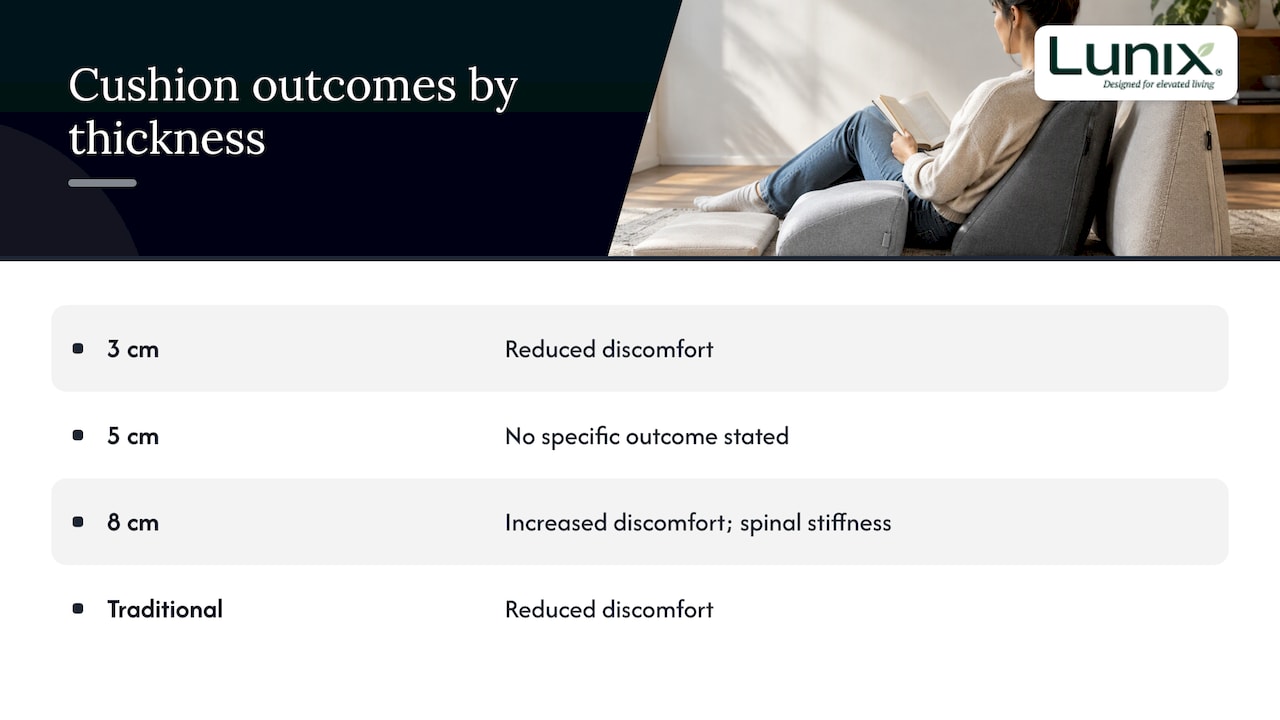
That is about 1.2 inches for the thin option. A dense, moderately thin seat keeps you stable, which means your trunk muscles do not have to work to stop you from wobbling.
A quick checklist before you sit
| Feature | What to aim for | Why it matters |
|---|---|---|
| Back height | Reaches the shoulder blades | Spreads load across the upper and lower back |
| Angle | Slight recline, about 15 degrees or more from vertical | Lets the backrest share your weight |
| Lower-back contour | A gentle curve, not a deep scoop | Keeps the lordosis without pushing the shoulders forward |
| Seat | Firm, thin to moderate, hips near knee level | Keeps you stable and your pelvis from rolling back |
| Cover | Washable and removable | Easy to keep clean with daily use |
How to sit on a floor couch so your back stays happy
Good equipment helps, and good habits finish the job. Here is a simple routine you can use every time you sit.
- Scoot all the way back. Your hips should touch the base of the backrest so the support meets your spine instead of floating behind your shoulders.
- Add a small cushion at your waist. The VA/DoD low back pain guidance suggests a back support or rolled-up towel to hold the normal curve of your lower back. A small firm cushion works the same way.
- Stack your ears, shoulders and hips. The same guidance describes a straight line perpendicular to the floor. If your head drifts forward, bring your screen or book up to eye level.
- Mind your knees and feet. Keep knees near a 90-degree angle with feet flat on the floor or a footrest when you can. Avoid crossing your legs, which the MSD Manual also advises against.
- Move on a schedule. Kaiser Permanente’s back pain guidance suggests changing positions every 30 minutes and breaking up sitting with a short walk or lying flat. It also advises avoiding very soft couches and twisted positions.
The VA/DoD guidance adds something reassuring: most low back pain is not serious and tends to settle within days, but sitting or standing too long in one position can leave back muscles stiff and sore. Frequent small changes beat one perfect posture.
A note on sitting up straight
Good posture does not mean rigid. A professional guideline from the American College of Occupational and Environmental Medicine (ACOEM) recommends a lordotic sitting posture for low back pain, and notes that a pillow or an existing seat feature is a low-cost way to get it. Think of it as a relaxed, slightly arched lower back with your chest open, not a military stance.
Setting up a floor couch for the whole family
Many of our customers are adults in their forties, fifties and sixties who shop for the household: a play area for grandchildren, a reading corner, a spot for the kids to do homework. The same rules apply to young spines. Kids slump just as easily, especially with tablets.
We wrote a hands-on guide, 3 setups to make a play couch support kids’ backs, that walks through arranging modular pieces so a child sits with support behind the back. Our modular play couches are made for exactly this kind of flexible arrangement, and our Kids’ Pillows collection rounds out the setup.
If you are mainly wondering how to ease discomfort from floor sitting, our article on a thin cushion and pelvic tilt for floor-sitting back pain pairs well with the checklist above. For a broader look at how design choices affect comfort, see our guide to ergonomic support and how it prevents pain, and for the foam itself, our piece on choosing the right high-density foam.
Finding firm, shaped support with Lunix
A floor couch only supports you as well as the foam behind your back. Our Wedge Pillow Sets are orthopedic sets made with high-density foam and washable covers, so the shape holds up and the cover goes in the wash when life happens. Our products carry OEKO-Tex certification, and shipping is free.

For households with children, our modular play couches and Kids’ Pillows let you build seating that grows and changes with them. Replacement covers are available too, which keeps a well-loved setup fresh. You can browse everything at lunixinc.com, and gift cards are there if you are shopping for someone else.
Our point of view on floor seating
We think of seating as part of recovery. Hours of sitting shape how your back feels at night, and a seat that lets your spine slump quietly undoes a lot of good work.
What we see in the research is simple. Floor sitting reduces the curve of the lower back, and the best response is to give that curve something firm to rest against. That is why we focus on high-density foam, shaped support and covers you can wash, rather than soft pillows that feel good for five minutes and give way.
We design for real homes: a couch the kids rebuild every weekend, a corner where you stretch after a long day, a spot where you can read with your back supported. Our orthopedic wedge pillow sets and modular play couches are made to slot into those daily routines.
The goal is not a perfect posture. It is a comfortable one you can return to, and a home that makes moving easy.
Lunix
When back discomfort deserves a doctor
A better seat helps with everyday stiffness. It is not a treatment for a medical problem, and some symptoms should be checked promptly.
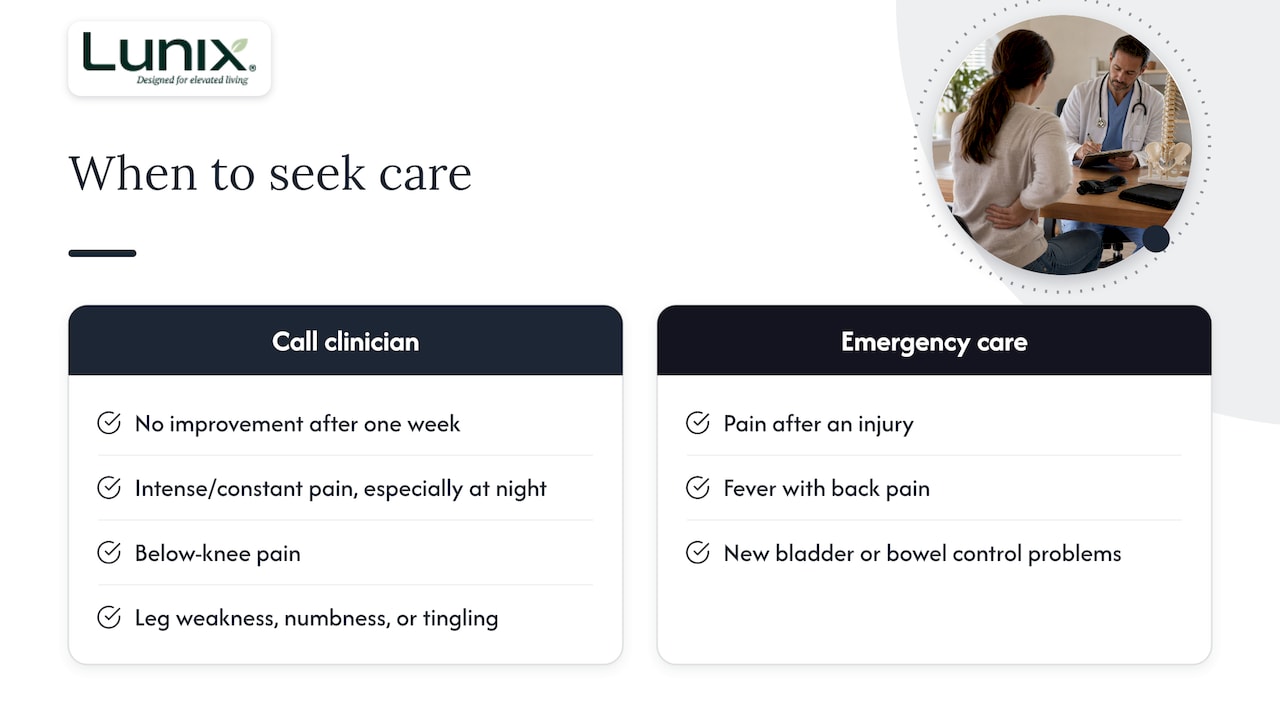
According to the Mayo Clinic, call a healthcare professional if your back pain has not improved after a week of home care, is constant or intense (especially at night), spreads down one or both legs below the knee, brings weakness, numbness or tingling in your legs, or comes with unintended weight loss. Seek emergency care if pain follows an injury, or comes with a fever or new problems controlling your bladder or bowels.
Duke Health gives a similar timeline: if pain lasts more than two weeks and keeps you from normal activities, see your family doctor. Chronic low back pain, meaning pain lasting 12 weeks or more, is common, affecting about 13% of U.S. adults. The same source notes that bed rest is not advised, so gentle movement is part of the answer.
If you have a spine condition, recent surgery or a diagnosis that limits how you sit, ask your physician which seating positions suit you before you settle into a new setup.
FAQ
Can a floor couch really support my back?
Yes, when it has a backrest that reaches your shoulder blades, a slight recline and a firm seat. Floor sitting without support flattens the lower-back curve, so the backrest is what makes the difference. Adding a small cushion at your waist helps hold the curve.
How thick should a floor cushion be?
Thinner and firmer tends to be more comfortable. A 2024 study found cushions thicker than 5 cm (about 2 inches) increased discomfort and spinal stiffness, while 3 cm (about 1.2 inches) reduced discomfort. A firm, moderately thin seat also keeps you steadier.
How long can I sit on a floor couch at one time?
Aim to change position about every 30 minutes. Stand, walk for a minute or two, or lie flat, then sit back down. Varying your posture is easier on your muscles than holding any single position for hours.
Is a floor couch a good choice if I already have back pain?
Many people with everyday stiffness find a supported floor seat comfortable, as long as the backrest holds the lower-back curve and they move often. If your pain lasts more than a week or two, spreads into a leg or causes numbness, see your doctor before choosing seating.
Are floor couches okay for kids?
Yes, with the same principles: support behind the back, an upright head and regular movement. Our guide to play couch setups shows how to arrange modular pieces so children sit with back support.
Sources
- Radiographic study of lumbar lordosis in floor sitting (Journal of Korean Neurosurgical Society, 2012)
- Biomechanical effects of different sitting postures (Bioengineering, 2023)
- Lumbar lordosis: normal curve, excess curve and what to do
- Tables, chairs and computers study (PMC, 2022)
- OSHA eTools: computer workstation chairs
- Selecting a Comfortable Chair (Utah State University Extension)
- Postural and spinal stability for different floor cushions (PMC, 2024)
- VA/DoD Clinical Practice Guideline for Managing Low Back Pain (2022)
- MSD Manual Consumer Version: Low Back Pain
- Kaiser Permanente: Back Pain Care Instructions
- ACOEM guideline on low back pain management (JOEM, 2020)
- Mayo Clinic: Back pain, when to see a doctor
- Duke Health: When can a doctor help your back pain?
- American Family Physician: Chronic Low Back Pain in Adults (2024)