


High density foam cushions are seating foam with enough material packed into every cubic foot to resist sagging, hold their shape, and outlast standard foam by years. Density is measured in pounds per cubic foot (lb/ft³), and for most seating projects, you want something in the 1.8 to 2.6 lb/ft³ range depending on how hard the piece works.
For a quick gut check on what to order:
- Sofa or daily-use seating: 1.8–2.6 lb/ft³, medium-firm feel (ILD 30–45)
- Dining chair or occasional seating: 1.5–1.8 lb/ft³, firmer feel is fine since sessions are shorter
- Heavy-use, commercial, or multi-person seating: 2.6–2.8 lb/ft³ for maximum sag resistance
If you’re replacing a worn-out cushion or building one from scratch, order cut-to-size foam at the density that matches your use case, and ask the vendor for the ILD (firmness) number too. Density alone won’t tell you how the cushion feels.
Pro Tip: Always request both numbers, density and ILD, before you buy. A vendor who can’t give you both probably isn’t selling upholstery-grade foam.
Key Takeaways
Choosing the right high-density foam cushion comes down to matching density to your durability needs and ILD to your comfort preference, then verifying both numbers before you buy.
| Point | Details |
|---|---|
| Density predicts lifespan | Aim for 1.8–2.6 lb/ft³ for sofas and daily-use seating; higher for heavy or commercial use. |
| ILD predicts feel | Look for 30–45 ILD for a medium-firm sit; density and ILD are independent numbers. |
| Match material to purpose | Polyfoam for value, HR foam for responsiveness, memory foam for contouring and pressure relief. |
| Certification matters | Choose CertiPUR-US listed foam to screen for emissions and harmful substances. |
| Lunix builds both in | Lunix’s wedge pillow sets pair high-density support cores with memory foam comfort layers and washable covers. |
Table of Contents
- What Does “High-Density Foam” Actually Mean?
- Is Density the Same as Firmness?
- Polyurethane, HR Foam, or Memory Foam: Which One Fits Your Project?
- What Density and ILD Should You Buy for Each Seating Type?
- How Do You Pick the Right Foam Without Getting Burned?
- How Do You Cut and Assemble a Cushion at Home?
- Where Should You Buy Cut-to-Size Foam?
- How Long Should a High-Density Cushion Last, and How Do You Maintain It?
- What Are the Downsides of High-Density Foam?
- Memory Foam or Standard High-Density Foam: Which One Do You Need?
- What Do Recovery-Focused Brands Look for in Seating Foam?
- Why We Think Most Buyers Get the Density Question Backward
- Ready to Upgrade Your Seating with Recovery-Grade Foam?
- Where to Verify These Specs Yourself
- Frequently Asked Questions
- Sources
What Does “High-Density Foam” Actually Mean?
Density in foam is a straightforward measurement: how many pounds a single cubic foot of that foam weighs. A foam block rated at 1.8 lb/ft³ weighs 1.8 pounds if you cut out a perfect one-foot cube and put it on a scale. More material packed into that same volume means more polymer structure to resist compression over thousands of sit-down cycles, which is the actual mechanism behind “durability” claims on foam packaging.
For furniture seating, foam is generally considered high density once it crosses roughly 1.8 lb/ft³, with performance-grade foam reaching 2.6 to 2.8 lb/ft³ for applications that need to survive heavy daily use without flattening out. Anything below that threshold, in the 1.0 to 1.5 lb/ft³ range, tends to compress permanently within a year or two of regular seating.
Here’s how the common density bands typically translate to real-world performance:
- Under 1.5 lb/ft³: Budget foam, common in low-cost furniture, usually shows visible sag within 12 to 18 months of daily use.
- 1.8 to 2.0 lb/ft³: The standard baseline for quality upholstery foam, holding its shape for several years under normal household use.
- 2.6 lb/ft³ and above: Performance-grade foam built for heavy use, commercial settings, or households where a couch sees constant traffic.
Density band snapshot: Foam under 1.5 lb/ft³ is generally reserved for decorative pillows and light-use cushions, not seats that carry body weight daily.
One more label worth knowing: CertiPUR-US certification. It means the foam has been independently tested for emissions and for the absence of certain heavy metals and flame retardants, which matters when you’re building something that sits in your living room and gets sat on for years. Checking a product’s listing on the CertiPUR-US database takes thirty seconds and rules out a category of cheap imported foam that skips testing entirely.
Is Density the Same as Firmness?
No, and this is the single most common mix-up buyers make when shopping for seat foam. Density tells you how long the foam will last. Indentation Load Deflection, or ILD, tells you how it feels when you sit on it. The two numbers move independently of each other, so a foam can be dense and soft, or light and rock hard, depending on how the manufacturer formulated it.
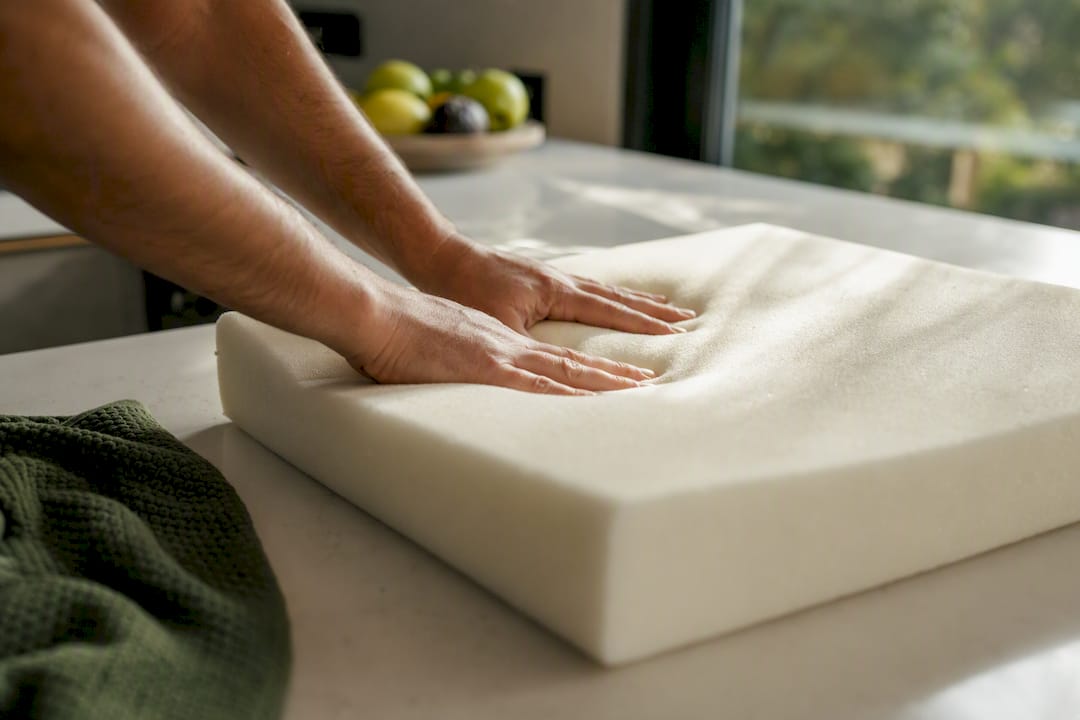
ILD measures the force required to compress a foam sample by 25% of its thickness, expressed in pounds. Lower numbers mean a softer sit; higher numbers mean a firmer one. For typical seating, industry guidance points to an ILD range of roughly 30 to 45 for a medium-firm feel that most people find comfortable for sofas and lounge chairs.
Here’s where it gets practical. Two foam samples can carry the exact same density rating and feel completely different under you:
| Density | ILD | What it feels like |
|---|---|---|
| 1.8 lb/ft³ | 30 | Softer sit, still durable, common for casual sofas |
| 1.8 lb/ft³ | 46 | Firm sit, same longevity, common for firm couch cushion replacements |
| 2.6 lb/ft³ | 35 | Medium feel with maximum sag resistance, ideal for heavy daily use |
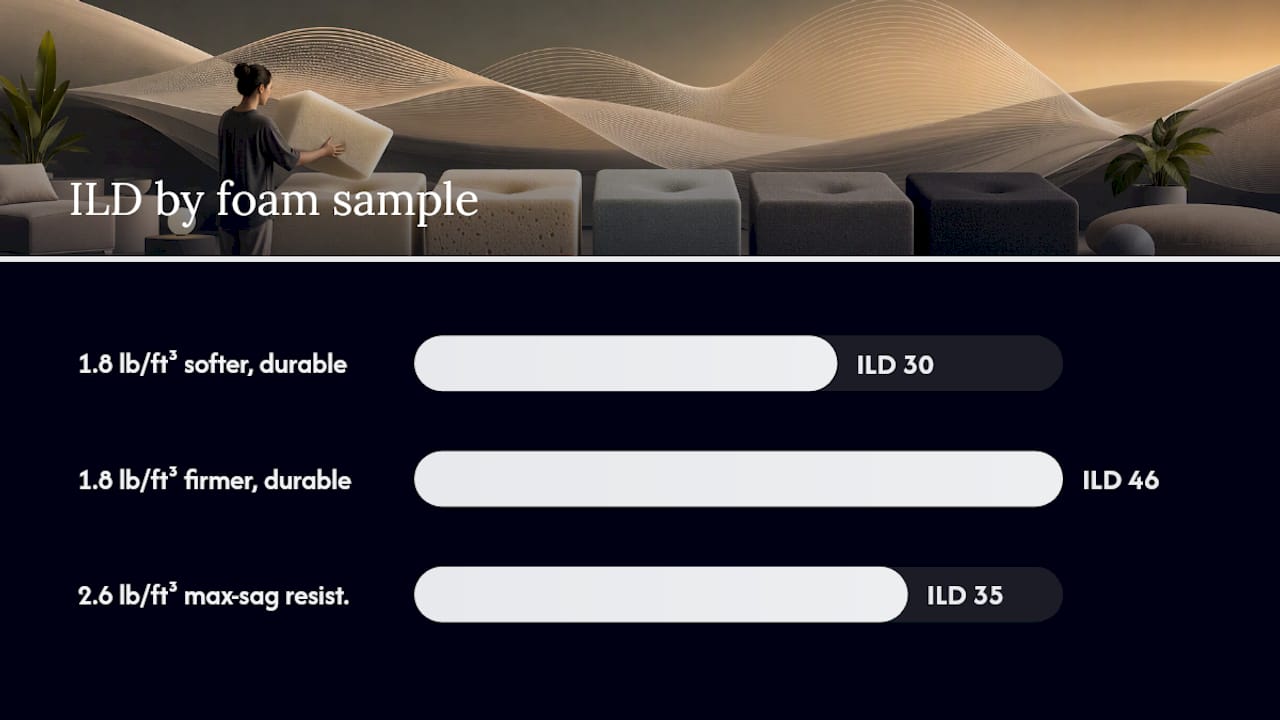
A real-world listing makes this clear. One popular replacement foam sells at 1.9 lb/ft³ density with a 34 ILD rating, landing squarely in the medium-firm zone most households want for a sofa. Compare that to a firmer option at the same density but a 46 ILD, and you get a noticeably stiffer sit despite identical longevity expectations.
When you’re comparing product pages, look for both numbers listed clearly. If a listing only mentions density, or only mentions firmness, or uses vague language like “medium comfort” with no numbers at all, that’s a sign to ask before you buy. A few questions worth sending a vendor:
- What is the exact density (lb/ft³) and ILD rating for this specific foam?
- Is the ILD tested at a standard thickness, or extrapolated?
- Do you offer a sample swatch so I can feel it before ordering a full sheet?
Skipping this step is how people end up with a couch cushion that’s technically durable but feels like sitting on a park bench.
Polyurethane, HR Foam, or Memory Foam: Which One Fits Your Project?
Three foam families dominate the seating world, and each one solves a different problem. Standard polyurethane foam (often called polyfoam) is the workhorse: affordable, widely available in high-density grades, and a solid default for most cushion replacement projects. High-resilience (HR) foam uses a different cell structure that gives it noticeably better bounce-back and support-to-weight ratio, making it the upgrade choice for people who want a firmer, more responsive sit without the extra bulk. Memory foam trades responsiveness for contouring, molding to body shape and holding it, which makes it better suited to pressure relief than to a bouncy sofa cushion.
- Polyurethane (polyfoam): Budget-friendly, good durability at high density, springs back quickly, widely available in cut-to-size sheets.
- HR foam: Costs more than standard polyfoam but delivers better support per pound, holds its shape longer under heavy use, and feels more “alive” underneath you.
- Memory foam: Excellent pressure distribution and contouring, but slower to recover shape and can retain heat, which is less ideal for a sofa you sit on for hours at a stretch.
| Material | Durability | Contouring | Cost | Best use |
|---|---|---|---|---|
| Polyurethane | Good at 1.8+ lb/ft³ | Low | $ | General cushion replacement |
| HR foam | Very good | Moderate | $$ | Heavy-use sofas, recliners |
| Memory foam | Good, 3–7 lb/ft³ typical range | High | $$$ | Orthopedic or pressure-relief seating |
Pro Tip: Don’t feel locked into one material. A hybrid build, high-density polyfoam or HR foam as the support core with a thinner memory foam topper, gives you both durability and contouring in one cushion.
That layering approach is exactly how most quality furniture is built today: a firm, dense base that won’t collapse, topped with a softer material that shapes to the body. If you’re replacing a cushion and want that “sink in but don’t bottom out” feel, cutting a support layer and a comfort layer separately, then gluing or stitching them together, often beats trying to find a single foam that does both jobs.
What Density and ILD Should You Buy for Each Seating Type?
Different seating jobs call for different specs, and matching them correctly is the difference between a cushion that lasts a decade and one that flattens by next winter.
For sofas and sectionals, aim for 1.8 to 2.6 lb/ft³ density with an ILD in the 30 to 45 range for a medium-firm feel most households find comfortable. If the sofa sees near-constant use, whether from kids, pets, or simply being the household’s main hangout spot, lean toward the top of that density range or higher.
Armchairs and recliners can use similar density to sofas, but the ILD often skews slightly firmer, in the 35 to 50 range, since a single-occupant chair benefits from more edge support to prevent that “sinking into a hole” feeling over time.
Dining chairs get away with lower density, typically 1.5 to 1.8 lb/ft³, paired with a firmer ILD around 40 to 60, since sitting sessions are shorter and the priority is a supportive perch rather than lounging comfort. Thickness here usually runs 2 to 3 inches, compared to 4 to 6 inches for sofa cushions.
For outdoor, boat, and RV seating, density matters just as much, but material choice shifts. Closed-cell or moisture-resistant foams matched to a marine-grade or weather-resistant vinyl cover matter more than squeezing out the last half-pound of density, since standard open-cell foam absorbs water and breaks down fast outdoors.
A quick reference for what to request when ordering:
- Sofa/sectional: 1.8–2.6 lb/ft³, ILD 30–45, 4–6 inch thickness
- Armchair/recliner: 1.8–2.6 lb/ft³, ILD 35–50, 4–5 inch thickness
- Dining chair: 1.5–1.8 lb/ft³, ILD 40–60, 2–3 inch thickness
- Outdoor/RV/boat: 1.8+ lb/ft³ with moisture-resistant formulation, ILD 30–45
Callout for heavy users: If more than one person over 200 pounds regularly uses the same seat, or if the furniture sees commercial-style traffic, push toward 2.6 lb/ft³ or higher. The jump from 1.8 to 2.6 lb/ft³ roughly doubles the sag resistance you get for the added cost, which matters far more over five years of daily sitting than it does on day one.
How Do You Pick the Right Foam Without Getting Burned?
Buying foam sight-unseen off a product page feels riskier than it needs to be once you know exactly what to check. Run through this before you click “add to cart”:
- Confirm the density, listed in lb/ft³, not just a vague “high density” claim with no number attached.
- Confirm the ILD rating, and make sure it’s specified rather than described only in words like “firm” or “plush.”
- Check the thickness options against your actual measurement, not a rounded estimate.
- Look for CertiPUR-US certification or an equivalent independent emissions test, especially for indoor seating.
- Read the return policy before you buy, since foam is hard to return once cut or unpackaged.
- Ask for a sample swatch if you’re unsure about feel, particularly for a big project like reupholstering a full sofa.
Beyond the spec sheet, a few questions to the vendor separate the professional cut-to-size shops from the ones just repackaging scrap:
- Will the edges be squared, or do I need to trim them myself?
- How is the foam shipped, rolled and vacuum-packed, or flat?
- How long should I expect the foam to take to fully expand after unboxing?
- Do you offer custom cutting for irregular shapes, like curved sofa arms?
Watch for a handful of red flags that signal low-quality foam before you commit:
- No density or ILD listed anywhere, just marketing language like “extra firm” or “luxury comfort.”
- A price that seems too good relative to competitors selling the same dimensions, since cheap imported foam often skips testing and uses lower-grade recycled material.
- No sample swatches offered, especially from a vendor selling large custom cuts.
- Vague or missing CertiPUR-US information when the listing claims to be “safe” or “non-toxic” without backing it up.
Pro Tip: If a listing price looks 30 to 40 percent cheaper than everything else at the same density, assume the ILD, cell structure, or certification is where they cut corners, not the density number itself.
On cost: expect standard 1.8 lb/ft³ polyfoam to run noticeably cheaper per board foot than 2.6 lb/ft³ HR foam or memory foam blends. Higher density and higher ILD both add to the price, since both require more raw polymer per cubic foot, but that upfront cost typically pays for itself by avoiding a full cushion replacement in two or three years.
How Do You Cut and Assemble a Cushion at Home?
Turning a raw foam sheet into a finished cushion is a manageable weekend project once you know the sequence.
- Measure your old cushion (or the seat frame) in length, width, and thickness, adding a small allowance if your fabric or cover will compress the fit.
- Order your foam slightly oversized, since it’s far easier to trim down than to patch a piece that’s too small.
- Gather the right tools: a long serrated bread knife or electric carving knife works well for straight cuts, and a metal straightedge helps keep lines true.
- Mark your cut lines clearly with a marker before cutting, checking measurements twice.
- Cut in slow, steady strokes, letting the serrated edge do the work rather than forcing the blade through.
- Round or bevel the edges if you want a softer profile, using the same knife at a shallow angle along the top edges.
A few practical notes as you go: spray adhesive rated for foam works well for layering different densities together, and it’s worth testing it on a scrap piece first since some adhesives can slightly degrade certain foam types over time. If you’re building a cover with a zipper, sizing the zipper panel about half an inch smaller than the foam helps the finished cushion look tight rather than baggy.
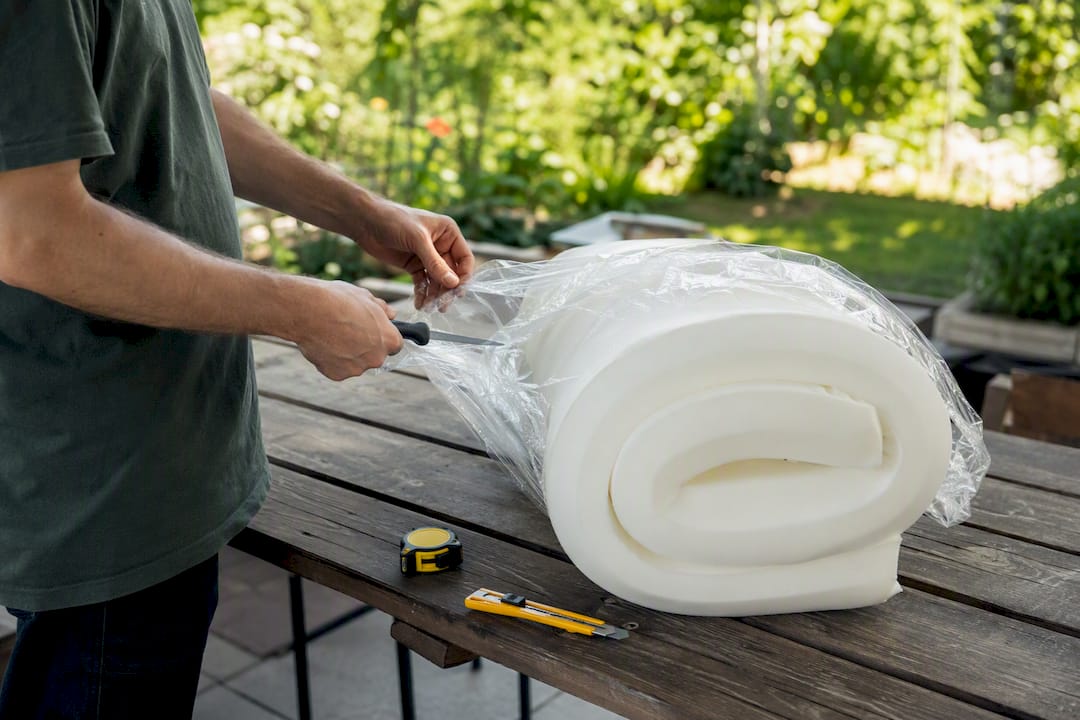
If your foam arrived vacuum-sealed and rolled, don’t cut it immediately. Give it time to fully expand and recover its shape, generally a day or two, before measuring or trimming, since a compressed roll can spring open with surprising force when the packaging is cut. Open it in a clear area and stand back as you cut the plastic wrap.
Pro Tip: For seams that see heavy stress, like the corners of a bench cushion, double-stitch or reinforce with a strip of webbing underneath the cover fabric. It’s a five-minute step that adds years to the seam’s life.
Where Should You Buy Cut-to-Size Foam?
You’ve got four main paths to a finished cushion, and each fits a different kind of project. Big-box craft and fabric stores sell foam sheets in standard sizes, convenient for simple rectangular cushions but limited on density options. Specialty foam cutters and online cut-to-size services offer the widest range of densities, ILDs, and custom shapes, usually with the clearest spec sheets. Local upholstery shops can cut and even assemble the whole cushion for you, at a higher price, if you’d rather skip the DIY step entirely. Marine and RV suppliers carry weather-resistant formulations that standard upholstery vendors don’t stock.
Before ordering from any of them, run the product page through this checklist:
- Density (lb/ft³) clearly stated
- ILD rating clearly stated
- Available sheet sizes and thickness options
- Cutting tolerance (how close to your exact dimensions they’ll cut)
- Shipping method (rolled and vacuum-packed versus flat)
- Return policy specifics
- CertiPUR-US listing or equivalent certification
If you’re unsure about the feel, most reputable cut-to-size vendors will ship a small sample swatch for a few dollars, which is money well spent before committing to a full sheet at 4 to 6 inches thick.
A few ordering tips that save headaches later:
- Add a small seam allowance beyond your exact measurement, since covers pull foam slightly tighter.
- Note panel orientation if your cushion isn’t a simple rectangle, so the cut follows the grain of use correctly.
- Ask whether the vendor wraps the finished cut in a protective layer, since raw foam edges can pick up dirt in transit.
How Long Should a High-Density Cushion Last, and How Do You Maintain It?
Higher density buys you time, but only if you take care of the cushion along the way. Rotate cushions periodically if your furniture allows it, spreading wear evenly instead of concentrating it on one favorite seat. Use removable, washable covers so you’re not stuck replacing the whole cushion over a spill. Avoid letting foam sit wet for extended periods, since prolonged moisture breaks down cell structure regardless of density. Give cushions occasional airing out and a light vacuum to keep dust and odor from building up inside the foam.
| Density range | Heavy daily use | Light/occasional use |
|---|---|---|
| 1.5–1.8 lb/ft³ | 2–4 years | 5–7 years |
| 1.8–2.6 lb/ft³ | 5–8 years | 8–12 years |
| 2.6+ lb/ft³ | 8 years | 8 years |
A handful of signs tell you it’s replacement time, not just a fluff-and-flip: permanent body impressions that don’t spring back, loss of side support that lets you feel the frame underneath, stress or splitting along seams, and one side of the seat sitting visibly lower than the other. Warranties vary widely by vendor, so treat the density and ILD numbers as your real guide to expected life rather than relying on a warranty period alone.
What Are the Downsides of High-Density Foam?
High-density foam isn’t the right call for every project, and it’s worth weighing the trade-offs honestly. It costs more upfront than standard low-density foam, sometimes significantly more at the 2.6 lb/ft³ and above tier. It’s also heavier, which matters if you’re building something that needs to be moved often, like a daybed cushion or a boat seat that comes in and out seasonally.
A few other things to keep in mind:
- Less initial plushness: A dense support core alone can feel firmer than expected unless paired with a softer comfort layer on top.
- Heat retention in some memory foam types: Denser memory foam traps body heat more than open-cell polyfoam, which matters for cushions used for long stretches.
- Not ideal for a “sinking in” feel: If you specifically want a soft, plush sink-in cushion, a single high-density slab alone will disappoint; you’ll want a comfort layer added on top.
- Disposal considerations: Foam isn’t easily recyclable in most municipal systems, so factor longevity into the environmental math, a cushion that lasts twice as long effectively cuts your foam waste in half.
Choosing CertiPUR-US certified foam helps address the chemical exposure side of that equation, since it screens for certain flame retardants and heavy metals during manufacturing.
Memory Foam or Standard High-Density Foam: Which One Do You Need?
It helps to separate two ideas that get blurred together constantly: “memory foam” describes a material, while “high density” describes a durability measurement that can apply to memory foam, polyfoam, or HR foam alike. You can have a low-density memory foam or a high-density memory foam, just as you can with polyfoam.
That said, memory foam generally runs on a higher density scale than standard polyfoam, often landing between 3 and 7 lb/ft³ compared to polyfoam’s typical 1.5 to 2.8 lb/ft³ range. That extra density is part of what gives memory foam its slow-recovery, body-molding feel, but it also means memory foam alone tends to feel less bouncy and responsive than a comparable-density polyfoam or HR foam.
For seating, the smart move is usually layering rather than choosing one exclusively: a high-density polyfoam or HR foam core for structural support, topped with a thinner memory foam layer for pressure relief where your body actually contacts the cushion.
- Orthopedic seating or wedge pillows: Memory foam layered over a firmer support core, prioritizing pressure relief and alignment.
- Heavy-use sofas: High-density polyfoam or HR foam as the primary material, since responsiveness and long-term shape retention matter more than deep contouring.
- Recovery-focused cushions: A hybrid build, similar to how Lunix designs its wedge pillow sets, combining a supportive base with a contouring comfort layer.
Pro Tip: If you’re building a cushion for someone with back or hip discomfort, don’t default to “more memory foam is better.” A too-soft, all-memory-foam cushion can actually undercut posture support. A firm core with a moderate memory foam topper usually serves that goal better.
What Do Recovery-Focused Brands Look for in Seating Foam?
When foam is doing double duty, supporting daily seating and supporting a body that needs alignment and pressure relief, the spec list gets more demanding. Lunix prioritizes a checklist that goes beyond a single density number: verified density and ILD together, CertiPUR-US certification as a baseline requirement, breathable and washable cover materials, and serviceable zippers that let you access or replace inner layers without tearing apart a seam.
If you’re testing a sample swatch at home, a few checks tell you more than the spec sheet alone:
- Compression test: Push down firmly and hold for ten seconds. Quality foam recovers its shape within a few seconds of release.
- Edge support: Sit near the edge, not just the center, and feel whether the foam collapses or holds a supportive line.
- Smell check: A strong chemical odor straight out of the packaging is a red flag, even before you check for certification.
- Recovery time: Note how long the foam takes to fully spring back after you stand up. Slower-recovering foam usually skews toward memory foam’s contouring properties rather than a durability defect.
Foam that looks identical on a spec sheet can behave completely differently under real body weight over months of use. The compression and recovery test takes thirty seconds and tells you more than any marketing claim on the package.
None of this replaces a professional upholsterer for complex reupholstery jobs, curved frames or tufted backs are genuinely easier left to someone with the right tools. But for straightforward cushion replacement, this checklist gets you most of the way to a supportive, long-lasting result. Lunix’s own dynamic cushioning approach reflects the same logic: pair a dense, stable core with a responsive comfort layer, and back it with certified materials.
Why We Think Most Buyers Get the Density Question Backward
Most people shopping for cushion foam ask “how firm should this be?” when the more important question is “how long do I need this to last?” Firmness is a preference you can adjust later with a topper or a different cover. Durability, once you’ve picked a low-density core and built a whole cushion around it, is baked in and expensive to fix.
We’d argue the conventional advice to “go with what feels comfortable in the showroom” actively misleads DIY buyers, because a showroom test lasts thirty seconds and a cushion’s real test is three years of daily sitting. Cheap foam feels fine on day one. The complaints show up at month fourteen, and by then the fabric cover is already worn to match the frame underneath.
Our product line reflects this bias toward the boring, unglamorous spec: dense support cores, verified ILD ratings, and certified materials, paired with the contouring comfort layer that makes a seat feel good rather than just endure. You can see that approach in the LX8 wedge pillow set and the wider wedge pillow lineup, both built on that same principle of support first, comfort layered on top.
Ready to Upgrade Your Seating with Recovery-Grade Foam?
If you’ve read this far, you already know what separates a cushion that lasts from one that flattens by next winter, and shopping loose foam sheets one spec at a time isn’t the only path there. Lunix builds that density-plus-comfort logic directly into finished products, so you skip the cutting, gluing, and guesswork entirely.

Every Lunix wedge pillow and support cushion pairs a high-density base with a memory foam comfort layer, the same combination this guide recommends for orthopedic or recovery-focused seating. That means the specs you just learned to check for, verified density, ILD, and certified materials, are already built in, along with washable covers and accessible zippers so you’re never stuck replacing an entire piece over one worn seam. If you’re building a reading nook, a recovery corner, or just want back support that won’t flatten out in a year, browse the Recovery collection and compare sizes against the seat you’re outfitting. Check the product page for exact density and firmness details before you order, the same way this guide taught you to check any vendor’s listing.
Where to Verify These Specs Yourself
Before you place an order, confirm density and ILD directly against these references rather than relying on a listing’s marketing copy alone.
- The PFA InTouch guide explains how density and ILD are measured and why both matter for seating.
- For posture-specific placement once your cushion is built, this cushion positioning guide covers spinal alignment basics.
- Lunix’s foam and support blog post expands on how these specs apply to recovery-focused products.
Always check both the density and ILD listed on a product page before you buy. One number without the other tells you only half the story.
Frequently Asked Questions
What is considered high density foam for cushions? Foam is generally considered high density once it reaches about 1.8 lb/ft³, with performance-grade options running 2.6 to 2.8 lb/ft³ for heavy-use seating.
Is higher density always better for seat cushions? Not necessarily. Higher density improves durability and sag resistance, but comfort depends on ILD too. A very dense, low-ILD foam can still feel soft, while a lower-density foam with a high ILD can feel firm but wear out faster.
What’s the difference between high density foam and memory foam? High density is a durability measurement based on weight per cubic foot; memory foam is a specific material known for slow-recovery contouring. Memory foam typically runs on a higher density scale, roughly 3 to 7 lb/ft³, compared to standard polyfoam.
How thick should foam be for a couch cushion replacement? Most sofa cushions use foam between 4 and 6 inches thick, though this depends on your existing frame depth and desired firmness. Measure your old cushion before ordering.
How long does high density foam last in daily use? Foam in the 1.8 to 2.6 lb/ft³ range typically holds up for 5 to 8 years under heavy daily use, and considerably longer under light or occasional use.
Is CertiPUR-US certification worth checking before buying? Yes. CertiPUR-US certification confirms independent testing for certain emissions and harmful substances, which is a useful screening step for any foam that will sit in your home for years.
Sources
- PFA InTouch (foam density and ILD guidance)
- What Is High-Density Foam in a Mattress? - The Mattress Advisor