


Morning hand stiffness usually comes from either inactivity or an early form of arthritis, and the clock is your best diagnostic tool. If your fingers loosen up within a short time of moving around, it’s likely mechanical and manageable with gentle exercise. If stiffness lingers for a prolonged period, recurs daily, or shows up with numbness, swelling, or weakness, it’s time to get evaluated rather than wait it out.
TL;DR:
- Stiffness lasting under 30 minutes in the morning typically results from inactivity or mechanical wear and improves with gentle movement and warmth.
- Persistent stiffness over 30 minutes, especially if accompanied by numbness or swelling, suggests inflammatory conditions like rheumatoid arthritis or nerve compression.
- Tracking stiffness duration and difficulty with tasks over two weeks can help identify whether self-care routines are effective or if medical evaluation is needed.
- A daily, five-minute stretching routine incorporating warmth, wrist circles, finger taps, and tendon glides can significantly reduce morning stiffness.
- Using heat and compression devices before exercises supports joint flexibility but should not replace professional diagnosis or treatment if symptoms worsen.
Table of Contents
- Why Are Your Hands Stiff in the Morning? Common Causes
- How Long Your Stiffness Lasts Tells You a Lot
- How to Relieve Stiff Hands at Home Each Morning
- What a Hand Evaluation and Treatment Actually Involve
- Understanding Morning Gel and Everyday Joint Care
- A Two-Week Plan to Test and Track Your Progress
- Where Lunix Devices Fit Into Your Morning Routine
- Sources
Why Are Your Hands Stiff in the Morning? Common Causes
Your joints and tendons don’t sit idle overnight without consequence. Several distinct conditions produce that same “waking up with stiff hands” feeling, but they behave differently once you start moving.
- Osteoarthritis: cartilage wears down over years, and stiffness peaks after periods of rest because the joint has had no motion to keep it lubricated.
- Rheumatoid or inflammatory arthritis: an autoimmune process attacks joint linings, often symmetrically on both hands, and frequently comes with fatigue or low-grade fever.
- Carpal tunnel syndrome: swelling around the wrist compresses the median nerve, producing numbness and tingling alongside stiffness, especially in the thumb, index, and middle fingers.
- Trigger finger and tenosynovitis: tendons and their sheaths become inflamed, causing a finger to catch, lock, or snap rather than move smoothly.
- Less common causes: Dupuytren contracture pulls fingers into a bent position over time, while diabetes and scleroderma can cause connective tissue changes that stiffen hands independent of joint disease.
These causes aren’t mutually exclusive. Osteoarthritis and carpal tunnel syndrome, for instance, commonly overlap in people over 50, which is part of why self-diagnosis only gets you so far.
How Long Your Stiffness Lasts Tells You a Lot
Duration is the single most useful clue you have, and it’s one most people never think to track. Stiffness that clears in under 30 minutes, especially with light activity, points toward mechanical wear or simple overnight inactivity. Stiffness that persists 30 to 60 minutes or longer suggests an inflammatory process such as rheumatoid arthritis, though prolonged stiffness can also occur with hand osteoarthritis, so duration alone isn’t a diagnosis.
Pattern matters just as much as timing:
- Symmetrical stiffness in both hands, especially in the knuckles closest to the palm, leans toward rheumatoid arthritis.
- One-sided stiffness concentrated in specific joints is more typical of osteoarthritis or a localized tendon issue.
- Numbness or tingling, particularly if it wakes you at night, points toward carpal tunnel syndrome rather than joint disease.
- Catching or locking of a single finger signals trigger finger, not generalized arthritis.
Certain signs mean you shouldn’t wait for a scheduled checkup. Sudden weakness, rapidly worsening swelling, or stiffness paired with fever or unexplained weight loss warrants prompt medical attention rather than a “let’s see how next week goes” approach.
How to Relieve Stiff Hands at Home Each Morning
Before you reach for anything, understand what’s actually happening in your joints. Synovial fluid, the natural lubricant inside each joint, thickens during long periods of rest. Hand surgeons sometimes call this the “morning gel” effect, and movement is what reverses it, restoring circulation and thinning the fluid back out.
Start with warmth. A 5 to 10 minute soak in warm water loosens tissue before you ask it to move. If you’re over 65 or have heart concerns, keep the water under 100°F to avoid dizziness or cardiac strain.
Once your hands feel warm, work through this sequence while still in bed or seated:
- Wrist circles: rotate each wrist slowly, 10 times in each direction.
- Finger taps: tap each fingertip to your thumb, 10 reps per hand.
- Fist stretch: make a loose fist, then fully extend your fingers, 10 slow reps.
- Finger bends: bend each finger at the base, middle, and end joints individually, holding briefly at each position.
- Tendon glides: move from a straight hand to a hook fist, then a full fist, then a straight fist, cycling through each shape 5 times.
Hand therapy protocols call for slow, pain-free repetitions with gradually increasing hold times, not force. If you feel sharp pain at any point, stop. Stretching through a locking or swollen joint tends to aggravate rather than help.
Beyond the morning routine, small daily habits reduce how often stiffness shows up at all: pacing repetitive tasks, adjusting how you grip tools or a phone, and adding light strengthening work a few times a week. Our guide on enhancing joint mobility covers this in more depth.
Pro Tip: Keep a simple log for two weeks: how many minutes stiffness lasts, and whether tasks like buttoning a shirt or opening a jar get easier. That record turns a vague “my hands feel bad” into specific data your clinician can actually use.
What a Hand Evaluation and Treatment Actually Involve
A clinician typically starts with a history and a focused hand exam, checking which joints are affected, whether swelling is present, and how symmetrical the pattern is. Diagnostic imaging like x-rays or ultrasound can confirm joint damage, while blood tests screen for inflammatory markers when rheumatoid arthritis or another autoimmune condition is suspected.
Treatment usually starts conservatively:
- Splints to rest an irritated joint or tendon overnight
- NSAIDs or topical anti-inflammatory gels for pain and swelling
- Targeted hand therapy with a certified therapist
- Corticosteroid injections for stubborn inflammation
Surgery or referral to a hand surgeon or rheumatologist comes into play when symptoms persist despite conservative care, or when structural damage like trigger finger locking or advanced Dupuytren contracture limits function. Early diagnosis matters most with inflammatory arthritis specifically, since starting treatment sooner tends to preserve joint function better than waiting until damage has progressed.
Understanding Morning Gel and Everyday Joint Care
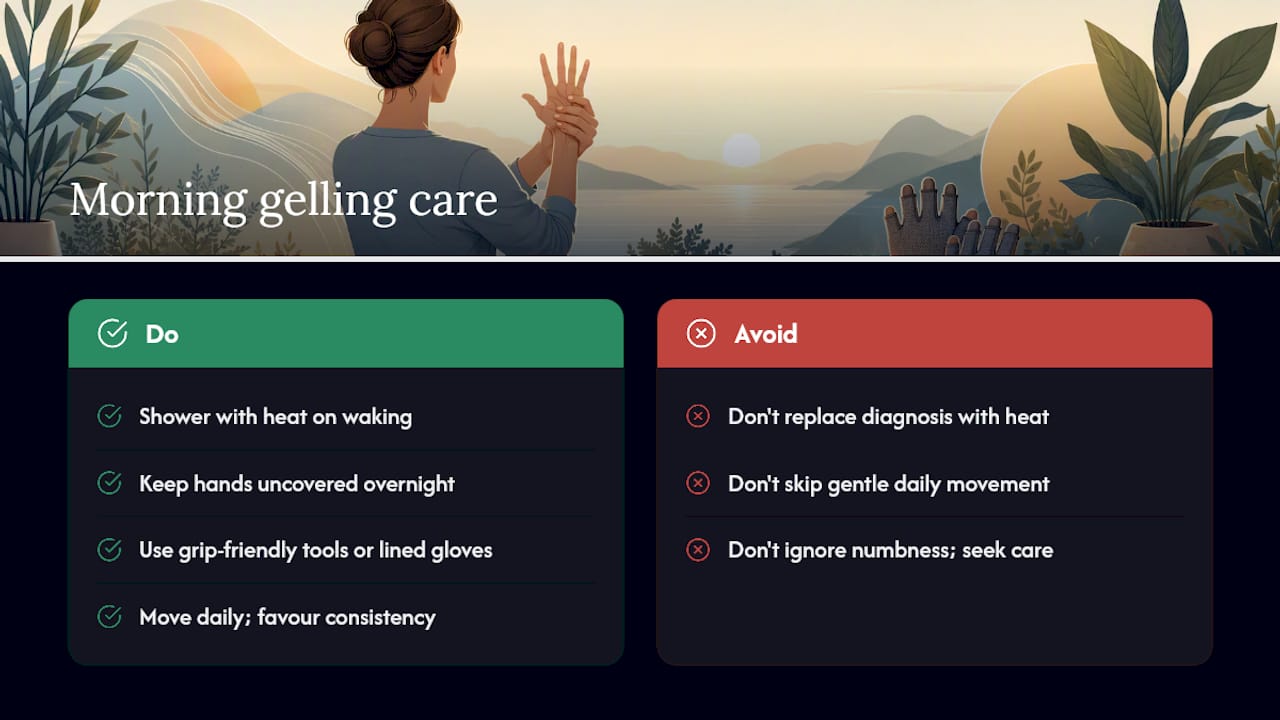
That “gelling” sensation isn’t damage happening in real time. It’s synovial fluid thickening during hours of stillness, and it’s fully reversible with movement and warmth. A hot shower first thing, keeping your hands out from under the blanket less often overnight, and switching to grip-friendly tools or lined gloves in cold weather all chip away at the problem before it starts.
Heat and gentle compression can support this process alongside exercise, never in place of it or a clinician’s diagnosis.
Even small daily movement patterns make a measurable difference in stiffness over days to weeks. Consistency, not intensity, is what changes the pattern.
Our carpal tunnel guide covers nerve-related stiffness in more detail if numbness is part of your picture.
A Two-Week Plan to Test and Track Your Progress
I’d suggest treating the next two weeks like a small experiment rather than a guessing game. Every morning, run through the five-move routine before you pick up your phone or make coffee. It takes five minutes.
Log two things daily: how many minutes stiffness lasts, and one functional task, buttoning a shirt, gripping a mug, opening a jar. Watch the trend line, not any single day.
If stiffness duration is shrinking and tasks feel easier by day 10 to 14, keep going. If duration is stuck at 30 minutes or more, new numbness appears, or a joint starts swelling, stop experimenting and book an appointment. That’s not a failure of the routine. It’s the routine doing its job by telling you when self-care has reached its limit.
Where Lunix Devices Fit Into Your Morning Routine
Heat and gentle compression have a real, supporting role once you know what you’re dealing with. Lunixinc’s heated air compression hand massagers combine warmth with rhythmic pressure to help loosen stiff fingers before you start your stretching sequence, which is often easier than a sink soak if you’re short on time. For stiffness tied to swelling or tendon irritation, a lightweight ergonomic wrist or hand support can reduce strain during the day, while red light therapy devices are sometimes used as an adjunct for joint discomfort, an approach explained in more depth here.
Use any warming or compression device before your exercises, not instead of them, and stop if you notice increased pain or swelling. These tools ease symptoms; they don’t diagnose or replace a clinician’s evaluation. If your two-week tracking shows worsening duration or new nerve symptoms, a device is not the next step, a hand specialist visit is.

Pair your morning routine with the right hand massager for your grip and comfort needs, and use our at-home hand exercises alongside it for a fuller relief routine.
Sources
- Stiff fingers: inflammatory arthritis warning signs — The Well by Northwell
- Why you wake up stiff — Cleveland Clinic
- Finger-bending exercises — University of Washington hand therapy
- Why you are so stiff in the morning and how to fix it — AARP
This article is general information, not a substitute for advice from a qualified doctor. Consult a qualified healthcare professional about your own circumstances before acting on anything here.