


Yes, a high density foam couch is worth it when the seat foam runs at least 2.5 lb/ft³, because that density range holds its shape through years of daily sitting instead of collapsing into a permanent dent. You get durability, support, and consistent comfort in exchange for a firmer initial feel, a heavier cushion, and a higher price tag. The rest comes down to matching density with the right firmness number, which is what turns a good spec sheet into a couch that actually feels good to sit on.
TL;DR:
- High-density foam cushions with at least 2.5 lb/ft³ are more likely to last 15 to 20 years with proper care, especially in high-use furniture.
- Density predicts lifespan, while firmness (ILD) determines how supportive and comfortable the cushion feels at the moment of sitting.
- A layered construction with dense foam core and softer top layer offers long-term support and plush comfort, ideal for daily heavy use.
- Confirm foam density in lb/ft³ and ILD before purchasing, as media labels like “high density” often lack specific technical details.
- Regularly rotate cushions, use removable covers, and avoid jumping to maximize foam longevity regardless of density.
Table of Contents
- What Does “High Density Foam” Mean for a Couch?
- Density vs. Firmness (ILD): What’s the Difference?
- Benefits and Trade-Offs of High-Density Foam Couches
- Which Density and Firmness Should You Choose?
- What to Ask For Before You Buy a Foam Couch
- How to Care for High-Density Cushions and What Lifespan to Expect
- How Lunix Approaches High-Density Foam in Product Design
- How Does High-Density Foam Compare to Memory Foam, Latex, and Down?
- Is High-Density Foam a Sustainable Choice?
- Common Misconceptions About High-Density Foam Couches
- How Does High-Density Foam Affect Comfort and Ergonomics?
- Why the Spec Sheet Matters More Than the Showroom Feel
- Explore High-Density Foam Couches and Modular Seating at Lunix
- Sources
What Does “High Density Foam” Mean for a Couch?
Density measures how much foam material is packed into a cubic foot, expressed as pounds per cubic foot (lb/ft³). It has nothing to do with how soft or firm the cushion feels. Two foams can share the exact same firmness rating and still have wildly different densities, because density is about the amount of material holding the cushion’s structure together, not how that structure feels under your hand.
Foam generally falls into three tiers:
- Low density (around 1.8 lb/ft³): Common in budget furniture, breaks down fastest under regular use.
- Mid-density (around 2.2 lb/ft³): A middle ground found in many mainstream sofas, moderate lifespan.
- High density (2.5 lb/ft³ and up): The premium threshold manufacturers use for seating meant to last, typically high-resilience (HR) polyurethane foam.
HR polyurethane is the standard material at the high end because its open-cell structure recovers its shape faster and more consistently than standard polyurethane foam of the same weight.
Density vs. Firmness (ILD): What’s the Difference?
Density predicts how long the cushion lasts. Firmness, measured as ILD (Indentation Load Deflection), predicts how the cushion feels the moment you sit down. These are two separate numbers, and confusing them is the single most common mistake couch shoppers make.
ILD tells you how much force it takes to compress foam by 25%. A couch seat cushion typically lands around 44 ILD for a balanced, supportive feel. That target isn’t fixed, though. Cushion thickness changes the math:
- Thin cushions (under 4 inches) need a higher ILD, closer to 54, or you’ll feel the frame underneath.
- Thick cushions (over 6 inches) can use a lower ILD and still feel supportive, since there’s more material to absorb your weight.
Pro Tip: You don’t have to choose between comfort and durability. A dense HR foam core wrapped in a softer top layer, often a Dacron-wrapped cushion, gives you the long-term support of high-density foam with a plush surface feel on day one.
Benefits and Trade-Offs of High-Density Foam Couches
High-density foam earns its reputation, but it’s not without real downsides worth weighing before you buy.
The benefits:
- Holds its shape instead of developing permanent body impressions
- Supports daily, heavy use without collapsing prematurely
- Works with virtually any upholstery style, from tight-back sofas to loose cushion sectionals
- Delivers consistent seating firmness for years, not months
The trade-offs:
- Feels firmer right out of the box compared to softer foam or down alternatives
- Retains more heat than open-cell alternatives, since the tighter cell structure limits airflow
- Costs more upfront and adds noticeable weight to each cushion
The lifespan payoff is significant. Low-density foam around 1.8 lb/ft³ typically lasts 2 to 4 years before sagging becomes obvious, mid-grade foam runs 5 to 10 years, and high-resilience foam in the 2.6 to 2.9 lb/ft³ range can last 15 to 20 years or more in a well-built cushion.
Which Density and Firmness Should You Choose?
The right density depends heavily on who’s actually sitting on the couch and how often.
- Everyday family sofa: Aim for 2.5 to 2.9 lb/ft³ HR foam in the seat cushions. This is the range that survives kids, pets, and daily lounging without sagging inside two years.
- Guest room or formal living room: A lighter 1.8 to 2.2 lb/ft³ foam is usually fine, since infrequent use doesn’t stress the material the way daily sitting does.
- Back cushions: These can run softer than seat cushions since they don’t bear full body weight the same way. A lower ILD here improves lean-back comfort without compromising the seat’s support.
- Thin-profile or modern low-back designs: Bump ILD higher regardless of density, since less foam thickness means less cushioning between you and the frame.
Matching these two numbers, density for lifespan and ILD for feel, is what separates a couch that still looks new after five years from one that needs replacement cushions after two.
What to Ask For Before You Buy a Foam Couch
Retailers don’t always volunteer specs, so come prepared with questions before you swipe your card.
Ask for these specs:
- Foam density in lb/ft³, not just a marketing label like “high density”
- The ILD or firmness number for both seat and back cushions
- Confirmation of foam type, ideally HR polyurethane for seating
- Cushion construction details, including whether there’s a wrap or topper layer
- Zipper access on cushion covers for cleaning or eventual replacement
In the showroom, test it yourself:
- Sit for a full minute, not just a quick perch, to feel how the foam responds under sustained weight
- Press near the edge of the cushion to check for edge support instead of a soft collapse
- Push down and release to see how quickly the foam recovers its shape
Pro Tip: A retailer that hesitates to give you a density number in lb/ft³ often doesn’t have one to give. A solid warranty and a clear return policy are two of the most reliable trust signals you’ll find, since companies rarely back cheap foam with generous terms.
How to Care for High-Density Cushions and What Lifespan to Expect
Foam longevity depends as much on care as it does on the density number on the spec sheet.
- Rotate and flip cushions every few months to spread out wear evenly.
- Choose removable, washable covers so you can clean fabric without compressing or soaking the foam itself.
- Spot-clean according to the fabric’s care instructions rather than saturating the cushion.
- Avoid jumping or standing on cushions, which accelerates cell breakdown far faster than normal sitting.
Realistic expectations by density: low-density foam runs 2 to 4 years, mid-grade foam runs 5 to 10 years, and HR foam in the 15 to 20 year range holds up under normal household use. When a cushion finally sags, replacement foam services can often cut a new core to the original shape, which is far cheaper than replacing the whole sofa. If only the fabric looks worn but the foam still springs back, a new cover or wrap solves it without touching the core.
How Lunix Approaches High-Density Foam in Product Design
Some modular pieces are designed with foam density decisions starting from the principle covered throughout this guide: density protects lifespan, and construction protects comfort. The LX22 modular play couch and the LX15 modular couch both pair dense foam cores with removable, washable covers and safety zippers, the same practical features this guide flags as trust signals worth checking on any couch. For readers who want the deeper technical breakdown, Lunix’s own guide to picking foam density and feel walks through how density and ILD interact in more detail than a single article can cover.
How Does High-Density Foam Compare to Memory Foam, Latex, and Down?
Every cushioning material makes a different trade between comfort, support, and lifespan, and none of them wins on all three at once.
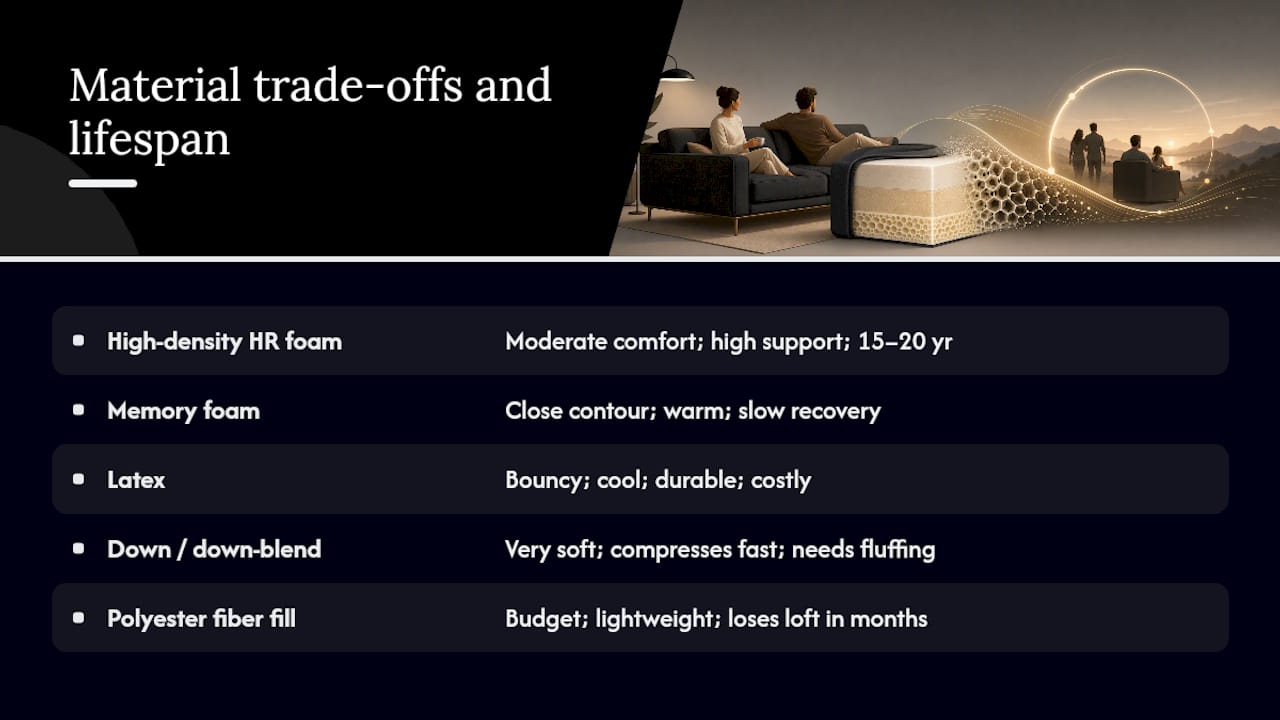
Memory foam contours closely to your body and reduces pressure points, but it runs warmer than HR foam and can feel slow to recover its shape, which some sitters find sluggish rather than supportive on a couch used all day.
Latex offers excellent bounce and a naturally cooler feel than polyurethane, plus strong durability. It also costs noticeably more and is heavier, which limits how often manufacturers use it in mid-priced modular seating.
Down and down-blend cushions feel luxuriously soft at first touch, but they compress fast and need regular fluffing to avoid a flattened, lumpy look within a year or two. They’re a comfort layer, not a structural one, which is why you’ll often see down used as a topper over a firmer core rather than as the entire cushion.
Polyester fiber fill is the budget option. It’s lightweight and inexpensive, but it compresses the fastest of any material discussed here and loses loft within months of regular use.
High-density HR foam sits in the middle on comfort but leads on the combination that matters most for a couch: support that holds up under daily body weight for 15 to 20 years rather than months. That’s why so many mid-to-premium sofas layer a softer material like down or a plush topper over an HR foam core. You get the immediate comfort of the softer material with the structural backbone of the dense foam underneath.
Is High-Density Foam a Sustainable Choice?
Longevity is the biggest sustainability factor most shoppers overlook. A cushion that lasts 15 to 20 years replaces far fewer landfill-bound cushions over its life than a low-density foam that wears out every two to four years, even though the initial manufacturing footprint of denser polyurethane foam is higher per unit.
Polyurethane foam itself is petroleum-based, and that’s a legitimate environmental concern worth naming plainly. It doesn’t biodegrade quickly, and production involves chemical processes that carry a real carbon footprint. Some manufacturers now offer plant-oil-blended or soy-based polyurethane foams that reduce the petroleum content, though these blends are still emerging in mainstream furniture and don’t yet match HR foam’s density-to-lifespan track record.
The more immediate lever for a couch buyer is construction, not just the foam itself. Removable covers mean you can replace worn fabric without discarding the cushion. Foam cores that can be re-cut or refreshed by replacement foam services extend a sofa’s life well past the point where a fixed, non-removable cushion would end up at the curb. Buying one high-density couch that lasts two decades is a smaller environmental footprint than buying five low-density couches over that same span, even before factoring in shipping, packaging, and manufacturing emissions for each replacement.
Common Misconceptions About High-Density Foam Couches
The biggest misconception is that “high density” automatically means “firm.” Density and firmness are independent specs, and a high-density foam can be built with a low ILD for a softer feel while still holding its shape for two decades. Firmness comes from the ILD number and the topper layer, not from density alone.
A second myth: heavier foam always means better foam. Weight is a rough proxy for density, but manufacturers can add fillers or use inconsistent cell structures that add weight without adding real resilience. The lb/ft³ number and the material type (HR polyurethane specifically) matter more than how heavy a cushion feels in your hands at the store.
A third misconception is that high-density foam never softens or breaks down. It does age, just far more slowly than lower grades. Even 2.8 lb/ft³ HR foam will eventually lose some resilience after 15 to 20 years of daily use, particularly in a home with heavy sitters or kids who treat the couch like a trampoline.
Finally, plenty of shoppers assume a higher price automatically means higher density. Price reflects fabric, brand, and design as much as foam specs. The only way to confirm density is to ask for the lb/ft³ number directly, since marketing language like “premium foam” or “luxury cushioning” carries no standardized meaning across brands.
How Does High-Density Foam Affect Comfort and Ergonomics?
Support and comfort aren’t opposites, though they often get treated that way in furniture marketing. High-density foam’s real ergonomic advantage is consistency: it distributes your body weight evenly across the cushion instead of letting pressure concentrate at one point, which is what causes the sunken, uneven feeling in an old, worn-out sofa.
That even weight distribution matters most for your lower back and hips. A cushion that’s collapsed in the middle forces your spine into a curved position that most people notice as discomfort after sitting for 20 minutes or more. A properly specified high-density cushion keeps its structure under your weight, which keeps your posture closer to neutral even during long stretches of sitting or working from the couch.

Edge support is the other ergonomic factor people underestimate. Dense foam resists collapsing near the edge of the cushion, which matters when you sit near the front to stand up, a motion older adults and anyone with joint concerns perform dozens of times a day. A layered construction with a firmer base and softer top layer gives you that structural edge support while still feeling comfortable to the touch, which is the combination most ergonomically sound seating aims for.
Why the Spec Sheet Matters More Than the Showroom Feel
Most buying advice tells you to trust your body in the showroom, and that’s only half right. A couch that feels perfect after a two-minute sit in a store can still sag within a year if the density underneath that comfortable topper is low. The research on this is consistent: density predicts lifespan, and no amount of showroom comfort testing reveals that number. You have to ask for it directly.
Where conventional advice falls short is treating firmness and density as one spec instead of two. Shoppers get talked into “premium” language without ever seeing an ILD or lb/ft³ figure, and they end up disappointed eighteen months later when a couch that felt great in the store turns lumpy at home. The fix is simple: prioritize the density number first, since it protects your investment over years, then negotiate firmness through toppers, cushion thickness, or ILD selection.
Lunix’s approach to modular seating reflects that same order of priorities: build the structural foam right, then layer comfort on top of it. That’s a more durable philosophy than chasing the softest cushion on the showroom floor.
— Lunix
Explore High-Density Foam Couches and Modular Seating at Lunix
Some modular seating is designed around the same density-first principle covered throughout this guide: a durable foam core first, comfort layered on top. If you’re comparing options after learning what lb/ft³ and ILD numbers actually mean, product pages may list the construction details this guide recommends you ask for, including foam type, removable covers, and safety zippers.

The LX15 modular couch and LX22 modular couch both build on high-density foam construction paired with washable, removable covers, so you’re not stuck choosing between comfort and something that holds up. If you want the full technical rundown before you decide, Lunix’s dedicated foam density guide breaks down feel and firmness in more depth. Visit the Lunix product catalog to check current specs, warranty terms, and ordering details before you make your next seating decision.
Sources
- Premium Modular Foam Sofa | High-Density Couch for Apartments, No Assembly Modern Minimalist Seating – ActiveWork
- Replacement Couch Cushions & Couch Cushion Foam — FoamOrder