


TL;DR:
- A mindful workspace is designed to reduce cognitive load, support emotional regulation, and improve focus. It emphasizes ergonomic comfort, sensory control, and daily mindfulness routines to enhance productivity and well-being. Regular maintenance and sensory variety are essential for sustaining a calm, focused environmental state.
A mindful workspace is defined as a physical environment intentionally designed to reduce cognitive load, support emotional regulation, and promote sustained attention. Creating a mindful workspace means going beyond tidying your desk. It means applying principles from biophilic design, neuroaesthetics, and sensory management to build a space where your brain can actually perform. Research from the Mayo Clinic and Simply Psychology confirms that structured environmental and mindfulness interventions measurably reduce stress and sharpen focus. This guide gives you the practical steps to build that environment from the ground up.
What are the foundational elements of creating a mindful workspace?
A mindful workspace starts with three non-negotiable foundations: physical comfort, visual calm, and sensory control. Get these right before adding anything else.
Ergonomics and physical comfort
Your body’s comfort level directly shapes your mental state. Poor posture creates a chain reaction of tension through your neck, jaw, and shoulders, which pulls attention away from your work. Ergonomic design addresses chair height, monitor distance, and keyboard placement as a system, not as individual tweaks. A chair that supports your lumbar curve and a monitor positioned at eye level removes the physical friction that drains focus over a full workday.

Decluttering as a design principle
Visual clutter is not just an aesthetic problem. Visible cable clutter subconsciously signals being tethered to technology, increasing perceived mental load and reducing focus. That means every tangled cord on your desk is quietly taxing your brain. Cable management trays, velcro ties, and desk grommets cost very little and return significant mental clarity. Clear surfaces signal to your nervous system that the environment is under control.
Pro Tip: Before you add any wellness element to your desk, spend 20 minutes routing and hiding every visible cable. The psychological shift is immediate and costs nothing.
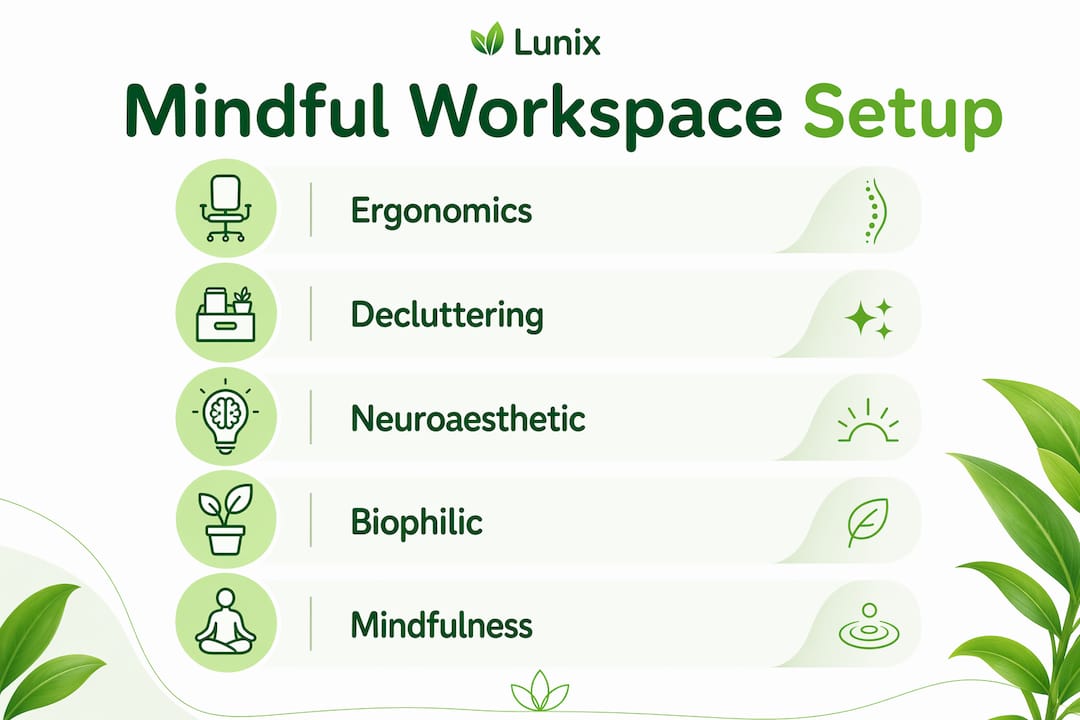
Neuroaesthetic design choices
Neuroaesthetic design shows that texture, color, pattern, and reflectivity each produce measurable emotional and physiological responses. Matte, warm-toned surfaces tend to calm, while high-gloss and cool-blue lighting tend to stimulate. These are not decorating preferences. They are sensory decisions that shape how your brain processes the space around you. Plan them from the start rather than treating them as an afterthought.
Here is a quick reference for the core elements your workspace needs:
| Element | Purpose | Example |
|---|---|---|
| Ergonomic seating | Reduces physical tension and distraction | Lumbar-support chair at correct height |
| Cable management | Lowers visual and psychological clutter | Desk grommets, velcro cable ties |
| Warm matte surfaces | Promotes calm emotional response | Wooden desk, linen desk pad |
| Natural or warm lighting | Supports focus and reduces eye strain | Adjustable LED with warm color temperature |
| Sound control | Reduces auditory distraction | Acoustic panels, white noise device |
| Air quality and scent | Supports cognitive clarity | Air purifier, subtle diffuser |
Which design choices promote sustained focus and relaxation?
The most effective mindful office design combines physical environment changes with daily behavioral practices. Neither works as well without the other.
Biophilic elements and their cognitive impact
Multisensory biophilic environments significantly reduce stress and improve cognitive performance during work. A study of 37 participants over eight weeks found lower stress ratings and better cognitive outcomes when natural elements were present across multiple senses. That means plants, natural textures, daylight, and even nature sounds all contribute. A single potted plant on your desk is a start. A workspace with layered natural elements, a wood surface, a small plant, and a window view, produces a meaningfully different cognitive environment.
Daily mindfulness routines that actually work
Brief mindfulness practices like a 10–15 minute morning meditation or 30–60 second STOP intervals improve attentional control and reduce tension in the jaw, neck, and shoulders. The STOP technique stands for Stop, Take a breath, Observe, and Proceed. It takes under a minute and resets your attention between tasks. These are not luxury habits. They are evidence-based tools that belong in your workday the same way a meeting schedule does.
Here are four daily practices that support a focused, calm work environment:
- Morning intention setting. Spend two minutes before opening any app to write down your top three priorities for the day. This primes your attention before distractions compete for it.
- STOP technique between tasks. Use the 30–60 second STOP method every time you switch from one project to another. It prevents attention residue from the previous task from bleeding into the next.
- Pomodoro single-tasking blocks. The Pomodoro technique uses 25–50 minute deep work segments to maintain attention and minimize cognitive load from fast task-switching. Set a timer, close unrelated tabs, and work on one thing only.
- Notification batching. Turn off all non-urgent notifications and check them at set intervals, such as 10:00 AM, 1:00 PM, and 4:00 PM. Constant interruptions fragment attention in ways that compound across the day.
Pro Tip: Use a physical object, like a specific mug or a small stone, as a focus activator. Place it on your desk only during deep work sessions. Your brain learns to associate it with concentrated effort, which makes entering a focused state faster over time.
Creating zones within your workspace
Not all work requires the same mental state. Deep writing demands quiet and low stimulation. Creative brainstorming benefits from slightly more sensory variety. If your space allows, designate a specific chair or corner for focused work and a different area for calls or planning. Even in a small room, a change in seating position signals a shift in cognitive mode.
How do you maintain a mindful workspace over time?
A calm workspace is not a one-time setup. It requires active, recurring maintenance to stay effective.
The “State Zero” ritual
Decluttering as a weekly ritual prevents the stress buildup associated with desk chaos. “State Zero” means returning your desk to its baseline cleared state at the end of each Friday. Every item goes back to its designated place. Papers get filed or discarded. The surface is wiped clean. You start Monday without the visual weight of last week’s unfinished business.
Common mistakes that undermine your setup
- Misusing focus activators. Focus activators used during low-focus tasks lose their effectiveness as psychological cues. Reserve them strictly for deep work.
- Overcrowding with wellness items. Too many plants, candles, and decorative objects create a new form of visual clutter. Each item should earn its place by serving a specific sensory or functional purpose.
- Treating setup as permanent. Your cognitive needs shift with seasons, projects, and life changes. Reassess your workspace layout every quarter and adjust accordingly.
Here is a maintenance schedule that keeps your workspace working for you:
| Frequency | Action | Why it matters |
|---|---|---|
| Daily | Clear desk surface at end of day | Prevents overnight clutter accumulation |
| Weekly | Full “State Zero” reset on Friday | Reduces Monday anxiety and cognitive load |
| Monthly | Audit sensory elements for overload | Prevents stimulation fatigue |
| Quarterly | Reassess layout and zone structure | Adapts space to evolving work needs |
What role does sensory design play in a mindful work environment?
Sensory design is the most underused lever in workspace planning. Most people focus on what their workspace looks like. The more powerful question is what it feels, sounds, and smells like.
Auditory and olfactory sensory inputs in workspaces are crucial to reducing cognitive fatigue and supporting attention regulation. Sound-masking systems, biophilic audio like recorded rainfall or birdsong, and subtle scent diffusion each contribute to a calming, focused environment. The key word is subtle. Overpowering scents or loud background music create their own form of distraction.
Here is how to address each sensory channel in your workspace:
- Visual: Use warm, matte surfaces and limit high-contrast decorative patterns near your primary work area. Position your monitor to avoid glare from windows.
- Auditory: Add a white noise machine or a low-volume nature soundscape to mask unpredictable background noise. Acoustic panels on walls reduce echo in hard-floored rooms.
- Tactile: Choose a desk pad with a soft texture. Use a keyboard with a keystroke feel that suits your preference. These small tactile choices reduce micro-tension in your hands and wrists.
- Scent: A diffuser with lavender or eucalyptus at low intensity supports calm without overwhelming the space. Avoid synthetic air fresheners, which can cause headaches with prolonged exposure.
- Lighting: Mimic natural light cycles with an adjustable LED lamp. Cooler light in the morning supports alertness. Warmer light in the afternoon eases the transition toward lower-intensity work.
“Modern workspaces benefit from providing varied sensory landscapes tailored to biological human needs, including low-sensory sanctuaries for deep focus and higher-sensory areas for collaboration and creative work. Designing for the full range of human senses is not a luxury. It is a prerequisite for sustained performance.” The ROI Of Sensory Office Design
For a deeper look at how healthy workspace examples translate these principles into real office settings, the patterns are consistent: sensory variety, physical comfort, and visual calm all appear together.
Key Takeaways
A mindful workspace combines ergonomic comfort, sensory design, and consistent behavioral rituals to produce lasting improvements in focus and well-being.
| Point | Details |
|---|---|
| Start with ergonomics and clutter | Fix physical comfort and remove visual noise before adding any wellness element. |
| Layer biophilic elements | Plants, natural textures, and daylight reduce stress and improve cognitive performance measurably. |
| Use mindfulness routines daily | The STOP technique and Pomodoro blocks are evidence-based tools, not optional extras. |
| Maintain with weekly rituals | A Friday “State Zero” reset prevents stress accumulation and starts each week with clarity. |
| Design for all five senses | Address sound, scent, light, texture, and visuals together for a fully supportive environment. |
What I’ve learned from building a workspace that actually works
The biggest mistake people make is treating workspace design as a one-time project. You buy the plant, arrange the desk, and expect the calm to hold. It doesn’t. What actually works is treating your workspace the way you treat your body: with regular attention and honest reassessment.
The combination that made the biggest difference for me was pairing sensory design with behavioral anchors. The physical environment sets the stage, but the daily rituals are what activate it. A beautiful, well-lit desk does very little if you open 12 browser tabs the moment you sit down. The STOP technique, the Pomodoro timer, and the Friday reset are what make the physical design actually function.
The other thing worth saying plainly: personalization matters more than perfection. A workspace that reflects your actual preferences, whether that means a specific scent, a particular plant, or a certain quality of light, creates a sense of ownership that generic “productivity setups” never achieve. You are more likely to maintain a space that feels like yours. And a maintained space is the only kind that delivers lasting results. For more on building mindfulness into daily stress relief, the behavioral side of this equation is just as worth investing in as the physical setup.
— Lunix
Recovery tools that support your mindful workspace
A well-designed workspace reduces daily stress, but your body still carries the physical cost of focused work. Tight shoulders, a stiff neck, and lower back tension are common after long sessions at a desk, no matter how good your ergonomic setup is.

Lunixinc designs recovery and wellness products built specifically for people who take their well-being seriously. From targeted muscle relief to comfort solutions that fit naturally into your end-of-day routine, these products complement the calm you build in your workspace by helping your body fully recover from it. When your physical recovery is consistent, your focus the next morning is sharper. That is the full picture of a mindful work life.
FAQ
What is a mindful workspace?
A mindful workspace is a physical environment designed to reduce distraction, support emotional regulation, and promote sustained focus through intentional ergonomic, sensory, and behavioral choices.
How do plants help with mindfulness at work?
Plants contribute to biophilic design, which research shows reduces stress and improves cognitive performance. Even a single plant on your desk adds a natural sensory element that supports a calmer mental state.
What is the Pomodoro technique and how does it support focus?
The Pomodoro technique structures work into 25–50 minute single-task blocks separated by short breaks. This approach maintains attention and reduces the cognitive load caused by constant task-switching.
How often should you reset your workspace?
A weekly “State Zero” reset, ideally every Friday, prevents stress-inducing clutter from accumulating and helps you start each week with a clear mental baseline.
What sensory elements matter most in a mindful office?
Lighting, sound control, and scent have the greatest impact on cognitive state. Warm adjustable lighting, low-level sound masking, and subtle natural scents each reduce cognitive fatigue and support sustained attention.