


TL;DR:
- Adults over 50 should prioritize annual wellness visits, medication reviews, and vaccinations to support healthy aging. They need consistent movement, nutritious diets, adequate sleep, stress management, and social engagement to maintain physical and mental well-being. Regular screenings, home safety checks, and advance directives are essential to prevent health crises and promote longevity.
If you’re 50 or older and want one clear plan to protect your health this year, here it is. This healthy aging checklist covers the six most important actions to take now, plus a full annual schedule you can bring to your next clinician visit.
Your six immediate actions:
- [ ] Book your Medicare Part B annual wellness visit (free, once per year)
- [ ] Write out every medication, supplement, and vitamin you take
- [ ] Schedule key screenings: blood pressure, cholesterol, colorectal, and bone density if due
- [ ] Start a weekly movement plan: regular moderate aerobic activity, combined with strength training sessions scheduled multiple times per week
- [ ] Confirm your vaccines are current: flu, shingles (Shingrix), Tdap, COVID booster
- [ ] Walk through your home for trip hazards, lighting gaps, and loose rugs
The CDC defines healthy aging as maintaining physical, mental, and social health across all areas of life, from nutrition and activity to sleep, social connection, and preventive care. Think of this checklist not as a one-time task but as a living plan you revisit each year.
Table of Contents
- Your complete healthy-aging checklist, organized by domain
- Preventive screenings and checkups: who needs what and how often
- Movement targets that actually protect you as you age
- Nutrition, sleep, stress, and social connection: the habits that compound
- Medication review, polypharmacy, and vaccines to confirm
- Home safety and fall prevention: a quick-sweep checklist
- Advance directives, emergency contacts, and digital organization
- Red flags: when to call 911 vs. schedule a visit
- Why these recommendations hold up: the evidence behind the checklist
- Key Takeaways
- What Lunix actually believes about healthy aging
- Lunixinc recovery products that support your checklist
Your complete healthy-aging checklist, organized by domain
Use this table as your master reference. Bring it to appointments, update it after each visit, and check off items as you complete them.
| Domain | Checklist Item | Frequency | Who to Involve |
|---|---|---|---|
| Medical | Annual wellness visit (Medicare Part B) | Yearly | PCP |
| Medical | Blood pressure check | Every visit or yearly | PCP |
| Medical | Cholesterol (lipid panel) | Every 4–6 years or as directed | PCP |
| Medical | Blood glucose / diabetes screening | Every 3 years (or yearly if at risk) | PCP |
| Medical | Colorectal cancer screening | Per provider guidance | PCP / GI |
| Medical | Bone density (DEXA) | Age 65 and older for women; earlier if clinically indicated | PCP |
| Medical | Vision exam | Every 1–2 years | Optometrist |
| Medical | Hearing assessment | Every 3 years after 50 | Audiologist |
| Medical | Dental cleaning and exam | regular intervals advised by your dental provider | Dentist |
| Medical | Mental health / depression screening | Yearly | PCP |
| Movement | 150 min moderate aerobic activity | Weekly | Self / PT |
| Movement | Strength training (all major muscle groups) | 2x/week | Self / PT |
| Movement | Balance and flexibility practice (tai chi, yoga) | Several days/week | Self / PT |
| Nutrition | Prioritize protein, fiber, whole foods | Daily | Self / dietitian |
| Nutrition | Limit refined carbs and ultra-processed foods | Daily | Self |
| Nutrition | Stay hydrated (water, not sugary drinks) | Daily | Self |
| Sleep | Keep a consistent wake time | Daily | Self / PCP |
| Stress & Mood | Light movement breaks during long sitting periods | Daily | Self |
| Stress & Mood | Daylight exposure and outdoor time | Daily | Self |
| Social & Cognitive | Weekly social check-in (call, class, volunteer) | Weekly | Self |
| Social & Cognitive | Mentally stimulating activity (reading, puzzles, learning) | Daily | Self |
| Home Safety | Remove trip hazards, secure rugs, improve lighting | Yearly or after any fall | Self / family |
| Home Safety | Install grab bars in bathroom | As needed | Contractor |
| Legal / Financial | Update advance directive, health care proxy, will | Every 3–5 years or after major life change | Attorney |
| Legal / Financial | Maintain current medication list and emergency contacts | Ongoing | Self / PCP |
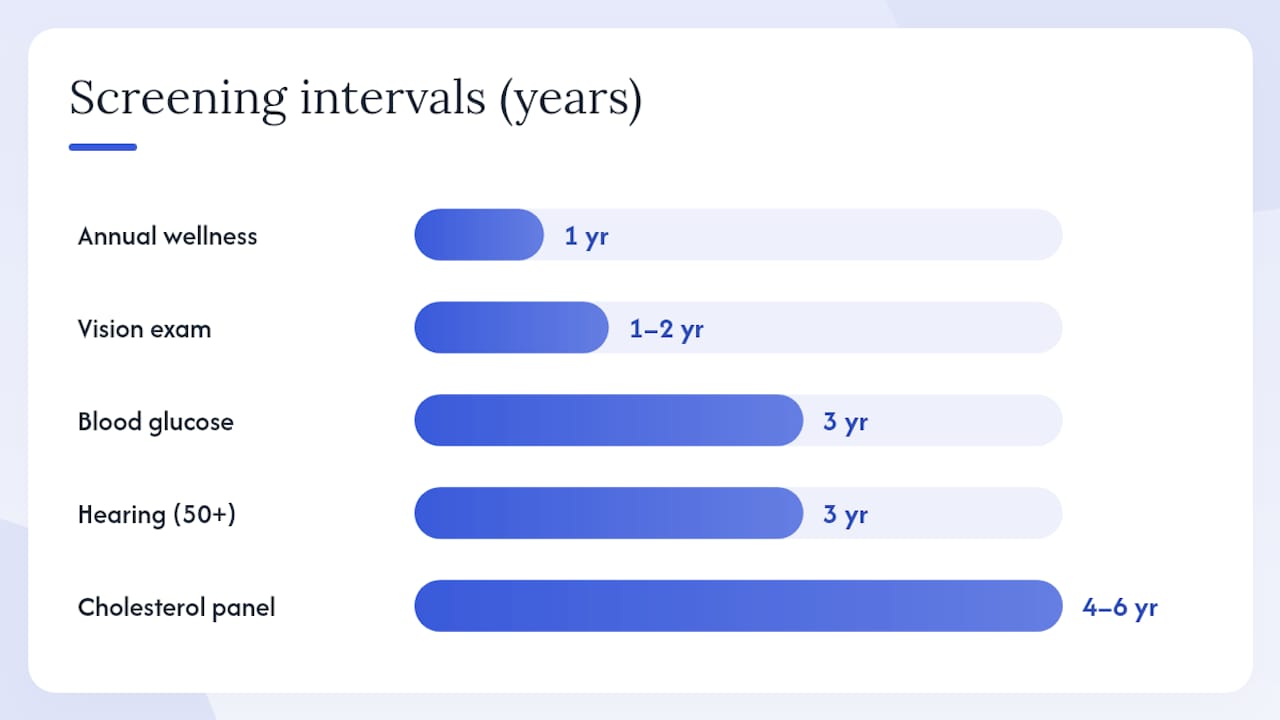
What to bring to every visit: your printed medication list (prescription, OTC, supplements), vaccine records, and two or three specific questions written in advance.
Preventive screenings and checkups: who needs what and how often
Screening schedules are not one-size-fits-all. Banner Health notes that some tests once considered routine may be unnecessary for certain older adults, while others remain critical. Your primary care provider (PCP) should guide the final call.
| Screening | Recommended Starting Age | Typical Frequency | Notes |
|---|---|---|---|
| Blood pressure | — | Every visit; at least yearly | Target under 130/80 for most adults |
| Cholesterol (lipid panel) | — | Every 4–6 years; more often if elevated | Adjust based on cardiovascular risk |
| Blood glucose / A1C | — | Every 3 years | Yearly if prediabetes or family history |
| Colorectal cancer | — | Per method: colonoscopy every 10 years; stool tests annually | Discuss options with PCP |
| Breast cancer (mammogram) | 40–50 | Every 1–2 years | Individualized by risk and preference |
| Bone density (DEXA) | 65 (women); earlier if risk factors | Every 2 years or as directed | Men: discuss at 70 or earlier if at risk |
| Prostate (PSA) | — | Discuss with PCP; not universally recommended | Shared decision-making required |
| Vision | 50+ | Every 1–2 years | More often with diabetes or glaucoma risk |
| Hearing | 50+ | Every 3 years | Sooner if you notice changes |
| Dental | All ages | regular intervals advised by your dental provider | Gum disease links to heart and diabetes risk |
| Depression screening | All adults | Yearly | PHQ-2 commonly used |
Medicare Part B payer note: Your free annual wellness visit under Medicare Part B is designed specifically for building a personalized prevention plan and reviewing medications. It is not a traditional physical exam, so you won’t get a head-to-toe clinical workup. Bring this checklist, your medication list, and your vaccine records. Use the visit to confirm which screenings are due and to request referrals for vision, hearing, or dental care.
The wellness visit is one of the most underused benefits in Medicare. Many adults skip it because they feel well, but that is exactly when it delivers the most value: catching gaps before symptoms appear.
Movement targets that actually protect you as you age
The numbers here come from Stanford Medicine’s 2026 healthy-aging guidance and align with Harvard Health’s five pillars of longevity. They are specific enough to plan around.
Weekly movement targets for adults 50+:
- Aerobic activity: 150 minutes of moderate intensity (brisk walking, swimming, cycling) or 75 minutes of vigorous intensity (jogging, aerobics) per week
- Strength training: All major muscle groups at least twice a week. Resistance bands, bodyweight exercises, and light dumbbells all count.
- Balance and flexibility: Several days per week. Tai chi, yoga, and simple single-leg stands are among the most accessible options.
- Daily movement breaks: Stand or walk briefly every 30–60 minutes during long sitting periods. This is not the same as your workout; it is a separate habit.
A note on cardiorespiratory fitness: Stanford’s guidance identifies maintaining cardiorespiratory fitness as one of the highest-impact actions for longevity in your 60s and 70s. You don’t need to run marathons. Consistent moderate aerobic activity, done most weeks, is what moves the needle.
Accessible activities worth trying: brisk walking in a neighborhood or mall, gardening (counts as moderate activity), chair exercises for those with mobility limits, water aerobics, and resistance band routines you can do at home. For joint-friendly options, see Lunixinc’s guide on keeping joints flexible and strong.
Pro Tip: If 150 minutes feels like too much to start, break it into 10-minute walks after meals. Three short walks a day, five days a week, gets you to 150 minutes. The consistency matters more than the session length.
For a deeper look at recovery between sessions, Lunixinc’s evidence-based physical recovery tips covers what to do on rest days.
Nutrition, sleep, stress, and social connection: the habits that compound
These four areas rarely get the same attention as screenings, but Harvard Health’s longevity research consistently shows that lifestyle pillars deliver more measurable benefit than single-target interventions. Here’s how to act on each one.
Nutrition
Older adults need more protein per pound of body weight than younger adults to preserve muscle mass, yet most eat less of it. Prioritize lean protein at every meal: eggs, fish, legumes, Greek yogurt. Pair that with high-fiber foods like whole-grain breads, beans, nuts, seeds, and deeply colored vegetables, which NIDDK recommends as cornerstones of healthy eating for older adults. Cut back on refined carbs and ultra-processed snacks, not because they are forbidden but because they crowd out the foods that actually support muscle, bone, and gut health.

Sleep
Aiming for adequate nightly sleep, focusing on consistency over exact duration. More important than the number, though, is a consistent wake time. Your body’s circadian rhythm anchors to when you wake up, not when you go to bed. If you’re struggling with sleep, start there before trying supplements or sleep aids. Common disruptors after 50: alcohol (even moderate amounts fragment sleep), late-day caffeine, and screen light within an hour of bedtime.
Stress and everyday movement
“Breaking up prolonged sitting with brief light activity meaningfully improves glucose and blood-pressure responses — and it’s one of the most underused stress-management tools available.” — Harvard Health
Most stress-management advice focuses on apps and breathing exercises. Those help, but daily movement breaks and outdoor time are more reliably effective for most people. A 10-minute walk after lunch does more for cortisol and mood than a 30-minute meditation session you never actually do.
Pro Tip: Daylight exposure in the first hour after waking resets your circadian rhythm and improves both mood and sleep quality. Step outside before checking your phone.
Social and cognitive engagement
Isolation is a genuine health risk, not just a quality-of-life issue. Weekly social contact, whether a class, a volunteer shift, or a standing phone call with family, protects cognitive function over time. For mental stimulation, learning something genuinely new (a language, an instrument, a craft) produces stronger cognitive benefits than familiar puzzles. For a structured approach to mental wellness, Lunixinc’s mental wellness checklist for adults 40–65 offers a practical companion guide.
Medication review, polypharmacy, and vaccines to confirm
Medication reconciliation
Mayo Clinic’s guidance on medication reconciliation is clear: bring every bottle to your review, including prescription drugs, over-the-counter medications, vitamins, and supplements. A pharmacist-led review can detect prescribing cascades, where a side effect of one drug leads to a second prescription to manage it, which then causes its own side effects. This cycle is common and often correctable.
Steps to complete your medication reconciliation:
- List every medication with its dose, frequency, and prescribing provider
- Include all OTC products: antacids, sleep aids, pain relievers, herbal supplements
- Ask your pharmacist or PCP: “Is everything on this list still necessary?”
- Ask specifically about deprescribing opportunities, especially for sleep aids, antacids, and pain medications taken long-term
- Update the list after every change and keep a copy in your wallet or phone
Vaccines for adults 50+
Consumer Reports’ senior health checklist and CDC guidance align on the core vaccines:
- COVID-19 booster: — Follow current CDC recommendations, which are updated seasonally
Bring your vaccine records to your annual wellness visit. Your PCP can order any missing vaccines or refer you to a pharmacy that carries them.
Home safety and fall prevention: a quick-sweep checklist
Falls are the leading cause of injury among adults 65 and older, and most happen at home. The good news: most fall risks are fixable in an afternoon.
Home safety sweep:
- Remove loose rugs or secure them with non-slip backing
- Clear walking paths of cords, clutter, and furniture with sharp corners
- Add nightlights in hallways, bathrooms, and staircases
- Install grab bars next to the toilet and in the shower (not towel bars, which pull out of walls)
- Check stair handrails for stability
- Wear supportive, non-slip footwear indoors. Socks on hardwood floors are a common fall cause.
- Move frequently used items to shelves between hip and shoulder height to avoid reaching or bending
When to get a physical therapy evaluation: A single fall, two or more near-falls in a year, new dizziness, or a medication change that affects balance are all reasons to request a PT referral. A physical therapist can assess your gait, strength, and balance in ways a standard office visit cannot. For structured guidance on fall prevention for older adults, Meddle offers practical balance and flexibility resources worth reviewing.
Pro Tip: Practice single-leg stands while brushing your teeth. Hold for 10 seconds per side, twice daily. It takes 4 minutes total and is one of the most evidence-supported balance exercises available.
Advance directives, emergency contacts, and digital organization
This section of the checklist gets postponed more than any other. It also delivers the most relief once it’s done, for you and for your family.
Legal and medical documents to complete or update:
- Advance directive (living will): Specifies your wishes for medical treatment if you cannot speak for yourself
- Health care proxy / medical power of attorney: Names the person authorized to make medical decisions for you
- Durable power of attorney: Covers financial decisions if you become incapacitated
- Will or trust: Review every 3–5 years or after any major life change
Where to find state-specific forms: The National Institute on Aging at NIH and MedlinePlus both link to state-specific advance directive forms. Your state’s bar association website is another reliable source.
Digital and practical organization steps:
- Store physical copies of all documents in a fireproof home safe or safe deposit box, and tell your proxy where they are.
- Give your health care proxy a copy of your advance directive.
- Set up a password manager (such as 1Password or Bitwarden) and document access instructions for a trusted person.
- Create a one-page emergency contact sheet: PCP name and number, pharmacy, insurance ID, and your proxy’s contact.
- Keep a current medication list in your wallet and on your phone.
- Document the location of key accounts (bank, insurance, retirement) for your designated person.
Many families face avoidable crises during health emergencies simply because no one knows where the documents are or how to access accounts. Completing this list once, then updating it annually, removes that burden entirely.
Red flags: when to call 911 vs. schedule a visit
Not every symptom needs an ER, but some do. Knowing the difference saves time and, in some cases, lives.
Call 911 immediately for:
- Chest pain or pressure, especially with shortness of breath or arm/jaw pain
- Sudden weakness or numbness on one side of the body
- Sudden slurred speech or confusion
- Severe shortness of breath at rest
- A fall with head injury or loss of consciousness
Schedule a same-week or urgent PCP visit for:
- New or noticeably worsening memory changes
- Unintentional weight loss of 10 or more pounds
- Recurrent falls or near-falls
- New or persistent dizziness
- New or worsening pain that limits daily activity
Pro Tip: When you call 911 or your clinic, have three things ready: your current medication list, the time symptoms started, and the name of your PCP. This information speeds triage and prevents medication errors in the ER.
For non-urgent symptoms, a message through your patient portal is often faster than a phone call and creates a documented record your care team can reference.
Why these recommendations hold up: the evidence behind the checklist
The targets and schedules in this checklist draw from a consistent set of authoritative sources. Here’s a compact reference.
| Recommendation | Source | Key Basis |
|---|---|---|
| 150 min/week moderate aerobic + strength 2x/week | Stanford Medicine (2026) | Cardiorespiratory fitness as high-impact longevity factor |
| Five pillars: movement, nutrition, sleep, stress, social connection | Harvard Health | Lifestyle pillars outperform single-target interventions |
| Screening schedule and vaccine timing | Consumer Reports senior health checklist | Compiled from CDC and clinical guidelines |
| Personalized screening decisions with PCP | Banner Health | Some screenings may be stopped; others remain critical |
| Medication reconciliation with pharmacist | Mayo Clinic | Prescribing cascade detection and deprescribing guidance |
| Healthy eating: fiber, protein, whole foods | NIDDK | Dietary guidance for older adults |
| Medicare Part B annual wellness visit | Consumer Reports / Medicare | Free yearly prevention planning visit |
Cardiorespiratory fitness and longevity: Stanford Medicine’s 2026 guidance identifies maintaining cardiorespiratory fitness as one of the single highest-impact actions for healthy aging in your 60s and 70s. Consistent moderate aerobic activity, not intensity, is the key variable.
This article provides general health information, not medical advice. Confirm current screening schedules, vaccine recommendations, and medication decisions with your primary care provider or a qualified health professional.
Key Takeaways
A complete healthy aging checklist for adults 50+ combines annual preventive screenings, consistent weekly movement, medication reconciliation, updated vaccines, and home safety steps into one living plan you revisit each year.
| Point | Details |
|---|---|
| Book your wellness visit first | The free Medicare Part B annual wellness visit is the fastest way to identify screening gaps and update your prevention plan. |
| Hit the movement targets | Aim for a target amount of moderate aerobic activity and two strength sessions per week; add balance practice several days a week. |
| Reconcile your medications | Bring every bottle (prescription, OTC, supplements) to a pharmacist or PCP review to catch prescribing cascades. |
| Complete advance directives | Update your health care proxy, advance directive, and emergency contact list, then store copies where your proxy can find them. |
| Lunixinc supports recovery | Lunixinc’s orthopedic pillows, percussion massagers, and compression devices help manage the soreness and sleep disruption that can derail consistent healthy-aging habits. |
What Lunix actually believes about healthy aging
Most healthy-aging content focuses on what you should add: more steps, more vegetables, more screenings. That framing is useful, but it misses something. The adults who sustain these habits long-term are usually the ones who have made recovery and comfort a non-negotiable part of their routine, not an afterthought.
There’s a tendency to treat soreness after exercise, poor sleep posture, or chronic hand and joint discomfort as things to push through. But those discomforts are often what cause people to skip workouts, sleep poorly, and gradually pull back from the physical activity that protects them most. The checklist items in this article are only as good as your ability to stick with them week after week.
Comfort is not a luxury in the context of healthy aging. It is a compliance tool. When your body recovers well, you show up for the next workout, the next walk, the next social commitment. That consistency is what the research actually measures when it finds that movement and sleep protect longevity.
Lunixinc recovery products that support your checklist

Sticking to a healthy-aging checklist is easier when your body feels supported between efforts. Lunixinc’s recovery collection includes orthopedic wedge pillow sets designed to improve sleep posture and reduce nighttime discomfort, heated air compression hand massagers for joint pain and circulation, percussion massagers for post-exercise muscle recovery, and infrared sauna blankets for deep relaxation and stress relief.
Each product is built for adults who take their well-being seriously and want tools that fit into a real daily routine, not a spa visit. If soreness after strength training, poor sleep quality, or hand and joint stiffness are getting in the way of your checklist goals, these are practical supports worth considering. Browse the full recovery and comfort lineup and find what fits your routine.
Lunixinc is a wellness e-commerce brand. This article is educational; product mentions reflect our own offerings.
Authoritative sources and further reading
- Healthy Aging at Any Age (CDC) — Foundational overview of the physical, mental, and social dimensions of healthy aging; useful starting point for understanding the full scope of preventive care.
- Health Tips for Older Adults (NIDDK) — Practical dietary and physical activity guidance from the National Institute of Diabetes and Digestive and Kidney Diseases, including fiber and protein recommendations for older adults.
- Healthy Aging (MedlinePlus) — NIH’s consumer health portal with links to state-specific advance directive forms, screening guides, and condition-specific resources.
- Healthy Habits for Successful Aging (Stanford Medicine, 2026) — Stanford’s evidence summary on cardiorespiratory fitness, strength training, and longevity for adults in their 60s and 70s.