


Short answer: yes, for many people. When red or near-infrared light is delivered at evidence-based doses and paired with stretching and load management, it reduces heel pain and improves function for people with plantar fasciitis. The catch is dosing. Device parameters and treatment schedules vary widely, and results depend on getting those details right, along with basic safety checks before you start.
TL;DR:
- Effective doses for red light therapy typically involve around 10 J/cm2 delivered over nine sessions within three weeks, with wavelengths of 800 to 980 nm.
- Clinical evidence shows significant pain and function improvements when PBMT is combined with stretching, load management, and supportive footwear.
- Proper protocol transparency, including specific wavelength and energy density, is crucial, as vague claims lack scientific support.
- Safety considerations include avoiding treatment during active malignancy or with photosensitizing medications, and consulting a doctor if systemic symptoms develop.
- Home devices designed for foot-specific targeting and consistent schedules generally offer better cost-efficiency and adherence for long-term management.
Table of Contents
- How Red Light Therapy Works on the Plantar Fascia
- What Does the Research Say About Red Light Therapy for Plantar Fasciitis?
- What Are the Typical Dosing Parameters for Plantar Fasciitis?
- How Do You Use Red Light Therapy for Plantar Fasciitis?
- Is Red Light Therapy Safe for Plantar Fasciitis?
- Combining Red Light Therapy With Stretching and Load Management
- Choosing a Home Device: What the Specs Actually Mean
- Is PBMT a Cure or Just Part of the Plan?
- Ready to Try Red Light Therapy at Home?
- Sources
How Red Light Therapy Works on the Plantar Fascia
Photobiomodulation therapy (PBMT), sometimes called low-level laser therapy (LLLT), works at the cellular level. Red and near-infrared light gets absorbed by mitochondria in your cells, which boosts ATP production, the energy currency your tissue needs to repair itself. That extra energy supports collagen synthesis in the fascia, calms down inflammatory signaling, and improves microcirculation to the area, which matters because the plantar fascia has notoriously poor blood supply on its own.
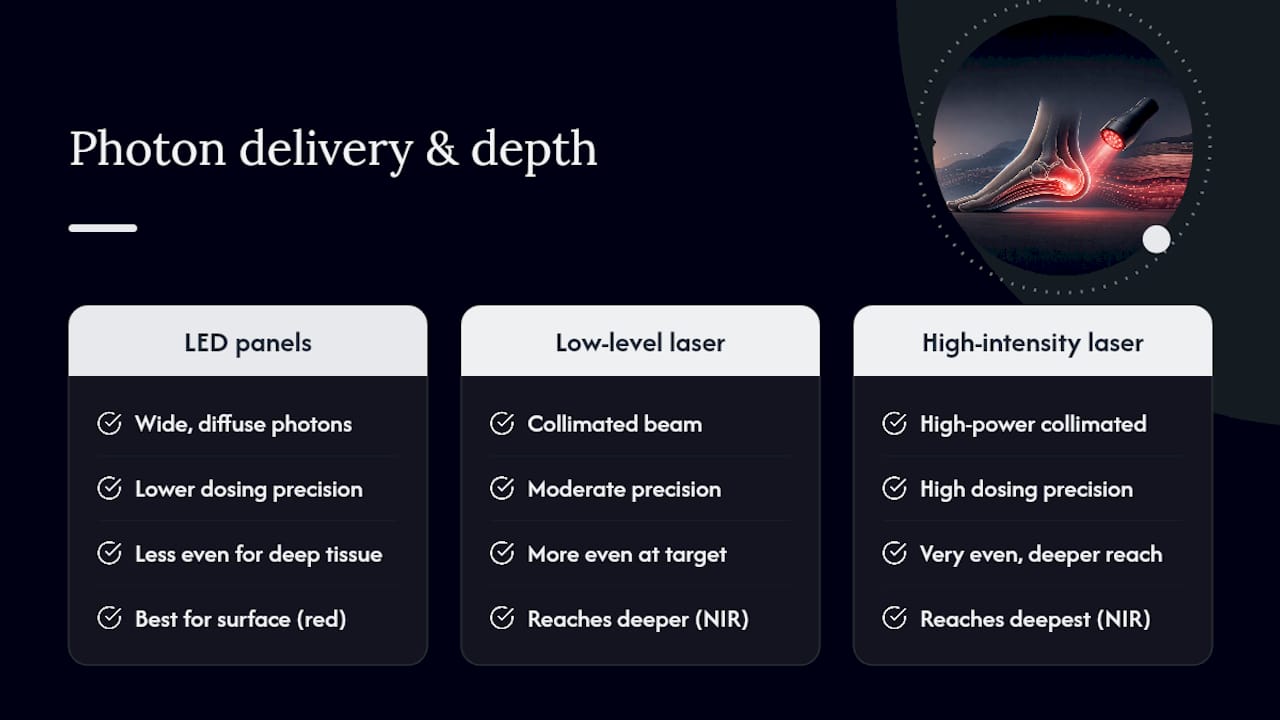
Wavelength determines how deep the light actually travels. Near-infrared light in the roughly 810 to 980 nm range penetrates deeper structures like tendon and fascia, while visible red light stays closer to the surface, useful for skin, but less so for a fascia band buried under fat pad and connective tissue. Device classes matter too. LED panels, low-level lasers, and high-intensity lasers all deliver photons differently, which affects how evenly light reaches the treatment site and how much dosing precision you get.
What Does the Research Say About Red Light Therapy for Plantar Fasciitis?
The clinical evidence here is stronger than for many wellness modalities you’ll find marketed online. A 2019 meta-analysis of six randomized controlled trials found LLLT significantly relieved heel pain, with benefits lasting up to three months post-treatment. That’s not a fluke result; it’s a pooled analysis across multiple independent trials.
More recent research builds on that foundation. A 2023 meta-analysis covering 1,089 patients found PBMT/LLLT outperformed placebo for pain and functional outcomes, with some pooled comparisons showing better results than extracorporeal shockwave therapy. A randomized trial pairing PBMT with usual care delivered nine sessions over three weeks at a standardized 10 J/cm2 dose per area. Pain scores dropped substantially on a standard scale, a shift usual care alone did not approach, and the improvement held through six months.
Not every trial shows a clean win. A study comparing LED to sham treatment found no difference between groups, but both arms also received friction massage and stretching, which likely masked any modality-specific effect. This points to a real limitation in the research:
- Dosing reporting is inconsistent across studies, with wavelength, power, and session time often poorly documented.
- Sample sizes in individual RCTs tend to be small, which limits how confidently you can generalize any single trial’s numbers.
- Combined interventions (manual therapy plus light therapy) make it harder to isolate what the light itself is doing.
The practical takeaway: favor protocols and devices that report their wavelength and J/cm2 clearly, since vague marketing claims are exactly where the evidence gets shaky.
What Are the Typical Dosing Parameters for Plantar Fasciitis?
Trial data gives you real numbers to check a device or clinic protocol against, rather than guessing.
- Energy density: many successful trials used around 10 J/cm2 delivered per treated area, a figure worth asking about directly.
- Session count: nine sessions spread across three weeks is a common protocol in the research showing sustained benefit.
- Wavelength: 800 to 980 nm is the range associated with adequate penetration to reach the plantar fascia, since skin and fat pad thickness both affect how far light travels.
- Power and time trade-off: the same J/cm2 dose can be reached at higher power for less time or lower power for longer, so a device’s stated power output alone tells you little without knowing session duration.
If a device or clinic can’t tell you the wavelength or energy density they’re using, that’s a red flag worth taking seriously. Vague language like “clinical grade” or “maximum strength” without numbers behind it isn’t a specification, it’s marketing.
How Do You Use Red Light Therapy for Plantar Fasciitis?
Treatment targets a few specific spots: the calcaneal insertion (where the fascia attaches to your heel bone), the medial band of the plantar fascia, and sometimes the lower calf if tightness there is contributing to your symptoms. Most protocols have you sit with your foot positioned so the device sits in direct contact with or closely spaced above the skin, since distance affects how much energy actually reaches the tissue.
Session templates from trials typically run a set number of minutes per targeted area, three times weekly for around three weeks, though some home protocols use gentler daily sessions instead. Clinic treatment gives you supervised, consistent dosing from a trained operator. A home device trades some of that precision for convenience and lower long-term cost, especially if you’re managing a condition that takes months to resolve.
- Confirm the device lists wavelength and J/cm2, not just “power” in vague terms.
- Check that session length and frequency match published protocols.
- Ask whether the operator (if using a clinic) has documented training with the device.
Pro Tip: Keep a simple pain log using a 0 to 10 scale before and after each session for the first two weeks. It’s the easiest way to tell whether your specific protocol is actually working before you commit months to it.
Is Red Light Therapy Safe for Plantar Fasciitis?
Clinical trials on PBMT for musculoskeletal conditions report few serious adverse events, with the most common side effects being transient warmth or mild discomfort at the treatment site, usually nothing that lingers.
Still, a few situations call for a conversation with your doctor first:
- Active malignancy at or near the treatment site.
- Use of photosensitizing medications, which can change how your skin reacts to light exposure.
- Pregnancy, where caution is generally advised for any new treatment near the lower body.
If you notice progressive numbness, rapidly worsening pain, or any systemic symptoms like fever, stop and get evaluated promptly, ideally with imaging and a podiatry or orthopedics referral. A resource on red light therapy contraindications is worth a look if you have a complicating medical history.
Combining Red Light Therapy With Stretching and Load Management
The strongest trial results came from PBMT paired with usual care, not light therapy used in isolation. A basic home program built around daily calf and plantar fascia stretches, paired with the causes of your specific flare-up, gives the light therapy something to work with rather than fighting inflammation alone.

Supportive footwear, orthotic inserts, and gradually reintroducing activity (rather than jumping back into running mileage) all matter here. Track your pain on a 0 to 10 scale weekly. Most people see early pain reduction within a few weeks, with functional improvements, like walking distance without discomfort, building over one to three months.
Choosing a Home Device: What the Specs Actually Mean
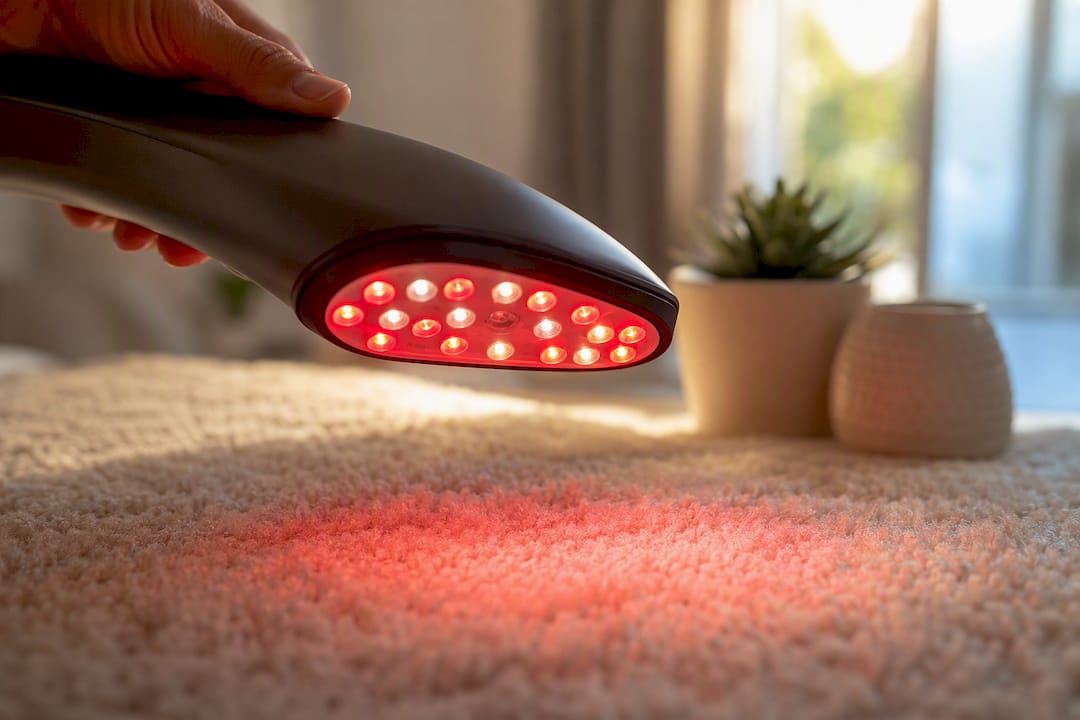
Wavelength tells you how deep the light reaches; power and J/cm2 tell you the dose delivered per session, the same variables the clinical trials tracked. The LX24 Red Light Foot Pain Relief Device is built specifically for foot contact and positioning, while the Lunix LX19 targets broader joint areas for people managing pain beyond the foot. Both are designed around a consistent home-use schedule rather than one-off sessions. If you’re weighing ongoing session costs against owning a device, that math usually favors home ownership for a chronic condition like plantar fasciitis.
Is PBMT a Cure or Just Part of the Plan?
PBMT is a genuine, evidence-backed accelerant for healing, not a standalone cure. The trials that show the best outcomes paired it with stretching and rehab, not light alone. If your pain isn’t improving after a few weeks of consistent, properly dosed use, or if something feels off beyond typical soreness, talk to a podiatrist rather than pushing through it solo.
— Lunix
Ready to Try Red Light Therapy at Home?
If you’ve read this far, you already know the difference between a device with real specs and one riding on vague marketing language. That’s exactly where the LX24 earns its place: it’s built around foot-specific positioning and a consistent home schedule, so you’re not improvising contact angles with a general-purpose panel.

A quick honest note first: if your pain is severe, rapidly worsening, or paired with numbness, see a clinician before starting any home protocol. For the ongoing, adjunctive care that most plantar fasciitis recovery actually requires, a home device saves you the recurring cost of clinic visits while keeping your sessions consistent. Visit Lunix to see how the LX24 fits into your recovery routine and get the details you need before your first session.
Sources
- Photobiomodulation therapy plus usual care RCT (PMC)
- 2023 meta-analysis of PBMT for plantar fasciitis
- Low-Level Laser Therapy meta-analysis (2019)
This article is general information, not a substitute for advice from a qualified doctor. Consult a qualified healthcare professional about your own circumstances before acting on anything here.