


Elevating your legs above heart level reduces swelling by helping fluid drain back toward the heart instead of pooling in your ankles and feet. Do it for a session of roughly half an hour multiple times per day. You’ll likely notice less puffiness within that same session. It’s a genuinely useful, low-risk habit for everyday leg heaviness. But if one leg suddenly swells more than the other, or you notice new warmth, redness, or pain, stop and get checked out. That pattern can point to a blood clot, not simple fluid buildup.
TL;DR:
- Elevating legs above heart level reduces hydrostatic pressure, aiding fluid drainage primarily for swelling caused by gravity-dependent fluid buildup.
- Proper technique involves supporting the entire calf and heel, keeping heels higher than the chest, and avoiding pressure on the back of the knee for at least 30 minutes per session.
- Elevation effectively relieves everyday swelling from travel, long standing, or pregnancy but is less useful for swelling from systemic conditions or advanced lymphedema.
- Combining elevation with compression stockings and regular movement enhances treatment, especially for chronic venous insufficiency or lymphedema management.
- Elevation is unsafe for sudden, one-sided swelling with warmth or pain, or if signs of blood clots or arterial disease are present, requiring immediate medical attention.
Table of Contents
- Why Elevation Reduces Leg Swelling
- When Leg Elevation Actually Helps
- How to Elevate Your Legs Correctly
- Elevation Works Best as Part of a Bigger Routine
- When to Skip Elevation and Call a Doctor
- Our Take: Comfort Beats Extreme Positioning
- A Wedge Built for Consistent Elevation
- Sources
- FAQ
Why Elevation Reduces Leg Swelling
Gravity is working against your legs all day long. Every time you stand or sit with your feet on the floor, blood has to fight its way back up to your heart through veins that rely on one-way valves and muscle contractions to keep it moving. When that system slows down, even a little, fluid seeps out of small blood vessels and settles into the surrounding tissue. That’s swelling, medically known as edema.
Your calf muscles normally act like a second heart for your lower legs. Every step squeezes the deep veins and pushes blood upward, a mechanism doctors call the calf muscle pump. Sit still for hours on a plane or at a desk, and that pump goes idle. Blood pressure inside your leg veins, known as hydrostatic pressure, climbs, and fluid gets pushed out into the tissue faster than your lymphatic system can clear it.
Raising your legs above heart level flips the physics in your favor. Gravity now helps venous blood flow home instead of fighting it, hydrostatic pressure drops, and your lymphatic system gets a chance to catch up on drainage.
That said, elevation only helps swelling caused by gravity and fluid mechanics. It won’t do much for:
- Edema from heart, kidney, or liver disease, which involves whole-body fluid retention rather than local pooling
- Swelling tied to an infection or inflammatory condition
- Lymphedema in advanced stages, where the drainage channels themselves are damaged
Knowing which category you’re in shapes how much benefit you can realistically expect.
When Leg Elevation Actually Helps
Elevation earns its keep in a handful of everyday situations. If you deal with chronic venous insufficiency, where leg vein valves have weakened over time, elevating your legs regularly is a core part of managing symptoms alongside other measures, according to the MSD Manual. Mild post-surgical swelling after foot, ankle, or knee procedures also responds well. Pregnancy-related swelling, especially in the third trimester, tends to ease with regular elevation breaks. And anyone who’s sat through a long flight or stood all day at work knows the relief that comes from finally putting their feet up.
It helps to separate two different jobs elevation does:
- Symptom relief: for travel swelling, a long shift on your feet, or pregnancy discomfort, elevation is often enough on its own to bring puffiness down for the day.
- Part of ongoing management: for venous insufficiency or lymphedema, elevation works best combined with compression, movement, and sometimes medication, not as a standalone fix.
Watch for signs that push your situation past simple self-care. Swelling in only one leg, skin that’s suddenly warm or discolored, pain that doesn’t match how much swelling you see, or swelling paired with shortness of breath all warrant a call to your doctor rather than a pillow under your feet.
How to Elevate Your Legs Correctly
Technique matters more than most people assume, and getting it right is the difference between real relief and thirty wasted minutes.
- Get your heels above heart level. Lie on your back and prop your legs up until your heels sit higher than your chest. This is the position that actually shifts hydrostatic pressure in your favor, according to nursing positioning guidance.
- Support the whole calf and heel, not just the ankle. A single thin pillow under your ankle can create a pressure point and actually restrict blood flow. Stack pillows or use a wedge that cradles the calf evenly.
- Keep pressure off the back of your knee. The popliteal fossa, that soft hollow behind your knee, houses major blood vessels. A rolled towel or firm pillow edge pressed into that spot can pinch circulation instead of helping it. Allow a slight bend in the knee for comfort.
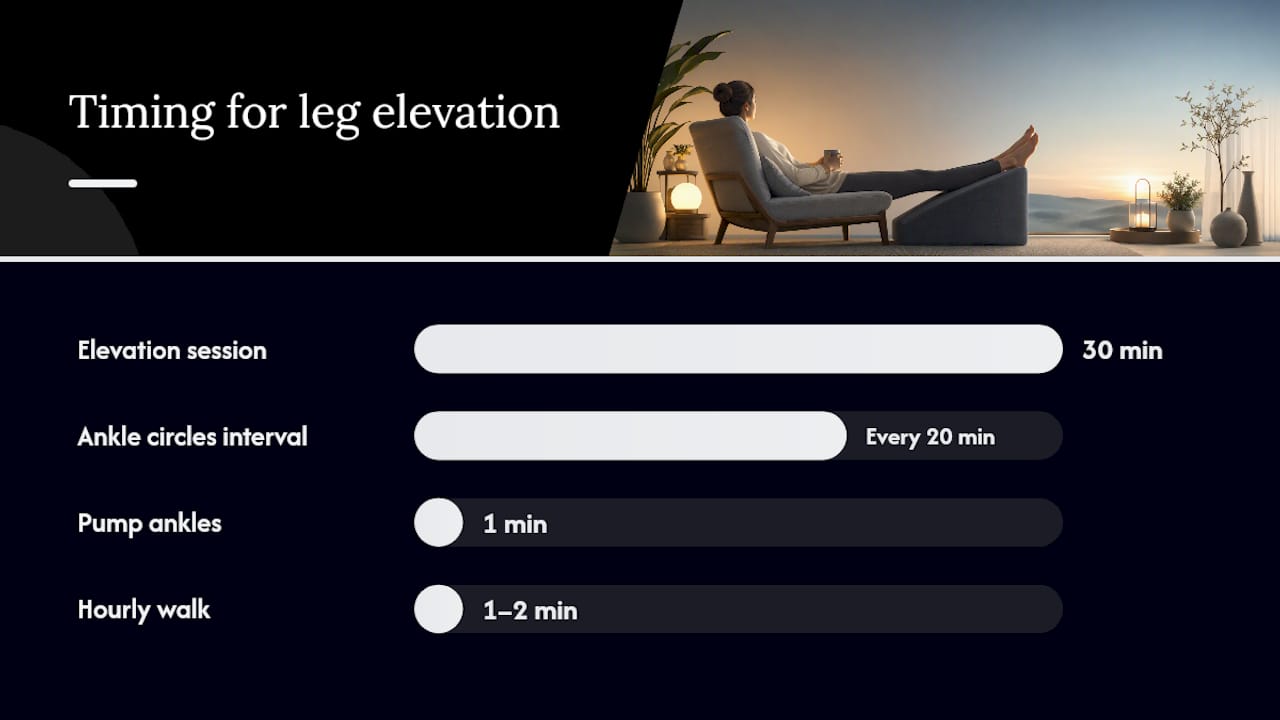
- Hold the position for 30 minutes or longer. Clinical guidance generally points to sessions of half an hour or more, repeated multiple times daily, rather than one marathon session.
- Pump your ankles before and after. Flexing your feet up and down for a minute engages the calf muscle pump and helps move fluid before gravity takes over.
If you’re stuck at a desk or on a plane, you don’t need a full recliner setup. Prop your feet on a bag or footrest for micro-breaks, do seated ankle circles every 20 minutes, and stand up to walk for a minute or two each hour.
Pro Tip: Higher isn’t better. A 2020 study on postoperative ankle fracture patients found that raising the leg dramatically above heart level did not reduce swelling more than a moderate elevation, but it did cause noticeably more discomfort. Comfortable and consistent beats extreme and abandoned after ten minutes.
Elevation Works Best as Part of a Bigger Routine
Elevation alone rarely solves persistent swelling. It’s one piece of a management approach that clinical guidance consistently pairs with a few other habits.
Compression stockings apply graduated pressure, tighter at the ankle, looser going up the leg, which helps prevent fluid from re-pooling the moment you stand back up. Fit matters here: a poorly fitted stocking can bunch behind the knee or dig into your calf, undoing the benefit. Movement matters just as much. Short walks and ankle pumps reactivate your calf muscle pump, and inactivity is one of the biggest drivers of gravity-dependent swelling in the first place. On the lifestyle side, cutting back on sodium reduces the amount of fluid your body retains overall, and maintaining a healthy weight eases pressure on leg veins. For some patients, a doctor adds a diuretic or other medication when lifestyle measures alone aren’t enough.
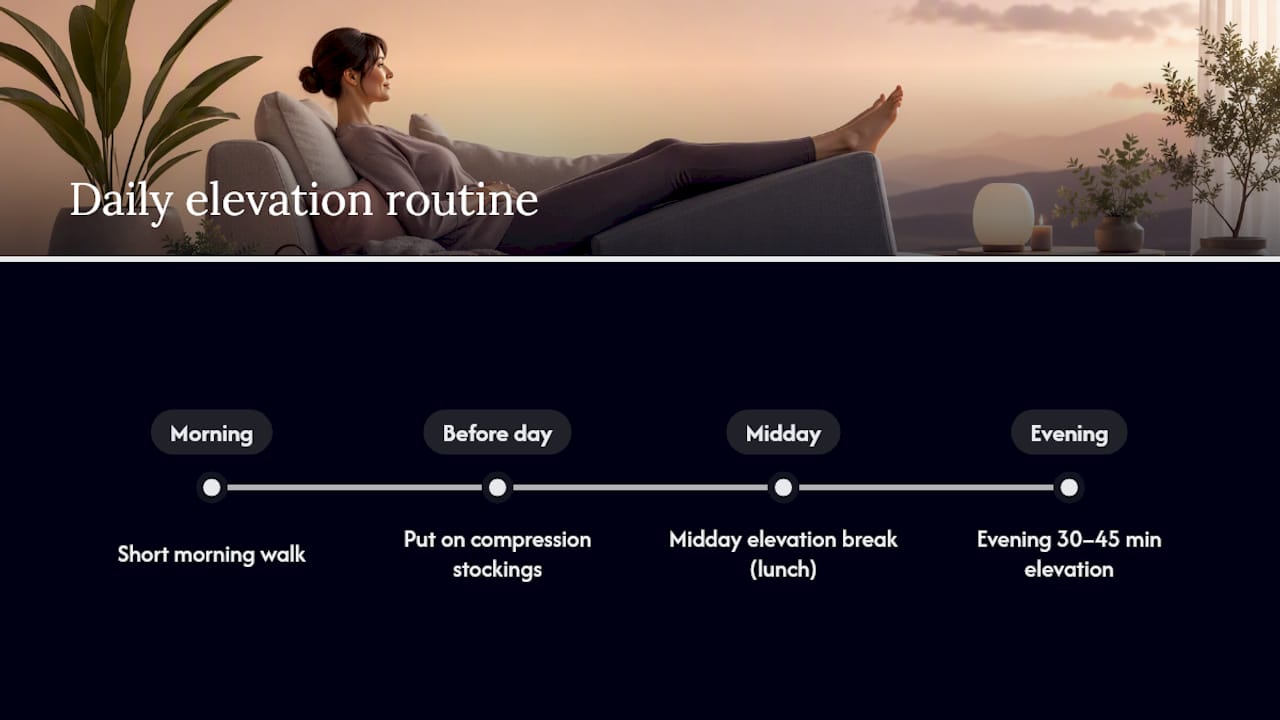
A realistic daily routine might look like this: a short walk in the morning, compression stockings on before you’re upright for long stretches, a midday elevation break during lunch, and a longer 30 to 45-minute elevation session in the evening while you catch up on reading or a show. Small, natural ways to support circulation throughout the day add up more than one long session ever will.
When to Skip Elevation and Call a Doctor
Elevation is safe for the vast majority of everyday swelling, but it’s not universally appropriate, and knowing the exceptions matters.
Sudden swelling in just one leg, especially with new warmth, redness, tightness, or pain that seems out of proportion to what you see, needs urgent medical attention. This combination can signal a deep vein thrombosis, and elevating or massaging a leg with a suspected clot can be harmful rather than helpful. Shortness of breath alongside leg swelling is another combination that belongs in an emergency room, not on a pillow at home.
Peripheral arterial disease (PAD) flips the usual advice. Poor arterial blood flow means the leg already isn’t getting enough oxygen-rich blood, and raising it above heart level can reduce that inflow further. Cool skin, pale color, and weak or absent pulses in the foot are signs worth mentioning to a doctor before you start any elevation routine.
According to Cleveland Clinic, sudden or one-sided swelling should always prompt evaluation rather than a home remedy. Nursing protocols also call for reassessing circulation after any positioning change, checking skin color, warmth, and pulse to confirm the leg is tolerating the position well.
Our Take: Comfort Beats Extreme Positioning
Most advice on leg elevation focuses on hitting the “perfect” angle, as if a few extra inches of height unlock dramatically better results. The research doesn’t back that up. The 2020 study on postoperative ankle swelling found no real difference in swelling reduction between high and low elevation, but people in the high-elevation group reported more discomfort. That’s a meaningful finding, because discomfort is exactly what makes someone quit after two days instead of building elevation into a lasting habit.
It is believed that adherence, not angle, is the variable worth optimizing. A support that holds your calf and heel steady without extreme height, and without digging into the back of your knee, is what actually gets used night after night. Choose stability and comfort over chasing a few extra degrees.
— Lunix
A Wedge Built for Consistent Elevation
A stack of couch pillows slides apart within ten minutes, which is usually about the time your legs actually need to stay elevated. That’s the gap Wedge pillow sets are designed to provide a fixed incline that keeps calves and heels supported at a steady height, night after night, without needing repositioning after shifting.

The LX8 two-layer orthopedic wedge uses high-density foam to hold its shape under sustained use, comes with a washable cover, and includes a hot and cold pack pocket if you want to combine elevation with temperature therapy for extra comfort. When picking a wedge, match the angle to what you can hold comfortably for a full 30 minute session rather than the steepest option available, and keep using compression stockings or your physician’s guidance alongside it if you’re managing venous insufficiency. Browse the full wedge pillow sets collection to find the angle and size that fits your bed and your routine, and if circulation support is your main goal, the leg massagers collection pairs well with elevation for added relief.
This article is general information, not a substitute for advice from a qualified doctor. Consult a qualified healthcare professional about your own circumstances before acting on anything here.
Sources
- Effect of Leg Elevation Height on Reduced Swelling of Patients of Postoperative Acute Ankle Fractures
- Edema: Causes, Symptoms & Treatment (MedlinePlus)
- Edema: Causes, Symptoms & Treatment (Cleveland Clinic)
- Leg elevation for venous return and dependent oedema (NurseOnShift)
FAQ
How long should you elevate a swollen leg?
Aim for at least 30 minutes per session, repeated several times throughout the day, rather than one extended stretch.
What is the correct way to elevate your legs to reduce swelling?
Lie down and raise your legs so your heels sit above heart level, supporting the entire calf and heel while keeping pressure off the back of your knee.
When you elevate your legs, where does the fluid go?
Raising your legs lowers pressure in the leg veins, letting pooled fluid drain back through the venous system and lymphatic vessels toward the heart instead of settling in your ankles and feet.
How long does it take for swelling to go down with elevation?
Many people notice visible improvement within a single 30 minute session, though swelling from chronic conditions like venous insufficiency usually returns unless elevation is repeated daily alongside compression and movement.