


A wedge pillow qualifies for HSA payment only when you use it primarily to treat or mitigate a diagnosed medical condition, not just for extra comfort. You need documentation to back that up, ideally a Letter of Medical Necessity from your doctor, plus an itemized receipt you keep on file. A store labeling a product “HSA eligible” or letting your HSA card go through at checkout does not guarantee approval; your plan administrator and, ultimately, the IRS set the real standard.
TL;DR:
- Only wedge pillows used primarily for diagnosed conditions like GERD or post-surgical recovery qualify for HSA reimbursement with proper documentation.
- A Letter of Medical Necessity must specify the diagnosis, how the pillow treats it, and include clinician details for the claim to be approved.
- The IRS does not approve products based on store labels; the medical purpose and supporting evidence are what determine eligibility.
- Using HSA funds without documentation can lead to taxes and penalties if the claim is later rejected.
- Pricing varies depending on features, but claims for higher-cost medical-grade wedges are stronger if justified by documentation.
Table of Contents
- Is a Wedge Pillow HSA Eligible Under IRS Rules?
- Which Medical Conditions Commonly Justify Wedge Pillow Use?
- What Documentation Do You Need for Reimbursement?
- How Do You Pay for a Wedge Pillow With HSA Funds?
- What Does a Wedge Pillow Cost, and How Should You Budget for It?
- Do Different Wedge Pillow Types Qualify Differently for HSA Use?
- How Do You Choose a Retailer for an HSA-Eligible Wedge Pillow?
- Lunix’s Perspective on Designing for Documented Medical Use
- Ready to Buy? Here’s How Lunix Fits the Documented Path
- Where to Verify HSA Eligibility Rules Yourself
- Sources
- FAQ
Is a Wedge Pillow HSA Eligible Under IRS Rules?
The IRS doesn’t publish a simple approved list for HSA purchases. Instead, Section 213(d) defines medical care as costs for the “diagnosis, cure, mitigation, treatment, or prevention of disease,” and everything else gets measured against that standard. Publication 502 spells out examples of what counts and what doesn’t, drawing a hard line between items bought for general health and items bought to address a specific, diagnosed problem.
Publication 969 applies that same 213(d) definition to HSAs specifically, with one added wrinkle: the expense has to happen after your HSA is actually open. Buy the pillow the week before you open the account, and it doesn’t count, no matter how solid your paperwork is later.
This is where the “but-for” test comes in. An IRS information letter explains that an ordinarily personal item, like a pillow, can still qualify if it’s used primarily to treat an illness or affect a body function, and if you can show you wouldn’t have bought it but for that condition. The letter also notes something practical: if a specially designed medical version of an item costs more than the regular version, that excess cost is often what’s deductible, not necessarily the whole price.
A few things worth remembering before you check out:
- Merchant “FSA/HSA eligible” tags are a convenience label, not an IRS ruling.
- Your card going through at point of sale doesn’t mean the expense survives a later audit.
- Employers and third-party administrators can request substantiation any time after the purchase, sometimes months later.
The real test isn’t what the checkout screen says. It’s whether you can prove, on paper, that the pillow treats a diagnosed condition.
Which Medical Conditions Commonly Justify Wedge Pillow Use?
Four situations come up again and again when people ask a clinician for wedge pillow documentation, and each one has its own logic.
- GERD and acid reflux. Elevating the upper body 6 to 8 inches while lying down reduces how often stomach acid backs up into the esophagus. A gastroenterologist’s note describing nocturnal reflux and recommending elevation therapy is strong support.
- Positional therapy for sleep apnea. A wedge is usually an adjunct here, not a standalone treatment, so documentation should describe it as part of a broader plan, sometimes alongside CPAP. Our breakdown of positional therapy walks through when elevation actually helps.
- Post-surgical recovery. Surgeons frequently prescribe elevated sleep after abdominal, cardiac, or orthopedic procedures to reduce swelling and pressure. Discharge instructions that specify elevation angle and duration double as useful proof.
- Chronic back pain. Elevation that reduces pressure on the lower spine can qualify, but this is the category where clinicians most often need to be specific about diagnosis, since “back pain” alone is vague.
Pro Tip: Ask your clinician to write “medically necessary for [condition]” rather than “recommended for comfort.” That single phrase change is often the difference between a claim that gets approved and one that gets kicked back.
What Documentation Do You Need for Reimbursement?
A Letter of Medical Necessity is the backbone of a strong claim, and generic wording won’t cut it. The strongest LMNs, following FSAFEDS guidance, include five specific elements:
- The diagnosis, ideally with an ICD-10 code.
- The specific item, named as “wedge pillow” with dimensions if possible.
- How the item treats the condition (for example, “requires 6 to 8 inches of elevation while supine to reduce nocturnal reflux episodes”).
- The expected duration of use, such as “nightly for 6 months.”
- The clinician’s signature, printed name, NPI number, and contact information.
If getting a full LMN isn’t practical, a prescription, a discharge summary, or post-operative instructions can sometimes work alone or combined with a shorter physician note.
Retain the itemized invoice and the LMN together for at least three years. Auditors typically expect the account holder, not the clinician’s office, to produce both documents on request.
Store both files somewhere durable, a cloud folder or a labeled physical folder works, and don’t rely on your credit card statement as your only record. A statement shows you spent money; it says nothing about what you bought or why. If your TPA follows up asking for more detail, respond promptly with the same LMN and receipt rather than a fresh explanation, since consistency matters more than eloquence.
How Do You Pay for a Wedge Pillow With HSA Funds?
You have two paths, and neither one is automatically safer than the other. Swiping your HSA debit card at checkout is faster, but it puts the burden entirely on you to keep documentation in case your TPA asks later, sometimes long after the purchase. Paying out of pocket and filing a reimbursement claim afterward feels slower, but it forces you to assemble your LMN and itemized receipt before you ever submit anything, which tends to produce cleaner paper trails.
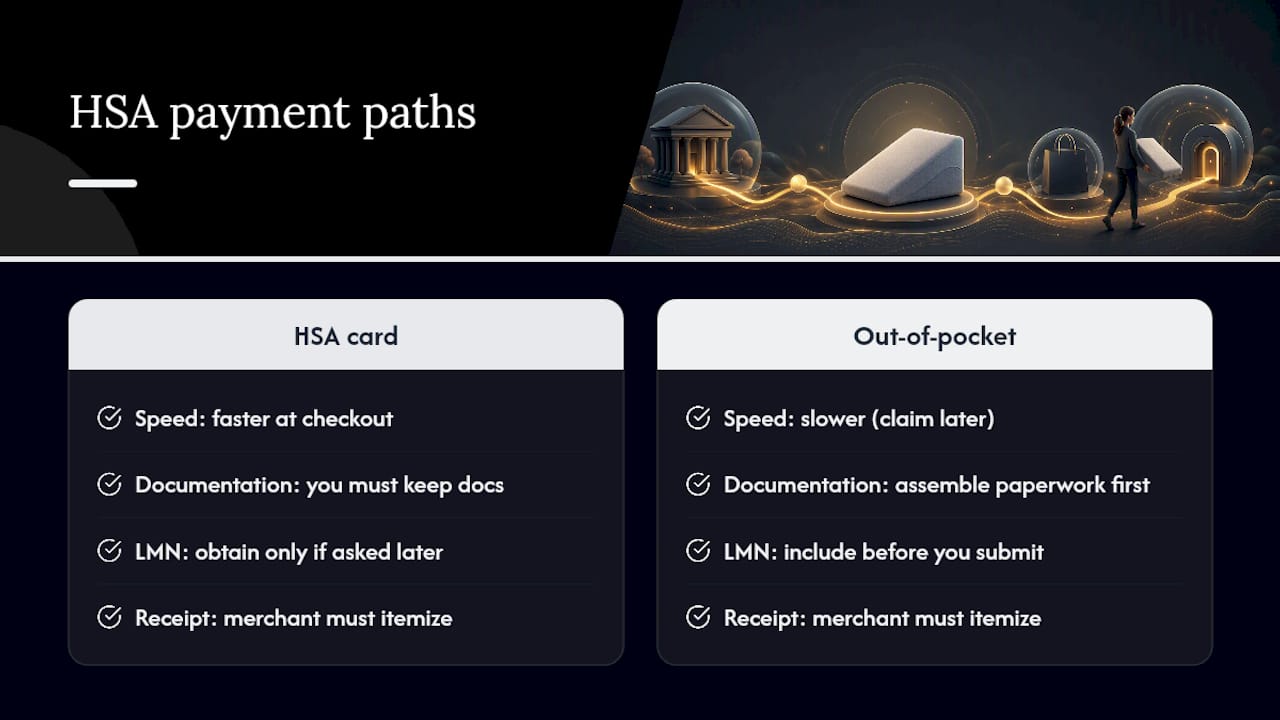
If a claim gets denied, most TPAs allow you to appeal or resubmit once you attach a proper LMN. Skip that step and use HSA funds for something that turns out not to qualify, and the consequences are real: the amount becomes taxable income, and Publication 969 confirms a 20% penalty applies on top of that if you’re under 65.
Whichever path you choose, make sure the merchant invoice itemizes the product name, price, and seller information. A vague “wellness purchase” line item is one of the most common reasons TPAs bounce a claim back for more detail.
What Does a Wedge Pillow Cost, and How Should You Budget for It?
Wedge pillow prices vary widely depending on foam density, incline height, and included accessories like covers or hot and cold packs. Basic single-layer foam wedges sit at the low end, while multi-piece orthopedic systems with washable covers and therapeutic add-ons cost more upfront.
That price spread matters for HSA budgeting in a specific way: if you’re contributing to your HSA throughout the year, a wedge pillow purchase is a one-time draw against a balance you’re probably also using for prescriptions, copays, and other recurring costs. Buying early in the plan year, when your HSA might still be building up contributions, can strain cash flow if you haven’t budgeted for it.
A practical approach is to request your clinician’s documentation first, then price out two or three specific models before deciding. That way you’re not choosing a pillow based on price alone and then scrambling to justify it medically after the fact. If your HSA balance is tight, some administrators allow partial reimbursement claims, letting you pay part out of pocket and part through the account, though this depends on your specific plan’s rules.
Keep in mind that Publication 502’s excess cost principle applies here too: if you buy a specialized medical-grade wedge system instead of a basic pillow, the price difference tied to the medical features is generally the stronger claim, not the full retail price if a portion clearly serves general comfort.
Do Different Wedge Pillow Types Qualify Differently for HSA Use?
Not every wedge pillow gets treated the same way when a TPA reviews a claim, and the differences come down to design intent, not brand.
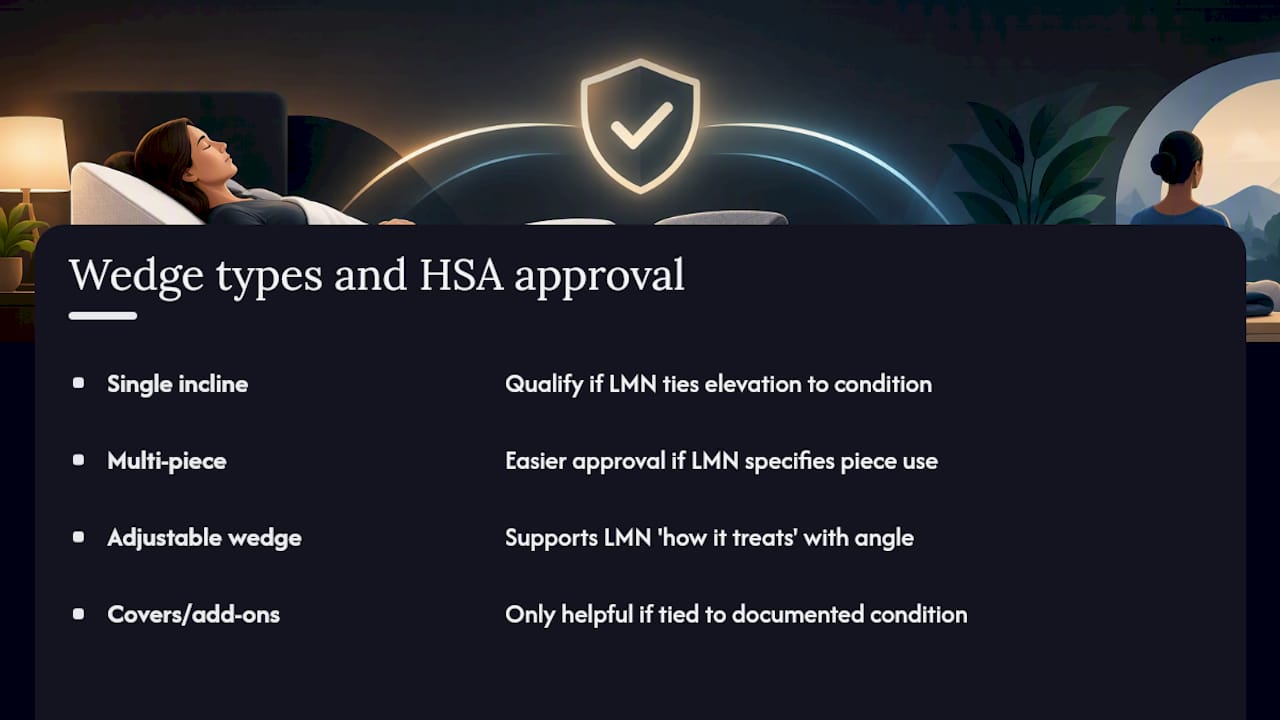
Single incline foam wedges are the simplest version, one solid piece of foam cut at an angle. They can qualify when documentation clearly ties the elevation to a diagnosed condition, but because they’re also marketed heavily as general comfort products, reviewers may scrutinize the claim more closely.
Multi-piece orthopedic wedge systems, which separate into sections for the back, legs, or knees, tend to have an easier path to approval when the LMN specifies which piece addresses which symptom. Separating the pieces also makes it easier to describe distinct therapeutic uses, elevation for reflux at the torso, for instance, and knee support for circulation.
Adjustable or incline-specific wedges, where the angle can be modified, help satisfy the “how it treats the condition” language an LMN needs, since you can point to a specific incline recommended by a clinician rather than a fixed, one-size angle.
Wedges with washable covers and add-on features, like removable hot and cold packs, don’t automatically improve eligibility odds on their own. What matters is whether those features tie back to the documented condition. A cover that supports hygienic post-surgical recovery is easier to justify than one that’s simply nicer to sleep on.
In every category, the deciding factor stays the same: the product’s design can support your case, but only your documentation proves it.
How Do You Choose a Retailer for an HSA-Eligible Wedge Pillow?
Not all sellers make the eligibility process easier, and a few practical checks can save you a denied claim later.
- Look for itemized invoices that list the product name, model, and price separately, not a single lump “wellness” charge.
- Favor retailers with clear product specifications, incline height, foam density, dimensions, since your clinician will want these details to write an accurate LMN.
- Check whether the retailer offers washable, replaceable covers, which matter if a clinician specifies hygiene needs during recovery.
- Confirm the retailer accepts HSA/FSA cards directly, which speeds checkout, but don’t treat card acceptance as proof of eligibility.
- Read the return policy in case your clinician ultimately recommends a different incline or configuration than the one you initially ordered.
A retailer that documents its products clearly makes your job, and your clinician’s job, considerably easier when it’s time to write that letter.
Lunix’s Perspective on Designing for Documented Medical Use
We built Lunix’s wedge pillow sets with clinical use in mind, not just bedroom comfort. Features like included hot and cold packs and aloe vera memory foam exist because recovery and positional therapy have real physical demands: swelling needs cold, stiffness needs heat, and skin under prolonged pressure needs a surface that won’t aggravate it.
Layered, multi-piece construction matters for another reason clinicians care about: stability. A pillow that shifts overnight undermines the very elevation a doctor prescribed. Removable, washable covers address a concern that comes up constantly in post-surgical contexts, hygiene during a vulnerable recovery window.
None of this replaces a conversation with your clinician. If you’re building a case for HSA eligibility, talk to your doctor first, then reference the specific product page when requesting your Letter of Medical Necessity, so the dimensions and features match what’s written down.
— Lunix
Ready to Buy? Here’s How Lunix Fits the Documented Path
Once you have a diagnosis and a clinician willing to put it in writing, choosing the actual pillow becomes the easy part. Lunix’s wedge pillow sets are designed around the same specifics an LMN needs: named layers, defined incline heights, and washable covers that make hygiene straightforward during recovery.
The LX13 six-piece orthopedic set separates into distinct support pieces, useful when your documentation needs to address more than one area, like reflux and leg elevation together. The LX11 five-piece set includes a hot and cold pack built for post-surgical swelling management, and the LX8 two-layer set offers a simpler configuration for straightforward reflux or back support cases.
Secure your Letter of Medical Necessity before charging your HSA card, or hold onto your itemized receipt and submit it alongside the LMN for reimbursement. Either way, having the paperwork ready before you buy is what keeps a Lunix wedge pillow purchase on solid ground with your plan administrator.
Where to Verify HSA Eligibility Rules Yourself
- IRS FAQ on nutrition, wellness, and general health expenses: the baseline explanation of what qualifies as medical care.
- Publication 502: detailed examples of qualifying and non-qualifying expenses.
- Publication 969: HSA-specific rules on distributions and penalties.
- IRS information letter 09-0209: the source of the “but-for” and excess cost standards TPAs reference.
Sources
- Frequently asked questions about medical expenses related to nutrition, wellness and general health | Internal Revenue Service
- INFO 2009-0209 Release Date: 12/31/2009 (GENIN-126807-09) | Internal Revenue Service
- Publication 969 — Health Savings Accounts and Other Tax-Favored Health Plans (draft) | Internal Revenue Service
- Publication 502 — Medical and Dental Expenses | Internal Revenue Service
FAQ
Are Wedge Pillows HSA Eligible?
Yes, but only when the primary use treats a diagnosed condition like GERD, positional sleep apnea, or post-surgical recovery, and you have supporting documentation. A Letter of Medical Necessity is the strongest form of proof a TPA will accept.
What Pillows Are HSA Eligible?
Any pillow, wedge or otherwise, can qualify if it’s primarily used to treat a specific medical condition rather than general comfort. The IRS standard applies the same “diagnosis, cure, mitigation, treatment, or prevention” test regardless of the pillow’s shape or brand.
What Are the Downsides of Using a Wedge Pillow?
Some people find the incline uncomfortable at first, and side sleepers occasionally struggle to stay positioned on the wedge overnight. It also doesn’t replace medical treatment for sleep apnea or severe GERD on its own; clinicians typically recommend it as one part of a broader plan.
Can I Use My HSA to Buy a Wedge Pillow?
You can, as long as you can substantiate medical necessity with documentation like an LMN or physician’s note and keep your itemized receipt. Without that paperwork, a non-qualified HSA distribution becomes taxable income and can carry a 20% penalty if you’re under 65.
How Much Does a Lunix Wedge Pillow Cost?
Current pricing for Lunix’s wedge pillow sets, including the LX8, LX11, and LX13, is listed directly on each product page.