


Two positions bring the fastest relief for most people: lying on your side with a pillow between your knees, or lying on your back with a pillow under your knees. Which one works better depends on what’s causing your sciatica, so try both for a few nights and stick with whichever calms your leg pain more. If numbness or weakness gets worse instead of better, stop experimenting and call your doctor.
TL;DR:
- Using a firm pillow between your knees while side sleeping can significantly reduce sciatic nerve pressure and leg pain.
- Elevating your knees with a proper pillow while on your back helps relieve disc pressure often caused by bulging or herniated discs.
- Avoid stomach sleeping altogether, or modify it with thin pillows under your hips and avoid thick head pillows to prevent nerve irritation.
- The best mattress for sciatic relief is medium-firm, with cheap adjustments like toppers or stacking pillows to fine-tune support.
- Prioritize testing free positioning fixes before investing in specialized pillows or mattresses to ensure proper alignment for your specific pain causes.
Table of Contents
- What is the best sleep position for sciatica?
- How do you set up each sleep position correctly?
- Which sleep positions make sciatica worse?
- What should you do before bed to calm sciatic pain?
- How do you move in bed without triggering a sciatica flare?
- Does your mattress or pillow need to change?
- When should you see a doctor about nighttime sciatica pain?
- How supportive pillows fit into a sciatica recovery plan
- Our take: positioning first, gear second
- Sources
What is the best sleep position for sciatica?
There’s no single sciatica sleep position that works for everyone, and any guide claiming otherwise is oversimplifying. What clinicians agree on is that a small handful of positions consistently outperform the rest, and your best bet is to test them like a personal experiment over the next few nights.
Here are the three worth trying, in order of how often they help:
- Side sleeping with a pillow between your knees. This keeps your hips and pelvis stacked in a neutral line instead of letting the top leg drop forward and twist your lower spine. It’s one of the most commonly recommended positions for sciatica relief, and it tends to work especially well when the pain runs down just one leg.
- Back sleeping with a pillow under your knees. Elevating your knees flattens out the exaggerated arch in your lower back, which takes pressure off the discs and eases tension along the sciatic nerve pathway. Cleveland Clinic notes this setup often helps most when a bulging or herniated disc is the root cause.
- A modified, gently curled position. If your sciatica comes from spinal stenosis (a narrowing of the space around your nerves), a slightly flexed posture, think knees drawn up partway rather than a tight fetal curl, can open up that space and quiet the leg symptoms.
Why the split? Knee elevation reduces the pressure inside your discs, which lessens the stretch on an irritated nerve root, while a flexed spine does something almost opposite: it opens the canal around the nerve for people dealing with stenosis. Same nerve, different mechanical problem, different fix.
Give each position two to three nights before judging it. Sciatica flares are notoriously moody, so one rough night doesn’t mean a position has failed. Track which one leaves you with less leg pain in the morning, not just which one feels comfortable when you first lie down.
How do you set up each sleep position correctly?
Getting the position right matters less than getting the setup right. A lot of people try “side sleeping with a knee pillow” and still wake up sore because the pillow shifted, or their neck was cranked at an odd angle all night. Here’s how to actually build each position:
For side sleeping:
- Place a firm pillow between your knees, not just resting near them. It should keep your top knee level with (or slightly above) your bottom knee.
- Tuck a small pillow or rolled towel into the gap at your waist if your mattress doesn’t fill that space naturally.
- Add a pillow behind your back if you tend to roll toward your stomach in your sleep.
For back sleeping:
- Use a large, firm pillow or a wedge-shaped orthopedic support under both knees, not just the ankles.
- Keep your head pillow low and flat. A pillow that’s too thick pushes your chin down and throws off the neutral line running from your head through your hips.
- Check that your lower back has gentle contact with the mattress. If there’s a noticeable gap, your knee elevation probably needs adjusting.
Contoured knee pillows hold their shape better than standard bed pillows, which is why they don’t slide out from between your knees the way a regular pillow does after an hour of shifting. If you share a bed, a body pillow can act as both a knee spacer and a barrier that keeps you from rolling into your partner’s space and losing your alignment.
Pro Tip: If your pillow keeps sliding out from between your knees, try a slightly firmer, smaller pillow rather than a bigger one. Bulk doesn’t fix slippage. Density does.
Which sleep positions make sciatica worse?
Stomach sleeping is the one position nearly every clinician will tell you to avoid, and for good reason. It forces your lower back into an unnatural arch while twisting your neck to one side for hours at a time. That combination tends to aggravate nerve irritation rather than calm it, which is the opposite of what you need.
If you genuinely can’t retrain yourself off your stomach, a few adjustments limit the damage:
- Slide a thin, flat pillow under your hips and lower stomach to reduce how far your lower back arches.
- Skip the head pillow entirely, or use one so thin it barely lifts your head, since a thick pillow makes the neck rotation worse.
- Try alternating which side you turn your head toward through the night if you wake up and reposition.
Your mattress matters just as much as your posture. A surface that’s too soft lets your hips sink and your spine curve out of alignment, while one that’s too firm creates pressure points that make you tense up and shift constantly. A medium-firm surface is the evidence-backed middle ground for most people with low back pain. You can test this cheaply tonight: fold a blanket or add a topper over a mattress that’s too hard, or stack a couple of firm pillows under a too-soft one to see if it changes how you feel by morning. Sleeping on the floor, despite what some people swear by, usually swaps one alignment problem for another and rarely helps.
What should you do before bed to calm sciatic pain?
A short pre-bed routine can take the edge off before you even lie down. Three stretches tend to help most:
- Piriformis stretch: Lie on your back, cross the affected leg over the opposite knee, and gently pull the knee toward your chest.
- Knee-to-chest stretch: Lying flat, bring one knee up toward your chest and hold, then switch sides.
- Cat/cow stretch: On hands and knees, alternate arching and rounding your back slowly.
Stop immediately if any stretch increases pain running down your leg. That’s a sign to back off, not push through.
Heat and ice serve different purposes. Apply heat for 15 to 20 minutes to loosen tight muscles before bed; use ice instead if you’re dealing with a fresh, acute flare, and always wrap it and check your skin partway through to avoid irritation. A short walk earlier in the evening, even ten minutes, keeps your hips and lower back from stiffening up the way they do after long stretches of sitting. Simple habits like timed heat and short walks can meaningfully cut down on night wakings, even before any structural treatment kicks in.
Sequence matters: stretch first to loosen things up, apply heat next to keep that looseness, then settle into your chosen position while everything is still relaxed.
How do you move in bed without triggering a sciatica flare?
The moment that wrecks a lot of decent nights isn’t the position itself. It’s the twist you make getting into or out of it. A sudden rotation between your shoulders and hips is exactly the kind of movement that flares an irritated nerve.
The fix is what physical therapists call the “log roll”:
- Bend both knees together, then roll your entire body as one unit onto your side, shoulders and hips moving together, not separately.
- To get out of bed, roll to your side first, then push up with your arms while swinging your legs off the edge in one motion.
- To stand, scoot to the edge of the mattress and pivot your whole body upright rather than twisting at the waist.
If getting in and out of bed has become genuinely hard, a slightly higher bed frame or a sturdy bedside rail can take a lot of strain out of the transfer. And if a pillow shifts overnight, reach down and adjust it in small pushes rather than lifting your hips or twisting to reposition it.
Pro Tip: Keep a spare pillow within arm’s reach at night. Fumbling around for one across the room usually means an unnecessary twist you didn’t need to make.
Does your mattress or pillow need to change?
Before spending money on new gear, run a few cheap tests to see whether your current setup is actually the problem.
Medium-firm mattresses show up repeatedly in clinical reviews as the best general fit for people dealing with low back pain, striking a balance that neither lets the spine sink nor fights against it. If your mattress feels wrong but you’re not ready to replace it, try these first:
- Add a medium topper over a mattress that feels too hard.
- Stack two or three firm pillows under a mattress that sags too much in the middle.
- Fold a thick blanket lengthwise and slide it under a soft mattress to firm up the surface temporarily.
Your head pillow loft matters more than most people realize. Side sleepers generally need a taller, firmer pillow to fill the larger gap between the ear and the mattress, while back sleepers need something noticeably flatter to avoid tipping the chin down. Getting this wrong quietly undoes all the work you put into positioning your hips and knees correctly.
If you’ve tested the cheap fixes and you’re still waking up sore, that’s usually the point where a dedicated wedge pillow or an adjustable base starts to make sense, since both let you fine-tune elevation with more precision than stacked pillows ever will.
When should you see a doctor about nighttime sciatica pain?
Most sciatica improves within four to six weeks with the kind of positioning and routine changes covered here. That said, a few symptoms mean you shouldn’t wait it out at home.
- Sudden numbness around the groin or inner thighs (sometimes called saddle anesthesia).
- New loss of bladder or bowel control.
- Progressive weakness in your leg or foot that’s getting worse, not better.
These are the red flags OrthoInfo specifically calls out as reasons for urgent evaluation, not a wait-and-see approach. Any of them warrants same-day medical attention.
If your pain hasn’t budged after several weeks of trying different positions, or it’s clearly getting worse instead of better, that’s the point to bring in imaging or further testing. When you do talk to your clinician, bring specifics: which positions helped, which made things worse, what time of night the pain flares, and whether you’ve noticed any new tingling or weakness. That level of detail helps far more than “my back hurts at night.” And hold off on trying anything aggressive, like inversion tables or high-intensity stretching routines, until a professional has actually looked at what’s driving your symptoms.
How supportive pillows fit into a sciatica recovery plan
Positioning is free, but it has limits, especially if your mattress or pillows actively work against the alignment you’re trying to hold. Specialized pillow products, such as wedge pillow sets and contoured knee pillows, can serve as tools that make the positions above easier to hold through a full night, not replacements for them.
When shopping for pillows in this category, prioritize features like high-density foam that resists flattening, a washable cover for regular use, and a size that fits your body rather than a generic one-size shape. Trial any new pillow for at least a week before judging it. Alignment products need a few nights for your body to adjust to the new support before you can tell if it’s actually helping.
Our take: positioning first, gear second
The research is consistent on one point that a lot of generic advice glosses over: there’s no universal best sciatica sleep position, only a best position for your specific cause. That’s the gap in most articles on this topic. They hand you a single “correct” position instead of teaching you how to test for your own.
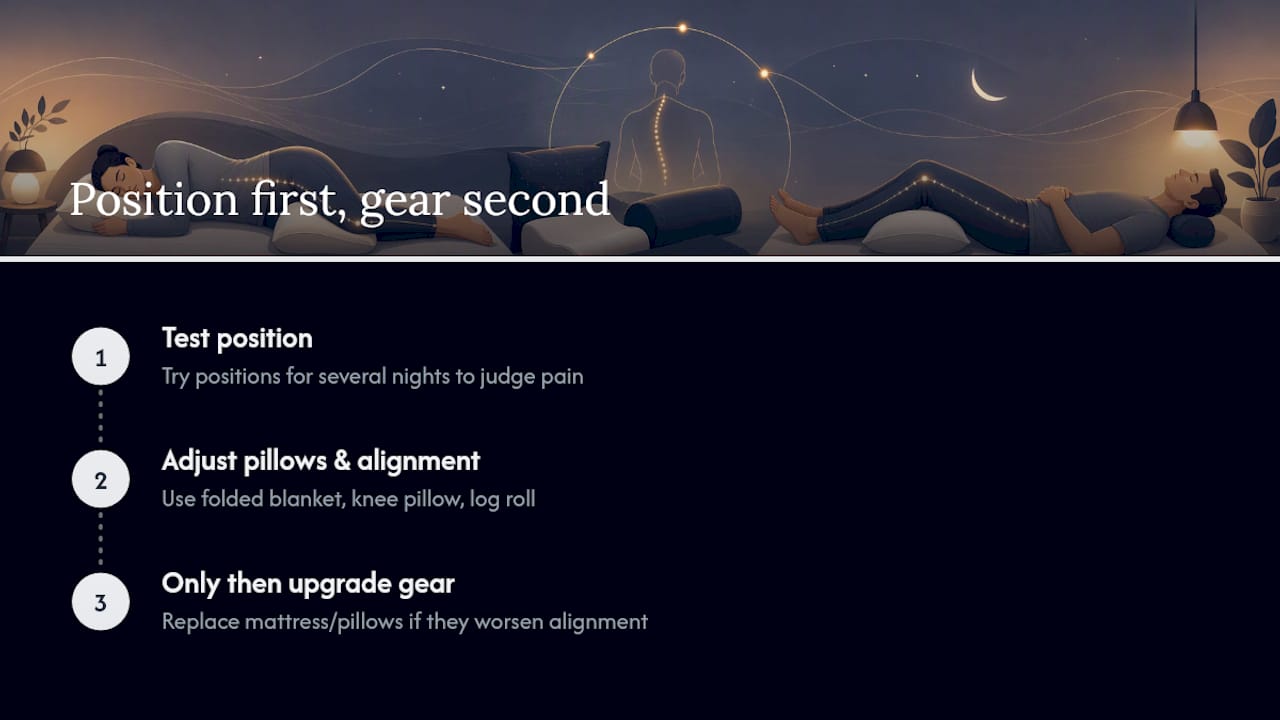
What we’d push back on is the instinct to buy a new mattress or a stack of specialty pillows before trying the free fixes first. A folded blanket, a repositioned knee pillow, and a log roll technique cost nothing and often solve half the problem. Gear matters, but only once you already know which position and which alignment your body actually needs.
Prioritize this in order: figure out which position calms your leg pain over a few nights, nail the pillow placement and neutral alignment, then decide if your mattress or pillows are working against you. Skip straight to buying new equipment and you risk spending money to support the wrong position entirely.
— Lunix
Ready to build a setup that actually holds your alignment through the night? Explore Lunix’s wedge and contour pillow solutions designed around the exact positions covered here, or check out Lunix’s guide on why side sleepers struggle with back pain for more on getting your hip alignment right. If broader sleep habits are also part of your struggle, this partner resource on building a better sleep routine is worth a look too.
This article is general information, not a substitute for advice from a qualified doctor. Consult a qualified healthcare professional about your own circumstances before acting on anything here.
Sources
- How to get better sleep with sciatica pain — Cleveland Clinic
- What to look for in a pillow if you have sciatica — Spine-Health
- How to Sleep With Sciatica: 8 Proven Sleeping Positions and Night Tips — Cory Calendine MD
- What type of mattress is best for people with low-back pain — Harvard Health
- Sciatica — American Academy of Orthopaedic Surgeons (OrthoInfo)