


Yes, a sauna blanket can genuinely help your body bounce back after exercise, but only if you time it right. The general rule: wait 30 to 60 minutes after finishing your workout before you wrap yourself up, giving your body a little breathing room before you add heat, and stretch that window longer after a very intense strength or endurance session. Whatever the timing, hydrate before and after, and ease into your first few sessions at a lower temperature.
TL;DR:
- Waiting 30 to 60 minutes after exercise before using a sauna blanket optimizes recovery by allowing inflammation signals to do their work.
- A single 20-minute infrared sauna session at around 43°C can reduce muscle soreness and maintain performance if timed properly after resistance training.
- Use lower temperatures and shorter durations initially, gradually increasing heat and time over several sessions for safe, effective heat therapy.
- Hydration and proper cooldown are crucial before and after each session to prevent dizziness and enhance recovery benefits.
- Sauna blankets are most effective as a habit-forming recovery tool rather than a performance enhancer, with consistency providing the main benefits.
Table of Contents
- Does a Sauna Blanket Actually Help Post-Workout Recovery?
- When Should You Use a Sauna Blanket After Exercise?
- What Safety Precautions Should You Take With a Sauna Blanket?
- How to Build a Repeatable Post-Workout Sauna Blanket Routine
- What Does the Research Actually Show About Sauna Blankets?
- Our Take on Making Sauna Blankets Part of Your Recovery Routine
- Where the Lunix LX17 Fits Into This Routine
- Sources
Does a Sauna Blanket Actually Help Post-Workout Recovery?
Heat therapy works on your body in a fairly straightforward way: it widens your blood vessels, a process called vasodilation, which pushes more blood into your muscles. That extra circulation helps ferry oxygen and nutrients where they’re needed and can speed the clearance of metabolic byproducts that build up during hard training. You feel the result as a warm, loosening sensation, but the mechanism behind it is measurable, not just a placebo of comfort.
The most useful data point here comes from a randomized crossover trial on male basketball players, where a single 20-minute infrared sauna session at roughly 43°C after resistance training reduced muscle soreness and preserved explosive jump performance 14 hours later, compared to passive recovery with no heat exposure. That’s a meaningful signal for anyone worried that heat exposure might interfere with rest.
There’s a second layer worth understanding: pain relief and biomarkers don’t always move together. Post-exercise heat therapy has been shown to relieve soreness for 24 hours or more, even in cases where blood markers of muscle damage stay flat. In plain terms, you might feel noticeably better without your blood work showing a dramatic biological shift. That’s not a contradiction. It just means subjective recovery and cellular repair operate on partly separate tracks.
Beyond the physiology, there’s a psychological piece that matters more than most people give it credit for. Wrapping up in warmth after a hard session triggers real relaxation, and that relaxation appears tied to lower cortisol, which supports recovery indirectly by easing the stress load your body is already managing. Experts who study heat therapy note that sauna blankets earn their value mainly through accessibility: they let you get consistent heat exposure without booking a sauna, driving to a gym, or waiting for a shared facility to open up.
Practical benefits of using a sauna blanket after training include:
- Reduced next-day muscle soreness, based on the same physiological pathway confirmed in exercise trials
- Better tolerance of heat therapy overall, since blankets run cooler and more controlled than a traditional room sauna
- A built-in wind-down ritual that supports sleep and stress management
- Localized, adjustable temperature control you don’t get standing in a communal sauna
Pro Tip: Think of the sauna blanket less as a performance hack and more as a recovery habit. Consistency, not intensity, is what drives the soreness and relaxation benefits over weeks of use.
Where the evidence gets thinner is on whether a sauna blanket outperforms other post-workout tools like a hot bath or contrast therapy. It probably doesn’t beat them outright. It just makes heat therapy easier to do regularly, and regularity is where most of the benefit comes from.
When Should You Use a Sauna Blanket After Exercise?
Timing determines whether your session helps or works against you. Heat applied too soon after intense training can blunt the acute inflammatory signals your body uses to trigger adaptation, which is why waiting a moderate amount of time is widely recommended as a baseline before you climb in. The exact number shifts depending on how hard you just trained.
Wait windows should scale with the mechanical stress of your workout. A high-load strength session or a long run justifies a longer delay, sometimes up to 90 minutes, while a light cardio day or a mobility session allows a much shorter wait. Here’s how that breaks down by workout type:
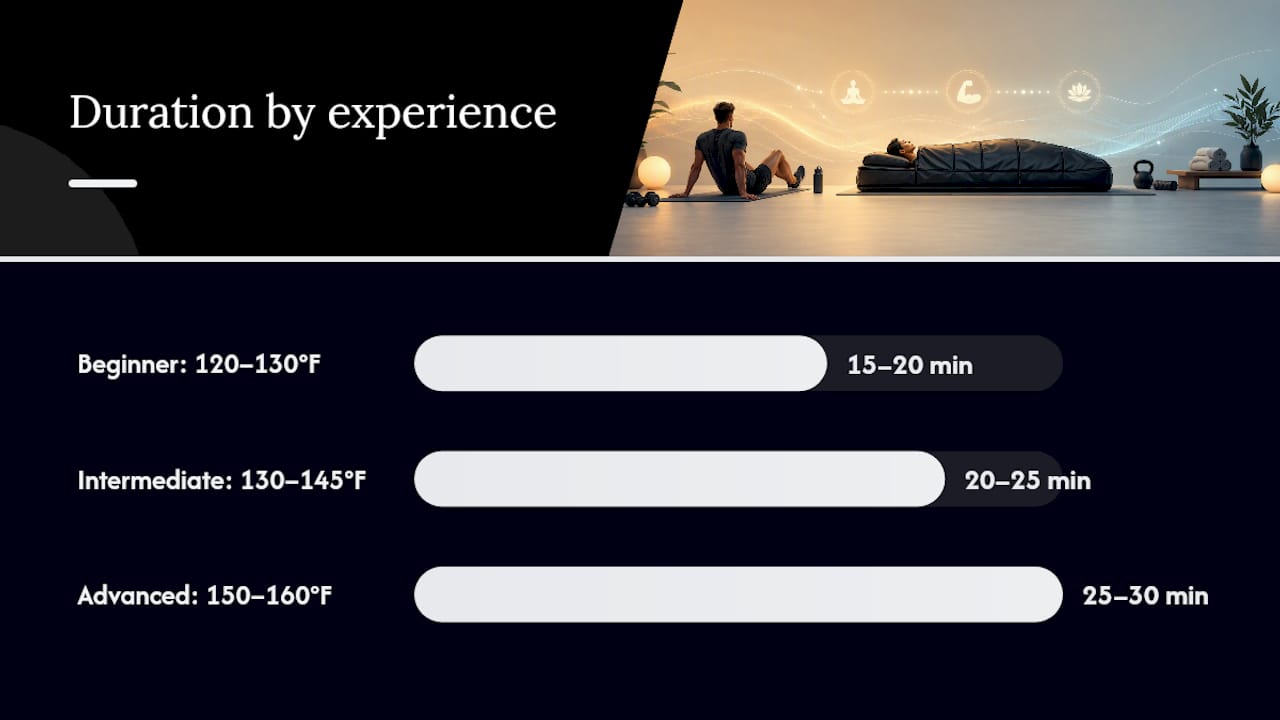
Temperature progression matters just as much as timing. Clinicians recommend that beginners start with shorter sessions around 15 to 20 minutes at conservative heat settings, since consumer blankets typically operate in a moderate temperature range depending on the model. A sensible progression looks like this:
- Beginner band (first four to six sessions): Stay in the 120 to 130°F range for 15 to 20 minutes, focusing on getting comfortable with the sensation rather than chasing sweat.
- Intermediate band: Once you’re tolerating beginner sessions easily, move into the 130 to 145°F range and extend to 20 to 25 minutes.
- Advanced band: Experienced users can push toward 150 to 160°F for 25 to 30 minutes, but only after weeks of consistent, symptom-free sessions at lower settings.
Before you even preheat the blanket, run through a short pre-session checklist:
- Finish a proper cool-down, not just an abrupt stop, so your heart rate has already started settling
- Drink 16 to 24 ounces of water in the window before your session
- Preheat the blanket for 5 to 10 minutes so it’s at temperature when you climb in, rather than warming up around you
- Change into dry, moisture-wicking clothing instead of sweat-soaked workout gear
And once the timer goes off, don’t skip the back half of the routine:
- Air-cool for 5 to 10 minutes before you shower or get dressed
- Rehydrate with another 16 to 24 ounces of water, adding electrolytes if the session ran long or you sweat heavily
- Eat something light within the hour. A balanced post-workout meal helps replace glycogen without weighing down a body that’s already working to cool itself
- Wait until your skin temperature normalizes before a hot shower, since layering more heat on top can leave you lightheaded
What Safety Precautions Should You Take With a Sauna Blanket?
Heat therapy is generally low risk for healthy adults, but it isn’t risk-free, and treating it casually is how people end up dizzy on the floor instead of relaxed on the couch. Know the warning signs before your first session, not after.
Stop immediately if you notice any of the following:
- Dizziness, lightheadedness, or a sudden headache
- Nausea or an upset stomach
- Confusion or difficulty concentrating
- A racing or irregular heartbeat (palpitations)
- Excessive sweating paired with chills, which can signal early heat exhaustion
Certain groups should skip sauna blanket use entirely, or get medical clearance first. That includes anyone who is pregnant, anyone managing unstable cardiovascular disease, people on medications that affect blood pressure or heart rate, and anyone recovering from a recent concussion, since heat can complicate the healing process for brain injuries. If you take medication for blood pressure, thyroid conditions, or diabetes, ask your doctor how heat exposure interacts with it before you assume it’s fine.
Hydration deserves its own attention beyond the basic checklist. Practitioner guides consistently recommend 16 to 24 ounces of water before a session, small sips during, and another 16 to 24 ounces afterward, with electrolytes added for longer or more frequent sessions. Skipping this step is the single most common reason people feel wiped out rather than refreshed afterward.

Monitoring yourself matters more than most people assume. Keep your phone within reach in case you need to end the session early, and if you’re new to heat therapy, have someone else in the house aware you’re using it. Track your rate of perceived exertion and how your body handles heat session to session. If today’s session felt harder than last week’s at the same temperature, that’s worth paying attention to rather than pushing through.
Pro Tip: Your tolerance for heat can shift with sleep quality, hydration status, and even how hard you trained that day. Don’t assume the temperature that felt easy on Monday will feel the same on a day you’re already run down.
How to Build a Repeatable Post-Workout Sauna Blanket Routine
A good routine removes the guesswork, so you’re not renegotiating your approach every time you finish a workout. Here’s a sequence you can follow start to finish.
- Cool down properly. Spend 5 to 10 minutes on light movement and stretching once your main workout ends. This lets your heart rate settle and gives your body the buffer it needs before heat exposure.
- Hydrate before you wrap up. Drink 16 to 20 ounces of water in the 30 minutes before your session, sipping rather than gulping, and add an electrolyte packet if you trained hard or sweat heavily.
- Set up your space. Lay the blanket on a yoga mat or another heat-resistant surface, and always place a towel between your skin and the material to reduce irritation and absorb sweat.
- Dress for the session. Wear moisture-wicking clothing rather than damp workout gear. It protects your skin and makes the whole experience more comfortable.
- Preheat before you climb in. Give the blanket 5 to 10 minutes to reach your target temperature so you’re not waiting around inside it while it warms up.
- Start conservative. New users should begin in the 120 to 130°F range for 15 to 20 minutes, working up gradually over your first several sessions.
- Set a timer and stay present. Don’t rely on guessing how much time has passed. Heat can distort your sense of time more than you’d expect.
- Air-cool afterward. Spend 5 to 10 minutes letting your body temperature come down naturally before you shower or dress.
- Rehydrate again. Drink another 16 to 24 ounces of water, and follow with a light snack, such as fruit and a protein source, within the hour.
- Shower once your skin feels back to normal. A lukewarm rinse is gentler on your system than jumping straight into hot water.
Pro Tip: Keep a simple log of your session temperature, duration, and how you felt afterward. Patterns show up fast, and that log becomes the fastest way to fine-tune your own protocol instead of following someone else’s exactly. For more on building sustainable recovery habits, this piece on recovering faster after a tough workout walks through complementary strategies worth pairing with heat therapy.
What Does the Research Actually Show About Sauna Blankets?
The strongest piece of evidence in this space is a small but well-designed study: a randomized crossover trial of 16 male basketball players who each did one post-exercise infrared sauna session at about 43°C for 20 minutes. Fourteen hours later, the heat group reported less soreness and jumped higher on counter-movement jump testing than the passive recovery group, with statistically significant results (p<0.01). Sleep quality and nighttime heart rate variability showed no adverse effects, which addresses a common worry that heat before bed might disrupt rest.
That result is genuinely encouraging, but it comes with real limits worth naming plainly. Sixteen participants, all male, all basketball players, is a narrow slice of the population, and a single session tells you something different than what happens over weeks of regular use. Just as important: this trial and much of the surrounding research used clinical infrared sauna equipment, not the consumer blankets sold for home use. As several reviews point out, there’s a real research gap between clinical IR devices and consumer sauna blankets, and translating lab conditions to your living room requires some conservative judgment on temperature and session length.
That’s exactly why the timing and temperature bands earlier in this article lean cautious rather than aggressive. A blanket that runs at 130°F for 20 minutes is not the same exposure as a clinical chamber at 43°C, even though both fall under the umbrella of “infrared heat therapy.”
The honest, evidence-aligned takeaway looks like this:
- Reduced soreness and preserved performance are supported by controlled research, even if the sample size is modest
- Relaxation and stress reduction are real and valuable, even where they’re harder to measure in a lab
- Claims that sauna blankets outperform a hot bath or other heat modalities aren’t backed by strong comparative data yet
- The biggest practical advantage may simply be that a blanket is easier to use consistently than a room sauna, and consistency is where most of the measurable benefit shows up
If you want to understand how heat interacts with the body more broadly, including questions about calorie burn and metabolic effects, this breakdown of what saunas can and cannot do physiologically is worth reading alongside the recovery research.
Our Take on Making Sauna Blankets Part of Your Recovery Routine
We think the conversation around sauna blankets gets skewed too far in one of two directions: either they’re framed as a miracle recovery device, or dismissed because the underlying research is still thin. Neither framing is honest. The real value sits in the middle. Heat therapy has a defensible physiological basis, and a blanket format simply makes that therapy easier to fit into a normal week than driving to a gym sauna ever was.
What we care about most is that people use these safely and consistently, not aggressively. That means safety zippers that let you exit fast if you feel off, washable covers that keep hygiene simple enough that you’ll actually use the blanket week after week, and temperature controls precise enough that a beginner isn’t stuck guessing between “too cold to matter” and “too hot to tolerate.” Recovery tools only work if you keep reaching for them, and design details that seem small, like an easy-to-clean cover or a display you can read without your glasses on, are often what decides whether a device becomes a habit or ends up in a closet. If you want a deeper look at how gentle heat supports stress reduction beyond the muscle soreness angle, our piece on heat therapy for pain relief and stress reduction covers that ground in more detail.
— Lunix
Where the Lunix LX17 Fits Into This Routine
Everything in this article points to the same conclusion: the sauna blanket that actually helps your recovery is the one you’ll use correctly and consistently, not the one with the flashiest marketing. That’s exactly what the Lunix LX17 Portable Infrared Sauna Blanket was built around.

The LX17 gives you precise temperature control across the beginner, intermediate, and advanced bands covered earlier, so you’re not stuck guessing your way up from 120°F. A safety zipper lets you exit fast if you ever feel the dizziness or nausea we flagged as stop signs, and the washable cover means hygiene never becomes a reason to skip a session. For your first four to six sessions, set the LX17 to its lower temperature range and keep the timer at 15 to 20 minutes, exactly the conservative starting point clinicians recommend. From there, follow the wait times by workout type outlined above, hydrate on both ends of the session, and let the LX17 handle the consistency while you handle the discipline. Visit the LX17 product page to check current availability and start building a recovery routine that actually sticks.
Sources
- A post-exercise infrared sauna session improves recovery of neuromuscular performance and muscle soreness after resistance exercise training
- Do Sauna Blankets Actually Work? | GQ
- Sauna blankets: what you need to know, according to experts
- Runner-focused guide to sauna blanket use and practical tips
This article is general information, not a substitute for advice from a qualified doctor. Consult a qualified healthcare professional about your own circumstances before acting on anything here.